
Buying a grab bucket without a clear framework is like ordering a crane by horsepower alone. The number tells you almost nothing useful. The right grab bucket depends on three things your supplier rarely asks upfront: what material you’re handling, what crane you’re connecting it to, and what throughput your operation actually demands.
This guide gives procurement teams a practical, structured answer to all three. You’ll find a breakdown of every major grab bucket type organized by two different classification frameworks, a capacity sizing method you can apply before requesting a quote, and realistic 2026 price benchmarks across the main product categories. Technical comparison tables and a FAQ section are included to support internal decision-making and supplier conversations.
If you’re evaluating grab buckets for a port terminal, steel mill, scrap yard, power plant, or waste-to-energy facility, the information here will help you move from shortlist to specification faster—and with fewer costly surprises on delivery.
- 1 Why Grab Bucket Selection Gets Complicated
- 2 How Grab Buckets Are Classified: Two Frameworks That Matter
- 3 Capacity Selection: How to Size a Grab Bucket Correctly
- 4 Price Guide: What a Grab Bucket Costs
- 5 Practical Selection Checklist
- 6 الملخص
-
7
الأسئلة الشائعة
- 7.1 Q1: What is the difference between a clamshell grab and an orange peel grab?
- 7.2 Q2: Can I use an electro-hydraulic grab bucket with a single-hook crane?
- 7.3 Q3: How do I calculate the correct grab bucket capacity for my application?
- 7.4 Q4: What certifications should I require when sourcing a grab bucket internationally?
- 7.5 Q5: What is a realistic service life for a grab bucket, and how can I extend it?


Why Grab Bucket Selection Gets Complicated
The grab bucket market looks straightforward from the outside: a mechanical jaw that opens, fills, and closes. In practice, buyers routinely encounter three problems that slow or derail procurement.
First, classification terminology is inconsistent. Different suppliers use “hydraulic grab,” “electro-hydraulic grab,” and “power grab” to describe overlapping or entirely different products. Without a shared vocabulary, comparing quotes becomes unreliable.
Second, capacity is quoted in volume, not weight. A manufacturer lists a 6 m³ clamshell grab. Whether that grab is correctly sized for your application depends entirely on the bulk density of your material—information the spec sheet rarely includes in usable form.
Third, compatibility is assumed, not verified. Grab buckets must match the crane’s rope drum configuration, hook capacity, and working radius. Mismatches discovered after delivery generate expensive modifications and project delays.
Understanding how grab buckets are classified—by structure, by drive method, and by application—resolves all three problems before they occur.
How Grab Buckets Are Classified: Two Frameworks That Matter
There is no single universal classification system for grab buckets. Manufacturers, standards bodies, and port engineers tend to group them differently depending on context. The two frameworks below each answer a different procurement question, and using all two together gives you a complete picture before you request quotes.
Classification by Structure: Shape of the Grabbing Mechanism
Structural design determines what kind of material a grab bucket can physically capture. Two designs account for the large majority of global installations.
دلو مسك صدفي صدفي


The clamshell is the most widely used grab bucket design worldwide. It consists of two symmetrical bucket halves joined at a central hinge. As the bucket descends, the halves open under their own weight; on retrieval, the closing mechanism draws them together around the material. The closed position forms a near-sealed chamber, which minimizes spillage—a critical requirement when handling fine or dusty materials.
Clamshell grab buckets perform best on loose, flowable materials: coal, coke, grain, mineral sand, cement, lime, and chemical fertilizer. For a detailed breakdown of selection factors, FEM duty classification, and 2026 pricing, see our clamshell grab bucket guide.
Their geometry suits granular materials that flow into the bucket naturally rather than needing to be gripped. They are the standard choice for port bulk terminals, power plant coal yards, and grain handling facilities.
Orange Peel Grab Bucket (Polyp Grab)
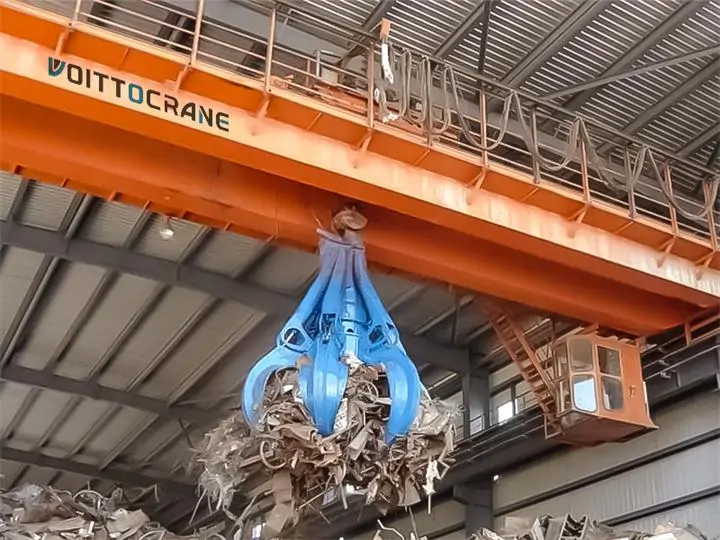

The orange peel grab consists of three to eight articulated tines—curved jaw arms—that radiate outward from a central hub, resembling the segments of a peeled citrus fruit. Unlike a clamshell, the orange peel closes with penetrating force rather than sweeping closure, making it effective on irregular, bulky, or interlocked materials that a clamshell cannot capture cleanly.
Orange peel grabs are the dominant choice for scrap steel handling, pig iron charging, mixed demolition waste, municipal solid waste (MSW) in waste-to-energy plants, and large-diameter timber. Tine count, capacity sizing, and duty class all vary significantly depending on the material — a detailed selection guide for orange peel grab buckets covers each of these variables for scrap and bulk handling applications.
Classification by Application: Material-Matched Specifications
The two framework groups grab buckets by the material they are designed to handle. This matters because bulk density, abrasiveness, particle size, and moisture content directly influence jaw geometry, wear plate specification, required closing force, and structural working duty rating.
| المواد | Recommended Grab Type | Typical Bulk Density | Primary Industries |
|---|---|---|---|
| Coal, coke | Clamshell, light–medium duty | 0.7–0.9 t/m³ | Power plants, port terminals |
| Iron ore, mineral concentrate | Clamshell, heavy duty | 1.8–2.5 t/m³ | Steel mills, mining ports |
| Grain, soybean, fertilizer | Clamshell, sealed closure | 0.6–0.85 t/m³ | Agricultural terminals |
| Scrap steel, pig iron | Orange peel, hydraulic | 1.5–3.0 t/m³ | Steel mills, scrap yards |
| Municipal solid waste (MSW) | Orange peel, electro-hydraulic | 0.3–0.6 t/m³ | WtE plants, transfer stations |
| Cement, lime, fly ash | Clamshell, sealed | 0.9–1.3 t/m³ | Cement plants, power plants |
| Timber, logs | Wood grab (tine/scissor) | 0.4–0.7 t/m³ | Timber yards, paper mills |
| Sand, gravel, crushed stone | Clamshell or cactus | 1.4–1.8 t/m³ | Construction, dredging |
| Slag, demolition debris | Orange peel, heavy duty | 1.2–2.0 t/m³ | Recycling, steel plants |
Reference: FEM Section IV Standards, 2022; ISO 4301-1:2016; Nemag BV Application Data, 2023
Why bulk density is the critical variable: A grab sized for coal (0.8 t/m³) will be mechanically overstressed if used at the same volume setting with iron ore (2.2 t/m³). Always verify that the grab’s rated payload in tonnes—not just its geometric volume in cubic meters—is compatible with your material’s actual density.
Capacity Selection: How to Size a Grab Bucket Correctly


Capacity is the most common source of procurement error. Buyers tend to focus on volume (m³) while underestimating the importance of weight capacity (tonnes) and crane compatibility. A properly sized grab bucket maximizes throughput while remaining comfortably within the crane’s safe working load (SWL) at the relevant working radius.
The Sizing Formula
Payload per cycle can be estimated before contacting a supplier using a straightforward calculation:
Payload (t) = Geometric Volume (m³) × Bulk Density (t/m³) × Fill Factor
The fill factor accounts for the fact that a grab rarely achieves 100% volumetric fill in practice:
- Clamshell grab on granular material: fill factor 0.75–0.90
- Orange peel grab on scrap or irregular material: fill factor 0.50–0.70
مثال على ذلك: A 5 m³ clamshell grab handling iron ore at 2.1 t/m³ with a fill factor of 0.82 yields a payload of approximately 8.6 tonnes per cycle. This figure must sit within the crane’s rated load at the operating radius—typically with a safety margin of 15–20%.
Standard Capacity Ranges by Application
| التطبيق | Typical Bucket Volume | Payload per Cycle | Approximate Grab Weight |
|---|---|---|---|
| Small inland terminal, coal | 2–4 m³ | 1.5–3.5 t | 1,200–2,800 kg |
| Medium port, ore or coal | 5–10 m³ | 9–22 t | 3,500–7,000 kg |
| Large bulk terminal | 12–20 m³ | 20–45 t | 7,000–15,000 kg |
| Scrap yard, orange peel | 1–6 m³ | 1.5–12 t | 800–4,500 kg |
| WtE plant, MSW | 4–12 m³ | 2–8 t | 2,500–8,000 kg |
| Excavator-mounted, construction | 0.5–3 m³ | 0.8–5.5 t | 300–1,800 kg |
Reference: Nemag BV Product Range, 2023; Rotar International Specifications, 2024; ZPMC Engineering Standards
Before requesting a quote, provide your supplier with three numbers: crane SWL, operating radius, and material bulk density. These determine which grab model is appropriate. Volume alone does not.
Price Guide: What a Grab Bucket Costs
Pricing in the grab bucket market varies significantly based on structural complexity, steel specification, onboard systems, manufacturing origin, and order volume. The ranges below reflect typical market pricing for standard configurations from established manufacturers as of 2024–2026. Custom designs, wear-resistant plate upgrades, and integrated automation features will add to these baselines.
Price Ranges by Type and Capacity
| Grab Type | نطاق السعة | Price Range (USD, FOB) | الملاحظات |
|---|---|---|---|
| Mechanical clamshell, standard | 1–4 m³ | $1,500–$2,500 | Chinese origin; CE/ISO available on request |
| Mechanical clamshell, heavy-duty | 5–15 m³ | $1,200–$1,500 | European origin typically higher |
| Electro-hydraulic clamshell | 1–8 m³ | $1,000–$1,500 | Motor and pump assembly included |
| Mechanical orange peel | 1–6 m³ | $1,100–$1,500 | Price increases with tine count |
| Electro-hydraulic orange peel | 1–8 m³ | $3,000–$4,000 | Onboard hydraulic pack included |
| Wood grab (tine/scissor type) | 0.5–3 m³ | $2,000–$4,000 | Coated or stainless options available |
| Custom / special specification | Any | +20–50% above standard | Lead time typically 8–20 weeks |
Key Cost Drivers
Wear-resistant steel — AR400 or AR500 plate on cutting edges and jaw liners significantly extends service life in abrasive applications. Budget an additional 10–20% on unit cost when this upgrade is specified.
الشهادة — علامة CE (required for EU market access) and third-party inspection by Bureau Veritas, DNV, or SGS typically adds $1,500–$5,000 per unit depending on scope.
Rope and hook compatibility — Some mechanical grabs require non-standard rope diameters or drum configurations. Confirming compatibility at the specification stage avoids post-delivery modification costs.
Spare parts package — Reputable suppliers offer a first-year spare parts kit (wear plates, pins, rope sheaves) at point of sale. Including this in the initial order is generally 20–30% cheaper than sourcing parts separately once the grab is in service.
Lead time and logistics — Standard models from Chinese manufacturers ship in 4–8 weeks. Custom or European-sourced units often require 12–20 weeks. Factor freight, import duties, and port handling into total landed cost.
Practical Selection Checklist
Before issuing a purchase order, confirm the following items with your engineering team and supplier:
- Material confirmed — bulk density (t/m³), particle size, moisture content, abrasiveness rating
- Crane verified — SWL at operating radius, drum configuration (single or dual), hook type
- Drive method matched — rope mechanical or electro-hydraulic, based on crane drum availability
- Payload calculation done — volume × density × fill factor ≤ crane SWL × 0.85
- Working duty rated — FEM/ISO duty class matches operating hours and cycles per day
- Certification scope defined — CE, ISO, third-party inspection requirements confirmed
- Wear spec confirmed — standard steel or AR plate based on material abrasiveness
- Spare parts included — first-year wear parts quoted at time of order
- Lead time acceptable — confirmed against project commissioning schedule
- Warranty and AMC terms reviewed — service response time and scope clearly documented
الملخص
Grab bucket selection is a three-layer decision: structure first (clamshell or orange peel), drive method second (mechanical or electro-hydraulic), application third (material-matched specifications). Errors at any layer—usually in matching payload to crane capacity or in selecting drive method without verifying crane drum configuration—generate costs that far exceed the price difference between options.
The 2026 market offers a wide range of capable products at competitive prices, particularly from Chinese manufacturers who can supply CE-certified equipment at significantly lower cost than European alternatives. The tradeoff is longer communication cycles and more rigorous specification verification upfront. Investing time in that verification stage is the single most effective way to avoid procurement surprises.
If you are ready to move to the specification stage, the next step is to collect your crane’s SWL and drum configuration from your equipment documentation, confirm your material’s bulk density, and use the sizing formula above to define your required payload. That information—not a volume requirement—is what a qualified grab bucket supplier needs to give you a meaningful quote.
الأسئلة الشائعة
Q1: What is the difference between a clamshell grab and an orange peel grab?
A clamshell grab consists of two symmetrical bucket halves that close in a sweeping motion, making it ideal for loose, granular materials such as coal, grain, sand, and mineral powder. An orange peel grab uses three to eight articulated tines that close with penetrating force, making it effective on bulky, irregular, or interlocked materials such as scrap steel, pig iron, demolition waste, and mixed solid waste. The primary selection criterion is material type: if the material flows freely into the bucket, use a clamshell; if it needs to be gripped or penetrated, use an orange peel. Using the wrong type significantly reduces operational efficiency and accelerates jaw wear.
Q2: Can I use an electro-hydraulic grab bucket with a single-hook crane?
Yes — this is one of the main reasons electro-hydraulic grabs are specified in modern installations. Because the hydraulic pump and motor are integrated into the grab body and powered through a trailing cable, the grab does not require a second hoisting drum. If your application is specifically choosing between a hydraulic clamshell and a hydraulic orange peel — including how crane operating pressure, flow rate, and hook block compatibility factor into that decision — the hydraulic grab bucket comparison guide covers both types side by side with 2026 FOB pricing. A standard single-hook overhead crane or gantry crane is sufficient. This makes electro-hydraulic grabs the practical choice for facilities where retrofitting a dual-drum crane is not feasible. The tradeoff is higher unit cost and the need for scheduled maintenance of the onboard hydraulic system.
Q3: How do I calculate the correct grab bucket capacity for my application?
Use the formula: Payload (t) = Geometric Volume (m³) × Bulk Density (t/m³) × Fill Factor. The fill factor is typically 0.75–0.90 for clamshell grabs on granular material, and 0.50–0.70 for orange peel grabs on scrap or irregular material. The calculated payload must fall within your crane’s safe working load (SWL) at the relevant operating radius, with a safety margin of at least 15%. Provide your supplier with your crane SWL, operating radius, and material bulk density before requesting a quote — these three inputs determine the correct model far more accurately than a volume specification alone.
Q4: What certifications should I require when sourcing a grab bucket internationally?
For equipment entering EU markets, CE marking is a legal requirement and should be non-negotiable. For other markets, ISO 4301-1 (classification of mechanisms) and FEM Section IV compliance are strong indicators of quality engineering. Third-party inspection by Bureau Veritas, DNV, or SGS provides independent verification of dimensional accuracy, weld quality, and load testing results — particularly important when purchasing from a new supplier or for critical applications. For ports and steel mills, ask specifically whether the grab’s working duty class (typically A6 or A7 under FEM classification) matches your expected operating hours and cycles per shift.
Q5: What is a realistic service life for a grab bucket, and how can I extend it?
A well-specified and properly maintained clamshell or orange peel grab bucket typically achieves 5–10 years of service life in standard bulk handling applications. Service life in highly abrasive environments — iron ore, slag, demolition waste — is shorter without wear-resistant steel upgrades. Specifying AR400 or AR500 plate on cutting edges, jaw tips, and high-contact surfaces at the time of purchase is more cost-effective than retrofitting wear protection later. Operationally, avoiding overfill (which overstresses the closing mechanism), lubricating hinge pins on schedule, and replacing rope sheaves before they generate point-contact wear on the ropes are the three maintenance actions with the greatest impact on service life. Establishing an Annual Maintenance Contract (AMC) with your supplier or a qualified local service provider is advisable for grabs operating in continuous or high-duty-cycle environments.




 English
  Español
  Português
  العربية
  Français
  Русский