If you have ever received a crane quotation with codes like QD, MG أو LX, you may have wondered what the letters mean. Chinese crane manufacturers use short letter codes to describe the crane type, structure and hoisting attachment. Once you know the logic, a model name tells you the basics at a glance.
This guide explains how crane model codes work, gives a full reference chart for the most common types, and shows how to use the codes when comparing suppliers.
Are Crane Model Codes a Mandatory Standard?
No. Older Chinese standards, such as GB/T 14405-93 for overhead cranes and GB/T 14406-93 for gantry cranes, did define code tables. Those standards have been withdrawn. Newer versions, including GB/T 14405-2011 and GB/T 14406-2011, no longer include a model-code system.
Today, under China’s TSG 51-2023 safety technical code for lifting equipment, a crane “model” simply identifies cranes of the same type that may differ in main parameters. The code is made up of letters describing the product type, main structure and mechanism layout, and each manufacturer defines its own model code.
In practice, most manufacturers still follow the traditional conventions, so the same letters appear across quotations. Treat the codes below as widely used industry habit, not a legal requirement. Always confirm the exact configuration in the written specification.
How to Read a Crane Model Code
Most codes follow a simple letter-by-letter pattern.
| موضع | Meaning | Common letters |
|---|---|---|
| 1st letter | Crane type | Q bridge (overhead), M gantry, L beam, C crawler, Y metallurgical, T tower |
| 2nd letter | Feature or lifting attachment | D hook, Z grab, C electromagnet, H hoist, X underhung |
| 3rd letter (if any) | Travel mode or structure | E double trolley, S bidirectional, W استخدام خارجي |
مثال على ذلك: QZ = Q (bridge crane) + Z (grab) = grab bridge crane.
Overhead (Bridge) Crane Codes

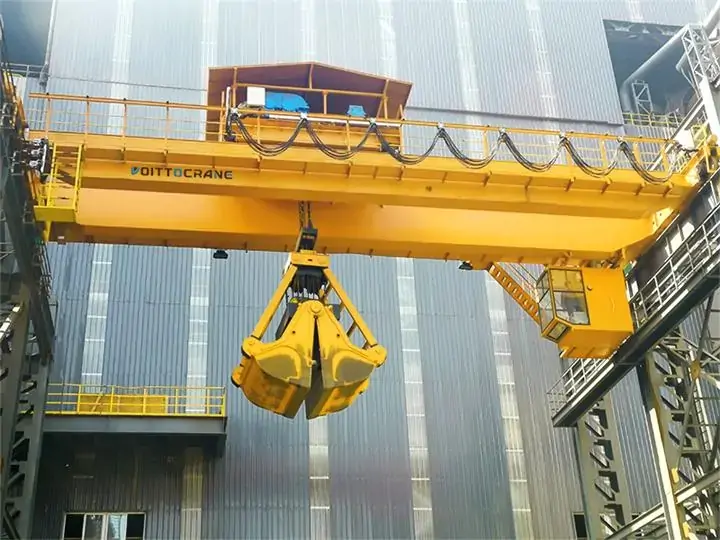
The first letter Q stands for bridge crane. The codes below come from the traditional table in GB/T 14405-93, now withdrawn, and the Crane Design Handbook.
| الرمز | Crane type | عربة |
|---|---|---|
| QD | Hook overhead crane | Single trolley |
| التيسير الكمي | Hook overhead crane | Double trolley |
| QZ | Grab overhead crane | Single trolley |
| مراقبة الجودة | Electromagnetic overhead crane | Single trolley |
| QN | Grab-and-hook overhead crane | Single trolley |
| QA | Electromagnet-and-hook overhead crane | Single trolley |
| QP | Grab-and-electromagnet overhead crane | Single trolley |
| QS | Three-purpose overhead crane (hook, grab or electromagnet) | Single trolley |
A “three-purpose” crane can use a hook, a grab or an electromagnetic chuck as a detachable lifting attachment. For an outdoor version, many manufacturers add W at the end of the model.
Gantry Crane Codes
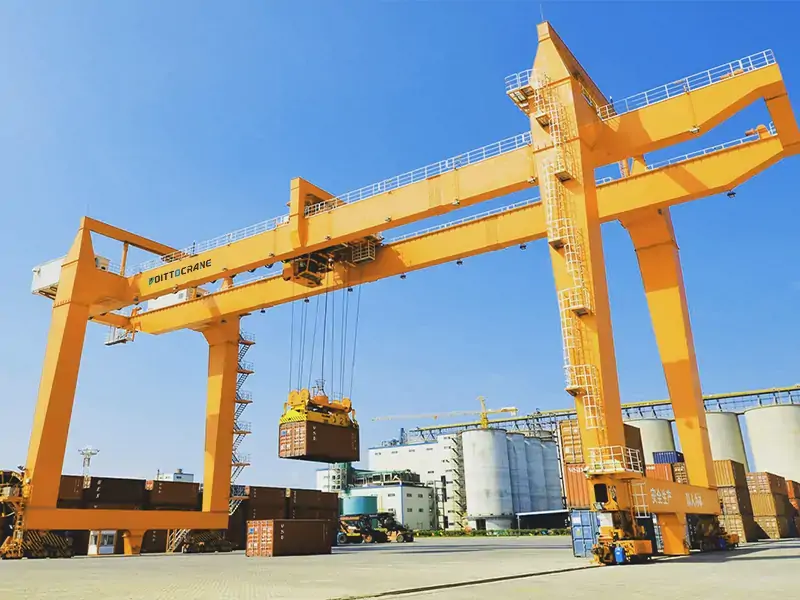
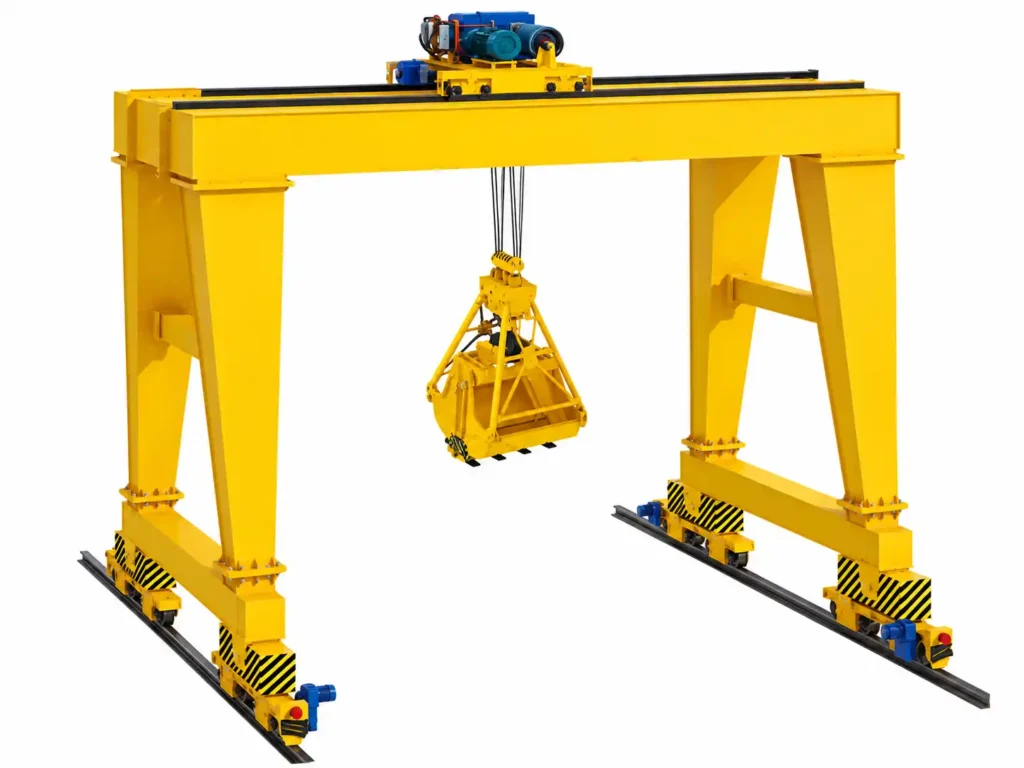
The first letter M stands for gantry crane. Codes are split by main girder type.
رافعات جسرية مزدوجة العوارض
| الرمز | Crane type | Girder and trolley |
|---|---|---|
| MG | Hook gantry crane | Double girder, single trolley |
| ME | Hook gantry crane | Double girder, double trolley |
| MZ | Grab gantry crane | Double girder, single trolley |
| MC | Electromagnetic gantry crane | Double girder, single trolley |
| MN | Grab-and-hook gantry crane | Double girder, single trolley |
| MP | Grab-and-electromagnet gantry crane | Double girder, single trolley |
| MS | Three-purpose gantry crane | Double girder, single trolley |
رافعات جسرية أحادية العارضة
Single girder codes insert D after the M. For example, MDG is a single girder hook gantry crane, MDE is a single girder gantry with double trolleys, and MDZ is a single girder grab gantry crane. The same pattern continues with MDC, MDN, MDP and MDS.
In short, MG = double girder hook gantry و MDG = single girder hook gantry. Mixing these two up is a common source of quotation errors.
Single Girder, Hoist, Explosion-Proof and Jib Crane Codes
Light-duty cranes built around electric hoists use a different set of codes, starting with L (beam) or B (jib).
| الرمز | Crane type |
|---|---|
| LD | Electric single girder crane (hoist below the girder) |
| LDP | Electric single girder crane (hoist on an angle-type trolley) |
| LDC | Electric single girder crane (hoist at the side of the girder) |
| LX | Electric single girder underhung crane |
| LXC | Underhung crane (hoist at the side of the girder) |
| LH | Electric hoist bridge crane |
| QB | Explosion-proof overhead crane |
| ل.ب | Explosion-proof electric single girder crane |
| LXDB | Explosion-proof underhung crane |
| LHB | Explosion-proof electric hoist bridge crane |
| MH | Electric hoist hook gantry crane |
| MHZ | Electric hoist grab gantry crane |
| MHC | Electric hoist electromagnetic gantry crane |
| BZ / BZD | Pillar-mounted jib crane (manual / electric slewing) |
| BX / BXD | Wall-mounted jib crane (manual / electric slewing) |
Note: in the explosion-proof codes, B means explosion-proof, not “jib.” That is why QB is an explosion-proof overhead crane, while BX is a wall-mounted jib crane. Always read the letter in context.
Since GB/T 8906-2014, Chinese standards use the term “cantilever crane” instead of the older “slewing jib crane.”
Metallurgical and Special-Purpose Crane Codes
Cranes for steel plants and ports use their own codes. Many of these come from industry practice rather than a formal standard.
| الرمز | Crane type |
|---|---|
| YZ | Foundry (casting) crane |
| YH | Quenching crane |
| YP / YN | Charging rake crane (rigid / flexible rake) |
| YB | Slab clamp crane |
| YQ | Clamp crane |
| YC | Rotating electromagnetic crane |
| YD | Forging crane |
| YT | Ingot stripping crane |
| YJ | Lid-lifting crane |
| QY | Insulated overhead crane |
| QM | Slow-speed overhead crane |
| QL | Electromagnetic beam overhead crane |
| MB | رافعة نصف جسرية |
| MJ | Container gantry crane |
| MQ | Ship-unloading bridge / gantry |
| MX | Container unloading bridge |
For example, YZ هو Y (metallurgical) plus Z (casting). Remember that many entries in this group are reference codes only, and different manufacturers may use different letters.
Why Model Codes Can Differ Between Suppliers
Since the codes are no longer fixed by a national standard, you may see variations:
- A manufacturer may add suffixes for European-style design, outdoor use, or special duty.
- Some brands use their own series names alongside or instead of traditional codes.
- The same letters may mean slightly different things for niche cranes.
The code is a shortcut, not a specification. Two cranes with the same code can have different capacity, span, duty class, lifting height and components.
How to Use Model Codes When Requesting a Quote
- Describe the application first, such as workshop, outdoor yard or steel plant, then ask the supplier to recommend a model.
- Ask for the code meaning in writing. A reliable supplier will explain every letter.
- Confirm the key parameters separately: rated capacity, span, lifting height, working duty (such as A5 or A6), power supply and control method.
- Check the lifting attachment. A hook, grab or electromagnet changes the design and price.
- Compare like with like. Do not compare a QD quotation with an LD quotation as if they were the same product. They differ in structure, duty and cost.
Explore Our Crane Range
VOITTO Crane supplies the common types covered above, including double girder overhead cranes (QD, QB, QZ, QY and others), electric hoist overhead cranes (LH/NLH), European-style overhead cranes (QDXX), explosion-proof cranes, steel-mill cranes (YZ, YB) and gantry cranes. If you are not sure which code fits your project, send us your capacity, span and working environment, and our engineers will recommend a suitable model.

آلان
أخصائي حلول الرافعات · رافعة Voitto
متخصصون في حلول تصدير الرافعات العلوية، والرافعات الجسرية، والرافعات الجيبية، ورافعات الموانئ، ورافعات الجسور العلوية الكهربائية. خبرة تزيد عن 10 سنوات في مساعدة العملاء العالميين من خلال الاستشارات قبل البيع، واختيار السعة، والتكوينات الخاصة بكل موقع.
الأسئلة الشائعة
Q1:What does QD mean in a crane model?
QD refers to a hook overhead (bridge) crane with a single trolley. Q stands for bridge crane and D for hook.
Q2:What is the difference between MG and MDG?
MG is a double girder hook gantry crane. MDG is a single girder hook gantry crane.
Q3:What does LD stand for?
LD is an electric single girder crane. L stands for beam type and D for electric.
Q4:What does the letter W mean at the end of a model?
W commonly indicates an outdoor version of the crane.
Q5:Are crane model codes the same worldwide?
No. They are widely used in China and by Chinese exporters. European and American manufacturers often use their own naming systems, so always confirm specifications in writing.




 English
  Español
  Português
  العربية
  Français
  Русский