
رافعة جسرية capacity is the maximum load a gantry crane may lift at the hook, as set by its crane manufacturer. Rated capacity depends on span, girder structure, duty class, and operating environment. When determining the appropriate specifications, the procurement team must calculate the total suspended load (i.e., the payload plus the combined weight of the lifting beam, slings, and rigging), and technical personnel must ultimately confirm the rated load. Next, this guide will introduce the calculation methods, key influencing factors, and common lifting capacity ranges related to gantry crane capacity.

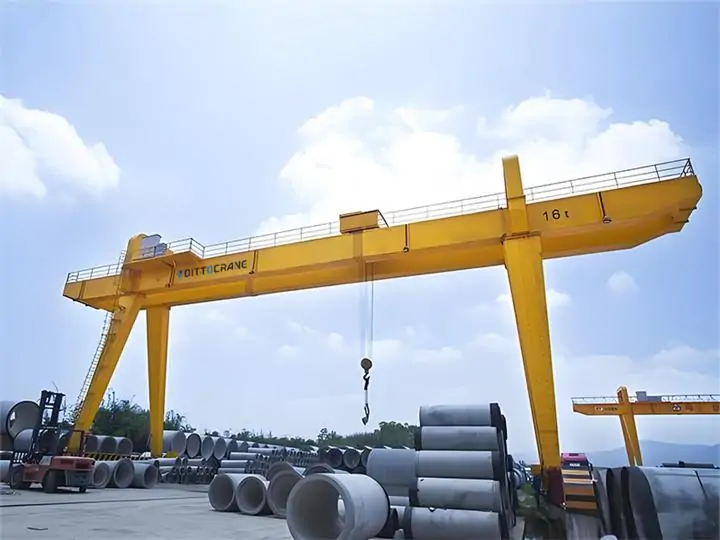
What Is Gantry Crane Capacity?
Gantry crane capacity is the maximum load a gantry crane can lift safely under defined conditions of span, lifting height, duty class, and environment. The rating plate states this gantry crane’s lifting capacity, and the designer sizes the girder, legs, hoist, brakes, and wheels around it. Buyers often confuse three different numbers: the product weight, the weight on the hook, and the crane’s rating.
Rated Capacity vs. Actual Lifting Load
Rated capacity is a fixed design limit, while the actual lifting load changes with every lift. A crane rated at 10 tonnes may lift 2 tonnes in the morning and 9.5 tonnes in the afternoon, and both lifts stay within its rated capacity.
The rating must cover the heaviest lift the crane will ever make, not the average one. It also belongs to a specific configuration. Span, lifting height, and duty class all influence gantry crane load capacity, so a figure quoted for one configuration does not transfer to another.
What Is Included in the Total Suspended Load?
The total suspended load is everything the hook carries during a lift, and it must never exceed the rated capacity. It normally includes:
- The payload, such as a mould, steel structure, machine, or container.
- Below-the-hook devices, including lifting beams, spreaders, grabs and magnets.
- Slings, chains, shackles and other rigging.
- Anything carried in or on the load, such as packaging or liquid inside a vessel.
Understanding Safe Working Load (SWL) and Rated Load
Terminology differs by region and standard. Rated load, or rated capacity, is the maximum load the designer assigns to the complete crane. Safe working load (SWL) is the traditional term, still common in older specifications and on lifting accessories.
Every component in the lifting chain has its own limit, and the lowest limit governs. A 10-tonne crane used with a lifting beam limited to 6 tonnes can only lift a 6-tonne payload.
How to Calculate the Required Gantry Crane Capacity
A gantry crane capacity calculation takes four steps: find the heaviest load, add every attachment, account for operating conditions, and confirm the result through engineering design.
Identify the Maximum Load to Be Lifted
Users should base their calculations on the heaviest object the crane is required to lift, rather than on standard objects. Please use verified data (such as design drawings, weighbridge records, or supplier documentation) to determine the weight; for castings, structural components, and partially loaded containers, use the maximum weight. In addition, consider situations involving multiple-load lifting and account for any increase in weight due to rain, ice, or residue.
Include Lifting Attachments and Rigging Weight
Lifting accessories are considered part of the load. Lifting beams used to hoist long components can weigh up to several hundred kilograms, while lifting electromagnets and grapples are often even heavier. If the suitability of a crane is assessed based solely on the weight of the product itself, the crane may already be overloaded once the lifting beam and slings are attached to the hook.
Consider Dynamic Effects and Operating Conditions
A load weighing 8.6 tons when at rest is not subject to a force equivalent to 8.6 tons while in motion. Factors such as lifting, sudden braking, passing over rail joints, load sway, and wind can all generate additional forces. Design standards address these factors through “dynamic factors” and “load combinations,” which are applied in the design of structures and mechanisms. Therefore, the buyer should not arbitrarily add a percentage to the nominal values listed on the nameplate. Instead, the buyer should provide the manufacturer with the key parameters used to determine these factors, such as hoisting speed and travel speed, duty class, hoisting frequency, and the prevailing wind conditions.
A Practical Gantry Crane Capacity Calculation Example
Consider a workshop that lifts a fabricated component with a lifting beam and slings.
| البند | الوزن |
|---|---|
| Maximum load weight | 8,000 kg |
| Lifting beam | 500 كجم |
| Slings and rigging | 100 kg |
| Total suspended load | 8,600 kg (8.6 tonnes) |
Total suspended load = 8,000 kg + 500 kg + 100 kg = 8,600 kg; therefore, the gantry crane’s rated lifting capacity must be at least 8.6 tons. Based solely on the weight of the products, an 8-ton crane might seem suitable, but it would actually be overloaded by 600 kg.
This figure is not the final rated lifting capacity, but rather the minimum suspended load that the crane must be capable of handling. The final rated lifting capacity is determined by a combination of design standards, engineering calculations, span, duty cycle, and anticipated future loads. Since manufacturers typically produce cranes according to standard specification series, this project may ultimately adopt a 10-ton specification; however, the specific outcome must still be confirmed through engineering evaluation.
What Factors Affect Gantry Crane Capacity?
Capacity is not a number a manufacturer can choose freely. The structure must resist bending, buckling, and fatigue at every tonne on the rating plate, and four factors dominate the design.
Span and Main Girder Design
The effect of span length is the most significant. For a simply supported beam with a span of L and a centrally concentrated load P, the maximum bending moment is PL/4, while the deflection increases proportionally to the cube of the span. Assuming the cross-section remains constant, if the span is doubled, the bending moment will also double, while the deflection will increase eightfold. To address this issue, designers typically increase the beam height or thicken the plate material; however, this increases the structural weight, thereby placing a greater load on the legs, running wheels, and track beams. For this reason, the maximum lifting capacity of a gantry crane is always specified in relation to specific span parameters.
Single Girder vs. Double Girder Structure
In a single-girder design, the entire load of the hoisting mechanism is concentrated on a single main girder; therefore, bending stress, torsional stress, and local flange stress all act on the same member. In a double-girder design, the load is shared by two main girders, and the trolley runs on a track spanning across both girders. This structure offers greater rigidity and better symmetry, and provides ample installation space for open-type hoist trolleys.
For these reasons, single-girder gantry cranes are typically suitable for smaller lifting capacity ranges (generally up to about 32 metric tons), while double-girder designs can achieve lifting capacities of several hundred metric tons. For a more comprehensive comparison, please refer to our guide on how to select an industrial gantry crane.
Duty Class and Lifting Frequency
The rated lifting capacity refers to the maximum weight a crane can lift. The duty cycle, on the other hand, reflects the frequency of the crane’s use and how closely the actual load being lifted approaches the rated lifting capacity. This distinction is important because of the issue of “fatigue”: if a structure is frequently subjected to loads close to its rated capacity, damage accumulates much faster than when lifting operations are performed only occasionally.
Two cranes with the same rated lifting capacity but different duty classes may have different components—such as the main girder, motors, and brakes—and therefore differ in price. When consulting with manufacturers, procurement teams should be sure to specify the number of lifts per hour, the proportion of operations performed near full capacity, and the daily operating hours.
Lifting Height and Working Environment
Greater lifting heights require taller outriggers and longer wire ropes. Taller outriggers can lead to buckling and stability issues, which are particularly pronounced in outdoor environments. Outdoor cranes must also withstand wind loads acting on both the structure and the load; therefore, designers must evaluate their performance under both normal operating conditions and storm conditions, and often install track clamps. In addition, extreme temperatures and coastal or chemically corrosive environments can also affect materials and coatings. When communicating with gantry crane suppliers, procurement teams should provide detailed information about the job site conditions, as these environmental factors may necessitate design modifications even if the gantry crane’s rated lifting capacity remains unchanged.
Common Gantry Crane Capacity Ranges and Applications
No single standard defines gantry crane capacity bands, so these are typical groupings rather than strict limits.
Light-Duty Gantry Cranes
Light-duty gantry cranes usually cover about 1-5 tonnes. They suit workshops, maintenance bays, small warehouses, and mould changing.
احصل على عرض أسعار

Medium-Capacity Gantry Cranes
Gantry cranes with medium lifting capacity typically have a rated load ranging from 5 to 32 tons. Typical applications include manufacturing workshops, steel and lumber yards, precast component storage areas, and power plant maintenance operations. This type of crane is available in both single-girder and double-girder configurations; span, duty class, and hook height are the primary factors determining the specific model selection.
احصل على عرض أسعار

Heavy-Duty Gantry Cranes
The lifting capacity of heavy-duty gantry cranes typically starts at around 32 tons and can reach up to several hundred tons. They are widely used in steel mills, hydropower projects, the shipbuilding industry, and heavy equipment installation, among other fields. They usually feature a double-girder structure and are equipped with open-type hoist trolleys.
احصل على عرض أسعار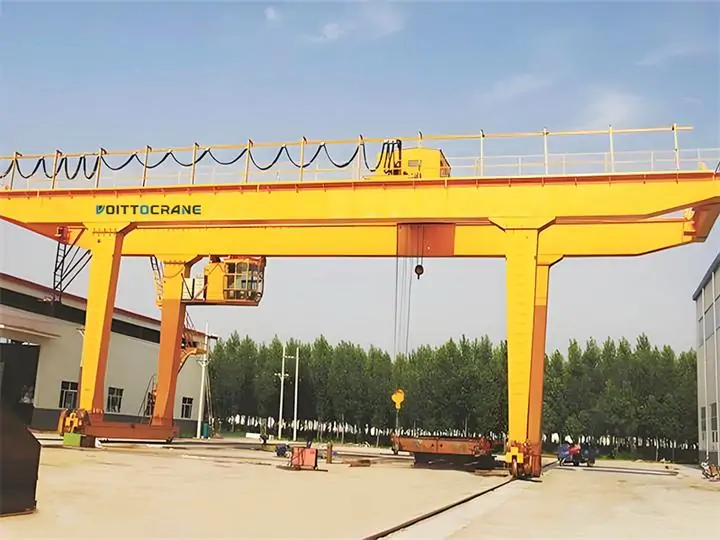
Heavy Duty Gantry Crane

رافعة جسرية مزدوجة العارضة
Specialized Gantry Cranes for Ports and Industrial Projects
Some cranes are designed around a specific task. Container gantry cranes, rubber-tyred or rail-mounted, are commonly rated at roughly 35 to 70 tonnes, usually measured under the spreader, so the spreader counts as part of the crane. Shipyard gantries, tunnel construction gantries and precast girder handlers are normally project-specific designs whose capacity follows the item lifted, the site and the handling cycle.
احصل على عرض أسعار
رافعة RMG
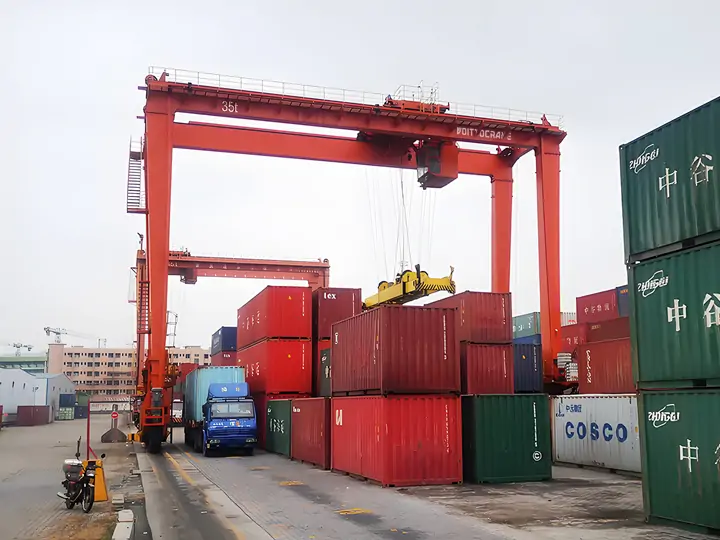
رافعة RTG
How to Choose the Right Gantry Crane Capacity
After determining the total suspension load, the procurement team must make three practical decisions.
Match Rated Capacity to Your Actual Lifting Requirements
Base the gantry crane capacity on the verified total suspended load of your heaviest regular lift. Over-specifying has a real cost, because a higher rating means a heavier structure, a larger runway, bigger motors, and a higher price. Under-specifying leaves the crane unable to do its job. Before requesting a quote, please prepare a list of loads to ensure that quotes from different parties are comparable.
Consider Future Load Requirements
Gantry crane capacity should last for decades, so check your product roadmap. If heavier components are planned, size for them or ask about a runway and foundations prepared for a later upgrade. Plan around realistic loads, because a vague allowance changes the structure and cost without a technical basis.
Consult a Gantry Crane Manufacturer
The final selection of the rated load capacity is a matter for engineering. Users must provide the manufacturer with the following information: maximum total suspended load, lifting tackle details, span, lifting height, duty cycle, on-site operating conditions, power supply, and local regulatory requirements. VOITTO Crane, as the manufacturer, can use this information to design a customized gantry crane solution for you and ensure that the equipment’s rated parameters comply with the relevant standards in your market.
الخلاصة
The gantry crane capacity is determined by a combination of factors, including the total load, span, main girder design, duty class, and operating environment. The rated lifting capacity is the maximum load limit that the crane must never exceed; when determining this value, the heaviest load that may actually occur (including lifting attachments, rigging, and other auxiliary lifting devices) should be used as the reference standard.
VOITTO Crane is committed to designing and manufacturing customized gantry crane solutions for international projects, taking into full consideration key factors such as lifting capacity, span, lifting height, duty class, and operating environment. If you are planning your lifting requirements, please feel free to contact the VOITTO team to discuss your project solutions.

آلان
أخصائي حلول الرافعات · رافعة Voitto
متخصصون في حلول تصدير الرافعات العلوية، والرافعات الجسرية، والرافعات الجيبية، ورافعات الموانئ، ورافعات الجسور العلوية الكهربائية. خبرة تزيد عن 10 سنوات في مساعدة العملاء العالميين من خلال الاستشارات قبل البيع، واختيار السعة، والتكوينات الخاصة بكل موقع.
الأسئلة الشائعة
What is the maximum capacity of a gantry crane?
There is no universal maximum. Single girder gantry cranes generally reach about 32 tonnes, while double girder designs commonly reach several hundred tonnes. Specialised project cranes can go higher, depending on span, duty class, and design.
What is the difference between crane capacity and lifting capacity?
In everyday use the two terms mean the same rated figure. Strictly, rated capacity is the maximum total load at the hook, while the net payload is what remains after subtracting lifting attachments such as beams and spreaders.
Can a gantry crane lift more than its rated capacity?
No. Lifting above the rated capacity overloads the structure, hoist, brakes and wheels, and it is unsafe. Overload protection devices exist to prevent it. If your loads are growing, review the crane with the manufacturer instead of exceeding the rating.
Does a longer span affect gantry crane capacity?
Yes. A longer span increases girder bending moment and deflection, so the girder must be deeper or heavier to carry the same load. Manufacturers therefore quote capacity together with span rather than as separate figures.
How much capacity do I need for my gantry crane?
Add the heaviest load to the weight of every lifting attachment to find the total suspended load. Then consider realistic future loads and duty. The manufacturer confirms the final rating through engineering design, not by adding an arbitrary margin.


 English
 Español
 Português
 العربية
 Français
 Русский