La grúa pórtico estándar europea FEM es un dispositivo de elevación de alto rendimiento. Diseñada conforme a las normas FEM europeas más avanzadas, esta unidad combina una estructura ligera, características de eficiencia energética y un control preciso. El equipo está equipado con polipastos eléctricos de cable de acero europeos, tecnología de variador de frecuencia (VFD) y una estructura de acero de diseño óptimo. En comparación con las grúas pórtico tradicionales, ofrece menor presión sobre las ruedas, mayor altura de elevación, un funcionamiento más suave y menores requisitos de mantenimiento. Estas grúas están disponibles en configuraciones de viga simple y doble, con capacidades de elevación que van desde 1 tonelada métrica hasta más de 320 toneladas métricas, y pueden personalizarse para satisfacer las necesidades de diversas aplicaciones industriales.
La grúa pórtico estándar FEM está disponible en dos configuraciones estructurales: sistemas de viga simple con capacidades de elevación nominales de 1 a 32 toneladas métricas, y modelos de doble viga con capacidades de elevación de 5 a 320 toneladas métricas. Ambas configuraciones cumplen con las normas FEM 1.001 e ISO 4305, están equipadas con sistemas de seguridad redundantes y ofrecen una velocidad de elevación de 2 metros por segundo. Generalmente, los usuarios utilizan este equipo para tareas de manipulación de materiales en los sectores de fabricación de acero, construcción naval y montaje industrial. El equipo cuenta con la certificación CE y está diseñado para una vida útil de hasta 25 años.
¿Qué es una grúa pórtico estándar FEM?
La grúa pórtico estándar FEM es un sistema de elevación montado sobre el suelo. Esta grúa pórtico europea combina una viga principal de sección cajón soldada con vigas de extremo atornilladas, lo que reduce el tiempo de instalación en 30% en comparación con las estructuras remachadas. Además, el sistema de viga simple tiene una luz de 6 a 18 metros y ocupa un espacio horizontal mínimo, mientras que la configuración de doble viga ofrece una luz mayor de 15 a 35 metros. Gracias a la integración de frenos limitadores de carga redundantes, puntos de suspensión dobles y células de carga de precisión, el sistema certificado por FEM alcanza un tiempo de actividad del 99,2%.
Grúa pórtico monorraíl
Grúa pórtico birraíl
Su diseño modular permite aumentar la capacidad de elevación sin necesidad de reemplazar la estructura principal, lo que prolonga la vida útil del equipo a más de 25 años. Por lo tanto, al seleccionar la configuración de vigas adecuada, los usuarios deben considerar detenidamente la distribución de la fábrica, la frecuencia de carga y los requisitos de producción.
Tipos de grúas pórtico estándar FEM
Una grúa pórtico monorraíl cuenta con una viga de acero soldada montada sobre cuatro patas. Tiene una capacidad de elevación de 1 a 32 toneladas métricas, una luz de 6 a 18 metros y una altura de elevación de 6 a 12 metros. Este sistema compacto es ideal para espacios con poca altura libre, ya que requiere 18% menos altura libre que los diseños de doble viga. Además, los modelos monorraíl incorporan un carro de elevación simplificado, lo que prolonga los intervalos de mantenimiento y reduce los requisitos de inventario de repuestos en 25%.
Las grúas pórtico de doble viga cuentan con dos vigas principales paralelas. Este modelo tiene una capacidad de elevación de 5 a 320 toneladas métricas, una luz de 15 a 35 metros y una altura de elevación de 10 a 25 metros. Este diseño distribuye la carga entre dos puntos de apoyo, lo que mejora la estabilidad durante las operaciones de elevación dinámicas. Por lo tanto, el sistema de doble viga es idóneo para la manipulación de equipos de fabricación pesados, grandes componentes de construcción naval y operaciones industriales continuas.
Ventajas y características
Las grúas pórtico europeas están diseñadas conforme a las avanzadas normas europeas FEM, combinando una construcción ligera, un rendimiento energéticamente eficiente y tecnología de control inteligente. A continuación, se describen las principales ventajas y características de las grúas pórtico que cumplen con la norma FEM.
Diseño ligeroEn comparación con las grúas pórtico tradicionales, su peso propio se reduce hasta en 301 TP3T, lo que disminuye eficazmente la carga sobre las ruedas y reduce los costes de construcción de la cimentación.
Viajes a Greater Hook: El diseño de poca altura maximiza la altura de elevación.
Eficiencia energética y alto rendimientoLos sistemas de accionamiento avanzados y los motores de alta eficiencia reducen el consumo de energía hasta en un 40%.
Control precisoEl control de frecuencia variable garantiza un funcionamiento suave, un posicionamiento preciso y minimiza la oscilación de la carga.
Bajos requisitos de mantenimientoLos componentes modulares y un sistema de accionamiento fiable minimizan las necesidades de mantenimiento y el tiempo de inactividad.
Larga vida útilLos componentes de alta calidad y un diseño estructural optimizado garantizan la durabilidad del equipo.
Funcionamiento silencioso: La tecnología de accionamiento avanzada reduce significativamente el ruido de funcionamiento.
Compatibilidad con la automatización inteligenteLas grúas pórtico europeas pueden integrarse con control PLC, sistemas antivibración, monitorización remota y soluciones automatizadas para la manipulación de materiales.
Aplicación
Los usuarios utilizan una grúa pórtico FEM Standard para realizar tareas de manipulación de materiales en los sectores de fabricación, logística, puertos, construcción naval, energía eólica e industria pesada.
Plantas de fabricaciónLos usuarios utilizan grúas pórtico europeas en talleres de fabricación para el transporte y montaje de componentes de gran tamaño.
Industrias de estructuras de acero y procesamiento de metalesLos operarios utilizan grúas pórtico estándar FEM para levantar y transportar acero y grandes componentes metálicos, así como para trasladarlos entre estaciones de soldadura.
Almacenes y centros logísticosLas grúas pórtico europeas se encargan de las operaciones de carga, descarga, apilamiento y logística de carga pesada.
Puertos y terminalesLos usuarios emplean grúas pórtico europeas para realizar operaciones de carga, descarga y transbordo en patios de contenedores y carga a granel.
Astilleros de construcción y reparación navalLos operadores de astilleros utilizan grúas pórtico que cumplen con la norma europea FEM para elevar secciones del casco de los barcos y grandes componentes estructurales.
Industrias de energía eólica y energías renovablesLos usuarios utilizan este equipo para levantar las palas de las turbinas eólicas, componentes de gran tamaño, secciones de torres y góndolas.
Componentes prefabricados e industrias de la construcciónLos operarios la utilizan para levantar vigas de hormigón prefabricado, componentes de hormigón pretensado y grandes módulos de construcción.
Corrales al aire libre y depósitos de materiales pesadosLos usuarios utilizan estas grúas para transportar acero, mineral y equipos de gran tamaño.
Transporte ferroviario y construcción de infraestructuraLos operarios utilizan grúas pórtico estándar FEM para elevar componentes estructurales del metro, secciones de puentes prefabricados y grandes componentes estructurales para sistemas de transporte ferroviario.
Fábricas inteligentes y talleres automatizadosLas grúas pórtico de estilo europeo manipulan materiales y programan operaciones en líneas de producción inteligentes y sistemas no tripulados.
Especificación
Parámetro
Viga única de 1 a 5 toneladas
Viga única de 5 a 16 t
Viga única de 16 a 32 t
Doble viga 5–100 t
Doble viga 100–320 t
Capacidad de elevación
1–5 t
5–16 t
16–32 t
5–100 t
100–320 t
Ancho de vano
4–6 metros
6–12 m
8–18 m
15–25 m
25–35 m
Altura de elevación
6–8 metros
6-10 m
8–12 m
10–18 m
12–25 m
Velocidad de elevación
2 m/s
2 m/s
2 m/s
2 m/s
2 m/s
Velocidad del tranvía
20-30 m/min
20-30 m/min
20–40 m/min
30–50 m/min
30–50 m/min
Viajes en puente
15–20 m/min
15–20 m/min
20–25 m/min
20-30 m/min
20-30 m/min
Potencia del motor
2,2 kW
3,7 kW
5,5 kW
15–37 kW
45–75 kW
Clase de servicio (FEM)
A5
A5
A5
A5
A5
Precisión de la celda de carga
±0,5%
±0,5%
±0,5%
±0,5%
±0,5%
Suministro eléctrico
380–480 V trifásico
380–480 V trifásico
380–480 V trifásico
380–480 V trifásico
380–480 V trifásico
Estándares
FEM 1.001 ISO 4305
FEM 1.001 ISO 4305
FEM 1.001 ISO 4305
FEM 1.001 ISO 4305
FEM 1.001 ISO 4305
NotaLas especificaciones anteriores son estándar. VOITTO Crane ofrece soluciones personalizadas y no estándar.
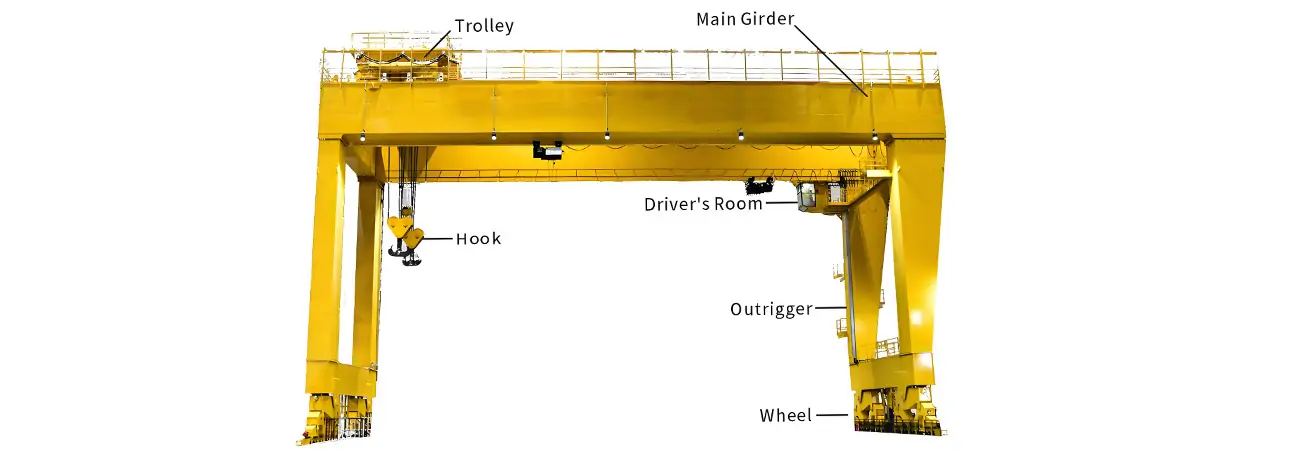
Partes de la grúa pórtico estándar FEM
La grúa pórtico estándar FEM integra doce componentes mecánicos, eléctricos y estructurales principales, diseñados para trabajar conjuntamente y realizar tareas de elevación.
Viga principal (simple o doble): Las vigas de acero de sección rectangular soldadas se utilizan como elementos portantes principales.
Vigas de extremo: Carros de cuatro ruedas montados sobre las patas transfieren la carga estructural a la cimentación.
Patas y estructura: Columnas de acero estructural soldadas se extienden desde la cimentación hasta la altura de la viga principal.
Conjunto de carro: Un carro elevador eléctrico equipado con cuatro ruedas de acero rectificadas con precisión, cojinetes de rodillos cónicos sellados y superficies de contacto con los rieles endurecidas.
Mecanismo de elevación: Sistema de enrollado de tambor, cable de acero o cadena accionado por motor.
Sensor de carga: Un sensor de fuerza de precisión montado en el punto de suspensión que transmite datos de peso al sistema de control en tiempo real.
Sistema de frenado: Frenos electromagnéticos con accionamiento por resorte y liberación neumática.
Sistema de accionamiento del motor: Motor de inducción trifásico de jaula de ardilla de corriente alterna acoplado a una caja reductora.
Variador de frecuencia (VFD): Unidad de conversión de potencia que cumple con el nivel de seguridad funcional de la norma EN 61800-5-1, lo que permite una aceleración suave y una desaceleración dinámica.
Armario de control eléctrico: Un controlador lógico basado en PLC alojado en una carcasa de acero inoxidable que cumple con las normas IEC 60529 IP55 y NEMA 4X, e integra relés, contactores y un módulo receptor inalámbrico.
Sistema de control remoto inalámbrico: un transmisor portátil alimentado por batería que cuenta con redundancia de doble canal y un dispositivo de parada de emergencia integrado.
Enclavamientos de seguridad e interruptores de límite: Una combinación de interruptores de límite de recorrido eléctricos (que cubren el izamiento, el desplazamiento del carro y el desplazamiento del pórtico) y dispositivos mecánicos de pasador de corte por sobrecarga.
Guía de precios de grúas pórtico europeas
La siguiente matriz de precios exhaustiva detalla las bandas de capacidad, los parámetros dimensionales y los rangos de inversión estimados para sistemas de viga simple y doble en aplicaciones industriales típicas.
Tipo
Capacidad
Envergadura (m)
Altura de elevación (m)
Rango de precios (USD)
Monoviga
1–5 toneladas
5–18
6–12
$8.000 – $25.000
Monoviga
5–10 toneladas
8–22
6–15
$15.000 – $45.000
Monoviga
10–20 toneladas
10–25
8–18
$30.000 – $80.000
Doble viga
10–50 toneladas
10–30
8–20
$35.000 – $120.000
Doble viga
50–100 toneladas
15–35
10–25
$80.000 – $250.000
Doble viga
100–320 toneladas
18–45
12–35
$200.000 – $600.000
NotaLos precios indicados anteriormente son solo de referencia. Los costos reales dependen de las especificaciones específicas.
Fabricante y proveedor europeo de grúas pórtico
VOITTO Crane fabrica grúas pórtico monorraíl y birraíl conforme a las normas FEM y cuenta con 25 años de experiencia profesional en el sector de la infraestructura de elevación industrial. Nuestra actividad abarca mercados de Europa, Sudamérica, el Sudeste Asiático y Asia Central, y hemos suministrado con éxito más de 480 sistemas de grúas. Los comentarios de los clientes indican que, desde la puesta en servicio del equipo, la eficiencia del ciclo operativo ha aumentado en 22%.
Además, tenemos la capacidad de personalizar soluciones para condiciones operativas especiales, incluyendo entornos hostiles como instalaciones de almacenamiento en frío a -40 °C, entornos marinos con niebla salina y entornos a prueba de explosiones que cumplen con la Directiva ATEX. Por lo tanto, ya sea que necesite una solución compacta de viga única para espacios confinados o un gran sistema de doble viga para operaciones continuas de alta exigencia, podemos adaptar una solución a sus planes de producción. Si necesita una solución de grúa pórtico estándar FEM, por favor Contacto.
Especialista en Soluciones de Grúas · Voitto Crane
10+Años Exp.
5,000+Clientes
50+Países
Especializados en soluciones de exportación de grúas puente, grúas pórtico, grúas de pluma, grúas portuarias y grúas EOT. Más de 10 años ayudando a clientes internacionales con consultoría de preventa, selección de capacidad y configuraciones específicas para cada emplazamiento.
¿Cuál es la principal diferencia entre las grúas pórtico estándar FEM de viga simple y de viga doble?
Los sistemas de viga única (de 1 a 32 toneladas) montan una sola viga sobre cuatro patas, ocupando un espacio horizontal mínimo en tramos de 4 a 18 metros, lo que los hace ideales para instalaciones compactas. Las configuraciones de doble viga (de 5 a 320 toneladas) emplean vigas paralelas dobles, que permiten cubrir tramos de 15 a 35 metros con una estabilidad de carga superior.
¿Cuánto tiempo suele requerir la instalación de una grúa pórtico estándar FEM?
La instalación de vigas simples requiere de 6 a 10 días hábiles para la cimentación, el montaje y las pruebas de aceptación en fábrica (FAT). Los sistemas de vigas dobles requieren de 10 a 16 días hábiles debido a la mayor complejidad estructural. Además, la preparación de las instalaciones, incluido el tiempo de curado del hormigón, prolonga los plazos entre 5 y 7 días. Por lo tanto, desde el pedido hasta la puesta en marcha, se estima un plazo de 10 a 14 semanas para vigas simples y de 12 a 16 semanas para vigas dobles.
¿Es posible adaptar los sistemas de viga simple con mejoras de capacidad para convertirlos en sistemas de doble viga?
La conversión completa de viga simple a viga doble requiere un reemplazo estructural total, lo cual no es viable económicamente. Sin embargo, los sistemas de vigas auxiliares pueden aumentar la capacidad de la viga simple entre 10 y 151 toneladas sin modificaciones importantes. Por lo tanto, para un crecimiento de capacidad previsto superior a 32 toneladas, recomendamos planificar inicialmente la instalación de vigas dobles. En consecuencia, este enfoque estratégico evita costosas conversiones a mitad de la vida útil del sistema.
¿Qué programa de mantenimiento preventivo se aplica a las grúas pórtico estándar FEM?
El mantenimiento preventivo incluye inspecciones visuales semanales, lubricación mensual (viga simple: 2 puntos, viga doble: 4 puntos), auditorías trimestrales del panel eléctrico y ensayos no destructivos (END) anuales de juntas soldadas realizados por terceros según los protocolos ultrasónicos EN 13134. Por lo tanto, el cumplimiento de este programa prolonga la vida útil de las vigas simples entre 2 y 3 años, y la de las vigas dobles entre 3 y 5 años.
¿Son las grúas pórtico estándar FEM adecuadas para entornos exteriores o marinos?
Sí, para su instalación en exteriores se requiere acero galvanizado en caliente (según la norma EN ISO 1461, con un espesor mínimo de 85 µm) y envolventes eléctricas de acero inoxidable NEMA 4X. Además, los controles inalámbricos deben cumplir con la norma EN 60204-32 de inmunidad electromagnética industrial. Por lo tanto, las instalaciones costeras y marinas se benefician de las clasificaciones para uso marino (IEC 60721-3-3C5), que protegen los equipos contra la corrosión por niebla salina. Tanto las configuraciones de viga simple como de viga doble permiten mejoras ambientales.
Cualificación y honor
Engineered Strength, proveedor mundial de grúas
servicio
Exclusivo y considerable, el cliente es lo primero.
01
Soluciones fiables y personalizadas
Nuestro equipo de preventa realiza consultas y adapta las soluciones a sus necesidades y entorno.
Ofrecen opciones de personalización de la capacidad de elevación, la envergadura y la altura de elevación, etc. para satisfacer necesidades específicas.
02
Proceso de producción actualizado
Actualizaciones de progreso en tiempo real: Informes semanales y comunicación PM.
Pruebas previas a la entrega: 100% comprobaciones de carga y seguridad, informes detallados.
03
Asistencia posventa de confianza
3-5 años de garantía y sustitución gratuita por defectos no de fabricación.
Asistencia en línea 24 horas al día, 7 días a la semana, y asistencia in situ en caso de problemas con la grúa.
PREGUNTAS FRECUENTES
Engineered Strength, proveedor mundial de grúas
¿Cómo se envían las grúas pórtico grandes al extranjero?
Las grúas pórtico grandes suelen enviarse al extranjero mediante desmontaje modular, en el que la grúa se desmonta en componentes principales (vigas, patas, polipastos) para su transporte en contenedores. Para las megagrúas, utilizamos buques especializados en cargas pesadas equipados con cubiertas reforzadas, y las piezas críticas se protegen con recubrimientos anticorrosión durante el transporte.
¿Qué estándares de voltaje admiten sus grúas pórtico?
Nuestras grúas pórtico son compatibles con los estándares de voltaje globales para garantizar un funcionamiento sin problemas en todo el mundo. Resuelva cualquier duda que tenga sobre el voltaje.
¿Se puede personalizar?
Sí, la capacidad de elevación, la envergadura, la altura, el tipo de estructura y las opciones de polipasto pueden personalizarse para adaptarse a condiciones de trabajo específicas.
¿Puedes diseñar una grúa pórtico para condiciones exteriores extremas?
Sí, nuestras grúas pórtico pueden utilizarse de forma estable en entornos adversos, como vientos fuertes o bajas temperaturas, gracias a su construcción especial y a la estructura de sus materiales.
¿Hacen envíos internacionales?
Sí, los envíos internacionales y la asistencia a la exportación están disponibles para los clientes de todo el mundo.
Póngase en contacto
No dude en dejarnos un mensaje. Le responderemos en 24 horas.
Por favor, especifique su necesidad refiriéndose a los siguientes aspectos:
¿Qué producto de grúa necesita?
¿Cuál es la capacidad máxima de elevación (en toneladas) necesaria para su proyecto?
¿Podría especificar la altura de elevación (en metros) necesaria?
¿Puede dar detalles sobre el entorno de trabajo, como las condiciones del terreno, las limitaciones de espacio y cualquier obstáculo?
¿Cuál es la frecuencia de uso prevista y la duración del proyecto?
productos relacionados
Potencia de precisión, personalización Solución de grúa.




 English
  Español
  Português
  العربية
  Français
  Русский