
If you operate an overhead crane in a U.S. general industry facility, 29 CFR 1910.179 is not one standard among many — it is your primary federal compliance obligation. It covers grúas puente, gantry cranes, semi-gantry cranes, cantilever gantry cranes, and storage bridge cranes. Miss the requirements and you face citations ranging from $16,131 per serious violation to $161,323 per willful violation (2024 OSHA penalty schedule, adjusted annually).
Most facilities that receive crane citations are not running visibly unsafe equipment. They are facilities where someone assumed that one annual inspection was enough, where the maintenance team didn’t know the OEM manual carries the force of OSHA law, or where an electrician updated wiring without checking Subpart S conductor color codes. This article works through each of those gaps — what the standard actually requires, why violations cluster where they do, and what a defensible compliance program looks like in practice.
One note on scope before going further: 1910.179 covers top-running overhead and gantry cranes. It does not cover underhung bridge cranes, monorail systems, construction cranes (those fall under 29 CFR 1926 Subpart CC), or mobile cranes. If you operate underhung equipment, the OSHA General Duty Clause still applies, and ASME B30.11 / B30.17 provide the relevant technical framework.
- 1 What OSHA 1910.179 Actually Covers
- 2 Rated Capacity Markings: The Citation That Keeps Appearing
- 3 Inspection Requirements: Service Class Determines Your Actual Schedule
- 4 Operator Qualification: “Designated” Means More Than “Assigned”
- 5 Electrical and Structural Safety Requirements
- 6 The OEM Manual Obligation: Where Compliance Programs Often Fail
- 7 Certification, Load Testing, and Pre-Service Requirements
- 8 Compliance and Certification Framework
- 9 Common Violation Categories and How to Close Them
- 10 Conclusión
-
11
PREGUNTAS FRECUENTES
- 11.1 Q1: Does OSHA 1910.179 require overhead crane operators to be third-party certified?
- 11.2 Q2: How often must an overhead crane be inspected under 1910.179?
- 11.3 Q3: What happens if my overhead crane is modified or rerated?
- 11.4 Q4: Are idle or standby cranes exempt from OSHA 1910.179 inspection requirements?
- 11.5 Q5: What are the OSHA penalty amounts for 1910.179 crane violations?

What OSHA 1910.179 Actually Covers
Scope and Definitions
OSHA 1910.179 applies to any overhead or gantry crane where the hoisting mechanism is an integral part of the machine and the crane travels on an overhead fixed runway structure. The practical boundary: if the crane lifts, lowers, and moves the load horizontally, and the hoist travels with the bridge, you are inside 1910.179’s scope.
The standard defines several crane types that matter for compliance planning. A cab-operated crane is controlled from an operator cab on the bridge or trolley — physical cab-access requirements (ladder, lighting, fire extinguisher, minimum cab clearance of 3 inches from fixed structures) apply specifically to this configuration. A floor-operated crane is controlled via pendant or rope by an operator at floor level. A remote-operated crane is controlled by any method other than pendant, cab, or rope — radio remote being the most common in modern facilities. Each control mode triggers different ergonomic and safety device requirements under 1910.179(e).
What 1910.179 does not govern: construction cranes, mobile cranes, and cranes with underhung running gear. Many facilities operate a mix — a top-running 20-ton bridge crane alongside an underhung 2-ton monorail, for instance. The 20-ton bridge crane is squarely inside 1910.179. The monorail is outside 1910.179 but inside the General Duty Clause and ASME B30.11. Running both through the same inspection protocol (1910.179 framework) is defensible practice and what most safety professionals recommend.
Design Standards That Carry Over Into Operations
New overhead and gantry cranes installed on or after August 31, 1971 must meet ANSI B30.2.0-1967, which OSHA incorporates by reference. This matters operationally because modifications to an existing crane — rerate, structural change, drive system upgrade — require the modified crane and its supporting structure to be rechecked by a qualified engineer or the OEM, and then load-tested before returning to service. The new rated load must be re-marked on both sides of the bridge.
The rerate rule catches many facilities off guard. A plant adds a second hook block to an existing hoist, or replaces a single-girder bridge with a heavier double-girder configuration, and assumes the original nameplate capacity still stands. It does not. Any modification that affects rated load — or that a reasonable engineer would question — triggers the recertification path under 1910.179(b)(3).
Rated Capacity Markings: The Citation That Keeps Appearing
Why Illegible Markings Remain a Top Citation Driver
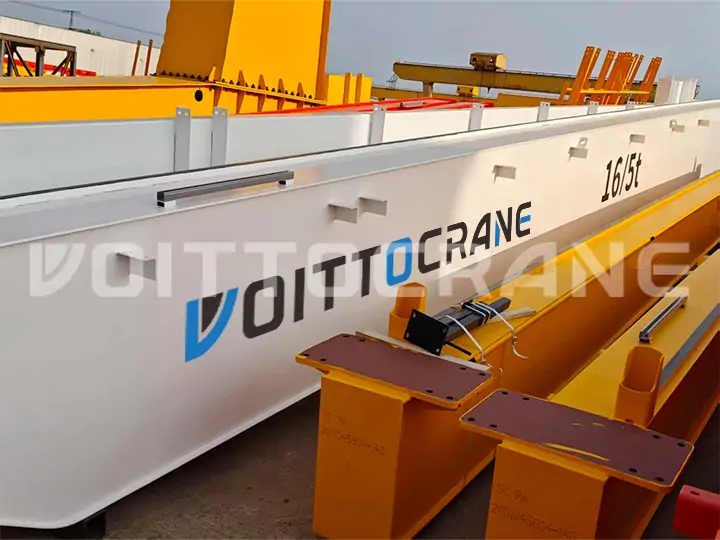
Capacity markings must be legible and displayed on both sides of the crane — this is one of the most consistently cited violations under 1910.179, and it is also one of the easiest to prevent. The standard at 1910.179(b)(5) requires the maximum rated load to be plainly marked on each side of the crane. Where multiple hoists exist, each hoist must display its individual rated capacity.
The reason this citation recurs is not that facilities deliberately remove markings. It’s that paint fades, grime accumulates, and nobody is specifically tasked with verifying legibility during routine walkarounds. Inspection checklists that ask “is capacity marked?” often get a yes based on memory rather than a fresh visual. A practical fix: make legibility verification explicit in the pre-shift inspection checklist, with the inspector required to physically read the marking from the floor, not just confirm it exists.
If multiple hoists are present on a single bridge and only the bridge-level rating is marked — not the individual hoist capacities — that is a citation waiting to happen. The hoist rating and the bridge rating are not the same number, and operators need to see both.
Inspection Requirements: Service Class Determines Your Actual Schedule
Frequent vs. Periodic — The Two-Tier System
OSHA 1910.179 requires two categories of inspection: frequent inspections at daily-to-monthly intervals, and periodic inspections at one-to-twelve-month intervals — but which interval within each range applies to your crane depends on how hard you actually use it, not on a default calendar.
This is where most compliance programs drift. A facility schedules one annual inspection, checks the “periodic inspection” box, and believes it has met 1910.179. That is often insufficient. The standard’s intervals are bands, not fixed dates. The correct interval within each band is determined by service severity — and a crane running multiple shifts at high load percentages is not on the same schedule as one that lifts occasionally in a maintenance bay.
Frequent inspection items (daily-to-monthly, depending on use):
- All functional operating mechanisms for excessive wear
- Air and hydraulic systems for deterioration or leakage
- Hooks for deformation, cracks, or latch damage (visual inspection required daily; monthly certified inspection with written record)
- Hoist chains, including end connections, for wear, twist, distorted links, or stretch beyond manufacturer limits (visual daily; monthly certified record)
- Wire rope reeving for compliance with manufacturer recommendations
- All safety devices — limit switches, load indicators, overload protection
Periodic inspection items (1 to 12 months, depending on service):
- Deformed, cracked, or corroded structural members — girders, end trucks, trolley frames
- Loose bolts or rivets
- Worn or cracked sheaves and drums
- Brake system components
- Electrical apparatus for signs of deterioration
- Load-bearing components showing excessive wear
- Wire ropes: a thorough inspection at least monthly, with a certification record (date, inspector signature, rope identifier)
For a more detailed inspection checklist, please visit Lista de comprobación completa para la inspección de puentes grúa: Su guía para la seguridad y el cumplimiento
How to Determine Your Service Class
The most common compliance gap is not knowing which service class applies to your crane — and most facilities underclassify. ASME B30.2 and CMAA Specification 70 provide the classification framework that OSHA’s inspection intervals reference. The classes run from A (standby/light) through F (continuous severe), and your actual minimum inspection frequency follows from honest classification.
OSHA 1910.179 sets inspection frequency as a band — daily-to-monthly for frequent, one-to-twelve months for periodic — and explicitly states the correct interval within each band depends on “the nature of the critical components of the crane and the degree of their exposure to wear, deterioration, or malfunction.” The standard does not assign fixed calendar schedules to specific crane types; that determination is a performance obligation on the employer.
The classification framework — ASME B30.2 and CMAA Specification 70 — provides the criteria for making that determination. Those are paid industry standards that must be consulted directly; their service classes run from Class A (standby service) through Class F (continuous severe service), and each class carries different guidance on appropriate inspection intervals. The key inputs to classification are: average number of lifts per hour, average load as a percentage of rated capacity, total projected operating hours over the crane’s service life, and environmental severity.
The practical obligation: an employer cannot simply pick “annual” as a default and call it compliant. The inspection interval must be defensibly derived from actual operating data for each crane. A maintenance bay crane used a few times per week is in a very different service class from a production crane running three shifts at high load fractions — and the inspection schedules must reflect that difference. When classifying, use the operating data from your actual production environment, not a theoretical or conservative estimate. Underclassifying a heavily used crane is a compliance gap — and in a post-incident investigation, inspection records built on an honest service-class analysis are far more defensible than records built on a convenient calendar.
Idle and Standby Cranes Are Not Exempt
A crane that sits unused for a period still requires inspection before returning to service — and standby cranes that run infrequently still require semi-annual inspections at minimum, even when not in active use. This surprises many facilities.
Under 1910.179(j)(4): a crane idle for one month or more but less than six months requires an inspection and operational check per the frequent inspection requirements of 1910.179(j)(2) before being placed back in service. A crane idle for over six months requires a complete inspection — covering both the frequent and periodic inspection scope under 1910.179(j)(2) and (j)(3) — before return to service. Standby cranes (defined in 1910.179(a)(56) as cranes not in regular service but used occasionally or intermittently) require semi-annual inspections at minimum covering the frequent inspection scope under 1910.179(j)(2).
The practical risk: a facility takes a crane out of regular service during a plant reconfiguration, leaves it powered down for three months, and puts it back in service without any inspection because “it wasn’t running.” That is a direct violation of 1910.179, and if the crane has deteriorated during storage — wire rope corrosion, brake drift, seized sheaves — the first post-storage lift is the highest-risk moment.
Operator Qualification: “Designated” Means More Than “Assigned”
The Qualified Person Requirement and What It Actually Demands
OSHA 1910.179(b)(8) requires that only designated personnel operate covered cranes — and “designated” means the employer has affirmatively determined the operator is qualified, not simply that the operator has been assigned to the crane. This distinction matters when an incident occurs and OSHA asks for documentation of the qualification basis.
Under 1910.179(a)(35), “designated” means selected or assigned by the employer as being qualified to perform specific duties. “Qualified” under OSHA’s general industry framework means demonstrably capable of safely operating the specific crane through training, experience, or instruction — and the employer is responsible for making and documenting that determination.
In practice, a defensible operator qualification program covers:
- The specific crane’s controls, rated load, and operating limits
- Pre-operation inspection procedures (what to check, what to do if a deficiency is found)
- Safe load handling — avoiding side loading, sudden starts, abrupt stops, carrying loads over people
- Standard hand signals (per ASME B30.2, hand signals must be standardized unless a communication system is used)
- Emergency procedures: what to do if a load drifts, a limit switch fails, or power is lost
Note that 1910.179 does not require third-party operator certification the way 29 CFR 1926.1427 (construction cranes) does. The qualification determination in general industry rests with the employer. That is both more flexible and more liability-bearing — if you cannot produce documentation showing why you concluded an operator was qualified, you own the gap.
One operational rule that surprises operators: under 1910.179(n)(3)(x), the operator shall not leave the controls while a load is suspended. This is not aspirational guidance — it is a specific behavioral requirement, and its violation is a common citation trigger in incident investigations.
Electrical and Structural Safety Requirements

The Electrical Grounding Gap Most Facilities Don’t Know About
OSHA 1910.179 requires crane electrical installations to comply with 29 CFR 1910 Subpart S, including mandatory conductor color coding — and the standard contains no express exemption based on crane age or installation date. This is a compliance area that older facilities frequently discover has not been formally audited.
Subpart S requires grounded conductors to be white or gray, and equipment grounding conductors to be green or bare. Older crane installations — particularly those predating widespread enforcement of current electrical standards — may use non-compliant conductor colors. Electrical work done on crane systems over the years by personnel unfamiliar with Subpart S requirements can compound the problem incrementally.
The compliance check requires access to the conductor runs: verify that all conductors match Subpart S color requirements. Facilities that have never formally audited their crane electrical systems against Subpart S should do so, as non-compliance here is not always visible during a routine operational inspection.
Clearance and Structural Requirements
Minimum clearances under 1910.179(b)(6)(i) are specific: 3 inches overhead clearance between the crane and obstructions, and 2 inches lateral clearance, per CMAA Specification No. 61 (incorporated by reference). These are not guidelines — they are minimum dimensions, and facilities that have added structural members, HVAC runs, or process equipment after crane installation sometimes discover clearances have been compromised without anyone formally assessing the impact on crane operation.
For cab-operated cranes where footwalks are provided, the standard requires a minimum of 48 inches of headroom on the footwalk, rigid construction capable of sustaining a distributed load of at least 50 pounds per square foot, anti-slip walking surface, and toeboards and handrails compliant with Subpart D.
Bumpers — required on most overhead cranes — must be capable of stopping the crane (without the suspended load) at an average deceleration not exceeding 3 ft/s² when traveling at 20% of rated load speed, and must have sufficient energy-absorbing capacity to stop the crane at 40% of rated load speed. Facilities that have replaced original bumpers with alternative configurations without engineering review may be out of compliance with these performance requirements.
The OEM Manual Obligation: Where Compliance Programs Often Fail
Why the Manufacturer Manual Has the Force of OSHA Law
Under 1910.179, your maintenance program must follow OEM (Original Equipment Manufacturer) directives — which means if the manufacturer specifies a component inspection at a particular interval, that interval becomes legally binding, not optional. This is the maintenance compliance gap that catches experienced safety professionals by surprise.
The mechanism: OSHA 1910.179(m) requires that “a preventive maintenance program based on the crane manufacturer’s recommendations shall be established.” This means OEM-specified maintenance intervals are not advisory suggestions — they become part of the legally required maintenance program. If your OEM manual specifies a component inspection or adjustment at a particular interval and your maintenance program runs at a longer interval, you are not compliant, regardless of whether 1910.179’s general framework would otherwise be satisfied by the longer schedule.
The practical implication: maintenance programs need to be built from two inputs. Start with 1910.179’s minimum requirements, then layer in OEM manual requirements, and take the more stringent of the two for each component. For older cranes where the original manual has been lost, engage the OEM or a qualified crane engineer to reconstruct the maintenance baseline — operating without a documented maintenance baseline is itself a compliance gap under 1910.179(m).
Maintenance records serve a dual purpose: they demonstrate compliance, and they establish due diligence if a crane-related incident occurs. OSHA’s position — widely reinforced by enforcement practice — is that if a maintenance action is not documented, it did not happen.
Certification, Load Testing, and Pre-Service Requirements
What Must Be Tested Before a Crane Goes Into Service
All new and altered cranes must be operationally tested before initial use, and must undergo a rated load test — this requirement is mandatory under 1910.179(k)(1) and confirmed by OSHA’s 2009 standard interpretation letter, which clarified that the advisory language in ANSI B30.2 does not relieve the employer of the OSHA obligation.
Required pre-service operational tests under 1910.179(k)(1) include: hoisting and lowering, trolley travel, bridge travel, and limit switches and locking and safety devices. For the rated load test under 1910.179(k)(2), test loads must not exceed 125% of the rated load (unless the manufacturer recommends otherwise) — the 125% figure is a ceiling on the test load, not a mandatory target. Test reports must be placed on file where readily available to appointed personnel. For cranes that have been modified and rerated, the same test protocol applies after the structural review by a qualified engineer or the OEM.
Facilities that acquire used cranes without documented load test records from the original commissioning should treat those cranes as if the pre-service testing requirement has not been met. A full pre-service inspection and load test before production use is the appropriate path, regardless of how recently the crane was last in operation elsewhere.
Compliance and Certification Framework
Standards That Apply Alongside 1910.179
OSHA 1910.179 is the federal floor — but ASME B30.2, CMAA Specification 70, and your crane’s OEM manual collectively define what a genuinely compliant program looks like, and several of these are incorporated by reference into the standard itself.
The standards framework for overhead cranes in U.S. general industry:
| Estándar | What It Governs | Relationship to 1910.179 |
|---|---|---|
| 29 CFR 1910.179 | Federal minimum requirements for overhead and gantry cranes | Primary legal obligation |
| ANSI B30.2.0 / ASME B30.2 | Design, construction, installation, operation, inspection, maintenance | Incorporated by reference for post-1971 cranes; provides inspection detail |
| CMAA Specification 70 | Top-running bridge crane design standards, service classification criteria | Used for service class determination |
| CMAA Specification No. 61 | Clearance requirements | Incorporated by reference into 1910.179 |
| 29 CFR 1910 Subpart S | Electrical installation requirements | Incorporated by reference into 1910.179 |
| OEM Maintenance Manual | Equipment-specific maintenance intervals and procedures | Legally binding where more stringent than 1910.179 |
OSHA will not cite a violation for non-compliance with ASME B30.2 directly — it cites 1910.179, or the General Duty Clause. But because ASME B30.2 is more detailed and is incorporated by reference in part, following it provides the strongest available defense in an enforcement context. For equipment not explicitly covered by 1910.179 (underhung cranes, monorails), the General Duty Clause is the enforcement vehicle, and ASME B30.11 / B30.17 represent what OSHA will use as the reasonableness benchmark.
Twenty-two states operate their own OSHA State Plans. Those plans must be at least as stringent as the federal standard, and some are more stringent. California (Cal/OSHA), Michigan (MIOSHA), and Washington (WISHA) have historically maintained crane requirements that exceed federal minimums in certain areas. Verify your state plan requirements independently if you operate in a State Plan jurisdiction.
Practical Document Checklist for an OSHA Audit
When OSHA arrives at a facility operating overhead cranes, these are the documents a compliance officer will ask to see. Gaps in any of them typically result in citations:
- Rated load markings — current, legible, on both sides of the bridge (verified through physical inspection)
- Pre-shift inspection records — dated, signed, tied to individual crane identifiers
- Frequent inspection records — monthly certified records for hooks, hoist chains, and wire ropes (date, inspector signature, crane/component identifier)
- Periodic inspection records — written documentation retained for the life of the crane; includes date, crane ID, inspector name and qualifications, condition findings, deficiencies identified, and corrective actions taken
- Operator qualification documentation — evidence of how the employer determined each operator is qualified for each crane they operate
- Operator training records — initial training and any required refresher, including topics covered
- Load test record — pre-service test at ≤125% rated load, with date and results
- Modification records — any rerate or structural modification, including the engineering review and post-modification test
- Maintenance records — aligned with both 1910.179 requirements and OEM manual directives
- Conductor color-code compliance records — documentation that electrical installation meets Subpart S requirements
The documentation rule is blunt: if it is not written down with a date and a name, OSHA’s enforcement practice treats it as if it did not happen.
Common Violation Categories and How to Close Them
The Five Areas Where Citations Cluster
Most OSHA 1910.179 citations fall into five categories — and all five are closeable through process changes rather than equipment replacement.
1. Illegible or missing capacity markings. The fix is operational: add rated load legibility to every pre-shift checklist as a physical verification step, not a checkbox assumption.
2. Inspection record gaps. Facilities often perform inspections but fail to document them at the required frequency or with the required content. The record must include date, crane identifier, items checked, findings, and inspector identity. Pre-printed inspection forms tied to crane identifiers are the most reliable format.
3. Unqualified operators. “The operator has been here for 10 years” is not a documented qualification. Each operator’s qualification basis — training records, demonstrated competency assessment, specific cranes they are authorized to operate — should exist in a personnel file and be updated when crane assignments change.
4. Service class underclassification. Review actual operating data (lifts per shift, average load as percentage of rated capacity) and reclassify honestly. The inspection interval follows from the honest classification.
5. Electrical conductor non-compliance. Audit conductor color coding against Subpart S requirements. If the installation predates current standards and has never been audited, budget for an electrical survey before the next OSHA inspection cycle.
Conclusión
OSHA 1910.179 compliance for overhead cranes is achievable and largely a function of three things: knowing which requirements apply to your specific equipment, building inspection and maintenance programs that match actual service classification rather than convenient calendar dates, and creating documentation that reflects what actually happens. The violations that generate citations and — more importantly — that precede incidents, are almost always in the execution and documentation layer, not in missing hardware.
If you are procuring overhead cranes for a U.S. general industry facility — whether sourcing domestically or importing — build compliance documentation requirements into the purchase specification before the crane ships. At minimum, require the supplier to provide: pre-delivery load test records per 1910.179(k)(2), the full OEM maintenance manual (which carries legal force under 1910.179(m)), dimensional documentation confirming clearance compliance at your specific installation, and rated load capacity marking as required by 1910.179(b)(5). Retrofitting compliance documentation after installation is slower and more expensive than requiring it as a delivery condition.
For facilities already operating covered cranes: run through the document checklist in the certification section above. If any category has gaps, close them before your next crane-related event gives OSHA the trigger to look.

Alan
Especialista en Soluciones de Grúas · Voitto Crane
Especializada en soluciones de exportación de grúas puente, grúas pórtico, grúas pluma, grúas portuarias y grúas EOT. Más de 10 años ayudando a clientes de todo el mundo con asesoramiento preventa, selección de capacidad y configuraciones específicas para cada emplazamiento.
PREGUNTAS FRECUENTES
Q1: Does OSHA 1910.179 require overhead crane operators to be third-party certified?
No — general industry crane operators under 1910.179 are not required to hold third-party certification. The standard requires that operators be “designated personnel,” meaning the employer has determined they are qualified. This is different from 29 CFR 1926.1427 (construction), which requires third-party or employer-audited certification. The employer’s qualification determination must be documented, and the basis — training records, demonstrated competency, experience — must be retrievable if OSHA audits.
Q2: How often must an overhead crane be inspected under 1910.179?
The honest answer is: it depends on your crane’s service classification. OSHA 1910.179 sets two bands — frequent inspections at daily-to-monthly intervals, periodic inspections at one-to-twelve-month intervals. Where your crane falls within each band is determined by actual service severity: how often it runs, at what fraction of rated load, and in what environment. The standard does not assign a fixed calendar schedule; that determination is a performance obligation on the employer, using criteria from ASME B30.2 and CMAA Specification 70. One annual inspection satisfies the minimum for a crane at the lightest end of the service spectrum. A crane running continuous production shifts at high load fractions requires a much shorter inspection interval within those same bands. Classifying your crane honestly based on actual operating data — and documenting that classification — is the foundational step.
Q3: What happens if my overhead crane is modified or rerated?
Any modification that affects the rated load — or that a reasonable engineer would question — triggers a full review. Under 1910.179(b)(3), the modification and supporting structure must be checked by a qualified engineer or the OEM, the crane must undergo a rated load test per 1910.179(k)(2) (test loads must not exceed 125% of the new rated load, unless the manufacturer recommends otherwise), and the new rated load must be re-marked on both sides of the bridge per 1910.179(b)(5). Operating a modified crane that has not gone through this process is a direct violation.
Q4: Are idle or standby cranes exempt from OSHA 1910.179 inspection requirements?
No. A crane idle for one month or more but less than six months requires an inspection per the frequent inspection requirements of 1910.179(j)(2) before returning to service. A crane idle for over six months requires a complete inspection covering both frequent and periodic scope under 1910.179(j)(2) and (j)(3) before return to service. Standby cranes — defined in the standard as cranes not in regular service but used occasionally or intermittently — require at least semi-annual inspections covering the frequent inspection scope under 1910.179(j)(2). The reasoning is straightforward: a crane that sits unused can deteriorate without anyone observing the change, making the first post-idle lift the highest-risk event in that crane’s operating cycle.
Q5: What are the OSHA penalty amounts for 1910.179 crane violations?
As of the 2024 penalty schedule (adjusted annually), OSHA can issue: up to $16,131 per serious violation, up to $16,131 per other-than-serious violation, up to $161,323 per willful or repeated violation, and up to $16,131 per day for failure-to-abate. Missing a required periodic inspection is typically cited as serious. Missing inspections after a known deficiency has been identified — and documented — can escalate to willful. Beyond fines, liability exposure in civil litigation for a crane-related injury is the more significant financial risk for most facilities.


 English
  Español
  Português
  العربية
  Français
  Русский