
A elevador de yates is a mobile gantry crane system. This equipment is specifically designed to lift boats, yachts, and vessels out of the water for maintenance, repair, or storage. Yacht handling equipment combines flexibility with precise load control capabilities, enabling it to operate in confined and narrow spaces, as well as within shipyards and yacht marinas. In the following sections, this article will provide a detailed explanation of the definition and operating principles of mobile yacht cranes, analyze the factors that influence pricing, and list the key considerations you should keep in mind before making a purchase.
- 1 ¿Qué es un elevador de yates?
- 2 How Does a Yacht Travel Lift Work?
- 3 Main Types of Yacht Travel Lifts
- 4 Yacht Travel Lift Pricing and Cost Factors
- 5 Key Selection Criteria – What Questions to Ask Before Purchasing
- 6 Travel Lift for Sale – VOITTO Marine Handling Solutions
-
7
PREGUNTAS FRECUENTES
- 7.1 How long does it take to lift and transport a boat?
- 7.2 What maintenance does a yacht travel lift require?
- 7.3 Can a yacht travel lift operate in wet or cold weather?
- 7.4 What is the typical service life of a yacht travel lift?
- 7.5 How do I know if a mobile or fixed-rail system is right for my yard?
¿Qué es un elevador de yates?
A boat travel lift is a specialized vessel handling device. This machinery is capable of lifting a vessel vertically out of the water and transporting the yacht horizontally to any location. The system consists of four main components: a vertical lifting column, a horizontal beam connecting the column, flexible nylon or rubber slings used to support the hull, and an electric trolley responsible for moving the vessel horizontally. VOITTO Crane, the manufacturer, provides customized solutions based on user application requirements, with lifting capacities typically ranging from 30 metric tons to 1,200 metric tons.

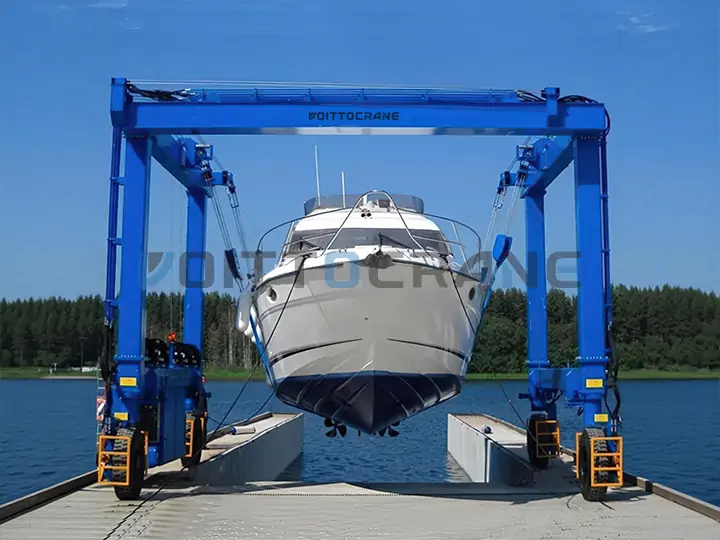
The main difference between yacht hoists and other marine lifting systems is that mobile yacht cranes integrate vertical lifting and horizontal transport functions into a single operation. While bridge cranes can perform vertical lifting, they cannot transport vessels horizontally. Gantry cranes can move vessels, but require extremely high positioning accuracy. In contrast, a yacht travel lift seamlessly combines these two functions, making it an ideal choice for shipyards or ship repair facilities where space utilization is critical.
How Does a Yacht Travel Lift Work?
This operating procedure consists of five key steps. First, the user positions the vessel—either manually or via electronic controls—directly beneath the crane’s slings.
Second, the operator controls the yacht travel lift to lower the slings until they make contact with the hull, then applies moderate upward tension to slowly lift the vessel out of the water. Distributing the load across multiple contact points in this manner prevents hull deformation.
Third, once the vessel is suspended out of the water, the user controls the travel system to transport the vessel to the designated area.
Fourth, the operator controls the hoisting system to lower the vessel onto blocks or support frames.
Fifth, the slings are removed, and the crane is returned to its original position, ready for the next vessel’s lifting operation.
Nota: The contact points of the lifting slings determine the maximum safe lifting angle. For a typical fiberglass hull, the angle between the lifting slings and the vertical must be maintained between 60 and 90 degrees. If this angle is exceeded, the load will be concentrated on a smaller area of the hull, posing a risk of structural damage.
Main Types of Yacht Travel Lifts
Yacht handling lifting equipment is typically classified by its structural design and method of operation.
Fixed-Rail Travel Lifts
These systems operate on permanently installed ground rails. The bridge carriage runs along steel rails embedded or laid on the yard surface. Advantages: high stability, minimal deflection under load, and lower maintenance. Disadvantages: high installation costs, inflexible layout, and difficulty of relocation. Best for permanent, high-volume boat yard operations.
Mobile Travel Lifts
This type of system uses rubber tires as its drive mechanism and operates on pre-treated road surfaces. Advantages: flexible positioning, lower installation costs, and the ability to serve multiple work sites. Disadvantages: slightly higher maintenance costs, road surface wear over time, and operations affected by weather conditions. It is best suited for scenarios requiring operational flexibility.
Yacht Travel Lift Pricing and Cost Factors
Prices for mobile yacht cranes vary widely. A basic 20-metric-ton mobile unit costs approximately $200,000, while a 500-metric-ton fixed-rail system equipped with an integrated work platform exceeds $2 million. The purchase price is primarily influenced by the following five factors:
- Capacidad de elevación: For every 50-metric-ton increase in lifting capacity, the base price typically rises by $60,000 to $100,000. Among comparable models, 100-metric-ton equipment generally costs about twice as much as 50-metric-ton equipment.
- Structural Type: Fixed-track systems cost 30% to 50% more than comparable mobile equipment due to site preparation, track laying, and anchoring requirements.
- Level of Automation: Systems equipped with load cells, automatic load monitoring, and wireless remote control capabilities for boat travel lifts incur costs that are $50,000 to $100,000 higher than those of manually operated equipment.
- Regional Supply and Customization Requirements: Custom configurations for specific hull shapes, environmental certifications (such as CE and ATEX), and transportation logistics costs may increase the final cost by 20% to 40%.
- Installation and Site Preparation: Costs for concrete foundations, ground tracks, electrical connections, and operator training typically add $30,000 to $150,000, depending on the shipyard’s infrastructure.
- Operating Costs, while Secondary, are Also Critical: Annual maintenance costs (including hydraulic oil changes, seal replacements, and calibration) typically account for 3% to 5% of the equipment’s purchase price. For a 200-metric-ton crane, the average power consumption per lifting cycle is approximately 30 to 50 kilowatts.


Key Selection Criteria – What Questions to Ask Before Purchasing
Before contacting suppliers, procurement staff should first clarify their procurement needs so that they can conduct targeted procurement negotiations.
Vessel Profile
What is the maximum vessel weight and beam width you expect to handle? Knowing the heaviest and widest boat ensures you select adequate capacity and an appropriate sling span. Many yards underestimate future demand and regret undersizing equipment.
Do you handle lifting operations for special vessel types (such as catamarans, sailboats with ballast keels, and metal-hulled vessels)? We are asking for this information because different vessel types require different sling configurations and load distribution plans.
Operational Tempo and Layout
How many lifting operations are expected per day? The requirements for high-frequency sites (averaging more than 5 lifts per day) are vastly different from those for sites used only 1–2 times per week. The usage frequencies and corresponding duty classes of the two are vastly different. This information is particularly important.
How much usable space is available on-site? Is the layout flexible? Sites with limited space are best suited for mobile cranes with a small turning radius. Sites with ample space can utilize long-distance fixed-rail systems designed to maximize throughput.
Environmental and Regulatory Context
What environmental regulations apply (EU, US, local)? CE Machinery Directive compliance is mandatory in Europe. Some regions require emissions certifications for mobile units with combustion engines.
Do you need operator training and certification? Plan for at least 3–5 days of on-site training and budget for ongoing safety audits.
Travel Lift for Sale – VOITTO Marine Handling Solutions
VOITTO Crane manufactures custom-built yacht travel lifts with lifting capacities ranging from 30 tons to 1,200 tons, serving yacht marinas, shipyards, and marine boat service centers worldwide.
Our equipment features a modular design that can adapt to confined spaces and complex site conditions. Each crane undergoes a load test at 125% of its rated capacity before delivery and comes with comprehensive operator training and local after-sales service support. Whether you operate a high-end superyacht facility or a high-throughput commercial shipyard, our engineering team will work closely with you to determine the optimal lifting capacity, configuration, and level of automation to maximize operational efficiency and reduce total cost of ownership.

Alan
Especialista en Soluciones de Grúas · Voitto Crane
Especializada en soluciones de exportación de grúas puente, grúas pórtico, grúas pluma, grúas portuarias y grúas EOT. Más de 10 años ayudando a clientes de todo el mundo con asesoramiento preventa, selección de capacidad y configuraciones específicas para cada emplazamiento.
PREGUNTAS FRECUENTES
How long does it take to lift and transport a boat?
A typical lift cycle takes 15–25 minutes: positioning (5 min), descent into water (2 min), sling engagement (3 min), lift to clear height (8 min), transport to storage area (5 min), and lowering (5 min). Experienced operators reduce this time through familiarity with your yard layout and vessel types.
What maintenance does a yacht travel lift require?
Annual maintenance includes hydraulic fluid analysis and replacement (every 2,000 operating hours), seal inspections, load cell calibration, and rust treatment on structural steel. Fixed-rail systems require rail cleaning and lubrication every 6 months. Mobile units need tire or track inspection and brake servicing annually. Budget 20–30 service hours per year for a 100-ton unit.
Can a yacht travel lift operate in wet or cold weather?
Light rain and cool temperatures don’t prevent operation; systems are sealed for weather resistance. Extreme conditions (heavy snow, ice, temperatures below –10°C or above 50°C) may limit operation or require equipment modification. Consult your supplier for regional climate specifications during procurement.
What is the typical service life of a yacht travel lift?
With proper maintenance, the equipment can operate reliably for 20 to 25 years. Key components—such as hydraulic cylinders, motors, and load cells—may need to be replaced after 15 to 20 years. Planning for component replacement or major overhauls around the 12- to 15-year mark can extend the equipment’s overall service life. Although some shipyards are still operating first-generation systems from the 1990s, this typically requires specialized after-sales technical support.
How do I know if a mobile or fixed-rail system is right for my yard?
Purchasing specialists can request an on-site assessment from suppliers. Suppliers will analyze the size of your shipyard, vessel throughput, site conditions, and future expansion plans to recommend the optimal configuration. Most suppliers will provide a cost-benefit analysis comparing mobile and fixed solutions tailored to your specific circumstances.


 English
  Español
  Português
  العربية
  Français
  Русский