Most procurement teams get the lifting capacity number wrong — not because they can’t read a nameplate, but because they only look at the nameplate. Crane lifting capacity is not a single figure. It’s the result of at least four interacting variables: the weight of your heaviest load, the rigging and hook weight added on top of it, the duty class your operation demands, and the span your facility requires. Miss any one of those, and you’ll either under-specify a crane that fails early or over-specify one and spend money the project didn’t need.
This guide is written for procurement managers and plant engineers sourcing industrial overhead cranes, gantry cranes, and EOT cranes. It walks through how rated lifting capacity is defined, what actually reduces it in real operating conditions, how to calculate the tonnage you need before you contact a supplier, and how Voitto Crane’s product ranges map to those requirements.
If you already know your load weight and just need a quick product reference, jump to the capacity selection table in the section below.
- 1 Quick Reference: Voitto Crane Lifting Capacity by Product Type
- 2 What Crane Lifting Capacity Actually Means
- 3 The Four Variables That Determine the Tonnage You Actually Need
- 4 Selecting Between Crane Types for Your Required Tonnage
- 5 Certifications and Compliance for Imported Cranes
- 6 Common Lifting Capacity Specification Errors — and How to Avoid Them
- 7 Заключение
-
8
ЧАСТО ЗАДАВАЕМЫЕ ВОПРОСЫ
- 8.1 Q1:What is crane lifting capacity and how is it measured?
- 8.2 Q2:How do I calculate the crane lifting capacity I need?
- 8.3 Q3:Does span affect crane lifting capacity?
- 8.4 Q4:What is the difference between duty class M4 and M6 for overhead cranes?
- 8.5 Q5:What certifications should I require when importing a crane from China?
Quick Reference: Voitto Crane Lifting Capacity by Product Type
| Тип крана | Lifting Capacity Range | Типичный диапазон | Primary Use |
|---|---|---|---|
| Подвесной кран | 1–10 ton | 3-16 m | Assembly lines, light workshops |
| Однобалочный подвесной кран | 1–32 тонны | 7.5-31.5 m | Общее производство, складское хозяйство |
| Двухбалочный подвесной кран | 5–800 ton | 10-50 m | Heavy industry, steel, power plants |
| Кран EOT | 1–800 ton | 7.5-31.5 m | Multi-shift industrial operations |
| Сталепрокатный кран | 5–500 тонн | 7.5-31.5 m | Foundries, metallurgy, rolling mills |
| Однобалочный козловой кран | 1–32 тонны | 5-35 m | Outdoor yards, precast concrete |
| KBK Light Crane | < 5 ton | 0.7–12 m | Workstation handling, precision assembly |
| Jib Crane (Floor Mounted) | 1–10 ton | Boom: up to 6 m | Fixed-point repetitive lifts |
Capacity figures are published specifications from Voitto Crane product pages. Confirm exact tonnage for your configuration with the engineering team.
Получить цитатуWhat Crane Lifting Capacity Actually Means
Rated Capacity vs. Working Load — They Are Not the Same Number
Crane lifting capacity — also called rated capacity or Safe Working Load (SWL) — is the maximum load a crane is designed to handle under its specified operating conditions, per Классификация кранов по стандарту ISO 4301 and FEM design rules. That rated figure assumes a specific span, hook speed, duty class, and ambient temperature range. Change any one of those conditions and the effective working load changes with it.
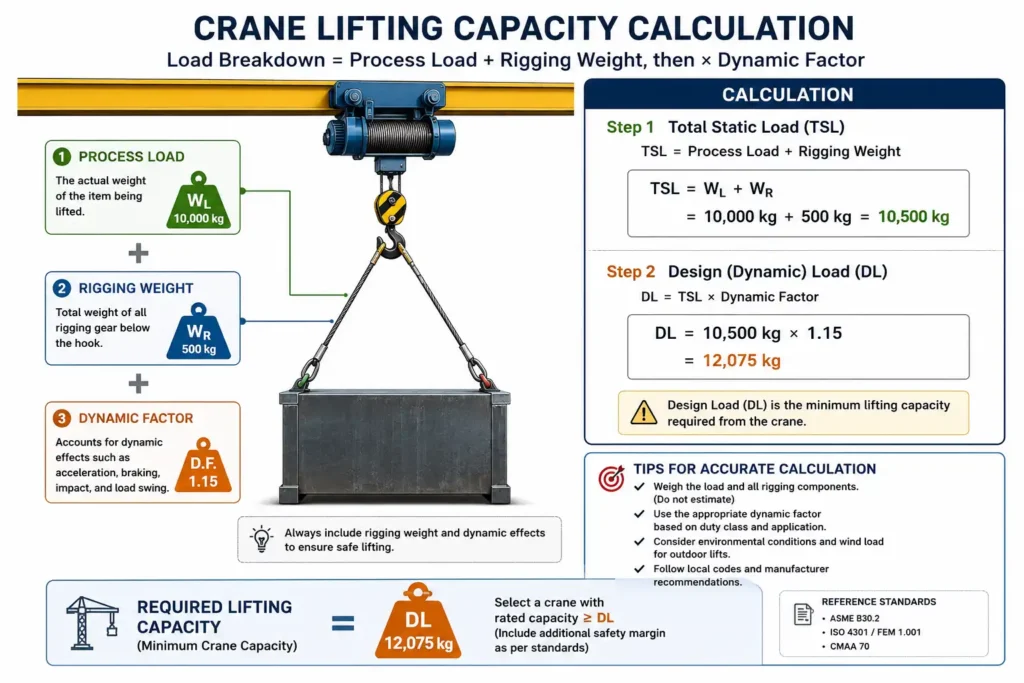
The critical distinction buyers miss: rated capacity is measured at the hook in a defined test configuration. In actual service, two additions eat into that headline number before a single kilogram of real load is applied. First, all rigging — slings, shackles, spreader bars, lifting beams — adds deadweight that counts against the rated capacity. A spreader beam for a 20-ton load can weigh 800–2,000 kg depending on its span. Second, in multi-leg sling arrangements, the vertical component of sling force is always less than the total sling tension, which means rigging efficiency must be calculated for the actual lift angle. The practical result: if your heaviest process load is 18 tons, and your rigging package weighs 1.2 tons, you need a crane rated for at least 19.2 tons before you apply any safety margin.
The Safety Factor Calculation Every Buyer Should Run
Industry practice under FEM 1.001 and ISO 4301 requires that the crane’s rated capacity exceed the sum of process load plus rigging weight, with an additional design safety margin built into the crane’s structural calculations. For procurement purposes, the working rule is straightforward:
Minimum rated capacity = (heaviest process load + rigging weight) × 1.1–1.25
The multiplier range depends on the application. Routine lifts in stable conditions use 1.1. Lifts involving dynamic loading — such as grab bucket operations, magnet lifts, or rapid cycle foundry work — require 1.25 or higher because impact forces transiently exceed static load weight. A 20-ton casting lifted with a magnet in a steel plant does not behave like a 20-ton static load; the inertia of acceleration and deceleration adds momentary load spikes that the structure must absorb without yielding.
The Four Variables That Determine the Tonnage You Actually Need
How Span Reduces Effective Lifting Capacity
Span — the distance between runway rails — is the single most commonly overlooked capacity variable in procurement. This matters because the bending moment acting on a crane girder increases with the square of span length. A crane rated for 20 tons at a 12-meter span is structurally different from a 20-ton crane at a 28-meter span, even though both carry the same nameplate rating.
In practice, as span increases, the girder must either be made heavier (increasing dead load and cost) or the rated lifting capacity is specified lower for the same structural cross-section. When requesting quotations, always specify your rail-to-rail span first, before asking for a capacity figure — the capacity at your span is the number that matters, not the category maximum published in a product brochure.
A rough industry reference for single girder overhead cranes: for spans above 22 meters, confirm with the manufacturer whether the published rated capacity applies, or whether a custom girder design is required. At Voitto Crane, single girder overhead cranes cover spans up to 31.5 meters, and double girder configurations extend to 50 meters — but capacity confirmation at specific span is always part of the engineering review.
Duty Class: The Variable That Determines Long-Term Reliability
Duty class is the second variable buyers most often under-specify, and the consequences tend to appear not at commissioning but at the 18-month mark. ISO 4301 classifies crane operating regimes from A1 (very light, infrequent use) through A8 (continuous heavy-duty operation). FEM 1.001 uses an equivalent system of M1–M8. The duty class governs the fatigue life of structural members, the selection of motor and gearbox, and the required inspection intervals.
The common procurement error: buyers specify based on their current average lift frequency and ignore peak demand. An automotive assembly line that runs 6 lifts per hour on a typical shift but reaches 14 lifts per hour during model changeover will experience fatigue loading at peak, not average, rate. If the crane is specified for A4/M4 based on average throughput but the actual peak load cycle belongs in A5–A6, structural fatigue will arrive years ahead of schedule.
As a starting-point reference:
- General manufacturing / warehousing (1–5 lifts/hour, 1 shift): A3–A4 / M3–M4
- Automotive / heavy production (6–10 lifts/hour, 2 shifts): A5 / M5
- Steel mill, foundry, continuous process (>10 lifts/hour, 3 shifts): A6–A7 / M6–M7
- Magnet or grab bucket operations, steelworks: A7–A8 / M7–M8
Voitto Crane’s Steel Mill Crane series is specifically designed for the A6–A8 duty range, with capacities from 5 to 500 tons and structural detailing matched to high-cycle foundry and rolling mill environments.
Hook Height and Lift Envelope
Hook height — the maximum vertical distance from floor level to the fully raised hook — determines whether a crane can actually perform the intended lift in your building. The calculation requires three inputs: the height of the tallest object being lifted, the height of the lifting point above the load (rigging height), and the clearance required to move the load over any obstruction in the travel path.
A common planning error in precast concrete facilities: the required hook height is calculated for the load alone, and then the actual pour mold turns out to be 40 cm taller than the design value used, eliminating the clearance to the roof structure. For any new facility, specify hook height with a 15–20% buffer over the calculated minimum. For existing facilities, measure the actual clear height to the underside of the runway beam before specifying.
Voitto Crane’s single girder overhead cranes offer lifting heights from 6 to 30 meters; double girder configurations reach 40 meters for applications such as power plant turbine halls and large-span steel fabrication shops.
Load Distribution and Center of Gravity
The final variable that rarely appears in procurement specifications is center of gravity (COG) offset. Most cranes are rated for a load suspended from a single hook at or near the geometric center of the load. When a load’s COG is not at its geometric center — which is common with machine tools, dies, and structural fabrications — the crane hoist must be positioned off-center to keep the load level. This imposes asymmetric loading on the bridge girder and, in double girder cranes, on the end trucks.
For loads with a COG offset exceeding 5% of the load’s plan dimension, inform the crane manufacturer during the specification phase. The engineering team will account for the asymmetric load case in the structural design. Ignoring this and centering the hoist geometrically results in the load hanging at an angle, creating lateral forces on the runway rail that the system was not designed to absorb.
Selecting Between Crane Types for Your Required Tonnage
When Single Girder Overhead Cranes Are the Right Choice
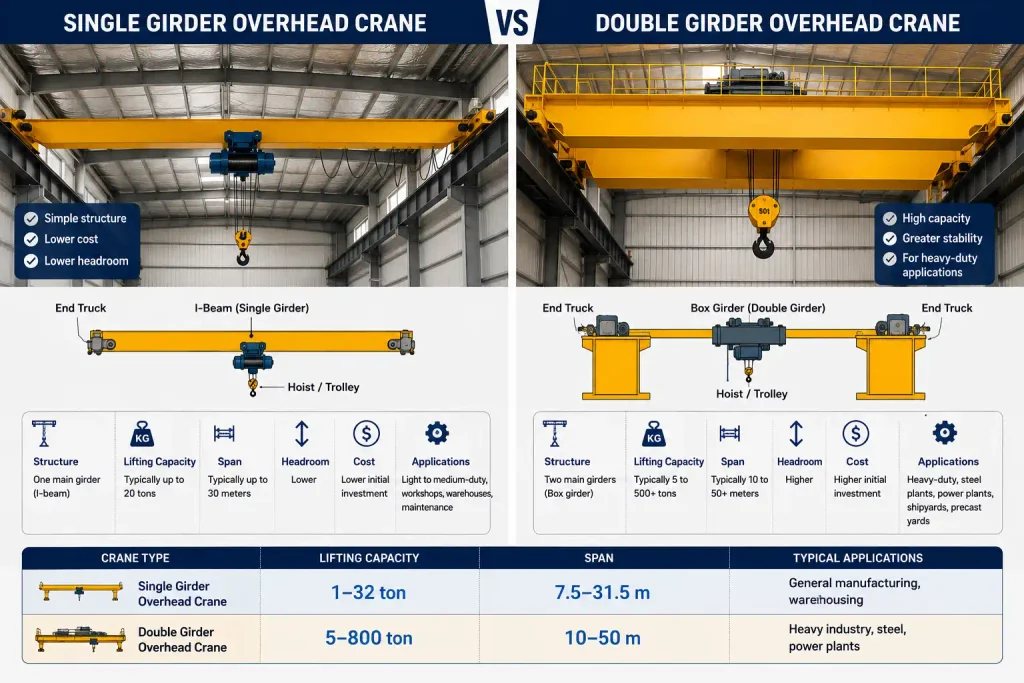
Single girder overhead cranes deliver the best cost-to-performance ratio for loads under 20 tons in spans up to approximately 22 meters, provided the facility’s roof structure can support the runway beam loads. The single girder configuration suspends the hoist from the bottom flange of the bridge beam, which means the hook’s highest position is limited by the beam depth — typically 300–600 mm below the top of the runway rail. This reduces the usable hook height compared to a double girder crane of equal span.
For general manufacturing, warehousing, paper mills, and light assembly, single girder cranes in the 5–16 ton range cover the majority of lifting requirements at capital costs typically ranging from $8,000 to $65,000 depending on span, height, and controls configuration.
When Double Girder Configuration Becomes Necessary
Double girder cranes become the right choice when any of the following conditions apply: load exceeds 20 tons consistently; span exceeds 22 meters; duty class is A5 or above; or the application requires an under-hung trolley for maximum hook height. The double girder bridge allows the hoist to travel on top of the girder rails rather than hanging from the bottom flange, which recovers 400–800 mm of hook height at a given building clearance.
For heavy industrial applications — steel mills, power stations, large fabrication shops — double girder cranes with capacities from 50 tons to 500+ tons are the standard solution. At these tonnages, single girder construction is not viable; the structural demands of the load require the dual load path of a double girder bridge. Market pricing for heavy double girder cranes in the 100–300 ton range typically starts around $180,000 and scales significantly with span and duty class.
Gantry Cranes for Outdoor and Yard Applications
Where overhead runway structures are not available — outdoor yards, precast concrete plants, fabrication yards — gantry cranes provide the same hook-and-travel functionality on legs running on surface rails. Voitto Crane’s single girder gantry configuration covers 1–32 tons across spans up to 35 meters, making it a practical choice for precast panel yards and outdoor storage operations.
The key specification difference from overhead cranes: gantry cranes must be rated for wind loading when used outdoors. Specify the design wind speed for your location during procurement. Wind loading in exposed coastal or open-plain sites can require significant additional structural reinforcement above what would be needed for an indoor installation of equivalent capacity.
Certifications and Compliance for Imported Cranes
Certification is not a paperwork formality — it is a procurement gate that determines whether the equipment can legally operate in your facility and whether your insurance covers incidents involving it. This section gives you a practical document checklist for evaluating a Chinese crane manufacturer’s compliance credentials.
What Certifications to Require and Why
CE Marking and EU Machinery Directive (2006/42/EC): Required for all cranes installed in European Union or EEA member states. CE marking means the manufacturer has self-declared conformity with applicable EU harmonized standards, including EN 14492-2 (power-driven hoists and cranes). To verify, require the Декларация соответствия ЕС — a signed document naming the specific directive, the harmonized standards applied, and the authorized representative within the EU. CE marking without this document is commercially worthless.
FEM Design Rules: FEM 1.001 (Fédération Européenne de la Manutention) establishes the structural and mechanical design framework for industrial cranes. A supplier claiming FEM compliance should be able to explain which duty class your crane was designed to (M3 through M8) and provide calculation documentation on request. FEM compliance is not certified by a third party in the way ISO is; it is an engineering framework the manufacturer applies during design.
ISO 4301 Crane Classification: The ISO standard for classifying cranes by use category (A1–A8), consistent with FEM. Verify that the duty class stated in the technical proposal matches the classification the structural calculations were based on.
ISO 9001 Quality Management: Ask for the manufacturer’s ISO 9001 certificate, including the scope statement and the certifying body’s name. Verify the certificate on the certifying body’s public registry — expired or fraudulent certificates are not uncommon in commodity manufacturing.
EAC (Eurasian Conformity) / TR CU: Required for installations in Russia, Kazakhstan, Belarus, and other Eurasian Economic Union member states. EAC certification for hoisting equipment is handled under TR CU 010/2011 (Safety of Machines and Equipment) and TR CU 004/2011 (Electrical Safety). Unlike CE self-declaration, EAC requires third-party certification by an accredited EAC certification body.
OSHA Compliance (USA): The US does not issue a single “crane certification” at the equipment level. Instead, cranes must be designed, installed, and operated in conformance with applicable ASME B30 standards (B30.2 for overhead cranes, B30.11 for monorails) and subject to annual third-party inspection. Voitto Crane equipment intended for the US market should be supplied with documentation confirming ASME B30 design compliance.
The Document Checklist to Send Every Supplier
Before placing an order, request in writing:
- EC Declaration of Conformity (if CE-marked)
- Load test certificate (typically at 125% of rated capacity)
- ISO 9001 certificate with certifying body contact
- Technical calculation package (structural and mechanical)
- Overload protection device test certificate
- List of safety devices fitted (overload limiter, travel limits, anti-collision if applicable)
Voitto Crane holds CE certification and ISO 9001 quality management system certification. Request documentation specific to your order configuration from the sales engineering team at the quotation stage.

Алан
Специалист по крановым решениям · Voitto Crane
Специализируется на производстве мостовых кранов, козловых кранов, стреловых кранов, портовых кранов и кранов EOT. Более 10 лет помогает глобальным клиентам в проведении предпродажных консультаций, выборе грузоподъемности и конфигураций для конкретного объекта.
Common Lifting Capacity Specification Errors — and How to Avoid Them
Under-Specifying Duty Class Costs More Than the Saving
The most financially damaging specification error is selecting a duty class that matches the average workload but not the peak. A crane specified for M4 duty running at M5 demand will not fail immediately — it will degrade progressively. Fatigue cracks typically appear in welded joints at the end truck, the hoist rope drum flange, or the girder web at approximately 40–60% of the designed fatigue life when consistently operated above the specified duty class. A crane purchased to save $12,000 in specification cost, then requiring a major structural repair at year three, does not produce the saving it appeared to.
The correct approach: determine your peak lift frequency over any two-hour window, not your daily average. Use that peak rate to select the duty class. The incremental cost of specifying M5 instead of M4, or M6 instead of M5, is rarely more than 8–15% of total crane cost for a standard configuration.
Ignoring Rigging Weight Shrinks Your Usable Capacity
The standard industry allowance when rigging weights are not yet confirmed: add 10% of process load weight as a provisional rigging allowance, then review against the actual rigging package before finalizing the order.
Confusing Rated Capacity with Actual Hook Height
A 20-ton crane with a 12-meter lifting height does not lift 20 tons to 12 meters in every configuration. At maximum hook height, the hoist rope is fully unwound and the system is at its rated condition. But at minimum hook height (drum fully wound, hook at lowest position), some hoist designs apply a drum fleet angle that reduces rated capacity by 5–10% — a detail confirmed in the hoist’s technical data sheet. For applications where lifts regularly occur at both extremes of hook travel, verify the capacity curve across the full height range with the manufacturer.
Заключение
Crane lifting capacity is not a single number — it’s the intersection of your heaviest process load, your rigging weight, your operating duty class, and the span your facility demands. Specify all four correctly before requesting a quotation, and you’ll receive a crane that performs as expected for its full design life. Specify only the load weight and leave the rest to assumption, and you create the conditions for either an undersized system that fails early or an oversized one that cost more than the project needed.
Three actions to take before you contact any crane supplier:
- Calculate your actual required capacity: (heaviest load + estimated rigging weight) × 1.1 to 1.25 depending on lift dynamics
- Determine your duty class from peak — not average — lift frequency
- Measure or confirm your rail-to-rail span and the clear hook height your application requires
Voitto Crane manufactures overhead cranes, gantry cranes, EOT cranes, and steel mill cranes across the full industrial capacity range from 1 ton to 800 tons, with CE and ISO 9001 certification and over 30 years of export experience. Contact the engineering team with your four specification parameters for a matched product recommendation.
Алан
Специалист по крановым решениям · Voitto Crane
Специализируется на производстве мостовых кранов, козловых кранов, стреловых кранов, портовых кранов и кранов EOT. Более 10 лет помогает глобальным клиентам в проведении предпродажных консультаций, выборе грузоподъемности и конфигураций для конкретного объекта.
ЧАСТО ЗАДАВАЕМЫЕ ВОПРОСЫ
Q1:What is crane lifting capacity and how is it measured?
Crane lifting capacity — also called Safe Working Load (SWL) or rated capacity — is the maximum load a crane can safely handle under its specified design conditions, as classified under ISO 4301. It is determined through structural design calculation and confirmed by a static and dynamic load test at 110–125% of rated capacity before delivery. The figure on the crane nameplate applies to a specific span, duty class, and operating configuration; operating outside those parameters can reduce the actual safe load.
Q2:How do I calculate the crane lifting capacity I need?
Start with the weight of your heaviest single lift (the process load). Add the estimated weight of all rigging equipment — slings, shackles, spreader beams, or magnets. Multiply the total by 1.1 for standard static lifts or 1.25 for dynamic operations such as grab bucket or magnet work. The result is the minimum rated capacity you should specify. Then confirm with the manufacturer whether that capacity is available at your required span and hook height.
Q3:Does span affect crane lifting capacity?
Yes — and it’s one of the most commonly overlooked specification variables. As span increases, the bending moment on the bridge girder increases with the square of span length. This means a crane capable of 20 tons at a 12-meter span requires a heavier or redesigned girder to achieve the same 20-ton rating at 24 meters. Always specify your rail-to-rail span upfront. At spans above 22 meters for single girder configurations, confirm capacity at your exact span with the manufacturer.
Q4:What is the difference between duty class M4 and M6 for overhead cranes?
Duty class (FEM M-class or ISO A-class) defines how intensively a crane is designed to work over its service life. M4 (ISO A4) is appropriate for moderate-use operations — roughly 3–6 lifts per hour, one to two shifts per day. M6 (ISO A6) is designed for heavy industrial continuous use — more than 10 lifts per hour across multiple shifts. The structural members, welds, motor sizing, and gearbox design all differ between these classes. Operating an M4 crane at M6 intensity will cause premature fatigue failure, typically within 3–5 years rather than the 15–20 year design life.
Q5:What certifications should I require when importing a crane from China?
At minimum, require: CE marking with a signed EC Declaration of Conformity (for EU/EEA installations), an overload and load test certificate, and a valid ISO 9001 certificate from the manufacturer. For Russia and EAC-zone countries, also require TR CU 010/2011 EAC certification from an accredited third-party body. For the US, confirm ASME B30 design compliance. Always verify ISO 9001 certificates directly with the issuing certification body — the certificate number should be traceable on the certifier’s public registry.




 English
  Español
  Português
  العربية
  Français
  Русский