блог

gantry crane capacity
12 November 2026

Gantry Crane Capacity: Understanding Load Ratings and How to Choose the Right Capacity

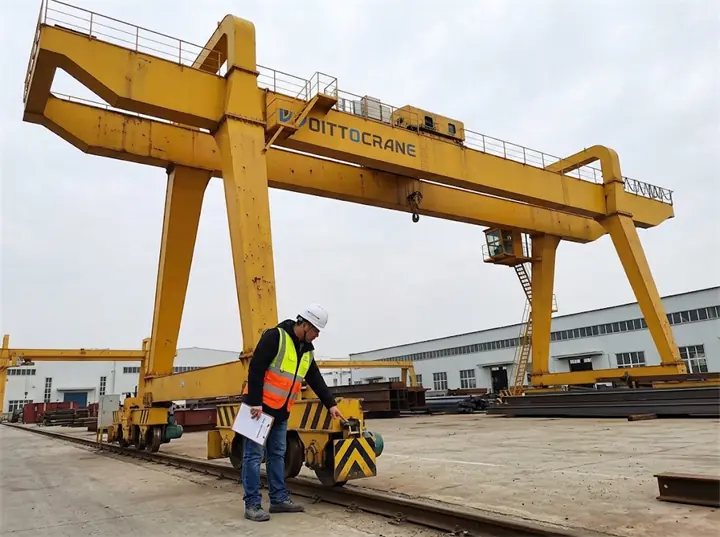
Gantry crane capacity is the maximum load a gantry crane may lift at the hook, as set by its crane manufacturer. Rated capacity depends on span, girder structure, duty class, and operating environment. When determining the appropriate specifications, the procurement team must calculate the total suspended load (i.e., the payload plus the combined weight of the lifting beam, slings, and rigging), and technical personnel must ultimately confirm the rated load. Next, this guide will introduce the calculation methods, key influencing factors, and common lifting capacity ranges related to gantry crane capacity. What Is Gantry Crane Capacity? Gantry crane capacity is the maximum load a gantry crane can lift safely under defined conditions of span, lifting height, duty class, and environment. The rating plate states this gantry crane’s lifting capacity, and the designer sizes the girder, legs, hoist, brakes, and wheels around it. Buyers often confuse three different numbers: the product weight, the weight on the hook, and the crane’s rating. Rated Capacity vs. Actual Lifting Load Rated capacity is a fixed design limit, while the actual lifting load changes with…

ЧИТАТЬ ДАЛЬШЕ
single vs double crane hook
12 November 2026

Single vs Double Crane Hook: DIN 15401/15402 Standards & Engineering Guide

When users choose between a single crane hook (DIN 15401) and a double ramshorn crane hook (compliant with DIN 15402), their decision depends primarily on the rated lifting capacity, the symmetry of the load distribution on the lifting device, and the crane’s duty class. This single vs double crane hook guide compares load paths, forged and laminated construction, and DIN strength grades M, P, S, T, and V. For the broader overhead crane hook and crane hook set assembly topic, including SWL and replacement practice, read our core guide first, then use this article for geometry, stress, and standards decisions. Single Hook vs. Double (Ramshorn) Crane Hook: Mechanics & Tonnage Boundaries Single hooks (DIN 15401) carry the load on one saddle, so they rig quickly and have capacities of about 80–100 tons. Ramshorn double hooks (DIN 15402) split the load across two symmetrical saddles, which lowers the bending moment and weight per ton, and they dominate 100–500 t double-girder lifts. Single Crane Hooks (DIN 15401) — Eccentric Load Path & Fast Rigging The single hook is the universal standard up…

ЧИТАТЬ ДАЛЬШЕ
изоляционный мостовой кран
11 November 2026

QY Insulation Overhead Crane: Voltage Classes, Insulation Points and Selection Guide for Power Substations and Transformer Workshops

A QY insulation overhead crane is a double-girder bridge crane with multiple built-in electrical isolation layers that prevent stray current from traveling through a lifted load back to the crane structure and operator. Market prices for factory-direct units typically range from $45,000 to $180,000+, depending on capacity (5–50 t), span (10.5–31.5 m), and the number of insulation layers specified. For power industry buyers — substation maintenance teams, transformer workshop managers, and EPC project engineers — the choice is not simply “do I need an insulated crane?” but rather which voltage class, which duty rating, and how many insulation points the application actually demands. The underlying hazard drives every specification decision: in electrolytic aluminum smelting halls, bus-bars carry 100,000–300,000 amperes of DC current at low voltage; in a 110 kV or 220 kV substation, the threat is high-voltage AC induced potential. These are different electrical environments, and they call for different insulation designs. Most supplier pages describe QY cranes only for “nonferrous metal smelting” — this guide covers both application families, so you can match the right spec to your site…

ЧИТАТЬ ДАЛЬШЕ
однобалочный мостовой кран
11 November 2026

Overhead Crane Lead Time: How Long It Really Takes From Order to First Lift

Overhead crane lead time from a Chinese manufacturer typically runs 20–70 days to complete production, then adds 1–6 weeks of sea freight and roughly 2–3 weeks for port clearance and inland delivery. Standard single girder units sit at the short end. Customized double girder and heavy-duty cranes sit at the long end. The problem is that two suppliers can quote “30 days” and mean different things. One counts from drawing approval, the other from the signed contract. One includes pre-shipment testing, the other stops at the factory gate. A buyer comparing quotes on the headline number alone ends up comparing different clocks. This guide breaks the overhead crane lead time into the stages that actually add up, shows typical ranges for each crane type Voitto Crane builds, and lists the documents and questions that turn a vague delivery promise into a schedule you can plan around. Quick Reference: Typical Production Time by Crane Type The ranges below are typical published windows for Chinese manufacturers, counted from confirmed specifications and approved drawings to ready-to-ship. They exclude shipping and installation. Exact slots…

ЧИТАТЬ ДАЛЬШЕ
truss gantry crane vs box gantry crane
28 October 2026

Козловой кран с ферменной конструкцией против козлового крана коробчатой формы: инженерное сравнение, анализ затрат и руководство по выбору для использования на открытом воздухе.

A truss gantry crane outperforms a box-girder gantry crane on high-wind coastal or mountain sites, on spans beyond 25–30 meters, in temporary precast concrete yards, and wherever soil bearing capacity is low. The open lattice cuts structural deadweight by 20%–35%, removes 60%+ of the windward surface area, and can lower total project cost (crane plus civil runway foundation) by 15%–30%. Those savings come from physics, not from thinner steel: bending stress is converted into axial force in the truss members, and crosswind passes through the structure instead of loading it. Starting with the key factors in deciding on the purchase of outdoor lifting equipment, this guide compares these two structural types, including wind load characteristics, wheel load and foundation costs, deflection under long spans, duty classes, corrosion protection and maintenance, and equipment relocation. In addition, this guide identifies specific operating conditions for which truss gantry cranes are not suitable. Please continue reading: Why Triangular Space Truss Design Changes Outdoor Lifting Economics A truss girder is built from angle steel or structural tubing arranged in triangulated panels. Each member carries mainly…

ЧИТАТЬ ДАЛЬШЕ
оценка рисков козлового крана
23 октября 2026 г.

Оценка рисков при работе с козловым краном: опасности на уровне земли, шаблон матрицы и инженерные средства контроля.

A gantry crane risk assessment has to start at the floor. Its outriggers, base beams, wheels, and power supply systems are all located at ground level, sharing the same space as pedestrians and forklifts, and are subject to environmental factors. Mobile equipment suffers from instability in its casters; outdoor equipment faces wind loads; and long-span equipment may experience outrigger skew. Precisely because of these ground-level hazards, one of the most common compliance errors often comes at a high cost: directly “copying and pasting” the risk assessment plan for indoor overhead cranes onto gantry cranes. While this approach may pass an internal audit, it overlooks nearly all of the genuine safety hazards surrounding gantry cranes that pose a threat to personnel. In the following sections, this guide provides a framework for identifying gantry crane hazards, a ready-to-use eight-row risk matrix, and in-depth analyses for different types of equipment. Additionally, the guide introduces various engineering controls that can fundamentally reduce risk levels without relying solely on operator vigilance. Gantry Crane vs. Overhead Bridge Crane Risk Profiles: Why the Difference Matters Bridge cranes…

ЧИТАТЬ ДАЛЬШЕ
how to use a gantry crane
22 October 2026

Как пользоваться козловым краном: пошаговая инструкция, стандартные операционные процедуры по технике безопасности и лучшие практики.

Knowing how to use a gantry crane comes down to a handful of habits repeated on every lift. Improper operation on the production floor often manifests as swinging loads that pose safety risks; damage to wire rope guides caused by lateral pulling; and deformation of the crane structure, which can lead to cracks at the toe of the welds where the outriggers connect to the main girder several months later. The vast majority of these failures stem from operators’ technical shortcomings, rather than an insufficient rated lifting capacity of the crane itself. This guide covers the differences between portable shop equipment and heavy-duty industrial equipment, a 6-step standard operating procedure (SOP), outdoor wind protection measures, the selection of control modes, and the five most common mistakes made by operators—mistakes that often result in high repair costs and downtime losses for plants. This guide is specifically designed for operators, plant managers, and Environmental, Health, and Safety (EHS) directors, and its content complies with relevant standards and classification requirements such as OSHA 1910.179, ASME B30.2/B30.17, and FEM/ISO. Know Your Equipment First: Portable…

ЧИТАТЬ ДАЛЬШЕ
Двухбалочный подвесной кран
28 October 2026

Overhead and Gantry Cranes for Copper and Gold Mining in Uzbekistan: Concentrator, Smelter and Tankhouse Selection Guide

For copper and gold mining facilities in Uzbekistan — including the Almalyk copper concentrator expansion and Muruntau gold mine operations in Navoi — overhead crane requirements split cleanly across four distinct working environments: ore processing, smelter ladle handling, electrolytic tankhouse, and open-pit stockyard. Each environment defines a different crane type, different duty class, and different engineering specification. Choosing the wrong configuration for any one bay does not just create a maintenance headache — it creates a compliance failure or a production stoppage in an environment where shutdowns carry serious cost. This guide maps each working environment to the crane type that actually fits it, explains the engineering logic behind each selection, and covers the certification requirements that Uzbekistan-bound project orders need to address. Quick Reference: Crane Configuration by Working Environment Working Environment Recommended Crane Type Duty Class Capacity Range Price Reference Concentrator — mill overhaul QD Double Girder Overhead Crane A5–A6 20–100T $35,000–$250,000 Smelter — ladle handling Steel Mill Crane (Ladle / Casting) A7–A8 50–320T $120,000–$600,000+ Tankhouse — copper electrolysis QY Insulation Overhead Crane A7–A8 5–100T $30,000–$200,000 Open-pit stockyard —…

ЧИТАТЬ ДАЛЬШЕ
Example of the wheelbase for a bridge crane with a four-wheel configuration on one side
23 октября 2026 г.

Crane Span,Gauge & Base Distance: Meaning and Differences

Crane span, gauge and base distance are three different horizontal dimensions. Span is the distance between runway rail centerlines, gauge is the rail-to-rail distance of a travelling mechanism, and base distance is the spacing between support centerlines along the direction of travel. The three terms are easily confused. Some suppliers use “gauge” and “wheelbase” interchangeably, and some treat span and trolley gauge as the same thing. In reality each one measures a different direction on a different part of the crane. This guide defines each term, compares them side by side, shows how base distance is read on layouts from two to twelve wheels, and explains the reference plane all of them are measured from. After reading, you should be able to check a crane drawing and say which dimension is which. Base distance (symbol b or B) is the horizontal distance between a crane’s support centerlines, measured parallel to its direction of travel, as defined in crane terminology standards such as GB/T 6974.1. What Do Span, Gauge and Base Distance Mean? Span (S): The Distance Between Rail Centerlines Span…

ЧИТАТЬ ДАЛЬШЕ
Crane Main Beam Deflection
20 October 2026

Crane Main Beam Deflection: Causes, Effects and How to Fix It

Crane main beam deflection is the permanent downward sag of a main beam below its original upward camber. Once the main beam drops below the horizontal line at mid-span under rated load, it generally needs straightening or retirement. For buyers and maintenance leads, the problem is rarely visible at first. The trolley still runs and the hoist still lifts, yet the main beam has quietly lost its built-in arch. By the time the trolley starts to struggle uphill toward mid-span or wear grooves appear on the rail, the damage is already well advanced. This guide explains what crane main beam deflection is, the six causes behind it, what it does to the trolley, rails and webs, and how flame straightening corrects it. It also covers the repair mistakes that make the main beam worse. What Crane Main Beam Deflection Really Means Camber vs. deflection: the definition Crane main beam deflection is the permanent downward set of a main beam that has lost its designed upward camber and may bow below the horizontal, as treated in crane design codes such as…

ЧИТАТЬ ДАЛЬШЕ
Crane Model Codes Explained_ QD, MG, LD, LX & More
14 October 2026

Crane Model Codes Explained: QD, MG, LD, LX & More (Complete Chart)

If you have ever received a crane quotation with codes like QD, MG or LX, you may have wondered what the letters mean. Chinese crane manufacturers use short letter codes to describe the crane type, structure and hoisting attachment. Once you know the logic, a model name tells you the basics at a glance. This guide explains how crane model codes work, gives a full reference chart for the most common types, and shows how to use the codes when comparing suppliers. Are Crane Model Codes a Mandatory Standard? No. Older Chinese standards, such as GB/T 14405-93 for overhead cranes and GB/T 14406-93 for gantry cranes, did define code tables. Those standards have been withdrawn. Newer versions, including GB/T 14405-2011 and GB/T 14406-2011, no longer include a model-code system. Today, under China’s TSG 51-2023 safety technical code for lifting equipment, a crane “model” simply identifies cranes of the same type that may differ in main parameters. The code is made up of letters describing the product type, main structure and mechanism layout, and each manufacturer defines its own model code.…

ЧИТАТЬ ДАЛЬШЕ
how does an electric hoist work
20 October 2026

Как работает электрическая лебедка?

An electric hoist works by using an electric motor and a transmission mechanism to move a wire rope or load chain, which raises or lowers the hook and the load attached to it. The motor produces rotation. A gearbox slows that rotation and increases its turning force. A rope drum or chain sprocket then converts it into straight-line movement of the rope or chain. Other parts keep that movement under control. A brake holds the load when the hoist stops, limit switches restrict hook travel, and many hoists add overload protection. This guide shows how an electric hoist works in the order it happens, from motor to hook. If you want a broader product overview first, read our overview of electric hoist types and uses. How Does an Electric Hoist Work? The easiest way to understand an electric hoist is to follow the path of power transmission from the power source to the load. Electrical Power → Electric Motor → Gearbox → Rope Drum or Chain Sprocket → Wire rope or Load Chain → Hook and Load The above represents…

ЧИТАТЬ ДАЛЬШЕ
Топ