Knowing how to use a gantry crane comes down to a handful of habits repeated on every lift. Improper operation on the production floor often manifests as swinging loads that pose safety risks; damage to wire rope guides caused by lateral pulling; and deformation of the crane structure, which can lead to cracks at the toe of the welds where the outriggers connect to the main girder several months later. The vast majority of these failures stem from operators’ technical shortcomings, rather than an insufficient rated lifting capacity of the crane itself.

Grúa de pórtico portátil

Grúa pórtico monorraíl

Grúa pórtico sobre raíles

Grúa pórtico sobre neumáticos RTG
This guide covers the differences between portable shop equipment and heavy-duty industrial equipment, a 6-step standard operating procedure (SOP), outdoor wind protection measures, the selection of control modes, and the five most common mistakes made by operators—mistakes that often result in high repair costs and downtime losses for plants. This guide is specifically designed for operators, plant managers, and Environmental, Health, and Safety (EHS) directors, and its content complies with relevant standards and classification requirements such as OSHA 1910.179, ASME B30.2/B30.17, and FEM/ISO.
- 1 Know Your Equipment First: Portable Workshop vs. Heavy-Duty Industrial Gantry Cranes
- 2 Phase 1: The 3-Minute Operator Pre-Lift Walkaround
-
3
Phase 2: How to Use a Gantry Crane (6-Step Standard Operating Procedure)
- 3.1 Step 1: Energize the System and Secure the Base or Clear the Track
- 3.2 Step 2: Position the Trolley Directly Over the Load’s Center of Gravity
- 3.3 Step 3: Attach Certified Rigging and Slings
- 3.4 Step 4: Execute the 6-Inch Test Lift (100–150 mm Hold)
- 3.5 Step 5: Smooth Hoisting and Traveling
- 3.6 Step 6: Controlled Lowering and Unhooking
- 4 Phase 3: Post-Operation and Outdoor Windproof Parking Protocols
- 5 Selecting the Right Control Mode for Safer Operation (Pendant vs. Wireless Remote vs. Cabin)
- 6 5 Costly Operator Mistakes That Damage Gantry Cranes (And How Hardware Prevents Them)
- 7 Conclusion: How to Use a Gantry Crane Safely and Efficiently
-
8
PREGUNTAS FRECUENTES
- 8.1 Can you move a gantry crane while it is under load?
- 8.2 Do operators need certification to use a gantry crane?
- 8.3 What wind speed is unsafe for outdoor gantry crane operation?
- 8.4 Why does my gantry crane hoist rope guide keep breaking during operation?
- 8.5 What is the difference between operating an overhead bridge crane and a gantry crane?
Know Your Equipment First: Portable Workshop vs. Heavy-Duty Industrial Gantry Cranes
Operating rules follow the crane’s structure and travel mechanism. A portable gantry on polyurethane casters is positioned by hand. A 40-ton rail-mounted gantry (RMG) travels on motorized wheel groups and needs skew control to keep its legs square. Treat them as different machines with different SOPs.
| Característica | Portable / Mobile Gantry (0.5T–10T) | Trackless Rubber-Tired Gantry (RTG) | Rail-Mounted Gantry (RMG, 10T–500T+) |
|---|---|---|---|
| Mecanismo de desplazamiento | Hand-pushed on polyurethane or steel swivel casters with brakes; some models have motorized drive | Motorized rubber tires with steering; travels on compacted or paved ground | Motorized wheel groups on steel rails; synchronized leg drives with skew detection |
| Moving Under Load Rules | Only if the data plate rates it for travel under load; otherwise prohibited. Always brakes locked while lifting | Permitted at creep speed on firm, level ground with a ground signalman | Permitted at design speed with skew control active and rail clamps released |
| Fuente de alimentación | Manual chain hoist, or electric hoist on single- or three-phase supply | Diesel generator, cable reel, or battery pack | Cable reel or conductor bar, typically 380–690 V three-phase |
| Typical Environment | Workshops, maintenance bays, warehouses | Precast yards, boatyards, container and lumber yards | Steel mills, ports, stockyards, rail terminals, power plants |
Can You Move a Gantry Crane Under Load?


For portable equipment, specific requirements depend on the rated parameters provided by the manufacturer. According to standard operating procedures for portable gantry cranes, the casters’ brakes must remain locked during any lifting operation; they may only be unlocked after the load has been fully set down. Some models allow short-distance movement while the load is suspended (for positioning purposes), but this typically requires a significant reduction in the rated load capacity (to only a fraction of the rated lifting capacity). If the equipment nameplate does not specify a rated load capacity for “movement under load,” moving the equipment while the load is suspended is strictly prohibited.
If moving under load is permitted, be sure to keep the load low and push the equipment at walking speed on a flat, smooth surface. Do not cross ground cracks, drainage grates, or cable trenches. Electric rubber-tired gantry cranes (RTGs) and rail-mounted gantry cranes (RMGs) are designed to operate under load, but their travel speed must not exceed the rated operating speed.
Phase 1: The 3-Minute Operator Pre-Lift Walkaround
This inspection is performed by the operator, not by engineering and technical personnel. The operator must perform this inspection at the start of each shift, before pressing the start button.
Workspace and Runway Clearance
- Mobile equipment: Engage the brakes on all four swivel casters. The operator pushes against each column to ensure the equipment will not slide. At the same time, inspect the floor for cracks, drain openings, or cable trenches.
- Rail-mounted gantry cranes (RMG): The operator should walk along the rail line and clear any pallets, tools, or debris from the tracks. The rail clamps may only be released once the path has been cleared.
- Mark the drop zone and ensure that personnel stay clear of the area directly below the lifting path.
Rigging and Hoist Quick-Check
- Steel wire rope: This component must be properly positioned within the drum groove and must not be loosely coiled, twisted, flattened, or deformed into a “birdcage” shape.
- Rope guide: This component must be in good condition and move freely. If a nylon guide shows cracks or flat wear, or if a cast-iron guide shows chipping, it must be replaced before use.
- Hook: The safety latch must close completely, and the hook opening must not be gaping or twisted.
- Sling: Markings must be clear and legible, and there must be no signs of cutting, broken wires, or melted fibers.
Controls and Limit Switches
With the hook unloaded, the operator should press the “Emergency Stop” button to confirm that all movements have stopped. Verify that the control buttons automatically return to the neutral position when released. Slowly move the hook close to the upper and lower limit switches, respectively, and confirm that each limit switch stops the corresponding movement. Finally, sound the horn and check that the warning light or operational alarm device functions properly.
This walk-around inspection does not replace regular routine inspections. Before putting the equipment into service, be sure to follow the comprehensive Lista de verificación para la inspección de grúas pórtico provided by Voitto Crane and perform the corresponding daily, monthly, and annual inspection procedures. If any non-compliance is found during this walk-around inspection, the “Lockout and Tagout” procedure must be implemented immediately on the crane.
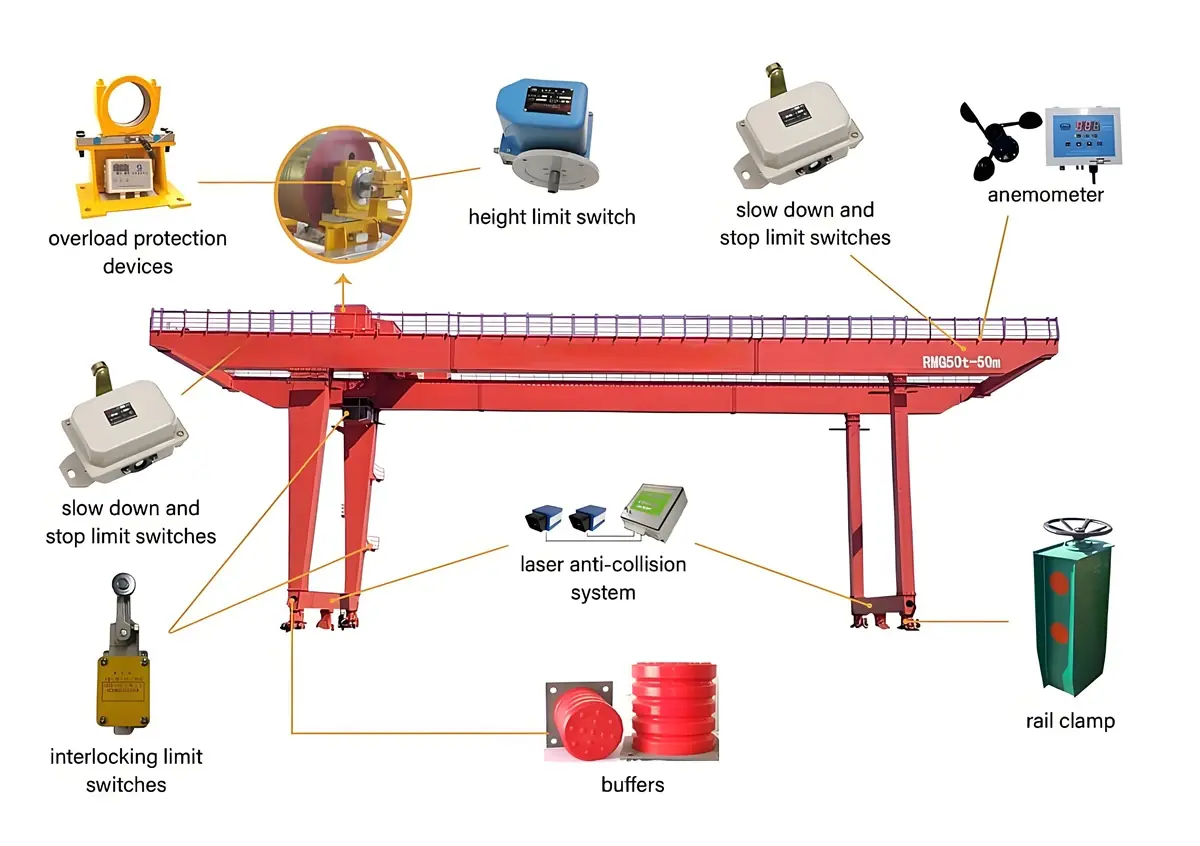
Phase 2: How to Use a Gantry Crane (6-Step Standard Operating Procedure)
Users may use this standard operating procedure for gantry cranes as a reference for workshop training.
Step 1: Energize the System and Secure the Base or Clear the Track
The operator should close the main isolating switch and wait for the control panel to complete its self-test. Sound the horn. For heavy-duty double girder gantry cranes, verify that the rail clamps are released and the wind-proof pins are retracted. For mobile equipment, keep the casters locked before preparing to move the crane.
Step 2: Position the Trolley Directly Over the Load’s Center of Gravity
Any lateral misalignment will cause the lift to become a sideways pull. The load will slide or swing toward the point directly below the hook, and the wire rope will pass through the rope guide and the drum groove at an angle. Before tensioning the wire rope, the hook should be positioned directly above the load’s center of gravity.
Step 3: Attach Certified Rigging and Slings
- Use slings rated for the load and the sling angle. Keep sling angles at 60° or more from horizontal where possible. At 30° from horizontal, tension in each leg is double the share of the load.
- Protect slings from sharp edges with corner protectors.
- Seat the sling in the hook bowl, never on the hook point or the latch.
- Confirm the safety latch is closed before taking weight.
Step 4: Execute the 6-Inch Test Lift (100–150 mm Hold)
Take up slack slowly, then lift the load 100–150 mm (4–6 inches) off the floor and hold for 3 seconds. Watch for brake drift, a tilting load, a shifting sling, and any movement in the gantry legs or casters. If the load tilts, set it down and re-rig. Do not correct a tilt in the air.
Step 5: Smooth Hoisting and Traveling
- During lifting and stopping, dual-speed control or variable-frequency drive (VFD) ultra-low-speed control should be used. The acceleration and deceleration processes of variable-frequency speed control can eliminate the impact caused by starting, thereby preventing the load from swinging.
- The load should be kept as low as possible while ensuring that it avoids obstacles and personnel. Lifting loads over personnel is strictly prohibited.
- For long-span gantry cranes, closely monitor the outrigger synchronization indicator. When the deviation exceeds the preset threshold, the control system must automatically stop operation; it is strictly prohibited to forcibly override this safety feature.
- For mobile lifting equipment, two operators must operate the controls from the outrigger area; it is strictly prohibited to operate the equipment via the load.
Step 6: Controlled Lowering and Unhooking
Upon reaching the designated location, the operator controls the equipment to place the load on the timber or support frame. Before releasing the sling, ensure that the wire rope is completely slack to prevent it from suddenly tightening if the load shifts. Next, raise the empty hook to a height of at least 2.1 meters (7 feet), ensuring it is above the heads of personnel and clear of walkways, and park the trolley in a location away from the work area.
Phase 3: Post-Operation and Outdoor Windproof Parking Protocols
Large gantry cranes have a large wind-exposed surface area, and even when the drive system is turned off, gusts of wind can cause them to move along the tracks. The safety of rail-mounted gantry cranes depends on strict adherence to wind-lockout procedures: the crane must be locked out at the end of each shift and whenever the anemometer sounds an alarm.
- Move the equipment to the designated parking area: The operator parks the equipment at the marked anchor points and secures the trolley and empty hook at the midspan.
- Activate the rail clamps: Use manual or electro-hydraulic rail clamps on both side outriggers.
- Place wheel chocks and install wind-proof pins: Insert the wind-proof pins into the ground anchors that have been set in place.
- Disconnect the main power supply: Disconnect the main isolating switch and lock it out with a tag.
- Secure the control devices: Store the wireless remote control in a safe place, or lock the handheld control box and the operator’s cab.
Install an anemometer equipped with an alarm interlock device at the highest point of the equipment. The operating limits are set by the manufacturer; in many designs, the upper limit for normal operation is approximately 13.8 meters per second, which corresponds to the upper limit of Beaufort Wind Scale Level 6. When the wind speed reaches the alarm setpoint, operations should be stopped, the load should be lowered to the ground, and the crane should be moved to a secured parking area.
Selecting the Right Control Mode for Safer Operation (Pendant vs. Wireless Remote vs. Cabin)
The choice between a wireless remote control and a pendant controller determines the operator’s position. This position determines whether the operator can clearly see the load and ensure that he or she remains outside the fall hazard zone.
| Factor | Wired Pendant | Wireless Radio Remote | Cabina del operador |
|---|---|---|---|
| Operator Position | Tethered to the crane, walking with the hook | Free to choose a safe position outside the fall zone | Seated in an enclosed cabin on the crane |
| Visibility | Limited by cable length; operator often close to the load | Optimal line-of-sight from any angle | Elevated view, but blind spots near the legs require a ground signalman |
| Main Hazard | Cable creates a trip and snag risk along the walking path | Signal loss or dead battery; needs auto-stop on signal loss | Communication errors between cabin and ground crew |
| Lo mejor para | Light-duty portable and workshop cranes | Most workshop and yard gantries up to medium capacity | High-capacity, high-duty RMG and RTG cranes |
When using a pendant controller, operators must remain within the length of the hook cable, which can pose a tripping hazard along the travel path. Use a cable equipped with a strain relief device, and ensure that operators stay clear of the area directly beneath the load.
Industrial Wireless Radio Remote
Button-style remote controls are suitable for simple lifting operations. Joystick-style transmitters, on the other hand, enable proportional speed control of hoisting and travel mechanisms driven by variable frequency drives (VFDs). Regardless of the type used, operators can stand outside the fall hazard zone and clearly observe the load. Be sure to select equipment that features a unique identification (ID) code, an automatic shutdown function in the event of signal loss, and a dedicated emergency stop button.
Cabina del operador
Use a cabin on high-capacity, high-duty RMG and RTG cranes, where long spans and heavy loads justify a seated operator. Pair it with a ground signalman for blind lifts and during rigging.
5 Costly Operator Mistakes That Damage Gantry Cranes (And How Hardware Prevents Them)
1. Side-pull or off-center lifting: When the load is pulled toward the hook, the wire rope passes through the rope guide at an angle, which can damage the guide and cause the wire rope on the drum to form a “birdcage” pattern. Preventive measures: Use heavy-duty rope guides and ensure operators are proficient in center of gravity (CoG) positioning techniques.
2. Operators using the upper limit switch as a regular braking device: Frequent contact between the hook and the limit switch can cause the contactor contacts to weld together, posing a risk of “top-out” (i.e., the hook block striking the drum or trolley frame). Preventive measures: Install a two-stage limit switch system, with a backup limit switch in addition to the primary one.
3. Frequent jog operation on single-speed hoists: Repeated starting by users can cause standard motors to overheat and burn out the contactors. Preventive measures: For heavy-duty manufacturing operations, select equipment that meets ISO M5/M6 duty classes; use variable frequency drives (VFDs) to achieve ultra-low-speed movement as an alternative to frequent jog operations. The ISO M3 duty class is only suitable for light loads and occasional use.
4. Ignoring outdoor wind alerts: Operating when wind speeds exceed Beaufort Scale 6 without an anemometer interlock system can easily lead to uncontrolled load sway. Preventive measures: Install an anemometer interlock system and equip the hoist with a reliable wind-lock mechanism.
5. Forcibly dragging a load: Forcibly pulling a jammed load places extreme dynamic stress on the main box girder and end beams. Preventive measures: Install an overload limiter to ensure it triggers protection before structural stress accumulates to dangerous levels. If a load becomes jammed, immediately stop operation, identify the cause of the jam, and manually clear the obstruction.
Conclusion: How to Use a Gantry Crane Safely and Efficiently
Operating a gantry crane requires following a set procedure: Before powering on, walk around the equipment to inspect it; align the hook with the load’s center of gravity; perform a test lift of 100–150 millimeters; operate smoothly; before unhooking, lower the load gently to the ground and ensure the wire rope is slack; after completing the operation, park the crane in the designated location and lock it in place. Of course, standard operating procedures (SOPs) are only one aspect of ensuring safety. The crane itself must also feature comprehensive safety redundancy designs, such as variable-frequency anti-sway systems, overload protection cut-off devices, travel alignment correction functions, and reliable wind-lock devices.
Are you considering upgrading the lifting equipment in your workshop or worksite? If you need custom portable gantry cranes, semi-gantry cranes, or rail-mounted gantry cranes, please visit www.voittocrane.com to contact the Voitto Crane engineering team. Please provide us with your span, rated load, and lifting height requirements, and we will provide you with a customized CAD layout and quote.

Alan
Especialista en Soluciones de Grúas · Voitto Crane
Especializada en soluciones de exportación de grúas puente, grúas pórtico, grúas pluma, grúas portuarias y grúas EOT. Más de 10 años ayudando a clientes de todo el mundo con asesoramiento preventa, selección de capacidad y configuraciones específicas para cada emplazamiento.
PREGUNTAS FRECUENTES
Can you move a gantry crane while it is under load?
This is only permitted if the crane has been specifically designed for this purpose and has the appropriate rated capacity. Rubber-tired gantry cranes (RTGs) and rail-mounted gantry cranes (RMGs) are designed to operate at their rated speed while carrying a load. For mobile gantry cranes equipped with casters, moving while under load is generally strictly prohibited unless the nameplate explicitly lists “load movement” as a rated parameter; even if permitted, movement must be performed at walking speed on a flat, level surface.
Do operators need certification to use a gantry crane?
Requirements vary by jurisdiction. OSHA requires employers to ensure that crane operators are trained and competent, and many sites also require documented training and authorization. Some states and countries add licensing requirements. Check local regulations and the manufacturer’s manual.
What wind speed is unsafe for outdoor gantry crane operation?
Follow the manufacturer’s rated working wind speed. Many outdoor gantries cap normal operation at about 13.8 m/s (Beaufort Scale 6, roughly 31 mph). At the anemometer alarm, land the load, drive to the tie-down bay, and engage the rail clamps and storm pins.
Why does my gantry crane hoist rope guide keep breaking during operation?
The usual causes are side pulling, off-center lifting, and rope running at a steep fleet angle. Each one pushes the rope against the guide. Fix the lift geometry first. If breakage continues, check that the guide material and size match the rope diameter and duty class.
What is the difference between operating an overhead bridge crane and a gantry crane?
A bridge crane runs on elevated runway beams inside a building. A gantry crane stands on its own legs and travels on the floor or on ground-level rails. That adds floor and rail clearance checks, leg skew monitoring, and, outdoors, wind runaway and tie-down procedures.


 English
 Español
 Português
 العربية
 Français
 Русский