
A freestanding jib crane — also called a floor-mounted jib crane or column-mounted slewing crane — delivers 360° rotational coverage from a single bolted column, with no overhead structure required. Capacity typically ranges from 0.5 to 10 tons, boom spans from 2 to 6 meters, and factory-direct pricing runs roughly $1,400 to $14,000+ depending on capacity and configuration.
If you’re evaluating freestanding jib cranes for a workshop, warehouse, or production line, this guide covers the specs that actually drive selection decisions — duty class, boom length, foundation requirements, and what to ask your supplier before signing a purchase order.
Quick Reference: Freestanding Jib Crane Specs at a Glance
| Especificación | Rango / Valor |
|---|---|
| Capacidad de elevación | 0.5 – 10 ton |
| Boom (beam) length | 2 - 6 m |
| Altura de elevación | 2 - 6 m |
| Ángulo de giro | 360° |
| Work duty class | A3 (ISO 4301 / FEM 1.001) |
| Velocidad de elevación | 8 m/min (single) / 8–0.8 m/min (dual) |
| Velocidad de giro | 0.46 – 0.76 r/min (varies by capacity) |
| Fuente de alimentación | 380V, 50Hz, 3-phase (other voltages on request) |
| Temperatura de funcionamiento | −20°C to +42°C |
| Controlar | Pendant push-button or wireless remote |
| Price reference | $1,400 – $14,000+ (FOB China, varies by capacity & options) |
Parameters are typical reference values for this equipment class. Confirm exact specifications with your supplier for any specific order.
Obtener presupuesto
What Is a Freestanding Jib Crane — and When Does It Make Sense?
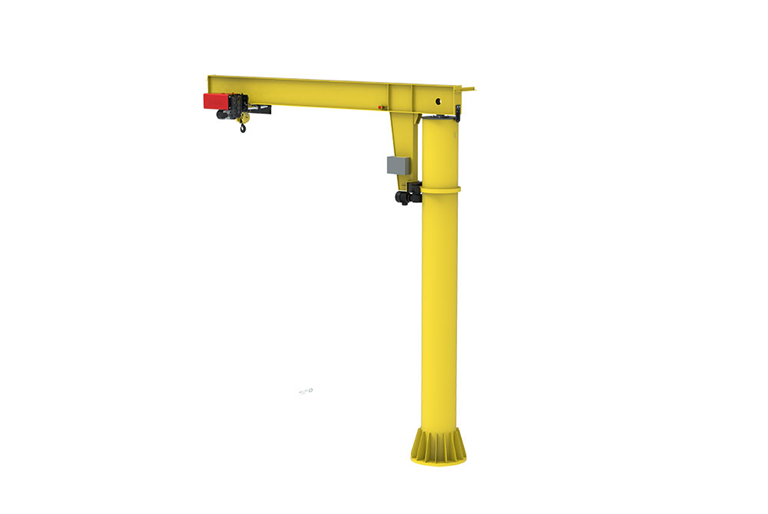

A freestanding jib crane is a floor-anchored, self-supporting lifting unit: the column bolts directly to a reinforced concrete foundation, and the cantilever boom sweeps a full 360° arc around it. This makes it independent of any building structure — unlike wall-mounted jibs, which transfer load into the building frame and require structural assessment before installation.
That independence is the primary decision driver. If your facility has concrete floors of adequate thickness (typically 300–500 mm for most capacity classes, though exact requirements depend on soil conditions and local engineering standards), a freestanding unit can go almost anywhere — in the center of a bay, under a bridge crane, at a loading dock, or in an open yard. If you’re renting a building, don’t have wall access, or need to cover a large circular work radius, freestanding is usually the correct choice over wall-mounted alternatives.
The practical boundary where a freestanding jib stops making economic sense is roughly above 10 tons of sustained capacity or when you need to cover a linear travel path longer than the maximum boom radius — at that point, an overhead bridge crane or gantry crane becomes the better-fit solution.
Freestanding vs. Other Jib Crane Types
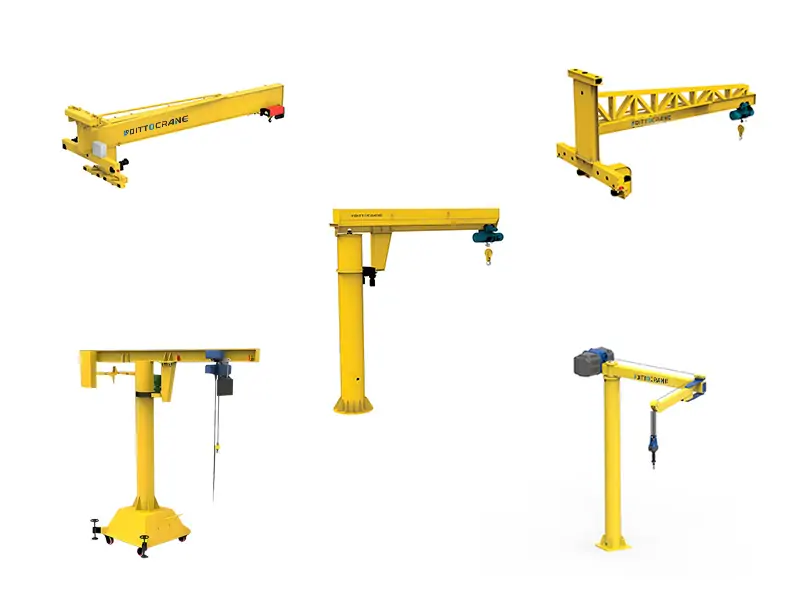
Understanding where the floor-mounted column crane fits among the jib crane family helps avoid mismatched purchases:
| Tipo | Rotación | Structural Dependency | Lo mejor para |
|---|---|---|---|
| Freestanding (floor-mounted) | 360° | None (self-supporting) | Open bays, outdoor, under bridge cranes |
| Industrial jib crane | 270°–360° | Minimal (heavier column) | Higher loads, larger radius up to 12 m |
| Portable jib crane (wheeled) | 270°–360° | None (mobile base) | Multi-location, no fixed foundation |
| Articulating jib crane | Hasta 360 | Wall or column | Tight spaces, obstacle avoidance |
The freestanding floor-mounted model is the standard workhorse for 0.5–10 ton applications. The industrial jib crane (valid radius up to 12 m) suits operations needing wider coverage. The portable wheeled variant trades foundation cost for mobility — useful where you need to move the crane between workstations or across shifts.
Key Selection Parameters: What Actually Drives the Right Spec
Capacity and Duty Class — Don’t Just Look at the Nameplate
The single most common purchasing mistake in the jib crane category is selecting capacity based on peak load alone, while ignoring duty class. Duty class (per ISO 4301 / FEM 1.001) defines how many lifting cycles per hour and per day the crane is designed to handle — and choosing too low a duty class for your actual operating pattern leads to accelerated wear and premature structural fatigue.
Voitto’s floor-mounted jib crane is rated at A3 duty class, which is designed for moderate-frequency operation — typically workshops where the crane runs several cycles per hour but is not cycling continuously like a production-line robot. For light workshop use or occasional maintenance lifts (a few cycles per shift), A3 is more than adequate. If your operation involves very high-frequency repetitive lifts every few minutes throughout a full shift, discuss a higher duty class requirement with your supplier before ordering — the column sizing and bearing selection will differ.
A practical checkpoint: if you’re lifting the same load more than roughly 30–50 times per hour on a sustained basis, ask explicitly for A5 or higher and confirm the crane’s calculated service life at that cycle rate.
Boom Length and Rotation Coverage — Calculate Your Work Zone First
The boom (beam) length determines the radius of the crane’s working circle, and getting this wrong forces awkward workarounds on the shop floor. The key calculation: the usable work area is approximately π × r², where r is the boom length. A 4-meter boom covers roughly 50 m² of floor; a 6-meter boom covers about 113 m².
One practical constraint worth noting: the effective hook coverage does not extend all the way to the boom tip when using a trolley-mounted hoist. Depending on trolley end-stop position, you typically lose 200–400 mm at each end of the boom. Account for this when measuring your required reach from the column centerline.
Standard boom lengths run from 2 to 6 meters. For operations requiring a larger radius — up to 12 meters — the industrial jib crane variant is the appropriate step up.
Turning Speed — Why Slower Isn’t Always Safer
The turning speed of a floor-mounted jib crane varies with capacity: at 0.5 tons, the slew rate is approximately 0.76 r/min; at 10 tons, it drops to around 0.46 r/min. This reduction is by design — heavier loads carry more inertia, and slower rotation reduces the risk of load swing and structural stress on the column.
For assembly or maintenance operations where the operator manually positions the load precisely, the actual swing speed matters less than hoist accuracy. Where cycle time is critical (e.g., a production line feeding a conveyor), factor slewing time into your throughput calculation before committing to a floor-mounted unit with motorized rotation.
Foundation Requirements — Planned Upfront, Not After Installation
The foundation is probably the most under-discussed element in the buying process, and insufficient concrete is the most common reason for costly post-installation remediation.
For a typical 1–5 ton floor-mounted jib crane, the column foundation generally requires reinforced concrete of at least 300–500 mm depth, with anchor bolt positions pre-cast or drilled to match the column base plate. The exact specification depends on soil bearing capacity and local structural engineering requirements — your supplier should provide a foundation drawing with the equipment. If your factory floor is a thin industrial slab (under 200 mm) or sits on poor-bearing soil, factor in foundation upgrade costs before your budget sign-off.
One practical tip: if there’s any possibility you’ll need to relocate the crane in the next 3–5 years, ask about sleeve-insert mounting options. A sleeve insert embeds in the first concrete pour; the column slides into it and can later be removed without breaking up the foundation — a significant cost saving if your factory layout changes.
Application Fit: Where Freestanding Jib Cranes Deliver the Best ROI
Automotive and Mechanical Assembly
In automotive and mechanical workshops, the need to position engine blocks, gearboxes, or heavy subassemblies with millimeter precision makes a 360° slewing jib the right tool. The crane stays fixed at the workstation, the boom rotates to meet the operator, and pendant or remote control keeps hands free for guiding the load. Cycle times in this setting are moderate — typically 10–30 lifts per shift — which fits A3 duty class comfortably.
Almacenamiento y logística
A floor-mounted jib positioned at a receiving dock or packing station lets one operator handle pallet-level loads without a forklift every time a heavy item needs repositioning. The key advantage over separate horizontal-transport equipment here is that the jib crane serves a fixed workstation radius without traffic conflicts. Where a facility has multiple workstations across a bay, overlapping jib crane coverage zones can eliminate the need for a full bridge crane system at a fraction of the capital cost.
Manufacturing and Production Lines
In fabrication and light manufacturing, jib cranes positioned at individual machining cells allow operators to load and unload heavy workpieces without manual strain — reducing both injury risk and cycle time variability. One measurable benefit: positioning accuracy. A trolley-mounted electric hoist on a jib crane can place a load within centimeters of a target, which matters when loading CNC fixtures or welding jigs.
Shipbuilding and Heavy Fabrication
For shipyard workstations and steel fabrication shops handling large plate sections or structural members, a 5–10 ton floor-mounted jib is a cost-efficient local lifting solution alongside larger overhead cranes — covering the “last meter” positioning work that a bridge crane is too slow or imprecise to handle efficiently.
Certifications and Compliance: What to Verify Before Purchase
This section is not optional for import purchasers — certification gaps cause customs delays, invalidate equipment insurance, and create liability exposure if an incident occurs.
What Certifications to Require
For industrial lifting equipment, the minimum documentation you should request from any supplier:
- Marcado CE (for EU/EEA destinations): The crane must carry a CE mark and be accompanied by an EC Declaration of Conformity referencing the EU Machinery Directive (2006/42/EC). Without this, the equipment cannot be legally placed into service in Europe.
- FEM design rules (FEM 1.001): Confirms the structural design follows European crane design standards, including duty class and fatigue calculations.
- ISO 4301 series: International standard for crane classification — relevant for verifying the duty class claim matches the actual design parameters.
- ISO 9001 quality management: Confirms the manufacturer’s production process is audited and documented. Ask for the current certificate, not just a claim.
- EAC marking: Required for Russia, Kazakhstan, Belarus, and other Eurasian Customs Union countries.
- OSHA compliance: For US-destination equipment, confirm the design meets ASME B30.11 (monorail and underhung cranes) or B30.20 (below-the-hook lifting devices) as applicable, and that operation will comply with OSHA 1910.179 requirements.
How to Verify — A Practical Checklist
Verbal assurances are not documentation. Before placing a purchase order, request these actual files:
- EC Declaration of Conformity (for CE-marked equipment) — should name the specific directive, the notified body (if applicable), and the model.
- Overload test certificate — most reputable manufacturers perform a static load test at 125% of rated capacity before shipment. Ask for the test report.
- ISO 9001 certificate — verify the certificate issuing body and expiry date.
- Foundation drawing and anchor bolt specification — this is also your engineering document for the civil works.
- Load test and safety device inspection record — confirms overload protection, anti-derailment, and electrical safety checks were completed.
A supplier who cannot provide items 1–3 on request before payment is a compliance risk, regardless of price.
Pricing Guide: What a Freestanding Jib Crane Actually Costs
Factory-direct pricing (China origin, market reference) for a floor-mounted slewing jib crane with electric wire rope hoist:
| Capacidad | Longitud del plumin | Approx. Price Range |
|---|---|---|
| 0,5 toneladas | 2–4 m | $1,800 – $2,500 |
| 1 tonelada | 2-5 m | $1,500 – $3,500 |
| 2 toneladas | 3-6 m | $2,000 – $5,000 |
| 3 toneladas | 3-6 m | $3,000 – $7,000 |
| 5 toneladas | 3-6 m | $4,500 – $9,000 |
| 10 toneladas | 4–6 metros | $7,500 – $14,000+ |
These are market reference ranges for factory-direct supply. Actual pricing depends on boom length, hoist type, control options, finish specification, and freight destination. Prices do not include civil foundation works or local installation.
Common hidden costs buyers miss:
- Foundation concrete and anchor bolt works (typically $500–$1,500+ depending on ground conditions and local labor)
- Local electrical connection (pendant and hoist power supply)
- Import duties and local compliance inspection fees
- Spare parts kit — not always included in base price; ask explicitly
Conclusion: How to Move from Evaluation to Order
A freestanding jib crane for sale in the 0.5–10 ton range is a high-value, long-service solution for any facility that needs localized precision lifting without building-structure modifications. The key decisions are capacity + duty class (match your actual cycle rate, not just peak load), boom length (calculate your work zone radius before specifying), foundation planning (get a drawing from the supplier before civil works), and certification documentation (request actual files, not verbal assurances).
Three actions to take now:
- Measure your required work radius and ceiling clearance, and confirm your concrete floor thickness.
- Identify your operating frequency (lifts per hour/shift) to match the right duty class.
- Contact us with those parameters — we’ll confirm the right specification and provide a factory-direct price within 24 hours.

Alan
Especialista en Soluciones de Grúas · Voitto Crane
Especializados en soluciones de exportación de grúas puente, grúas pórtico, grúas de pluma, grúas portuarias y grúas EOT. Más de 10 años ayudando a clientes internacionales con consultoría de preventa, selección de capacidad y configuraciones específicas para cada emplazamiento.
PREGUNTAS FRECUENTES
Q1: What is the difference between a freestanding jib crane and a wall-mounted jib crane?
A freestanding jib crane is self-supporting — it bolts to a floor foundation and requires no building structure for load transfer, making it suitable for open bays, outdoor areas, or rented facilities. A wall-mounted jib crane transfers its load into the building wall or column, which requires a structural assessment and limits placement options. If your facility has adequate floor concrete and you need 360° coverage, freestanding is almost always the more flexible choice.
Q2: What concrete foundation does a freestanding jib crane require?
For most 0.5–5 ton floor-mounted jib cranes, the foundation typically requires reinforced concrete at least 300–500 mm deep, with anchor bolts pre-cast or chemically anchored to the base plate specification provided by the manufacturer. The exact depth and bolt pattern depend on the crane’s capacity, boom length, and your site’s soil bearing capacity. Your supplier should provide a foundation drawing — if they don’t, request one before placing the order.
Q3: How much does a freestanding jib crane for sale cost from a factory-direct supplier?
Factory-direct pricing (China origin) typically runs from around $1,400 for a 0.5-ton unit with a short boom up to $14,000+ for a 10-ton, full-specification model. The final price depends on capacity, boom length, hoist type, and control options. Freight, local foundation works, and import duties are additional. Contact us for a specific quote based on your capacity and configuration.
Q4: What duty class should I specify for a workshop jib crane?
The standard duty class for workshop freestanding jib cranes is A3 (per ISO 4301 / FEM 1.001), which covers moderate-frequency operation — several cycles per hour across a normal working day. If your operation involves sustained high-frequency lifting (30+ cycles per hour continuously), discuss A5 or higher with your supplier, as the column, bearing, and structural design will need to reflect the higher fatigue loading. Never select duty class based on peak load alone — the cycle rate is equally important.
Q5: Can a freestanding jib crane be relocated after installation?
Yes, with the right mounting option. A base-plate-mounted unit requires breaking up the anchor area to relocate, while a sleeve-insert mounting allows the column to be removed and reinstalled at a new location without destroying the original foundation. If there is any chance you’ll need to move the crane in the future, specify sleeve-insert mounting when ordering — the cost difference is modest, and the long-term flexibility is significant.




 English
  Español
  Português
  العربية
  Français
  Русский