Grúa puente independiente: diseño modular y soluciones de estaciones de trabajo autoportantes.
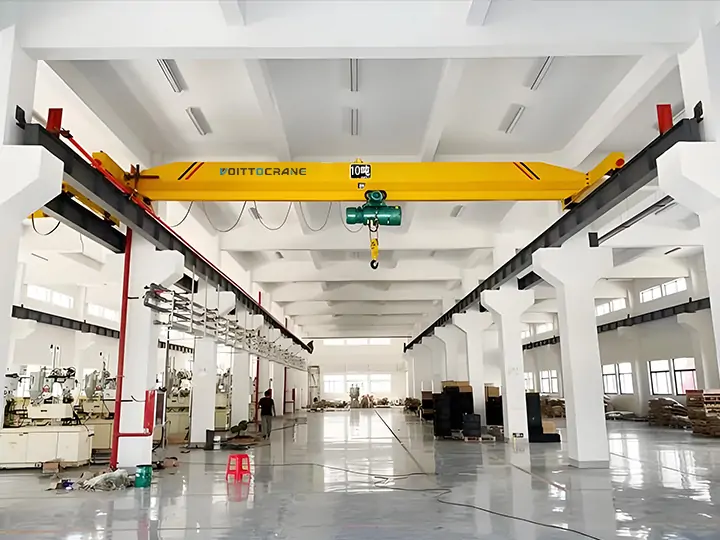
Una grúa puente autoportante es un dispositivo de elevación independiente. Todo el equipo no depende de las vigas ni columnas del techo de la fábrica para soportar la carga. Solo requiere una cimentación sencilla (hormigón C30, espesor >200 mm), lo que reduce considerablemente el coste de construcción de una fábrica o taller de reparación.
Una grúa puente autoportante es un sistema de elevación modular que requiere únicamente una base de hormigón C30 sin refuerzo en el techo. Su capacidad de elevación oscila entre 0,25 y 5 toneladas, con luces de 1 a 12,5 metros. Se utiliza en la fabricación industrial, la producción automotriz y los talleres de reparación. A continuación, esta página ofrece una introducción detallada a este dispositivo de elevación autoportante.
Descripción del producto
Una grúa puente autoportante es un sistema de elevación aéreo independiente que funciona sin depender de las vigas o columnas del techo del edificio. Su diseño autoportante facilita la instalación y el desmontaje, permitiendo su uso en diferentes áreas de trabajo y ofreciendo una solución rentable para satisfacer las demandas de producción en constante evolución. Por lo tanto, las grúas puente autoportantes son la opción ideal para instalaciones con capacidad de carga estructural limitada.
A diferencia de las grúas puente tradicionales, esta grúa puente para estaciones de trabajo cuenta con una estructura modular, con el bastidor autoportante montado sobre una base de hormigón a nivel del suelo. Solo requiere una base sencilla (hormigón C30, espesor >200 mm), lo que reduce significativamente los costos de construcción para fábricas o talleres de reparación. Este diseño ofrece a fábricas y talleres las ventajas de una instalación rápida, menores costos de construcción y una gran flexibilidad.
La grúa puente autoportante es una solución ideal para la manipulación de materiales: eficiente, económica y fácil de instalar. VOITTO Crane ofrece diseños personalizados según las necesidades específicas de los usuarios y las rutas de manipulación de materiales.
Tipos de grúas puente independientes
Las grúas puente autoportantes se pueden clasificar en diferentes tipos según su estructura y materiales, incluyendo grúas puente autoportantes flexibles, grúas puente autoportantes rígidas, estructuras de viga única, estructuras de viga doble y grúas puente autoportantes de aleación de aluminio. Estos tipos se describen a continuación.
Grúa puente autoportante de una sola viga
Grúa puente de doble viga para estación de trabajo
Sistema de grúa monorraíl rígida
Grúa para estación de trabajo flexible
Grúa puente de estación de trabajo independiente de aleación de aluminio
Grúa puente autoportante de una sola vigaEste tipo de grúa cuenta con una sola viga principal. El mecanismo de elevación se desplaza a lo largo del ala inferior de la viga principal y se utiliza para el izamiento vertical y la manipulación horizontal de materiales. Su capacidad de elevación nominal no suele superar las 2 toneladas.
Grúa de estación de trabajo de doble vigaEn comparación con las estructuras de viga única, las grúas de estación de trabajo autoportantes de doble viga ofrecen mayor capacidad de carga y un funcionamiento más suave, lo que las hace idóneas para la manipulación de materiales de tamaño mediano a grande. Su capacidad de elevación oscila entre 125 kilogramos y 3,2 toneladas.
Sistema de grúa monorraíl rígidaEste equipo utiliza una estructura de acero rígido como sistema de soporte. Estas grúas presentan una deformación mínima durante su funcionamiento, ofreciendo alta estabilidad y gran resistencia a la oscilación. Su capacidad de elevación nominal suele oscilar entre 125 kilogramos y 2 toneladas métricas, y algunas estructuras reforzadas pueden soportar hasta 3 toneladas.
Grúa para estación de trabajo flexibleEste tipo de grúa está construida con componentes de acero modulares y ligeros. La viga principal y los rieles se atornillan para formar una estructura de bastidor, lo que facilita enormemente su instalación y desmontaje. Estas grúas son adecuadas para entornos de trabajo donde la capacidad de carga no supera las 2 toneladas métricas.
Grúa puente de estación de trabajo independiente de aleación de aluminioEste tipo de estructura utiliza aleación de aluminio como material principal. La unidad completa se caracteriza por su ligereza, alta resistencia, resistencia a la corrosión y propiedades inoxidables. Se utiliza ampliamente en entornos con altos requisitos de limpieza y flexibilidad, como la industria alimentaria, farmacéutica, electrónica, aeroespacial, líneas de montaje y laboratorios.
Características y ventajas
Gracias a su diseño modular y su rápida implementación, las grúas puente para estaciones de trabajo independientes han incrementado progresivamente la eficiencia de la producción en un 30 %. A continuación, explicaré cada una de estas características en detalle:
EstructuralEste diseño estructural no solo reduce los costes de construcción, sino que también permite un montaje rápido en obra.
Fácil instalaciónLa grúa puente para estaciones de trabajo independientes cuenta con un diseño modular, lo que facilita enormemente su instalación, desmontaje y reubicación. Los usuarios pueden ajustar su posición o rango de operación de forma flexible según la configuración de la línea de producción.
Funcionamiento fluidoEquipado con rieles de alta precisión y un sistema de accionamiento, este equipo funciona de manera suave y silenciosa, con una vibración mínima.
Fácil mantenimientoEl equipo utiliza componentes modulares, lo que facilita la inspección y la sustitución, y mantiene bajos los costes de mantenimiento diarios.
Rentable y prácticoEn comparación con las grúas puente tradicionales, la estructura autoportante no requiere la renovación de la fábrica, tiene un ciclo de instalación corto y consume menos energía.
Alta movilidadLa grúa puente autoportante se puede desmontar por completo o trasladar a nuevas estaciones de trabajo, talleres o lugares de trabajo para su uso.
Amplia gama de opcionesLos usuarios pueden elegir entre varias configuraciones estructurales —incluidas vigas simples, vigas dobles, estructuras rígidas, flexibles o de aleación de aluminio— en función de sus necesidades de elevación.
Aplicación
Las grúas puente aéreas autoportantes se utilizan ampliamente en diversos entornos industriales y de producción. A continuación, se presentan algunos escenarios de aplicación para la grúa puente de estación de trabajo:
Fabricación industrialLos usuarios operan la grúa puente móvil independiente para el mecanizado, el montaje de equipos, la instalación y sustitución de moldes, etc.
Sector de fabricación de automóvilesEl operador utiliza grúas EOT independientes para levantar piezas de automóviles, motores y equipos mecánicos de gran tamaño.
Almacenamiento y logística: Grúas puente independientes con control por parte del usuario para la carga, descarga, apilado y clasificación de mercancías.
Electrónica y producción industrial ligeraLos usuarios utilizan grúas EOT independientes de aleación de aluminio para el montaje de productos, la realización de pruebas y la manipulación de materiales ligeros.
Industrias alimentaria y médica: Las grúas puente independientes, con sus características de funcionamiento ligero y limpio, se utilizan para la manipulación de materiales y la carga y descarga.
Campo aeroespacialLos operadores controlan el equipo para levantar componentes de precisión.
Taller de reparación: Utilizado por los usuarios para la inspección, la sustitución de piezas y la rotación de materiales.
Partes de la grúa puente para estación de trabajo independiente
Una grúa puente aérea independiente consta de columnas de soporte, una viga de rodadura, una viga de puente, un mecanismo de elevación, un sistema de fijación a la base, un sistema de suministro de energía, un sistema de fijación a la base y un sistema de control.
Especificaciones
Modelo
Grúa puente independiente
Capacidad de carga
0,1-3,2 toneladas
Span
1-12,5 m (personalizado según el área de trabajo)
Altura de elevación
3,7 – 13,5 m
Fuente de alimentación
380 V, 50 Hz, trifásico
Equipos de elevación
Polipasto de cadena o polipasto de cable metálico
Método de control
Mando a distancia
Tipos de viajeros
Manual o eléctrico
Clase de servicio
A2-A3
Precio de grúa puente independiente
El precio de las grúas puente autoportantes varía según la capacidad de elevación, el tipo y los materiales utilizados. A continuación, se muestran los rangos de precios. Para obtener un presupuesto personalizado, especifique sus requisitos de elevación, las dimensiones del tramo y el entorno de aplicación.
Tipo
Capacidad
Span
Rango de precios (USD)
Grúa puente autoportante de una sola viga
0,1–2 toneladas
3-12 m
$3.500–15.000
Grúa de estación de trabajo de doble viga
0,1–3,2 toneladas
5–15 m
$8.000–35.000
Sistema de grúa monorraíl rígida
0,125–3,2 toneladas
Personalizado
$1.500–12.000
Grúa para estación de trabajo flexible
0,125–2 toneladas
3-10 m
$2.000–10.000
Grúa puente de estación de trabajo independiente de aleación de aluminio
0,125–2 toneladas
2–8 m
$3.000–18.000
NotaLa lista de precios anterior es solo de referencia. Los precios reales dependen de las especificaciones específicas.
Grúa puente independiente en venta
VOITTO se compromete a proporcionar a sus clientes soluciones de elevación con grúas puente independientes eficientes, seguras y fiables. Con conceptos de diseño avanzados, procesos de fabricación sofisticados y un estricto control de calidad, VOITTO ha establecido alianzas estratégicas con más de 70 países de todo el mundo.
El fabricante y proveedor de grúas VOITTO puede proporcionar soluciones personalizadas de grúas puente aéreas para estaciones de trabajo independientes en función de la anchura y la altura de la fábrica del cliente. Si tiene algún requisito específico o necesita más ayuda, no dude en ponerse en contacto con nosotros. Contacto.
Especialista en Soluciones de Grúas · Voitto Crane
10+Años Exp.
5,000+Clientes
50+Países
Especializados en soluciones de exportación de grúas puente, grúas pórtico, grúas de pluma, grúas portuarias y grúas EOT. Más de 10 años ayudando a clientes internacionales con consultoría de preventa, selección de capacidad y configuraciones específicas para cada emplazamiento.
¿Cuál es la principal diferencia entre una grúa puente independiente y una grúa aérea tradicional montada en el techo?
Una grúa puente autoportante funciona sobre una estructura autoportante que solo requiere una sencilla base de hormigón, mientras que las grúas aéreas tradicionales dependen del refuerzo de las vigas del techo.
¿Con qué rapidez se puede instalar y reubicar una grúa puente independiente?
Gracias a su diseño modular, una grúa puente autoportante se puede ensamblar en el suelo en 2 a 4 días. Además, todo el sistema se puede desmontar y trasladar a nuevas ubicaciones, lo que la hace ideal para entornos de fabricación en constante evolución.
¿Se puede personalizar una grúa puente independiente para adaptarla a requisitos de elevación específicos?
Sí, la personalización abarca la capacidad de elevación (0,25–3 toneladas), el ancho del tramo (1–12,5 metros), la altura de elevación y el tipo de polipasto. Por lo tanto, nuestro equipo de ingeniería diseña soluciones adaptadas a sus necesidades operativas específicas y a las limitaciones de sus instalaciones.
¿Qué mantenimiento y asistencia requiere una grúa puente autoportante?
El diseño modular facilita la inspección y el reemplazo de componentes, lo que reduce los costos de mantenimiento. Además, ofrecemos soporte técnico las 24 horas, disponibilidad de repuestos y una cobertura de garantía integral con opciones de extensión.
¿Es una grúa puente autoportante adecuada para talleres de reparación pesada?
Por supuesto. Su portabilidad, estructura autoportante y capacidad de carga (hasta 5 toneladas) la hacen ideal para talleres de reparación. De esta forma, los operarios logran una manipulación eficiente de los materiales sin necesidad de costosas modificaciones en las instalaciones.
Cualificación y honor
Engineered Strength, proveedor mundial de grúas
servicio
Exclusivo y considerable, el cliente es lo primero.
01
Soluciones fiables y personalizadas
Nuestro equipo de preventa realiza consultas y adapta las soluciones a sus necesidades y entorno.
Ofrecen opciones de personalización de la capacidad de elevación, la envergadura y la altura de elevación, etc. para satisfacer necesidades específicas.
02
Proceso de producción actualizado
Actualizaciones de progreso en tiempo real: Informes semanales y comunicación PM.
Pruebas previas a la entrega: 100% comprobaciones de carga y seguridad, informes detallados.
03
Asistencia posventa de confianza
3-5 años de garantía y sustitución gratuita por defectos no de fabricación.
Asistencia en línea 24 horas al día, 7 días a la semana, y asistencia in situ en caso de problemas con la grúa.
PREGUNTAS FRECUENTES
Engineered Strength, proveedor mundial de grúas
¿Hacen envíos internacionales?
Sí, los envíos internacionales y la asistencia a la exportación están disponibles para los clientes de todo el mundo.
¿Es usted fabricante o proveedor?
VIOTTO es un fabricante y proveedor de plataformas elevadoras de tijera de alta resistencia, que ofrece soluciones directas de fábrica y opciones personalizadas.
¿Qué incluye su servicio posventa?
Ofrecemos un servicio posventa completo, que incluye mantenimiento periódico, asistencia técnica rápida y suministro de piezas de repuesto. El periodo de garantía estándar es de 1 año, con opciones de ampliación en función de sus necesidades.
¿Se puede personalizar?
Sí, la capacidad de elevación, la envergadura, la altura, el tipo de estructura y las opciones de polipasto pueden personalizarse para adaptarse a condiciones de trabajo específicas.
Póngase en contacto
No dude en dejarnos un mensaje. Le responderemos en 24 horas.
Por favor, especifique su necesidad refiriéndose a los siguientes aspectos:
¿Qué producto de grúa necesita?
¿Cuál es la capacidad máxima de elevación (en toneladas) necesaria para su proyecto?
¿Podría especificar la altura de elevación (en metros) necesaria?
¿Puede dar detalles sobre el entorno de trabajo, como las condiciones del terreno, las limitaciones de espacio y cualquier obstáculo?
¿Cuál es la frecuencia de uso prevista y la duración del proyecto?
productos relacionados
Potencia de precisión, personalización Solución de grúa.







 English
  Español
  Português
  العربية
  Français
  Русский