
Hook drift is the uncontrolled downward slide of a crane hook or load after the controller has been returned to zero, beyond the permitted braking distance. It is also called load drift, and it means the hoist brake is no longer holding the way it was designed to. Any drift beyond the limit should be treated as a safety fault, not a nuisance.
The difficulty is that a small slip is easy to ignore. The hook settles a few centimeters, the operator corrects it, and the shift carries on. But hook drift rarely stays small. A contaminated brake surface, a worn lining or a mis-set spring gets worse with every lift, and the same defect that lets a load sink 20 cm today can let it fall tomorrow.
This guide gives you the allowable drift limits for overhead cranes, gantry cranes and electric hoists, with a worked calculation. It then covers the six most common causes, a symptom-to-cause diagnostic table, practical fixes, and the design choices that prevent hook drift in high-duty work.
Hook drift is the non-commanded downward movement of a hook or load after the hoist controller returns to zero, exceeding the allowed braking distance, as judged against limits such as those in GB/T 6067.1-2010.
What Hook Drift Is and How Much Is Too Much
Hook Drift vs. Lateral Hook Drift
In this guide, hook drift means vertical sliding, not the sideways hook movement that some hoist makers also describe by the same name.
The second meaning is a geometry effect. As wire rope unwinds from the drum, the hook can wander sideways, which matters for precise placement and is reduced by wider drums or double-reeved designs. That is a positioning issue and does not mean anything is failing.
Vertical hook drift (also called load drift or hoist drift) is different: it is a braking problem. The brake is supposed to close when the motor stops and hold the load still. If the hook keeps moving, the brake, the drive or the control circuit is not doing its job. If your hook moves sideways but stops dead when you release the controller, this article is not about your problem.
Allowable Braking Distance for Overhead and Gantry Cranes
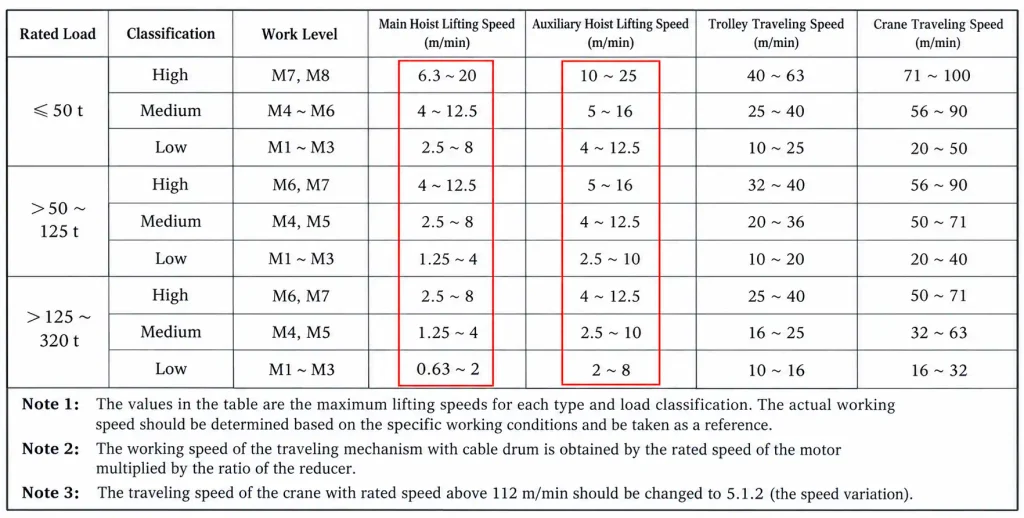
For hook-type overhead and gantry cranes, braking distance is generally kept to no more than 1/65 of the distance the hook travels in one minute at steady speed.
This rule appears in the general crane safety and design standards GB/T 6067.1-2010 and GB/T 3811-2008, and it covers general-purpose overhead cranes, general-purpose gantry cranes and bridge-erecting cranes. Braking distance here means the slide from the moment the brake loses power (controller back at zero) until the load stops.
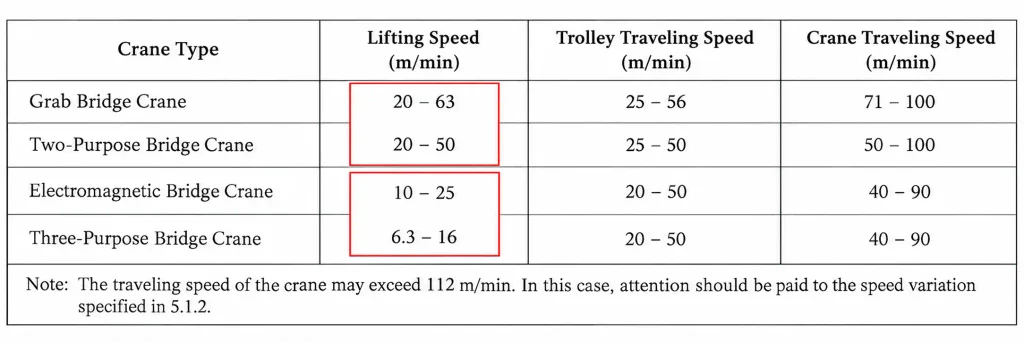
The calculation is simple. If a crane hoists at 12.5 m/min, the permitted braking distance is about 12.5 / 65 = 0.192 m, or roughly 192 mm. A faster hoist is allowed a longer stop, so always use the crane’s actual rated hoisting speed rather than a generic figure. Preferred working speeds for bridge cranes are listed in GB/T 14405-2011.
One caution: these values assume rated conditions. A crane that meets the limit empty may still exceed it at full load, so test with the load you actually lift.
Stricter Limits for Electric Hoists
Electric hoists carry a tighter limit: brake slip of no more than v/100 and no more than 200 mm, where v is the distance hoisted in one minute at steady speed.
The requirement is set in JB/T 9008.1-2014 for wire rope electric hoists and JB/T 5317-2016 for chain electric hoists, and it applies at rated voltage, rated frequency and rated load. A hoist lifting at 8 m/min should therefore slip no more than 80 mm. At very high speeds the 200 mm cap takes over.
Compare the two rules at the same speed. At 12.5 m/min, a general overhead crane may drift about 192 mm, while an electric hoist should stay near 125 mm. The reason is design intent: hoists are often used in short, repetitive lifts with people working close to the load, so the standard allows less slip.
| Оборудование | Typical allowable drift | Reference standard |
|---|---|---|
| General overhead crane, gantry crane, bridge-erecting crane | ≤ 1/65 of one-minute steady hoisting distance | GB/T 6067.1-2010, GB/T 3811-2008 |
| Канатная электрическая таль | ≤ v/100 and ≤ 200 mm | JB/T 9008.1-2014 |
| Цепная электрическая таль | ≤ v/100 and ≤ 200 mm | JB/T 5317-2016 |
If your crane or hoist exceeds the figure for its class, it is drifting. Confirm the exact limit for your model with the manufacturer.
Common Causes of Hook Drift
Brake Surface and Wear Problems
Most hook drift starts at the brake surface: contamination or wear reduces the friction the brake needs to hold the load.
Oil or rainwater on the brake wheel or lining lowers the friction coefficient, so the brake produces less holding torque than designed. Worn brake shoes or pads have the same effect and also widen the brake gap, so the brake closes late and weakly, and the hook sinks under its own weight and the load.
On single-girder electric hoists, the equivalent faults are a worn brake disc at the rear of the motor or a broken brake shaft. In every case the symptoms are similar, so inspect the friction surfaces first, because this is where the cheapest fix usually is.
Adjustment and Sizing Problems
A brake that is too loosely set, mechanically sticking or simply too small cannot produce enough torque to hold the load.
Brake torque depends largely on spring force. If the brake spring is adjusted too loosely, braking force drops, and drift follows. Moving parts that stick or bind in the brake linkage have a similar effect because they stop the brake from closing fully. Finally, some drift is a design problem: if the brake was selected too small for the load and duty, no amount of adjustment will give it enough margin.
The practical check is whether drift appeared right after a service or adjustment (suspect settings) or has been present since commissioning (suspect sizing).
Electrical and Operating Causes
Electrical faults and operating habits cause drift by delaying the brake or reducing motor torque at the moment of stopping.
Typical electrical causes include a brake contactor that sticks or welds, inverter (VFD) parameters set incorrectly or changed without authorization so that torque is insufficient, faults in a DC-excited lifting control, and control circuits so complicated that the brake reacts slowly. A large voltage drop is another cause: if the motor’s torque falls below the load torque, the hook cannot be held steady.
Operation matters too. Overloading can leave the motor underpowered and stress the reducer and brake. Rapid, repeated jogging of the button can outpace the contactor, and non-standard handling habits add to the problem.
This guide covers electrically driven overhead cranes, gantry cranes and electric hoists. Hydraulic mobile cranes have different drift mechanisms and are outside its scope.
Symptom-to-Cause Diagnostic Table
Matching the pattern of drift to a likely cause tells you where to look first and saves hours of trial and error.
| What you observe | Likely cause | Check first |
|---|---|---|
| Drift after rain, or near an oil leak | Contaminated brake surface | Inspect and clean brake wheel and lining |
| Drift grows gradually over weeks | Worn pads, shoes or brake disc | Measure lining thickness and brake gap |
| Drift began right after maintenance or a parameter change | Spring setting or VFD parameters | Recheck spring adjustment and drive settings |
| Drift is intermittent, or brake seems slow to close | Sticking contactor or voltage drop | Test the contactor and measure voltage under load |
| Drift only with heavy or overloaded lifts | Overload or undersized brake | Compare the load with rated capacity and brake torque |
The table lists typical starting points based on the mechanisms above, not a substitute for inspection by a qualified engineer.
How to Fix Hook Drift
Mechanical Fixes
Mechanical repair is the first step in most cases: restore the brake’s friction surfaces, spring force and moving parts.
Replace worn brake shoes or pads, clean oil or moisture from the brake wheel and lining, and adjust the brake spring to restore the correct braking torque. Check that the brake linkage moves freely. For electric hoists, inspect the brake disc and brake shaft at the rear of the motor.
After any adjustment, repeat the drift test at rated load and compare the result against the limits in the table above, rather than judging by eye.
Electrical and Drive Fixes
If the brake is mechanically sound, move on to the electrical circuit and drive settings.
Check the control wiring and the brake contactor, then review the inverter parameters against the manufacturer’s recommended values. Parameters changed by site staff without records are a common reason a previously stable crane starts to drift. Verify that supply voltage stays within range under load so the motor can produce enough torque.
Replace worn electrical parts with matched components. Voitto Crane’s электрооборудование крана и редуктор двигателя крана pages list the parts used in these repairs.
When to Take the Crane Out of Service
Treat any drift beyond the allowable limit as a reason to stop lifting until the brake system has been inspected and repaired.
Drift is usually a warning that the brake’s holding margin is shrinking. A brake that slips a little under test can fail completely under a heavier load or in worse conditions, such as rain or a hot, worn lining. Continuing to lift with a drifting hook means people may be working beneath a load that the brake cannot reliably hold.
Preventing Hook Drift in High-Duty Applications
Double Brakes and Safety Brakes
For high-duty and high-risk lifting, a second brake is the most direct way to keep one worn brake from becoming a dropped load.
Where the hoisting mechanism is rated at duty class M6 or above, double brakes are generally used. Metallurgical cranes and other high-risk applications may also add a safety brake. These are normally specified in the purchase agreement, so ask for them at the quotation stage rather than after delivery. Some regional rules also set holding-brake torque as a percentage of rated load, often cited as 150% for a single brake. Confirm the requirement that applies in your market.
For new equipment, you can specify these options on double girder overhead cranes, gantry cranes and heavy-duty EOT cranes.
Overspeed Switches and Electrical Protection
An overspeed switch guards against the electrical failure modes that a purely mechanical brake upgrade does not address.
It monitors hoisting speed and trips if the hook runs faster than it should, such as when a brake or drive fails to hold. Like a second brake, it is usually requested in the purchase agreement. Combine it with correct inverter settings and a simple control circuit, since a complicated circuit can slow brake response.
Matching Brake, Motor Power and Duty Class to the Real Lifting Cycle
Prevent hook drift at the specification stage by sizing brake torque, motor power and duty class to how the crane will really be used.
An undersized brake and chronic overloading are design-level causes, so repairs alone will not cure them. Frequent starts, heavy loads and long working hours all push the equipment toward a higher duty class. Use the crane duty classification calculator and the hoist motor power calculator to check your duty cycle before you choose a configuration. For lighter lifting, consider whether an electric hoist, with its tighter v/100 brake-slip requirement, suits the task.
Заключение
Hook drift means the hoist brake has lost its margin, and the allowable limit is clear: about 1/65 of one-minute hoisting distance for overhead and gantry cranes, and v/100 (up to 200 mm) for electric hoists. Most cases trace back to a contaminated or worn brake, a mis-set spring, an electrical fault or overload.
Three actions will help most. Measure drift at rated load and compare it with the limit. Work through the diagnostic table before replacing parts. And specify double brakes and an overspeed switch for any high-duty crane. Hook drift left alone tends to get worse.
Have a specific hook drift problem or a selection question? Contact our engineering team with your crane model, rated load and hoisting speed, and we will help you identify the cause.

Алан
Специалист по крановым решениям · Voitto Crane
Специализируемся на экспортных решениях в области мостовых кранов, козловых кранов, поворотных кранов, портовых кранов и мостовых кранов. Более 10 лет помогаем глобальным клиентам в проведении предпродажных консультаций, выборе грузоподъемности и разработке конфигураций с учетом специфики объекта.
ЧАСТО ЗАДАВАЕМЫЕ ВОПРОСЫ
Q1:What is hook drift on a crane?
Hook drift is the uncontrolled downward slide of a hook or load after the controller returns to zero. It means the hoist brake is not holding as designed, and the distance slid exceeds the allowed braking distance. It is also called load drift. Treat it as a safety fault and have the brake system inspected.
Q2:How much hook drift is acceptable?
For general overhead and gantry cranes, drift should be no more than 1/65 of the distance hoisted in one minute, about 192 mm at 12.5 m/min. Electric hoists must stay within v/100 and 200 mm. These are reference values, so confirm the exact limit for your model with the manufacturer.
Q3:Why does my hoist slide down after stopping?
The most common reasons are oil or water on the brake surface, worn brake pads or disc, and a loosely adjusted spring. Electrical faults such as a sticking contactor or incorrect inverter settings can also cause it, as can overload. Use the diagnostic table above to find the likely cause.
Q4:Can VFD settings cause hook drift?
Yes. Incorrect or unauthorized inverter parameters can leave the motor with too little torque at the moment the brake closes, and the load then slips. Restore the manufacturer’s recommended settings and record any later changes. Have a qualified engineer check the drive after changes.




 English
  Español
  Português
  العربية
  Français
  Русский