
A well-maintained overhead crane typically lasts 20 to 30 years, depending on its duty class. That number is a design convention, not a warranty: what really ends a crane’s life is fatigue in its load-bearing steel structure, not the age on the calendar.
Buyers see “30-year design life” in tender documents, and owners of older equipment are asked whether to repair, refurbish or replace. Neither figure says how much life is actually left.
This guide explains where the 20-, 25- and 30-year figures come from, how design life is calculated, what shortens it, and how to estimate remaining cycles with our free Crane Lifespan Calculator.
Crane design service life is the total number of working cycles a crane is calculated to perform under stated loading conditions, as classified under ISO 4301-1.
How Long Does an Overhead Crane Last by Duty Class?
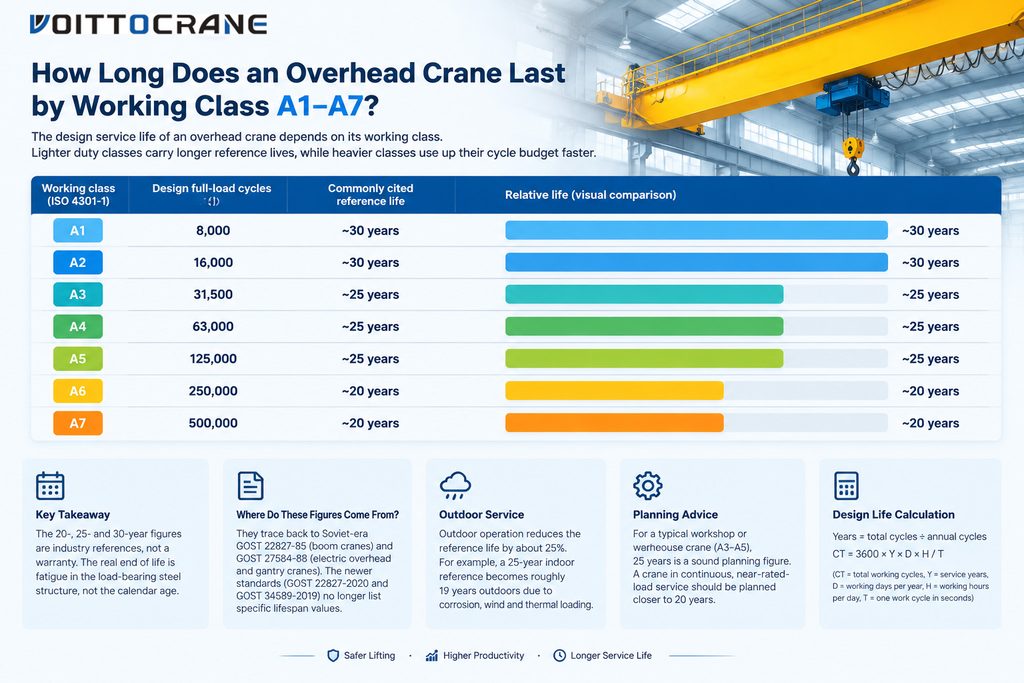
Reference design lives run from about 20 to 30 years by working class
Lighter duty classes carry longer reference lives: roughly 30 years for A1–A2, 25 years for A3–A5 and 20 years for A6–A7. The reason is the cycle budget. Each working class is assigned a total number of full-load cycles, and heavier classes simply spend it faster.
| Working class (ISO 4301-1) | Design full-load cycles (Cf) | Commonly cited reference life |
|---|---|---|
| A1 | 8,000 | ~30 years |
| A2 | 16,000 | ~30 years |
| A3 | 31,500 | ~25 years |
| A4 | 63,000 | ~25 years |
| A5 | 125,000 | ~25 years |
| A6 | 250,000 | ~20 years |
| A7 | 500,000 | ~20 years |
Read the last column as an industry reference, not a promise for any specific model. Confirm actual design parameters with the manufacturer.
For a typical workshop or warehouse мостовой кран in the A3–A5 range, 25 years is a sound planning figure. A crane in continuous, near-rated-load service should be planned closer to 20.
Most quoted lifespans trace back to Soviet-era GOST standards
The 20-, 25- and 30-year values were popularised by GOST 22827-85 (boom cranes) and GOST 27584-88 (electric overhead and gantry cranes). The latter listed a service life for each working class.
Both standards have since been replaced, by GOST 22827-2020 and GOST 34589-2019, and the new versions dropped the specific lifespan values. So the figures on your specification sheet are inherited conventions rather than a current international requirement. Regulators are moving toward asking for an explicit design life in the design documents (China’s TSG 51-2023 is one example), which is why specifications now often state one.
Outdoor service cuts the reference life of an overhead or gantry crane by about 25%
GOST 27584-88 reduces the service life of cranes working outdoors by 25%. A 25-year indoor reference becomes roughly 19 years outdoors. Weather exposure accelerates corrosion and adds wind and thermal loading that indoor cranes never see.
This matters most for a козловой кран in a yard, where outdoor exposure is the default. If you are comparing a yard installation against an indoor one, plan on the shorter figure and specify protective coatings accordingly.
How Is Crane Design Life Calculated?
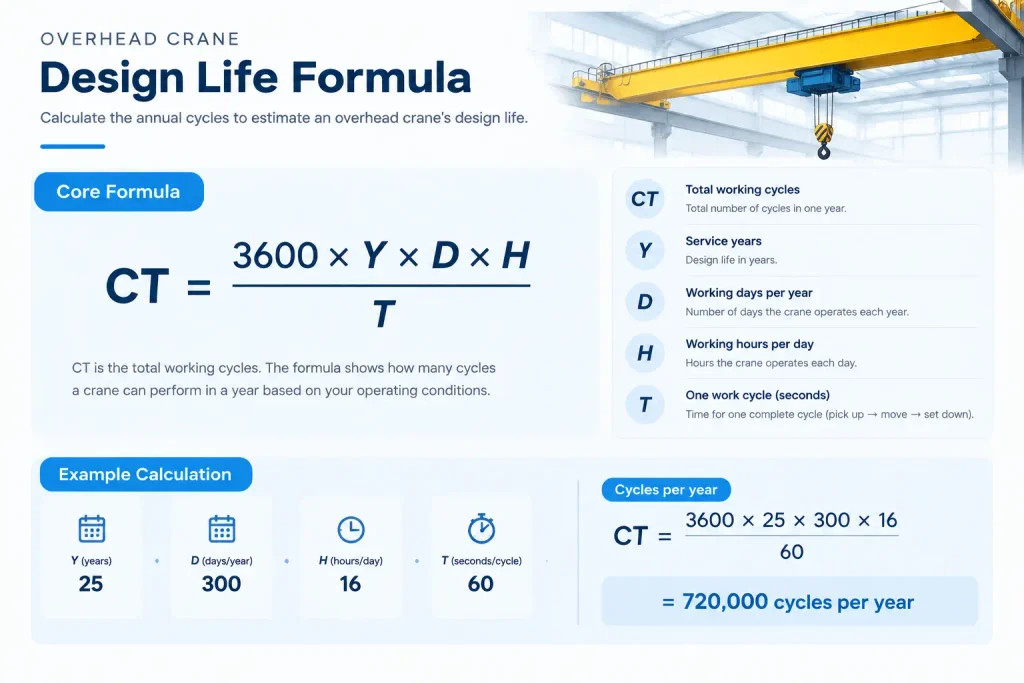
The years on a spec sheet are a cycle budget divided by your annual cycles
Design life in years follows from total cycles and how fast you use them: CT = 3600 × Y × D × H / T. Here CT is total working cycles, Y is service years, D is working days per year, H is working hours per day and T is one work cycle in seconds. A work cycle runs from picking up one load to being ready for the next.
The consequence is that one crane class can last very different numbers of years. Using the U5 utilization class (500,000 design cycles), before any load-spectrum credit or safety factor (illustrative arithmetic):
| Usage pattern | Cycles per year | Years to use up 500,000 cycles |
|---|---|---|
| 6 cycles/hour, 6 h/day, 250 days | 9,000 | ~55 |
| 20 cycles/hour, 16 h/day, 300 days | 96,000 | ~5 |
If your operation is busier than the crane’s class assumes, the “30 years” on paper shrinks fast. This is why the Калькулятор классификации грузоподъемности крана is worth running before you buy.
Lighter loads stretch design life through the load spectrum coefficient
ISO 12482 credits lighter loads by weighting each cycle with a coefficient Kp, based on the Palmgren-Miner rule that fatigue damage accumulates linearly. Kp runs from 0.0313 (very light, Qp0) to 1.0 (nearly every lift at rated load, Qp5).
At Qp3 (Kp = 0.25), 60,000 actual cycles count as only 15,000 fatigue-equivalent cycles. The same crane therefore lasts roughly four times longer than one lifting at full capacity every cycle. The catch is documentation: the credit is only defensible if the load history is recorded.
Reaching design life does not mean retirement
A crane that has used its design life can often continue in service, but only after inspection or assessment. The design life is defined for calculation purposes; it is a guide for maintenance and refurbishment planning, not a guaranteed operating period.
In practice that means a structural assessment, non-destructive testing of primary welds, and an engineer’s sign-off, with regulatory approval in many jurisdictions. For a new purchase, state the ISO 4301-1 class and the intended design life in the purchase specification, and ask the supplier to document them in the design and conformity documents.
What Shortens Overhead Crane Life?
Structural fatigue, not motor or hoist wear, sets the ultimate limit
A crane’s life is governed by its load-bearing steel structure. Hoists, brakes and motors can be replaced; girders and end carriages cannot, at least not economically. Six factors do most of the damage:
| Фактор | How it shortens life | What helps |
|---|---|---|
| Fatigue | Repeated stress cycles initiate cracks at welds | Match the duty class to real use |
| Wear | Wheels, rails, ropes and gears lose material | Scheduled inspection and lubrication |
| Коррозия | Section loss and coating failure | Coatings; outdoor derating |
| Accidents | Impact during operation, assembly or dismantling | Trained operators; rigging discipline |
| Overload | Overstresses structure beyond design | Rated-load limiters |
| Poor maintenance | Small defects compound unnoticed | Written inspection programme |
Mechanical components age on their own schedule
Hoist machinery, brakes, wire rope, wheels and hooks have service lives independent of the structure’s fatigue life. Assessing them separately is standard practice, and the lifespan calculator itself applies only to the whole structure.
Plan for replacing wear items several times over a crane’s life. Genuine spares such as a crane pulley, motor reducer, crane wheel or hook set keep the structure in service long after those parts wear out. The Crane Hoist Wire Rope Replacement Calculator helps time rope changes.
Environment and load history decide how fast a structure ages
Corrosive, humid or dusty conditions age steel and electrical gear faster, and a steel-mill duty cycle consumes the cycle budget far faster than a maintenance shop. When you specify equipment for such conditions, say so up front: it changes the duty class, and the class changes the reference life.
How Do You Estimate Remaining Crane Life?
Estimate remaining cycles in six steps
- Find the working class (A) or utilization class (U) in the design documents or nameplate.
- Choose a method: working class (Method 1) or utilization class with load spectrum (Method 2).
- Get the consumed cycles (Ca) from logbooks, counters or PLC records.
- If records are missing, estimate Ca = cycles/hour × hours/day × days/year × service years.
- Set the safety factor f₁ from 1.0 (complete records) to 1.5 (estimated).
- Calculate and read the result.
The Crane Lifespan Calculator does steps 4–6 for you and follows ISO 4301-1 and ISO 12482.
Method 1 is quick and conservative; Method 2 is more accurate with load records
Method 1 uses N = Cf / f₁ − Ca and counts every cycle as full load. Method 2 uses N = DN / f₁ − Kp × Ca and credits lighter loads.
| Method 1 (working class) | Method 2 (U + Kp) | |
|---|---|---|
| Needs | Рабочий класс | Utilization class + load spectrum |
| Bias | More conservative | Less conservative |
| Лучшее для | Quick screening, near-full-load duty | Documented load history |
Illustrative example: an A5 crane (Cf = 125,000) with f₁ = 1.2 and 60,000 consumed cycles has about 104,167 − 60,000 ≈ 44,000 cycles remaining. The two methods use different units, so compare each result with its own budget, not against each other.
For most in-service assessments, Method 2 gives the more accurate figure when the load spectrum is reliably known. The tool covers cranes with a permanent, fixed installation; cranes relocated between sites are outside its scope.
Refurbish while the structure has fatigue life left; replace when it does not
A positive result means fatigue life remains. A result near zero calls for a full ISO 12482 inspection including weld NDT. A negative result means the design cycle budget is exhausted: not immediate failure, but continued use needs a structural assessment and engineering sign-off first.
The result is a design-life indicator, not a failure prediction, and it does not replace statutory periodic inspections. If the structure has life left, refurbishing hoists, controls and electrics is usually the economical route; if it does not, replacement is the safer one.
Заключение
How long does an overhead crane last? Usually 20 to 30 years, but the real answer is your cycle budget divided by how hard you use the crane. Ask for the working class and design life in writing, plan for outdoor derating, and track consumed cycles from day one.
If you are sizing a new crane or assessing an old one, run your numbers through the Crane Lifespan Calculator. Have a specific selection question? Свяжитесь с нашей командой инженеров.

Алан
Специалист по крановым решениям · Voitto Crane
Специализируемся на экспортных решениях в области мостовых кранов, козловых кранов, поворотных кранов, портовых кранов и мостовых кранов. Более 10 лет помогаем глобальным клиентам в проведении предпродажных консультаций, выборе грузоподъемности и разработке конфигураций с учетом специфики объекта.
ЧАСТО ЗАДАВАЕМЫЕ ВОПРОСЫ
Q1:What is the average lifespan of an overhead crane?
Typically 20–30 years, depending on duty class. Light-duty A1–A2 cranes are commonly referenced at about 30 years, A3–A5 at 25 and A6–A7 at 20. These are design references, not guarantees. Actual life depends on consumed cycles, load history, environment and maintenance.
Q2:Can an overhead crane be used beyond its design life?
Yes, if it passes inspection or a structural assessment. Design life is a calculation basis, not a hard expiry. Continued use normally requires non-destructive testing of primary welds, an engineer’s sign-off and, in many jurisdictions, regulatory approval.
Q3:Does outdoor use shorten overhead crane life?
Yes, by roughly 25% under GOST 27584-88. A 25-year indoor reference becomes about 19 years outdoors. Corrosion, wind and thermal loading are the main causes, so outdoor cranes need protective coatings and closer inspection.
Q4:Can I use the lifespan calculator for hoists, gearboxes or wire rope?
No. It evaluates the crane structure as a whole against its design class. Wire ropes, gearboxes, bearings and brakes have their own service limits from manufacturer specifications and inspection findings, so assess them separately.
Q5:Does ISO 12482 replace statutory crane inspections?
No. ISO 12482 gives a framework for monitoring design working period and estimating remaining fatigue life. It complements, but does not replace, periodic statutory inspections required by national regulations, which cover operational safety, mechanical condition and structural integrity.




 English
  Español
  Português
  العربية
  Français
  Русский