
If your facility has a ceiling height under 6 meters — or existing pipework, ductwork, and structural ties that eat into the space between the roof beam and the floor — a standard overhead crane will likely leave you with insufficient hook travel to do useful work. A кран с малой высотой подъема solves this by using a European-style hoist that sits beside or within the bridge beam rather than hanging below it, typically recovering 400–700 mm of vertical space compared to a conventional design. For most tight-space applications, a European-style single girder crane covers 1–12.5 tons, while European double girder configurations extend that range significantly — with market reference prices from $15,000 to $180,000+ depending on capacity, span, and configuration.
The decision most buyers get wrong isn’t choosing between low headroom and standard — it’s assuming that the “minimum headroom” figure in a supplier’s datasheet represents their actual usable hook height. It doesn’t. This guide explains the engineering difference between European-style and conventional cranes, gives you a calculation framework to determine real hook height in your building, and walks through the three procurement mistakes that turn a competitive quote into an expensive post-installation problem.
By the end, you’ll be able to write a specification that holds suppliers accountable for real performance numbers, not just catalog claims.
- 1 Quick Reference: European-Style vs. Standard Overhead Crane
- 2 Why European-Style Cranes Recover More Headroom Than Standard Designs
- 3 How to Calculate Your Actual Usable Hook Height
- 4 Three Procurement Mistakes That Drive Up Real Cost
- 5 Сертификация и соответствие требованиям
- 6 Заключение
-
7
ЧАСТО ЗАДАВАЕМЫЕ ВОПРОСЫ
- 7.1 Q1: What is the key difference between a European-style and a standard overhead crane for low headroom applications?
- 7.2 Q2: When should I choose a European single girder vs. a European double girder crane?
- 7.3 Q3: How much does a low headroom European-style crane cost compared to a standard crane?
- 7.4 Q4: What is the minimum building height for a European-style low headroom crane?
- 7.5 Q5: What certifications should I require from a European-style low headroom crane supplier?
Quick Reference: European-Style vs. Standard Overhead Crane
| European Single Girder (Low Headroom) | European Double Girder (Low Headroom) | Standard Single Girder | Standard Double Girder | |
|---|---|---|---|---|
| Типовая емкость | 1–12.5 T | 5–50 T | 1–32 Т | 5–800 Т |
| Hook Approach Distance | 120–200 mm | 150–250 mm | 270–400 mm | 300–500 мм |
| Min. Building Height (Typical) | ~4.5–5.5 m | ~5–6.5 m | ~5.5–6.5 m | ~6.5–8 m |
| FEM Duty Class (Typical) | М3–М5 | M4–M6 | М3–М4 | M4–M7 |
| Рыночная справочная цена | $15,000–$60,000 | $35,000–$180,000+ | $8,000–$45,000 | $25,000–$350,000+ |
| Лучшее для | Workshops, auto assembly, tight bays | Heavier production in constrained buildings | Общее производство | Тяжелая промышленность |
Prices are market reference ranges based on Chinese supplier levels. Actual cost depends on span, lifting height, and runway system scope. Get a configuration recommendation for your facility
Получить цитату
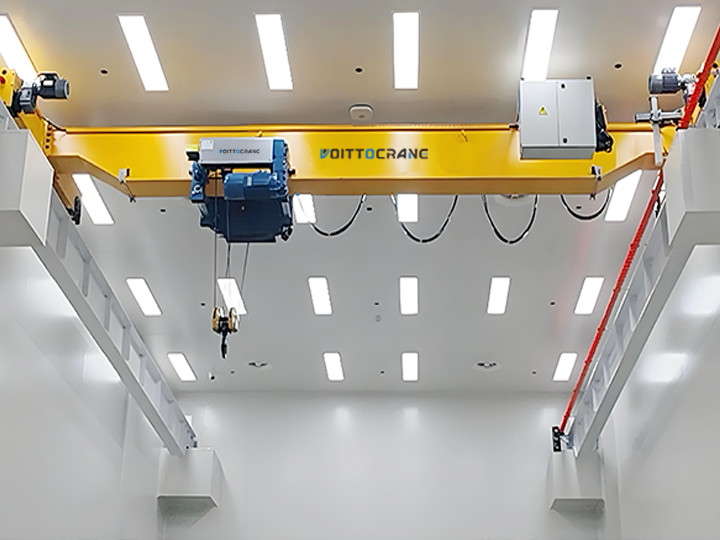

Why European-Style Cranes Recover More Headroom Than Standard Designs
The hoist position is the single biggest design difference
European-style overhead cranes recover headroom by mounting the hoist trolley within or alongside the lower flange of the bridge beam, eliminating the full hoist body height from the vertical stack — this is the fundamental engineering difference from a conventional crane, and it’s what makes the performance gap real rather than a marketing claim.
In a standard overhead crane, the hoist hangs entirely below the bottom flange. Everything stacks vertically: rail → beam depth → hoist body → rope head distance → hook. In a facility with a 5.5-meter eave height, that full column typically consumes 1.3–1.8 meters, leaving 3.7–4.2 meters of actual hook travel. For many applications involving standard sling sets and load heights, that’s marginal at best.
A European-style hoist trolley travels along the bottom flange with its drum and gearbox positioned beside the beam rather than below it. The hoist body height — which accounts for 300–550 mm in a standard wire rope hoist — is no longer additive to the total dimension. The practical result: in the same 5.5-meter building, a European single girder crane typically delivers 4.4–4.9 meters of usable hook travel. That 500–700 mm difference frequently determines whether a facility can use standard lifting attachments or must custom-shorten every sling set.
European single girder vs. European double girder: not just a capacity question
For loads up to 12.5 tons, a European single girder crane is the standard choice; above that threshold, a European double girder design is required — but the structural difference also affects how much headroom each configuration actually needs.
A European single girder crane uses a shallow I-section or box beam with the hoist trolley running on the bottom flange. The beam depth is optimized for the span and load, typically 300–500 mm for spans under 20 meters. Because the hoist sits alongside the beam rather than below it, the total height from rail top to hook at maximum lift is compact.
A European double girder crane carries the hoist trolley on rails mounted on top of the two main girders, with the hook descending between them. This means the hoist body sits above the girder top, and the hook drops through the gap between the beams. The geometry is different from a single girder — the hook can descend very close to the bottom of the girder assembly, but the overall crane height above the runway rail is greater. For heavy loads in constrained buildings, this is still significantly better than a conventional double girder design with a standard wire rope hoist suspended beneath the beam.
The practical boundary: if your load is under 10 tons and your building is under 6 meters, European single girder is almost always the right answer. For 10–50 tons in buildings between 5.5 and 7 meters, European double girder is the design to evaluate.
How to Calculate Your Actual Usable Hook Height
The four-dimension stack that determines real performance
Usable hook height is not the same as building height — it’s what remains after subtracting four stacked dimensions, and buyers who skip this calculation routinely discover the problem only after installation.
The formula:
Usable Hook Height = Eave Height − Rail Height − Beam Depth − Hoist Body Height − Rope Head Distance
Each element, with typical values for reference:
- Rail height: the crane rail sitting on the runway beam adds 50–120 mm depending on rail size (QU70/QU80 are common in industrial overhead crane installations)
- Beam depth: the bridge girder itself — standard single girder cranes typically 400–700 mm depending on span; European designs use shallower optimized sections, often 280–450 mm for the same span
- Hoist body height: where the biggest difference lives — standard wire rope hoists contribute 350–550 mm; European low-headroom hoists contribute 130–260 mm
- Rope head distance: distance from hoist drum to hook at maximum lift, typically 180–350 mm
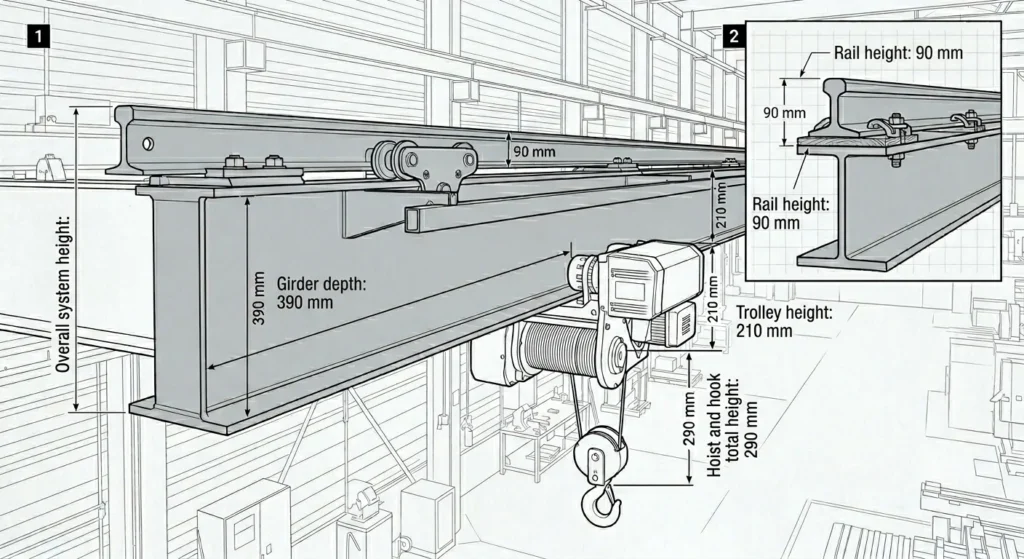
Note: All specified dimensions are for reference only. Please consult product specifications and installation manuals for actual data.
Running the same building through both designs makes the impact concrete. In a facility with a 5.8-meter eave height, runway rail at 5.4 meters (400 mm consumed by runway beam + rail), the comparison looks like this:
| Измерение | Standard Single Girder | European Single Girder |
|---|---|---|
| Runway rail elevation | 5,400 mm | 5,400 mm |
| Beam depth | −500 mm | −350 mm |
| Hoist body height | −450 mm | −180 mm |
| Rope head distance | −250 mm | −210 mm |
| Usable hook travel | ~4,200 mm | ~4,660 mm |
The 460 mm difference in this example is typical of what plants actually measure after installation. It doesn’t sound like much until you’re trying to lift a 2-meter-tall die set using a 500 mm sling — at which point 460 mm is exactly the margin you needed.
Why retrofitted buildings lose more headroom than drawings suggest
In older or converted facilities, the real usable headroom is frequently 300–500 mm less than the architectural drawings show — because pipework, fire suppression lines, cable trays, and HVAC runs installed after the original building was surveyed occupy the overhead zone the drawing treats as clear.
This gap between drawing and reality is one of the most consistent sources of post-installation complaints about insufficient hook height. A food processing facility that later added hygiene piping at ceiling level, or a manufacturing plant that installed compressed air runs after the original crane assessment, may have lost 400 mm of clear headroom without anyone revising the crane specification.
The correct procedure is a physical site survey — with measurements taken at the actual hook travel zone, not at the center aisle — before the crane specification is finalized. For any facility with suspended services, request a cross-section drawing with all installed infrastructure marked. This takes a day to produce and costs nothing; discovering the problem after installation costs significantly more.
Three Procurement Mistakes That Drive Up Real Cost
Mistake 1: Reading “minimum headroom” as usable hook height
Suppliers quote a “minimum headroom requirement” that describes what the crane needs to fit — not what hook travel you’ll actually get — and this distinction causes the majority of low headroom installation complaints.
When a datasheet states “minimum headroom 4,500 mm,” it means the crane requires at least 4,500 mm between the floor and the underside of the runway beam to physically operate. Your usable hook travel in that envelope — after subtracting beam depth, hoist body, and rope head distance — might be 3,600–3,900 mm. Buyers who treat these numbers as equivalent discover the gap only after the crane is commissioned.
The fix is straightforward: require the supplier to provide a dimensioned cross-section drawing of the crane installed in your runway configuration, showing every element of the vertical stack and the resulting hook travel. Any competent supplier can produce this in a few days. If a supplier can’t or won’t provide it before order placement, that response tells you something important about their engineering capability.
Mistake 2: Ignoring runway compatibility until after the quote is accepted
The cost item most frequently missing from initial low headroom crane quotes is runway system modification — and in older facilities, this commonly adds $8,000–$35,000 to a project budgeted at equipment cost only.
European-style cranes require tighter runway geometry than conventional cranes: rail alignment within tighter tolerances, specific rail cap profiles to match end carriage wheel groove dimensions, and elevation matching within ±2 mm end-to-end. Facilities built for conventional cranes — with rails sized for the previous crane’s wheel load, aging fishplate connections, or accumulated rail joint gaps — often need partial or full rail replacement before a European-style crane can be installed correctly.
This isn’t a quality issue with the crane; it’s a geometry compatibility issue that should be assessed before quoting, not discovered during commissioning. Before signing any purchase contract, require the supplier to confirm in writing whether runway modification is included or excluded, what rail profile the crane requires, and whether an existing rail condition assessment is part of the scope. A quote that doesn’t address these questions is incomplete.
Mistake 3: Selecting a European-style hoist for its dimensions without checking duty class
The compact footprint of European-style hoists is achieved through optimized engineering — but in lower-grade products, the same compact dimensions are achieved by undersizing the gearbox service factor or motor thermal class, and these units fail significantly earlier than their rated duty class suggests.
A 5-ton European-style hoist at $3,200 and one at $6,500 may look nearly identical in a product photo. The difference is almost always in FEM duty class, motor insulation class, gearbox service factor, and the quality of components used in the drum and braking system. In facilities running 15 or more lifts per shift, an undersized duty class hoist will show accelerated brake wear and gearbox heat within 18–30 months — costs that far exceed the initial price saving.
For production-line applications, specify FEM M4 minimum; for multi-shift or continuous operations, FEM M5. Require the supplier to state the duty class in the purchase contract, not just on the nameplate — and ask for the component-level design basis (gearbox service factor, motor thermal class) if the application is demanding. This request is reasonable and standard; a supplier who can’t answer it is working from catalog selection rather than engineering.
Have your facility drawings ready? Send them to our engineering team for a headroom calculation and configuration recommendation at no cost
Получить цитатуСертификация и соответствие требованиям
What documents to require before placing any order
CE marking under Директива ЕС по машинному оборудованию 2006/42/EC is the baseline compliance requirement for European market buyers, but a CE mark without notified body involvement is non-compliant for most overhead cranes above 1 ton — and this is one of the most common documentation gaps in the market.
For lifting equipment covered under Annex IV of the Machinery Directive, conformity assessment by an EU notified body is required. Self-declared CE without a named notified body and certificate number does not satisfy this requirement and will not pass European customs inspection for covered equipment categories. This matters at the port of entry, not just on paper.
Request the following documents in writing before contract signing:
- Декларация соответствия ЕС: must name the specific notified body and certificate number; a declaration without these is non-compliant for Annex IV equipment
- Загрузить сертификат испытаний: static overload test at 125% of WLL, dynamic test at 110% WLL, per EN 13001 or equivalent — must be specific to the crane configuration ordered, not a generic type certificate
- Сертификат ISO 9001: current, with scope explicitly covering crane and hoist manufacturing (not just a parent company certificate with a different scope)
- FEM duty class documentation: confirming the crane and hoist structure were designed to the stated duty class — ask for the design calculation summary, not just a nameplate
For buyers in Russia, Kazakhstan, and the Eurasian Economic Union: EAC certification under TR CU 010/2011 is required for customs clearance. Allow 3–4 months if the supplier does not already hold a current certificate for the specific configuration.
How to verify documents beyond the certificate number
Certificate numbers are easy to list; the factory audit behind them is what matters. For any order above $30,000 or any application in demanding conditions, also request:
- The ISO 9001 surveillance audit report from the most recent cycle — not just the certificate
- Weld procedure qualification records (WPS/WPQR) for the main girder welds; European-style cranes use thinner optimized sections where weld quality control is more critical than in heavier conventional girders
- NDT records for girder welds: ultrasonic or radiographic testing, not visual inspection alone
A supplier who resists providing these documents before contract award is signaling that the documentation either doesn’t exist or doesn’t reflect the actual production process.
Заключение
A low headroom crane is the right starting point for any facility where ceiling height, retrofitted infrastructure, or building economics make a conventional overhead crane impractical. The engineering logic is clear: European-style single and double girder designs recover 400–700 mm of hook height in the same building envelope by repositioning the hoist mechanism — and that margin directly determines whether standard lifting attachments work or whether every operation requires custom rigging.
The procurement discipline matters as much as the product choice. Confirm your actual usable hook height using the four-dimension calculation before committing to a specification. Verify runway compatibility before treating any quote as complete. Match the hoist duty class to your real operating cycle, not the minimum catalog option. And require the full compliance document package — EC Declaration, load test certificate, ISO 9001 — before the wire transfer.
Ready to configure a low headroom crane for your facility? Send us your building dimensions and we’ll provide a headroom calculation and written configuration recommendation within 24 hours.

Алан
Специалист по крановым решениям · Voitto Crane
Специализируется на производстве мостовых кранов, козловых кранов, стреловых кранов, портовых кранов и кранов EOT. Более 10 лет помогает глобальным клиентам в проведении предпродажных консультаций, выборе грузоподъемности и конфигураций для конкретного объекта.
ЧАСТО ЗАДАВАЕМЫЕ ВОПРОСЫ
Q1: What is the key difference between a European-style and a standard overhead crane for low headroom applications?
The hoist position is the core difference. A standard crane hangs the hoist entirely below the bridge beam, consuming 350–550 mm in hoist body height alone. A European-style crane mounts the hoist beside or within the beam’s lower flange, reducing this to 130–260 mm. In a 5.5-meter building, the practical result is typically 400–600 mm more usable hook travel — enough to determine whether standard sling sets work without modification.
Q2: When should I choose a European single girder vs. a European double girder crane?
For loads up to 12.5 tons in buildings under 6 meters, European single girder is almost always the right choice — simpler, lighter on the runway structure, and lower cost. For loads of 10–50 tons in buildings between 5.5 and 7 meters where a standard double girder can’t fit or doesn’t deliver enough hook height, European double girder is the design to evaluate. The boundary isn’t rigid; specific span, duty class, and building geometry all affect the decision.
Q3: How much does a low headroom European-style crane cost compared to a standard crane?
European single girder cranes typically run $15,000–$60,000 vs. $8,000–$45,000 for a comparable standard single girder — a premium of roughly 25–40% for the crane equipment itself. European double girder configurations start around $35,000 vs. $25,000+ for standard double girder. The premium reflects higher-grade hoist components, tighter manufacturing tolerances, and the compact trolley design. For facilities where headroom is the constraint, the alternative — building modification or reduced operational capability — almost always costs more than the premium.
Q4: What is the minimum building height for a European-style low headroom crane?
European single girder cranes in the 1–10-ton range typically require an eave height of 4.5–5.5 meters minimum, depending on span and rail configuration. This is a theoretical figure for the crane in isolation; your actual minimum also depends on the height consumed by the runway beam and rail. Always ask the supplier to confirm usable hook height after accounting for all four stacked dimensions in your specific building — not just the crane’s standalone minimum headroom figure.
Q5: What certifications should I require from a European-style low headroom crane supplier?
At minimum: EC Declaration of Conformity naming a specific EU notified body and certificate number (required for Annex IV equipment — a self-declared CE is not sufficient); load test certificate (static 125% WLL, dynamic 110% WLL per EN 13001 or equivalent); and current ISO 9001 certificate with manufacturing scope. For EAC markets, add TR CU 010/2011 certification. Request all documents before contract signing, not after payment.




 English
  Español
  Português
  العربية
  Français
  Русский