
Material handling cranes include overhead cranes, gantry cranes, jib cranes, and monorail crane systems. Users operate this equipment in factories, warehouses, and logistics facilities to lift, move, and position materials. Selecting the appropriate crane depends not only on lifting capacity but also on load capacity, span, lifting height, duty class, and on-site conditions. Next, this article will introduce the definition of material handling cranes, describe the types of cranes commonly used in factories, warehouses, and specialized facilities, and discuss the practical considerations that determine which crane configuration should be selected for specific applications.


- 1 What Are Material Handling Cranes?
- 2 What Types of Cranes Are Used in Material Handling?
- 3 What Are the Different Types of Indoor Cranes?
- 4 How Do Material Handling Cranes Work?
- 5 Material Handling Equipment: Where Do Cranes Fit?
- 6 Material Handling Crane Applications
- 7 What Types of Cranes Are Used for Container Handling?
- 8 How to Choose the Right Material Handling Crane
- 9 Why Work with a Professional Material Handling Crane Manufacturer?
- 10 Заключение
- 11 ЧАСТО ЗАДАВАЕМЫЕ ВОПРОСЫ
What Are Material Handling Cranes?
Material handling cranes are lifting systems used to lift, move, position, and transfer loads within a specific work area (typically located inside or around industrial facilities). This term does not refer to a single crane design but rather encompasses a class of equipment—including overhead cranes, gantry cranes, jib cranes, and monorail systems—that are specifically designed to support material flow in manufacturing, warehousing, and logistics operations.
Примечание: “Material handling” refers to the movement, protection, storage, and control of materials throughout a facility, covering the entire process from raw material intake and production through to finished goods storage and shipment. Cranes fall under the broader category of material handling equipment, alongside forklifts, conveyors, and automated guided vehicles (AGV Cart).
Crane equipment is the preferred choice when loads are heavy, oversized, or difficult to handle, or when precise vertical and horizontal control is required along fixed, repeatable paths. Typical facilities that rely on material handling cranes include machining and metal fabrication shops, steel mills, foundries, warehousing and distribution centers, assembly plants, and shipyards.
It is important to distinguish “cranes” from the broader concept of “material handling equipment”: “cranes” specifically refer to the lifting system and steel structures and their travelling systems, whereas “material handling equipment” is a general term that encompasses all types of devices used to move materials—whether cranes, forklifts, conveyors, or other equipment.
What Types of Cranes Are Used in Material Handling?
Several crane configurations are used for material handling, each suited to different building layouts, load types, and duty requirements. No single crane type is correct for every application.
Подвесные краны
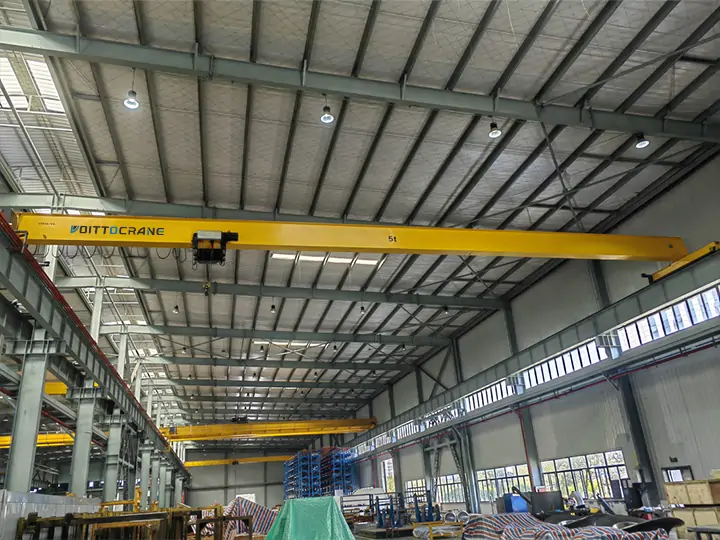
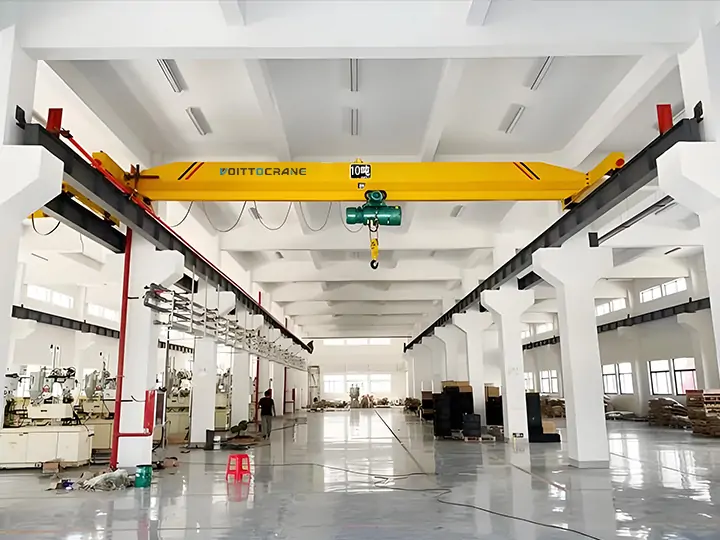
Overhead cranes run on tracks installed above the work area and are typically supported by building columns or specialized steel structures. They are widely used in indoor facilities where repetitive lifting operations are required within a specific floor area.
Single Girder Bridge Crane

Двухбалочный мостовой кран

Подвесной кран
- A single-girder bridge crane features a single main girder, with the hoist system traveling along the lower flange of the main girder or on a monorail track. This type of crane is ideal for light- to medium-duty applications where headroom or budget is limited.
- Double-girder overhead cranes are equipped with two parallel main girders, and the hoist trolley runs on a track mounted on top of the main girders. This equipment is suitable for heavy-duty, long-span applications, as well as work scenarios with higher requirements for hook lifting height.
- Underslung cranes are suspended from the ceiling structure or roof trusses and do not require column support. This type is the preferred solution when it is not possible to install floor-mounted support columns.
Overhead cranes are ideal for repetitive material-handling operations. Their rail and trolley systems provide a fixed, repeatable travel path, thereby minimizing setup time between lifting operations and reducing the physical strain associated with manual handling.
Козловой кран
Gantry cranes are similar to overhead cranes, but their support structure relies on their own legs rather than elevated track beams.

Однобалочный козловой кран

Двухбалочный козловой кран

Портативный козловой кран
- Single-girder gantry cranes are suitable for lighter loads and are more cost-effective for shorter spans.
- In contrast, double-girder gantry cranes are suitable for heavier loads and larger spans.
- Portable gantry cranes are particularly well-suited for scenarios requiring flexible movement between different work areas, rather than continuous, high-intensity operations.
Gantry cranes can be used both outdoors (such as in yards, material storage areas, and precast concrete plants) and indoors where overhead tracks cannot be installed. Gantry cranes are typically preferable to overhead cranes in the following situations: when the building structure cannot support track beams, when the crane needs to serve outdoor areas, or when the work area has an irregular shape that makes it unsuitable for installing fixed tracks.
Jib Cranes
Jib cranes provide localized coverage through the rotation of their jibs, which differs from the long-distance, linear travel paths of overhead or gantry cranes.

Напольный стреловой кран

Настенный подвесной кран

Настенный стреловой кран
- Floor-mounted jib cranes are secured to a column and can rotate over a wide range (typically 200 to 360 degrees, depending on the presence of surrounding obstacles).
- Wall-travelling jib cranes are mounted on walls and have a rotation angle of approximately 180 degrees; these cranes can travel along walls or other support structures on overhead tracks, covering a broader work area.
- Wall-mounted jib cranes are secured to existing walls or columns, allowing for increased local lifting coverage without the need for a separate foundation.
Jib cranes are typically used at individual workstations (such as machine tools, welding areas, or loading/unloading platforms), where lifting requirements are frequent, but the operating range is limited to a small radius rather than spanning the entire width of the facility.
Lifting capacity and operating radius depend on the specific project. Users should base their engineering design on the actual workstation layout rather than relying solely on general specification parameters for estimation.
Monorail and Workstation Cranes


Monorail cranes run a single hoist along a fixed overhead track, often following a production line or routing loads between defined stations. Workstation crane systems extend this concept with modular, often aluminum, track that can include curves and branch lines to connect multiple work areas. Both are common in assembly lines, warehouses handling routed totes or components, and any environment where the same lift-and-move sequence repeats at a defined set of points.
Получить цитатуWhat Are the Different Types of Indoor Cranes?
The most commonly used types of indoor cranes include overhead cranes, underhung cranes, jib cranes, monorail cranes, and workstation cranes. When rail structures cannot be installed, portable gantry cranes are used. Note: Selecting the appropriate type of indoor crane depends on several site-specific factors:
| Фактор | Consideration |
|---|---|
| Грузоподъемность | Heavier, more frequent lifts favor double girder overhead cranes; lighter, occasional lifts suit jib or single girder configurations |
| Зона покрытия | Full-bay coverage favors overhead or gantry systems; localized coverage favors jib cranes |
| Available headroom | Underslung or low-headroom overhead designs suit buildings with limited hook height |
| Building structure | Runway-supporting columns favor overhead cranes; insufficient structure favors gantry or portable systems |
| Frequency of lifting | High-cycle, repetitive lifting favors overhead or monorail systems designed for continuous duty |
| Required travel path | Long, linear travel favors overhead/gantry; fixed-radius coverage favors jib cranes |
| Installation requirements | Runway-mounted systems require a building assessment; gantry and portable systems generally require less structural work |
How Do Material Handling Cranes Work?
Although material handling cranes come in various configurations, most material-handling equipment follows a common sequence of operations. However, not all types of cranes perform all of the following operations.
- Attaching the Load — Use slings, chains, or lifting devices suited to the load’s shape and weight to connect the load to the hook or lifting mechanism.
- Hoisting — The hoisting mechanism lifts the load vertically upward. The hoisting mechanism is the component responsible for lifting and lowering and operates independently of the crane’s travel mechanism.
- Trolley Movement — If the crane is designed with a trolley, the trolley can move the hoisting mechanism laterally along the bridge girder or main beam, thereby enabling lateral positioning. Jib cranes typically use a trolley that runs along the jib beam.
- Crane Traverse — For overhead and gantry cranes, the entire bridge structure travels along the tracks via end beams (elevated tracks for overhead cranes and ground-level tracks for gantry cranes), thereby covering the longitudinal working area of a factory or yard.
- Load Positioning — Through a combination of lifting, trolley movement, and bridge travel, the operator can position the load at a specified location in three-dimensional space.
- Lowering and Unloading — Lower the load to the target position and unload it (unhook).
Примечание: the hoist performs vertical lifting; the trolley provides horizontal movement of the hoist along the bridge or jib; the bridge (for overhead cranes) or gantry structure (for gantry cranes) supports the hoist and trolley and provides the structural span; and the end girder and crane travel mechanism, where present, move the whole bridge along the runway. A jib crane has no bridge or end carriages at all — its trolley travels along a fixed arm instead.
Material Handling Equipment: Where Do Cranes Fit?
Cranes are a type of material handling equipment; other categories include forklifts, conveyors, AGV/AMR, pallet handling equipment, and standalone winches and hoists. There is no absolute hierarchy of superiority or inferiority among these devices; rather, each is suited to different loads, layouts, and process conditions. Cranes are the more suitable solution for the following operating conditions:
- When the weight or dimensions of the load exceed the safe operating limits of forklifts or manual handling equipment
- When the load needs to be lifted vertically to clear obstacles, machinery, or other inventory items
- When the same “lift-and-move” workflow is repeated frequently, making a fixed installation worthwhile
- More precise and controlled positioning is required than what forklift mast lift and tilt functions can provide
- The work area is large enough to justify the installation of fixed tracks or a gantry with a suitable span
For the continuous, high-volume handling of small, uniform-sized goods along fixed or flexible routes, conveyors and AGVs are typically more efficient. However, for point-to-point transport without a fixed path across large floor areas, forklifts offer greater flexibility. Cranes are not the optimal solution in every situation—they provide unique value only when vertical lifting, heavy-load handling, or fixed, repetitive paths are the primary requirements.
Material Handling Crane Applications
Производственные предприятия: Users employ this equipment to transport raw materials, components, and finished parts between machining centers and assembly areas.
Machine Shops: Operators use the equipment to lift and move engine blocks, transmissions, and various assemblies during machining, assembly, and testing processes.
Сталелитейные заводы: Users employ this equipment to handle steel coils, billets, and slabs. Typically, these cranes are equipped with specialized lifting attachments and heavy-duty configurations.
Foundries: Material-handling cranes move molten iron ladles, molds, and castings in high-temperature and high-frequency operational environments.
Склады и логистические центры: Users operate this equipment to handle palletized cargo, large containers, and irregularly shaped goods.
Construction-Related Material Handling: Material handling equipment is used at precast processing sites to load and unload precast concrete components, structural steel, and bulk materials.
Shipbuilding and Ship Repair: Users operate this equipment to lift ship sections, engines, and heavy components during shipbuilding and repair.
Port and Container Operations: Port operators use specialized lifting equipment to transfer containerized cargo between ships, yards, and transport vehicles.
What Types of Cranes Are Used for Container Handling?
Container handling is a specialized field of material handling, and the types of cranes used in this field are entirely different from the factory and warehouse cranes mentioned earlier. They primarily include:

Кран STS

Кран RMG

Кран RTG

Контейнерный кранов-перегружатель
- Ship-to-Shore (STS) Cranes: Used to load and unload containers between ships and docks.
- Rail-mounted gantry cranes (RMG): These operate on fixed rails in container yards and are responsible for stacking and retrieving containers according to predetermined rows.
- Rubber-tired gantry cranes (RTG): These perform operations in container yards but are mounted on tires, allowing them to move between different rows without the need for fixed rail infrastructure.
- Кран-перегружатель: A straddle carrier combines lifting, transporting, and stacking functions into one. It can move directly over cargo, using lifting attachments to lift it from the ground, transport it, and stack it in the designated location.
These cranes are designed with the standard dimensions and weights of containers in mind, as well as the demands of high-frequency port operations, which sets them apart from the general-purpose material-handling cranes used in factories and warehouses discussed elsewhere in this article.
How to Choose the Right Material Handling Crane
Crane selection should be based on the complete working conditions of the application, not on lifting capacity alone. Key factors include:
- Rated Lifting Capacity — The maximum load the crane must be able to handle safely, with a reasonable allowance for future needs
- Span — The distance the main girder of a bridge or gantry crane must span
- Lifting Height — The vertical distance between the lowest and highest positions of the hook
- Duty Class — The frequency of use and load intensity of the crane, which affects structural and mechanical design
- Lifting and Travel Speeds — Must be matched to production cycles and safe operating procedures
- Indoor vs. Outdoor Environments — Affects corrosion protection requirements, electrical protection ratings, and wind load design for outdoor gantry cranes
- Available headroom — Determines whether a standard bridge crane, a low-headroom design, or an under-slung system is suitable
- Building structure — Whether existing columns or track beams can support the crane’s load, or whether a gantry crane or self-supporting structure is required
- Floor and foundation conditions — Relate to the installation of gantry crane tracks and the foundation for floor-mounted jib cranes
- Operating Frequency — The expected number of lifting cycles per hour or per shift
- Load Characteristics — Shape, center of gravity, and whether special lifting gear or attachments are required
- Power Supply — Available voltage and number of phases, as well as whether power supply via conductor rail, trolley (cable), or drum is suitable
- Control Methods — Pendant control, wireless remote control, or cab control, depending on the operator’s location and visibility requirements
- Safety Requirements — Limit switches, overload protection, and other safety devices appropriate for the application
- Maintenance Requirements — Ease of inspection and component replacement throughout the crane’s service life
- Future Capacity Requirements — Whether the facility’s production plans may require higher lifting capacity or greater coverage in the future
Why Work with a Professional Material Handling Crane Manufacturer?
Selecting and specifying a crane involves engineering judgment across structural design, hoisting system selection, electrical configuration, and safety compliance. Working with an experienced manufacturer such as VOITTO Crane means:
- Engineering and technical support to ensure that crane types, configurations, and hoisting systems precisely match actual application requirements
- Manufacturing capabilities covering both standard product lines and project-specific customization needs
- Component selection based on actual operating conditions (rather than being limited to specifications in a fixed product catalog)
- Safety device configuration and compliance considerations tailored to specific installation environments
- Installation and commissioning support to ensure the crane is put into service smoothly
- After-sales service, including maintenance, spare parts supply, and troubleshooting
- Customized project solutions for facilities with multiple crane types or phased expansion plans
VOITTO Crane is committed to working closely with customers’ procurement teams and plant engineers to tailor the most suitable crane and hoisting system configurations for specific facilities.
Заключение
Material-handling cranes come in a variety of configurations—including overhead, gantry, jib, and monorail crane systems—each suited to specific plant layouts, load types, and duty cycle requirements. When selecting the appropriate crane, procurement teams should comprehensively evaluate lifting capacity, span, lifting height, duty class, and on-site operating conditions based on actual application needs, rather than focusing solely on lifting capacity as a single metric.
VOITTO Crane offers engineering support, manufacturing capabilities, and customized project solutions to assist procurement teams and plant engineers in selecting the most suitable lifting and hoisting systems for their facilities. Please contact VOITTO Crane for crane selection recommendations, technical consultations, or customized quotes.

Алан
Специалист по крановым решениям · Voitto Crane
Специализируется на производстве мостовых кранов, козловых кранов, стреловых кранов, портовых кранов и кранов EOT. Более 10 лет помогает глобальным клиентам в проведении предпродажных консультаций, выборе грузоподъемности и конфигураций для конкретного объекта.
ЧАСТО ЗАДАВАЕМЫЕ ВОПРОСЫ
What are material handling cranes?
Material handling cranes are lifting systems used to lift, move, and position loads in industrial and logistics facilities. They primarily include overhead cranes, gantry cranes, jib cranes, and monorail cranes.
How much do material-handling cranes cost?
Pricing depends on factors such as lifting capacity, span, lifting height, duty class, hoist type, control system, and installation conditions. The crane manufacturer must evaluate the customer’s specific application to provide an accurate quote.
Which type of crane is best suited for indoor material handling?
Overhead cranes are suitable for scenarios with ample headroom that require coverage across the entire span; jib cranes are suitable for localized lifting at workstations; and low-headroom or under-slung designs are suitable for facilities where hook height is limited.
How do you select the appropriate lifting capacity for a crane?
When selecting a lifting capacity, you should not only consider the rated load but also factor in the actual maximum load, a margin for future needs, as well as span, duty cycle, and lifting height.



 English
  Español
  Português
  العربية
  Français
  Русский