
A hydraulic gantry crane is a heavy-duty lifting system. This equipment is equipped with hydraulic cylinders and hoisting motors to lift, lower, and position loads. Engineers typically opt for this type of equipment when a project exceeds the actual lifting capacity of a bridge crane or mobile crane. Its load capacity typically ranges from 100 tons to over 1,000 tons. Next, VOITTO Crane will provide a detailed overview of the equipment’s operating principles, components, areas of application, and factors that buyers should evaluate before making a purchase.
What is a Hydraulic Gantry Lifting Systems?
This lifting system is a modular steel structure equipped with hydraulic lifting cylinders that can raise and lower loads along a controlled vertical path. The frame typically consists of four or more legs connected by a horizontal beam, with the load suspended from lifting points beneath the horizontal beam. Unlike wire-rope hoists, which rely on drums and steel cables to lift loads, this system uses hydraulic pistons driven by a central hydraulic power unit to push or pull the load.
The primary purpose of this equipment is to lift and position loads that are too heavy, too tall, or too bulky. For example, a 500 ton power transformer or a large ship hull component cannot be lifted using a conventional crane, but a suitably configured hydraulic gantry crane system can be built specifically for such heavy loads.


This equipment differs from traditional gantry cranes in its hoisting mechanism and the way it distributes structural loads. Traditional gantry cranes use electric hoists and steel wire ropes that run on a trolley. However, their lifting capacity is limited by the size and strength constraints of the wire ropes, drums, and motors. In contrast, a hydraulic system distributes the lifting force across multiple cylinders operating in synchrony, allowing the structure to be scaled up to achieve higher lifting capacities. Consequently, once a project’s lifting requirements exceed the reasonable load-bearing range of a wire-rope gantry crane, hydraulic lifting equipment becomes the standard choice.
How Does a Hydraulic Gantry Crane Work?
This lifting system works by converting hydraulic fluid pressure into controlled mechanical lifting force. The process begins at the hydraulic power unit, continues through the cylinders, and finishes with a computer-controlled synchronization system that keeps every lifting point moving at the same rate.
Hydraulic Power Generation: The hydraulic power unit contains a motor-driven pump that pressurizes hydraulic oil and sends it through a network of hoses and valves to each cylinder. The pump generates the force needed to lift the load, while pressure relief valves and safety valves protect the system from overload.
Гидравлические цилиндры: Each hydraulic cylinder converts hydraulic pressure into linear motion. When pressurized oil enters the hydraulic cylinder, the piston rod extends or retracts, thereby raising or lowering the lifting beam. Because hydraulic cylinders can be positioned at multiple points around the load, the crane is able to distribute the weight evenly rather than concentrating the pressure at a single lifting point.
Synchronized Lifting System: A PLC-based control system links all hydraulic cylinders, enabling them to extend and retract at exactly the same speed. This synchronization is critical because even the slightest difference in lifting speed between cylinders can cause the load to tilt, result in uneven stress on the structure, or even damage precision equipment such as transformers or turbine components. Sensors continuously transmit position data back to the controller, which adjusts the hydraulic flow in real time to keep the load level.
Система управления: Operators monitor lifting speed, load weight, and cylinder position via the central control panel. If the system detects an imbalance, it automatically slows down or stops the affected cylinder until the load is level again. This closed-loop control process enables the equipment to lift with millimeter-level precision.
What are the Main Components of a Hydraulic Gantry Crane?
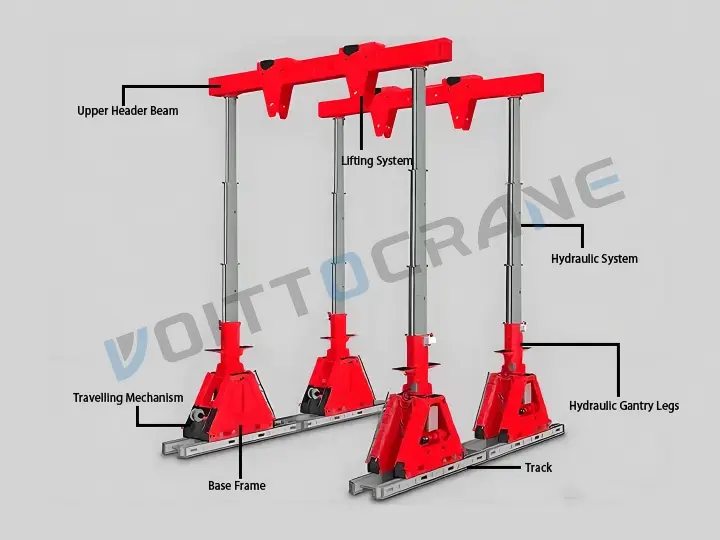
Every hydraulic gantry lifting system is built from six core components, and each one plays a specific role in lifting capacity, stability, and safety.
- Gantry Frame: This frame constitutes the load-bearing structure of the crane. The frame transfers the hoisting load to the ground, and it must be designed to withstand the vertical loads and lateral forces generated during the hoisting process.
- Hydraulic Lifting Cylinders: These cylinders generate the actual lifting force. The stroke length of the cylinder determines the maximum height that can be lifted in a single operation.
- Hydraulic Power Unit (HPU): The HPU consists of a pump, motor, reservoir, valves, and a filtration system, and supplies pressurized hydraulic fluid to each cylinder.
- PLC Synchronization Control System: This component coordinates cylinder movement, monitors load sensors, displays real-time lifting data, and triggers an automatic shutdown when faults such as pressure loss or load imbalance are detected.
- Lifting Beam: The lifting beam connects the hydraulic cylinder to the load itself, distributing the weight across multiple connection points.
- Система слежения: This component enables the load to be moved horizontally after it has been lifted.
Applications of Hydraulic Gantry Crane
The following lists common applications for a hydraulic gantry crane.
Transformer Installation: Users operate this equipment to move power transformers weighing between 200 and 800 metric tons. This equipment is particularly well-suited for substations with limited working space.
Power Plant Equipment Lifting: Steam turbines, generators, boilers, and pressure vessels are common items lifted during power plant construction and maintenance outages. Users assemble modular hydraulic lifting systems on-site to perform equipment lifting tasks.
Shipbuilding and Ship Repair: Shipyards use hydraulic gantry systems to lift and position hull components, engines, and propulsion equipment.
Heavy Machinery Installation: Operators use this equipment to assist in the installation of large presses, rolling mills, or industrial furnaces.
Нефтехимическая промышленность: Reactors, columns, and storage tanks used in refineries and chemical plants are typically large in size. Users can reduce the risk of structural damage during installation by performing slow, synchronized lifting operations using hydraulic systems.
Bridge Construction Projects: Construction teams use this equipment to lift main girders and precast segments for bridges.


How to Choose the Right Hydraulic Gantry Crane?
When selecting the right equipment, the buyer must first have a clear understanding of the lifting task, as capacity, height, and configuration all depend on the specific details of the project rather than standard catalog specifications.
- Грузоподъемность: The buyer should confirm the actual maximum load weight, including any rigging, lifting beams, or lifting attachments, and add an appropriate safety margin. The crane’s size should not be determined based solely on the weight of the crane itself.
- Высота подъема: The vertical distance the load must be lifted determines the stroke length of the hydraulic cylinder and, in some designs, also determines whether multi-stage lifting is required to reach the final height.
- Рабочая среда: Indoor factories, crowded industrial sites, and outdoor infrastructure projects all impose different constraints on space, headroom, and foundation bearing capacity. These constraints affect the frame width, leg spacing, and foundation requirements.
- Load Dimensions: The physical dimensions and shape of the load—not just its weight—determine the number of lifting points required and how the lifting beams should be configured to prevent concentrated loads or tipping.
- Рабочая частота: Cranes used for one-time installation projects have different duty cycle requirements than those reused across multiple projects, which affects component selection and long-term maintenance plans.
- Требования безопасности: In projects within regulated industries such as the power and petrochemical sectors, cranes require specific certifications, redundant safety systems, and documented load tests.
Гидравлический козловой кран на продажу
Buyers evaluating this equipment for sale should understand that price depends on far more than tonnage alone. Several factors shape the final cost of a project-specific system.
VOITTO Crane is a professional manufacturer and supplier of a hydraulic gantry crane. The company designs and manufactures hydraulic gantry crane systems with lifting capacities ranging from 100 metric tons to over 800 metric tons. Each unit is custom-designed based on the customer’s load requirements, span, and on-site conditions, rather than being based on a fixed product catalog. For hydraulic gantry lifting system solutions, please контактный кран VOITTO.

Алан
Специалист по крановым решениям · Voitto Crane
Специализируемся на экспортных решениях в области мостовых кранов, козловых кранов, поворотных кранов, портовых кранов и мостовых кранов. Более 10 лет помогаем глобальным клиентам в проведении предпродажных консультаций, выборе грузоподъемности и разработке конфигураций с учетом специфики объекта.
Заключение
The key reason why hydraulic gantry cranes have established themselves in heavy-lift projects is that cylinder-based lifting offers greater lifting capacity than wire rope systems without sacrificing control precision. It is precisely this advantage that makes hydraulic gantry cranes the preferred choice for loads exceeding 100 metric tons where extremely high precision is required.
Selecting the appropriate system for a specific project still depends on the particular circumstances—lifting capacity, span, site conditions, and the safety standards required by the specific industry. Only when users share load data, site constraints, and lifting sequences with a professional engineering team in advance can manufacturers transform a hydraulic gantry crane from a generic specification sheet into a system tailored specifically for the task at hand.
ЧАСТО ЗАДАВАЕМЫЕ ВОПРОСЫ
What is a hydraulic gantry crane used for?
Users operate this equipment to lift and position extremely heavy or oversized loads, such as power transformers, ship components, and petrochemical vessels.
How much weight can a hydraulic gantry crane lift?
How much weight can a hydraulic gantry crane lift? Capacities typically range from 100 tons to over 800 tons, depending on the number of hydraulic cylinders and the structural design of the gantry frame.
What is the difference between a hydraulic gantry crane and a traditional gantry crane?
Traditional gantry cranes are equipped with electric hoists or winches as lifting mechanisms, while hydraulic gantry cranes use synchronized hydraulic cylinders, enabling them to achieve higher lifting capacities and better load control.
How does a hydraulic gantry crane stay level while lifting?
A PLC-based synchronization system monitors each cylinder’s position and adjusts hydraulic flow in real time so that every lifting point moves at the same rate.


 English
  Español
  Português
  العربية
  Français
  Русский