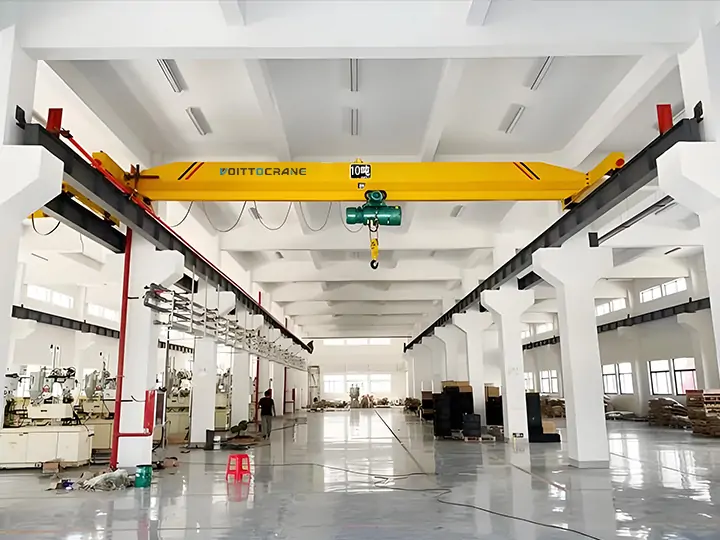
An underslung crane is a kind of lifting equipment suspended under the roof or supporting structure by rails, which consists of a main girder, end girder, hoisting mechanism, and electrical system, and can realize longitudinal and transverse movement.
An underslung crane is a hoisting system suspended directly from the roof or from a steel support structure, without relying on floor columns for support. The system consists of a main girder, end beams, a hoisting mechanism, and an electrical control system, enabling the longitudinal and transverse movement of loads without occupying floor space. The VOITTO suspension underslung overhead crane system is suitable for loads ranging from 0.5 to 10 metric tons and spans from 3 to 22.5 meters. It is particularly well-suited for factory workshops, warehouses, automotive assembly lines, and maintenance facilities where floor space is limited or where existing building structures prevent the installation of floor-supported crane tracks.
Product Introduction
An underslung crane operates by suspending the main girder directly from tracks mounted on the roof or an existing steel structure, eliminating the need for support columns on the floor, as required by traditional overhead cranes. This design allows the crane to move both longitudinally and transversely, making full use of the available vertical headroom without occupying floor space in the facility.
When faced with limited floor space, building structures unsuitable for installing floor-supported tracks, or the need to upgrade existing facilities without major structural modifications, buyers typically opt for underhung overhead cranes. However, compared to floor-supported systems, overhead cranes have a lower maximum load capacity and a shorter span. Therefore, users must confirm the building structure’s load-bearing capacity, the required load, and the span requirements before selecting a model.
Typically, users employ single-girder underhung overhead cranes in the machinery manufacturing, automotive, and food processing industries to perform material handling tasks.
underslung eot crane
Advantages
The advantages of suspended cranes stem directly from their installation method: Since the main girder is suspended from the building’s existing roof or steel structure rather than supported by columns on the ground, these cranes offer high space utilization, ease of operation, and low installation and maintenance costs. The following is a summary of the features and advantages of suspended underhung overhead cranes.
Space-saving: The equipment is installed directly on the existing beam structure of a factory or warehouse, eliminating the need for additional columns or support structures.
High Flexibility: The equipment is suitable for a variety of operating environments and can meet the needs of general light industrial and warehousing applications.
Easy Operation: The equipment supports operation via a ground-level control handle or wireless remote control.
Easy Installation: The equipment has a relatively simple structure, making installation and commissioning convenient and requiring minimal routine maintenance.
Underslung Crane Specification
Type
Underslung Overhead Crane
Load Capacity
0.5-10 ton
Span
3-22.5 m
Lifting Height
3-18.5 m
Lifting Speed
0.7-8 m/min
Hoist Running Speed
20 m/min
Crane Running Speed
20 m/min
Work Duty
A3, A4
Custom designs available
When selecting an underslung crane, the key parameters to confirm are lifting capacity, span, and lifting height — these determine whether the crane fits your existing roof structure and load requirements. Work duty class reflects how frequently and intensively the crane will operate, while hoist type and control mode affect day-to-day handling. Because an underslung crane relies on the building’s roof or steel structure for support, building structural capacity should always be verified alongside these specifications.
Application
Underslung overhead cranes do not take up floor space, making them ideal for work environments where floor space is limited but material handling at height is still required.
Factory Workshops: Users control the equipment to perform material handling tasks on production lines.
Warehousing and Logistics: Operators use the equipment to handle, load, unload, and stack heavy cargo within warehouses.
Automotive Manufacturing: Users control the equipment to transport vehicle bodies, engines, and large components along assembly lines.
Maintenance Workshops: Operators use the equipment to handle large components during aircraft and train maintenance.
The price of an underslung overhead crane depends on a variety of factors: lifting capacity, span, and lifting height are the primary cost determinants, followed by hoist type, duty class, and electrical control components. Below, I will list the price ranges for suspended overhead cranes with different configurations for reference only; actual prices are subject to specific specifications.
Load Capacity
Span
Lifting Height
Reference Price
0.5 Ton
3–22.5 m
3–18.5 m
$2,000–4,750
1 Ton
3–22.5 m
3–18.5 m
$2,200–5,400
2 Ton
3–22.5 m
3–18.5 m
$2,600–6,200
3 Ton
3–22.5 m
3–18.5 m
$2,800–7,150
5 Ton
3–22.5 m
3–18.5 m
$3,550–8,550
10 Ton
3–22.5 m
3–18.5 m
$4,750–15,500
Underslung Crane Manufacturers
Choosing the right underslung crane manufacturer means confirming that load capacity, span, and building compatibility are properly engineered for your facility — not just supplied off a catalog. VOITTO designs and manufactures underslung cranes to order, covering everything from initial layout consultation to production, quality inspection, and after-sales support, with each unit built to meet international safety standards.
For a configuration matched to your building structure and load requirements, our engineering team can review your specifications and recommend a suitable design. If you need a suspended underslung overhead crane solution, please contact us.
Specialized in Overhead Crane, Gantry Crane, Jib Crane, Port Crane & EOT Crane export solutions. 10+ years helping global clients with pre-sales consultation, capacity selection and site-specific configurations.
Difference Between Underslung Crane And Eot Crane?
The main beam of an underslung crane is suspended below the roof track, saving floor space but requiring high roof load-bearing capacity. In contrast, the bridge of an overhead crane is installed above the top track. The main difference between the two lies in the support and installation methods of the bridge.
Difference Between Underslung Crane And Explosion-Proof Overhead Crane?
The difference between underslung cranes and explosion-proof overhead cranes lies in their application and structural design. Underslung cranes have main beams suspended below roof tracks, saving space and reducing costs. Explosion-proof overhead cranes, on the other hand, are composed of explosion-proof motors, electrical components, and protective structures, making them suitable for use in flammable and explosive environments.
Difference Between Underslung Crane And European Overhead Crane?
The difference between an Underslung crane and European overhead cranes lies in their structural design. Underslung cranes use roof-mounted suspension tracks for support, with the main beam running beneath the tracks. Different from the underslung crane, the European overhead crane has a lighter weight and smaller structural dimensions at the same lifting capacity.
Does an Underslung Crane Require Floor Columns?
No — it is suspended from the roof or existing steel structure, which is the main reason it saves floor space compared with a conventional overhead crane.
Can an underslung crane be installed in an existing factory?
Yes, provided the existing roof or steel structure can support the additional suspended load — this should be confirmed with an engineering review first.
Qualification and Honor
Engineered Strength, Global Crane Supplier
service
Exclusive and Considerable, Customer First.
01
Reliable and Customized Solutions
Our pre-sale team provides consultations, tailoring solutions to your needs and environment.
Offer customization options for lifting capacity, span and lifting height etc. to meet specific needs.
02
Updated Production Process
Real-Time Progress Updates: Weekly reports and PM communication.
3-5 years warranty and free replacement for non-manufacturing defects.
24/7 online support and on-site assistance for crane issues.
FAQ
Engineered Strength, Global Crane Supplier
How do I choose the right overhead crane for my facility?
A: Consider these factors:
Load Capacity (Max weight to lift, including rigging).
Span Width (Distance between runways).
Lifting Height (Hook path elevation).
Duty Cycle (Frequency of use: light, moderate, or severe service).
Power Supply (Electric, manual, or hybrid options).
For more detailed answers, please contact our engineers as soon as possible. Our engineers will be based on your use of the scene to give you the most professional program for you to choose!
What industries are your EOT cranes suitable for?
Our overhead cranes are suitable for use in a variety of industries, including manufacturing, construction, metallurgy, logistics, and transportation etc. We specialize in providing customized solutions to multiple industries.
Can you customize an overhead crane to my specific needs?
Yes, we can customize an overhead crane to meet your specific business needs. We can design and manufacture complete crane systems or upgrade existing systems.
What’s included in your after-sales service?
We offer comprehensive after-sales service, including regular maintenance, rapid technical support, and spare parts supply. The standard warranty period is 1 year, with options for extension based on your needs.
Do you ship internationally?
Yes, international shipping and export support are available for global customers.
Get In Touch
Please feel free to leave a message. We will reply in 24 hours.
Please specify your requirement by referring to the following aspects:
Which crane product do you need?
What is the maximum lifting capacity (in tons) required for your project?
Could you specify the lifting height (in meters) needed?
Can you provide details on the working environment, such as ground conditions, space limitations, and any obstacles?
What is the expected frequency of use and the duration of the project?




 English
  Español
  Português
  العربية
  Français
  Русский