A single-girder overhead crane provides an economical, space-efficient lifting solution for factories, warehouses, and material-handling facilities. Available with standard hook attachments or grab buckets for bulk material handling, these cranes cover a wide range of industrial applications, from general workshop lifting to loading and unloading loose materials such as coal, ore, or grain.
A single girder overhead crane (also called a single-beam overhead crane or single-girder bridge crane) uses a single main girder supported by end beams at both ends to move loads along a single rail system. Voitto Crane’s single-girder overhead cranes offer lifting capacities ranging from 1 to 32 tons, spans from 7.5 to 31.5 meters, and lifting heights from 6 to 30 meters. Their five configurations meet most industrial needs. Each crane can be customized based on load capacity, span, lifting height, control method ( remote control or cab), and hoist type.
Product Introduction
A single-girder overhead crane features a single main girder and a single hoisting mechanism. This configuration offers the most cost-effective solution for light- to medium-duty lifting tasks with a load capacity of up to 32 tons. Compared to double-girder cranes, the single-girder design reduces clearance height requirements, lowers the dead weight of the steel structure, and simplifies installation and maintenance. It still meets the lifting capacity, span, and lifting height requirements of most manufacturing and warehousing facilities.
The five configurations listed below (LX, LD, LDZ, LB, and HD) differ primarily in terms of installation method, hoist type, and suitable operating environments. Please review the specifications and refer to the pricing and selection guide sections to choose the configuration that best suits your operating conditions.
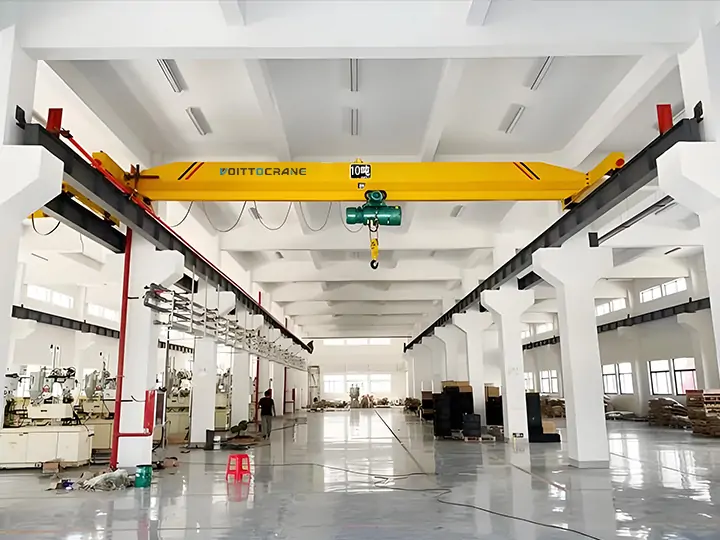
Single Girder Overhead Crane
Single Beam Bridge Crane
Product Selection
Load capacity (t)
1.0
2.0
3.2
5.0
7.5
10.0
12.0
15.0
20.0
Span length (m)
7.5
10.5
13.5
16.5
18.5
19.5
22.5
Lifting height (m)
6.0
9.0
12.0
18.0
24.0
You have selected equipment with the following parameters:
Our single girder overhead cranes are available in various types and configurations, each suited to specific lifting needs and usage scenarios. Let’s take a look at the most common types:
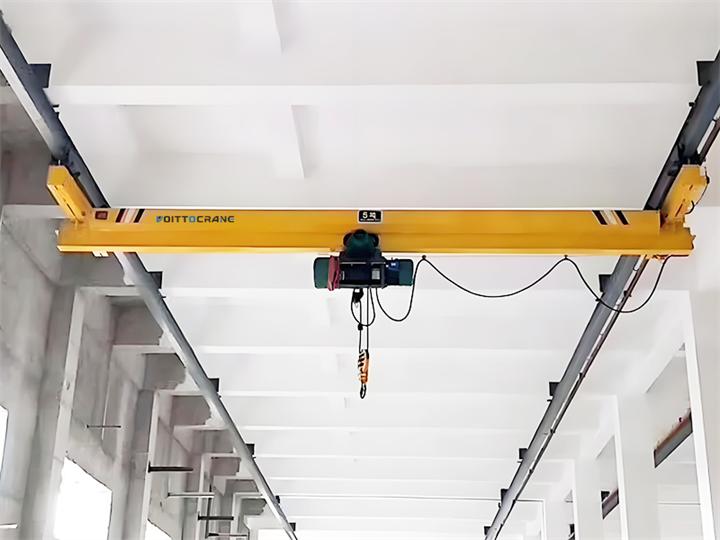
NLX/LX Underslung Overhead Crane
Application: Underslung single girder overhead crane is suitable for small standardized factories, warehouses, sewage treatment plants and maintenance workshops.
Features: The single girder underhung crane runs on rails suspended from the ceiling, offering significant space ground savings. It has the characteristics of compact structure, light weight, low cost and easy maintenance.
Why Buyers Choose This Configuration: Choose this when floor space is limited or a column-mounted runway isn’t practical, and capacity needs stay within the LX range.
Application: LD type electric single girder overhead crane can be used in factory workshops, food and beverage factories, textile workshops and other environments, mainly responsible for material handling and lifting.
Features: The LD type electric single-girder overhead crane is the most widely used lifting equipment. It has high load capacity, a simple structure, a low cost, easy to install and maintain.
Why Buyers Choose This Configuration: The default choice for general-purpose workshop lifting where cost and simplicity matter more than headroom savings.
Application: The LB type explosion-proof single-girder overhead crane is mainly used in dangerous environments such as the petroleum, chemical industry, gas stations, etc, where flammable gases exist.
Features: An explosion-proof electric hoist is used as the lifting mechanism, which has the characteristics of compact structure, small size and large carrying capacity.
Why Buyers Choose This Configuration: Required wherever local safety codes classify the work area as hazardous for flammable gas — not optional for these environments.
Note: All parameters can be customized according to requirements.
HD European Single Girder overhead Crane
Application: European single girder overhead crane is suitable for lifting and handling in workshops, warehouses, etc. Compared with the LD single girder overhead crane, it can complete various lifting tasks more efficiently.
Features: The European electric hoist adopts a lightweight design, has the characteristics of compact structure, higher load-bearing capacity, small limit size, space saving, easy installation, etc., which can effectively improve production efficiency.
Why Buyers Choose This Configuration: Select this configuration when ceiling clearance is limited or when users have high requirements for equipment installation space and operational efficiency.
Note: All parameters can be customized according to requirements.
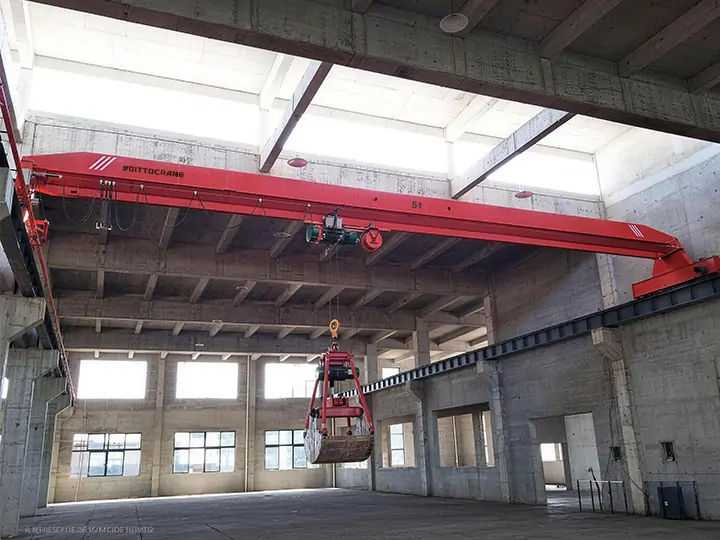
LDZ Grab Overhead Crane
Applications: Users operate this equipment to handle the loading, unloading, and transfer of bulk and loose materials.
Features: This equipment is equipped with a grab-type spreader, typically featuring a dual-motor control system. Additionally, the crane structure has been reinforced, and the hoist has been specifically configured to handle the frequent cyclic loading conditions characteristic of grab operations.
Why Buyers Choose This Configuration: Required whenever the material itself can’t be lifted with a hook — bulk/loose materials need a grab to grip, release, and cycle loads quickly.
Light-to-moderate duty: workshops, warehouses, general manufacturing
Heavy-duty, large-span: steel mills, shipyards, heavy manufacturing
Choose a single girder overhead crane when capacity stays at or below roughly 32 tons and span requirements are under roughly 31.5 m — most manufacturing, warehousing, and workshop lifting tasks fall inside this range. Move to a double-girder overhead crane once capacity, span, or duty cycle exceeds these limits, or where headroom allows a top-running trolley design.
Single Girder Overhead Crane Parts
The single girder overhead crane consists of the main girder, the end girder, the Overhead Travel Mechanism, the electric hoist, and other parts. The functional characteristics of each part are as follows:
Main Beam: Bracket for horizontal installation of electric hoist and determination of lifting span.
End Beam: Mounting overhead Travel Mechanism, Longitudinal movement of the crane.
Electric Hoist: A Device to move the hook up and down. It consists of a motor, gearbox, brake, drum, wire rope, hook, and block.
Remote Controls: Device for controlling the operation of cranes
Electrical Systems: Powering the crane to run.
Safety Device: A protective device against crane lifting overloaded weights.
Single Girder Overhead Crane Price
Single girder overhead crane price depends on the full specification, not tonnage alone:
Lifting Capacity and Span — The longer the span, the heavier the main girder must be, and additional structural reinforcement is required.
Lifting Height — Longer wire ropes or chains and taller end beams increase costs.
Duty Class (A3/A4/A5) — Higher duty classes require components with greater resistance to operational cycles.
Hoist Type — European-style hoists used in HD-type cranes also cost more than standard hoists.
Control System — Pendant pushbutton controls are the standard configuration; wireless remote controls and cab controls increase costs.
Electrical Components —Motor brand, protection rating (IP rating), and voltage/frequency (50 Hz/60 Hz, single-phase/three-phase) affect the price of export orders.
Installation Requirements —— Condition of the track beams, on-site assembly, and commissioning support.
The price ranges in the table below reflect the standard configurations for each crane type; the final price depends on a combination of the various factors listed above.
Type
Load Capacity
Span
Lifting Height
Price Range
LX Electric Single Girder Suspension Overhead Crane
0.5-10 ton
7.5-22.5 m
3-23.5 m
$3000 ~ $10000, depending on specifications
LD Electric Single Girder Overhead Crane
1-32 ton
7.5-31.5 m
3-26 m
$3100 ~ $25000, depending on specifications
LB Single Girder Explosion-Proof Overhead Crane
1-20 ton
7.5-28.5 m
6-27 m
$4000 ~ $18500, depending on specifications
HD European Single Girder overhead Crane
1-20 ton
7-31.5 m
3-28.5 m
$7800 ~ $50700, depending on specifications
LDZ Grab Overhead Crane
3-10 ton
7.5-31.5 m
6-12 m
$12,000–$26,000, depending on specifications
Note: The table content is for reference only, the actual price is subject to the actual specifications.
Buying Guide
Lifting Capacity — Calculate the sum of the heaviest standard load and the weight of the rigging, and round up to the nearest standard tonnage (1, 2, 3.2, 5, 7.5, 10, 12, 15, 20, or 32 tons).
Measure the Span — The span refers to the distance between two track beams (for overhead cranes, this refers to the spacing between ceiling tracks); verify this measurement in relation to building columns or the ceiling structure.
Lifting Height — Measure the distance from the floor (or lowest work surface) to the bottom of the track beam to determine the required hook travel.
Duty Class — The duty class should be selected based on the duty cycle frequency and average load factor, rather than solely on tonnage.
Hoist Type —European wire rope hoists are suitable for higher tonnages and high-frequency duty cycles; CD/MD electric hoists are suitable for lighter loads and low-frequency lifting operations.
Control Method — Select a pushbutton panel (handle) for fixed-position operation; choose a wireless remote control for mobile operation; and opt for cab control for continuous heavy-duty operations.
Installation Environment — In environments with flammable gases, select an LB explosion-proof crane; when ceiling clearance is limited, it is recommended to choose the LX suspended or HD European-style configuration.
Customized Single Girder Overhead Crane
At VOITTO Crane Manufacturing, we specialize in providing customized lifting solutions that meet the specific needs of our customers. We can provide modular designs to suit diverse needs while ensuring structural soundness and standardized production.
Lifting Capacity: 1~32 ton
Span: 7.5 m~31.5 m
Lifting Height: 6 m~30 m
Control Options: Pendant / Remote / Cabin control
Hoist Type: Wire rope or chain hoist
Certification: CE, ISO
If you have any specific requirements or need further assistance, please feel free to contact our team of experts, who will provide you with custom solutions and professional support.
Specialized in Overhead Crane, Gantry Crane, Jib Crane, Port Crane & EOT Crane export solutions. 10+ years helping global clients with pre-sales consultation, capacity selection and site-specific configurations.
A single girder overhead crane has one main beam supported by two end trucks that travel along runway beams (or ceiling rails, for underslung types), with an electric hoist running along the underside of the beam. It’s the most common, lowest-cost overhead crane configuration for light-to-moderate lifting.
What capacity can a single girder overhead crane handle?
Voitto’s single girder overhead cranes cover 1 to 32 tons across the five configurations. HD and LB cranes typically top out around 10–20 tons, while the LD bridge crane reaches up to 32 tons.
What span can a single girder overhead crane cover?
Span ranges from 7.5 m to 31.5 m depending on configuration, with the HD European crane covering the widest standard range. Span should match your building’s runway beam or column spacing.
What is the difference between a single girder and double girder overhead crane?
A single girder crane uses one main beam with an electric hoist; a double girder crane uses two beams with a top-running trolley. Single girder cranes cost less and need less headroom but top out around 32 tons — beyond that, or for spans over roughly 32 m, a double girder crane is the better fit. See the comparison table above for details.
What industries is a single girder overhead crane suitable for?
Manufacturing, warehousing and logistics, steel fabrication, chemical and hazardous-material handling, and food, beverage, or textile production. The right configuration depends on capacity, span, and whether the environment requires explosion-proof equipment.
Qualification and Honor
Engineered Strength, Global Crane Supplier
service
Exclusive and Considerable, Customer First.
01
Reliable and Customized Solutions
Our pre-sale team provides consultations, tailoring solutions to your needs and environment.
Offer customization options for lifting capacity, span and lifting height etc. to meet specific needs.
02
Updated Production Process
Real-Time Progress Updates: Weekly reports and PM communication.
3-5 years warranty and free replacement for non-manufacturing defects.
24/7 online support and on-site assistance for crane issues.
FAQ
Engineered Strength, Global Crane Supplier
How do I choose the right overhead crane for my facility?
A: Consider these factors:
Load Capacity (Max weight to lift, including rigging).
Span Width (Distance between runways).
Lifting Height (Hook path elevation).
Duty Cycle (Frequency of use: light, moderate, or severe service).
Power Supply (Electric, manual, or hybrid options).
For more detailed answers, please contact our engineers as soon as possible. Our engineers will be based on your use of the scene to give you the most professional program for you to choose!
Can you customize an overhead crane to my specific needs?
Yes, we can customize an overhead crane to meet your specific business needs. We can design and manufacture complete crane systems or upgrade existing systems.
What industries are your EOT cranes suitable for?
Our overhead cranes are suitable for use in a variety of industries, including manufacturing, construction, metallurgy, logistics, and transportation etc. We specialize in providing customized solutions to multiple industries.
Get In Touch
Please feel free to leave a message. We will reply in 24 hours.
Please specify your requirement by referring to the following aspects:
Which crane product do you need?
What is the maximum lifting capacity (in tons) required for your project?
Could you specify the lifting height (in meters) needed?
Can you provide details on the working environment, such as ground conditions, space limitations, and any obstacles?
What is the expected frequency of use and the duration of the project?








 English
  Español
  Português
  العربية
  Français
  Русский