
An overhead crane, also known as a overhead travelling crane. It is a type of heavy-duty material handling equipment. The bridge crane, with its unique structure, spans above the factory building, steadily and accurately undertaking tasks such as material lifting and horizontal movement. Next, this article will introduce the overhead crane working principle, as well as its definition, types, parts, and other information. This will help you better understand bridge cranes so that you can choose the right overhead travelling crane solution.


How Does An Overhead Crane Work?
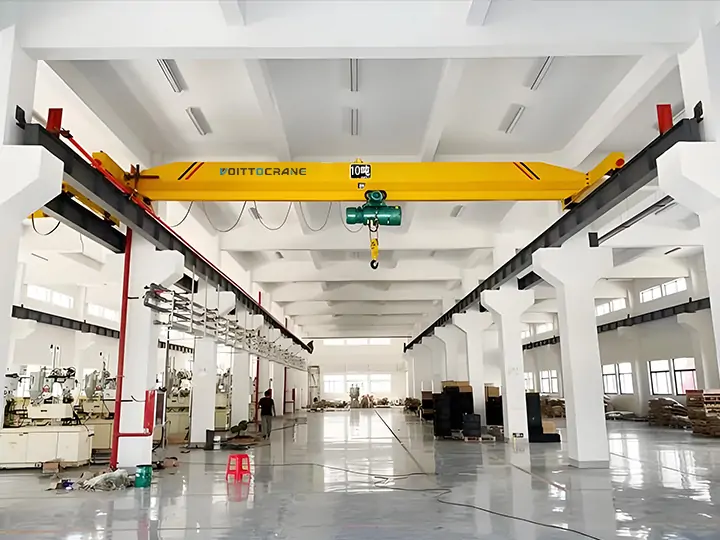
Overhead travelling cranes complete lifting tasks through the coordinated work of various parts and operator control. The bridge supports the entire structure. The end beam running mechanism runs on tracks on either side of the plant building, enabling the crane to move longitudinally. The trolley on the main beam, driven by its drive mechanism, moves laterally, while the hoist mechanism on the trolley lifts the material vertically. Through the coordinated movement of the overhead travel mechanism’s longitudinal motion, the trolley travel mechanism’s lateral motion, and the lifting mechanism’s vertical motion, cargo is moved from point A to point B. Each of those parts — main girder, end beam, trolley travel mechanism, hoisting mechanism, electrical system, and safety devices — has a specific structural definition and functional role that goes beyond what the working principle overview covers. The overhead bridge crane components guide covers each one in detail with diagrams.
The motor driving that hoist mechanism is doing far more than spinning a shaft — it manages torque under variable loads, dissipates heat across hundreds of daily start-stop cycles, and holds the load safely when power stops. Our overhead crane motor guide explains how crane motors work and why duty cycle class and insulation grade matter more than kilowatt rating when specifying one.
What Is A Crane Trolley?
The crane trolley is the core moving component of an overhead travelling crane. Mounted on a track atop the crane’s main beam, it moves horizontally across the width of the plant building via its independent drive system (consisting of a motor, inverter, wheel assembly, and brake). The trolley is equipped with an electric hoist(including a motor, wire rope, pulley block, and hook) responsible for the vertical lifting of the load.


Overhead Crane Types
There are many types of overhead cranes, and each type has different structures and load capacities. The following will introduce different types of overhead travelling cranes:

Single Girder EOT Crane
A single-girder EOT crane is a simple, economical, and relatively compact lifting equipment. It consists of a main girder, two end beams, running mechanism, and an electric hoist. It is typically used for light to medium-duty capacity and short to medium-span applications. Single-girder EOT cranes typically have a load capacity of 0.5 to 32 tons.

Double Girder Overhead Crane
A double-girder overhead crane consists of two main beams, two end beams, running mechanism, crane trolley, and other components. The two ends of the main beams are connected by end beams to form a “bridge” structure. Double girder bridge cranes have a load capacity of 5-800 tons.

Suspension Underslung Overhead Crane
A suspension underslung overhead crane is a kind of lifting equipment suspended under the roof or supporting structure by rails. It does not need ground support and directly utilizes the upper space, which is economical and efficient, but the load capacity and span are smaller. Typically, the load capacity of a suspension underslung overhead crane is between 1 and 10 tons.
Overhead Crane Parts And Functions
Overhead cranes consist of more key components that work together to lift and move cargo. Below is a description of the functions of each component:

- Trolley Travel Mechanism: Use the Lateral movement of the trolley.
- Overhead Travel Mechanism: Longitudinal movement of the crane.
- Lifting mechanism: Installed on the crane trolley, responsible for vertically lifting the goods.
- Cabs: The operator controls the entire machine in the cab.
- Electrical systems: Provide power for the entire machine.
- Safety devices: equipped with limiter, overload limiter, and emergency brake button.
- Walkway: Walking paths for overhaul and post-maintenance.
- Main beam: Installation of rails for lateral movement of the trolley.
- End beam: Mounting Bridge Travel Mechanism.
- Buffer protection device: Absorbs the impact of track end collisions.
Conclusion
This article is designed to help you better understand the overhead travelling crane working principle. Whether you are looking for a custom solution to your needs or want to learn more about overhead, we hope to provide you with valuable reference.
If you have any specific requirements or need further assistance, please feel free to contact our team of experts. VOITTO will provide you with custom overhead crane solutions and professional support.




 English
  Español
  Português
  العربية
  Français
  Русский