
- 1 The Lifting Solution Built for Scale
- 2 What Is a Gantry Crane?
- 3 What Is a Gantry Crane Used For?
- 4 The Different Types of Gantry Cranes
- 5 Gantry Crane Types at a Glance
- 6 How Does a Gantry Crane Work?
- 7 Gantry Crane Parts
- 8 Custom Gantry Cranes from Voitto
- 9 Summary
-
10
FAQ
- 10.1 Q1: What is the difference between a gantry crane and an overhead crane?
- 10.2 Q2: How much can a gantry crane lift?
- 10.3 Q3: Can a gantry crane be used outdoors?
- 10.4 Q4: What is an RTG crane and how is it different from a rail-mounted gantry crane?
- 10.5 Q5: What maintenance does a gantry crane require?
The Lifting Solution Built for Scale
Some lifting jobs demand more than a fixed crane can offer. When loads are heavy, spans are wide, and the work happens outdoors or across large open areas, a gantry crane is often the only practical answer.
From port container terminals to wind turbine assembly sites, gantry cranes handle material movement at a scale that few other systems can match. Stable structure, high load capacity, and wide operational range make them a core piece of equipment across heavy industry worldwide.
This guide covers everything you need to understand about gantry cranes — what they are, how they work, which types exist, what they’re made of, and where each configuration performs best.

What Is a Gantry Crane?
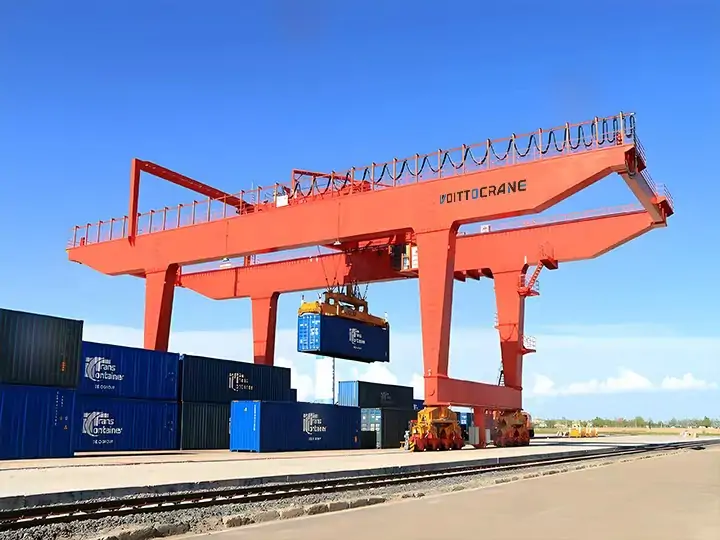
A gantry crane is a large material handling system built around a portal frame structure. Two vertical support legs carry a horizontal main beam across the working area. This leg-and-beam combination forms a door frame — or gantry — which gives the equipment its name.
The entire structure travels along ground-level tracks, with the trolley and hoist moving laterally along the main beam. This combination of longitudinal bridge travel and lateral trolley movement gives the crane full two-dimensional coverage of the area it spans.
Unlike overhead cranes, which rely on building columns and roof structure for support, a gantry crane is self-supporting. This makes it the preferred solution for outdoor yards, open work areas, and facilities where building infrastructure cannot carry the load.
What Is a Gantry Crane Used For?
Gantry cranes are deployed wherever the work area is large, loads are heavy, and flexibility of coverage matters. Their stable structure and strong adaptability make them particularly well suited to outdoor and large-scale environments.
Port terminals rely on rail-mounted container gantry cranes and RTG cranes for container loading, unloading, stacking, and transshipment — operations that run continuously and at high volume.
Railway freight yards use gantry cranes to handle coal, ore, timber, steel, and containers — cargo types that vary widely in weight and form but share the need for consistent, reliable lifting.
Warehousing and logistics facilities use open-air gantry configurations for loading, unloading, and stacking steel, timber, large equipment, and prefabricated components in yards where overhead crane infrastructure doesn’t exist.
Bulk cargo yards pair gantry cranes with grab buckets for handling coal, sand, gravel, and ore — materials that must be moved in large volumes rather than individual lifts.
Steel markets and heavy manufacturing plants use gantry cranes to lift and stack sheet metal, structural steel, large machine components, and finished assemblies during production and dispatch.
Construction sites deploy gantry cranes for lifting prefabricated bridge sections, large construction equipment, and heavy building materials that exceed the capacity of mobile equipment.
Energy projects — particularly wind farm installations — depend on gantry cranes to position blades, nacelles, and tower sections during turbine assembly and maintenance.
Shipyards operate some of the largest gantry cranes in existence, lifting ship sections, hull plates, and structural profiles across spans that can exceed 100 meters.
The Different Types of Gantry Cranes
The right configuration depends on load, span, site conditions, and application. Here is how the main types compare.
Single Girder Gantry Crane
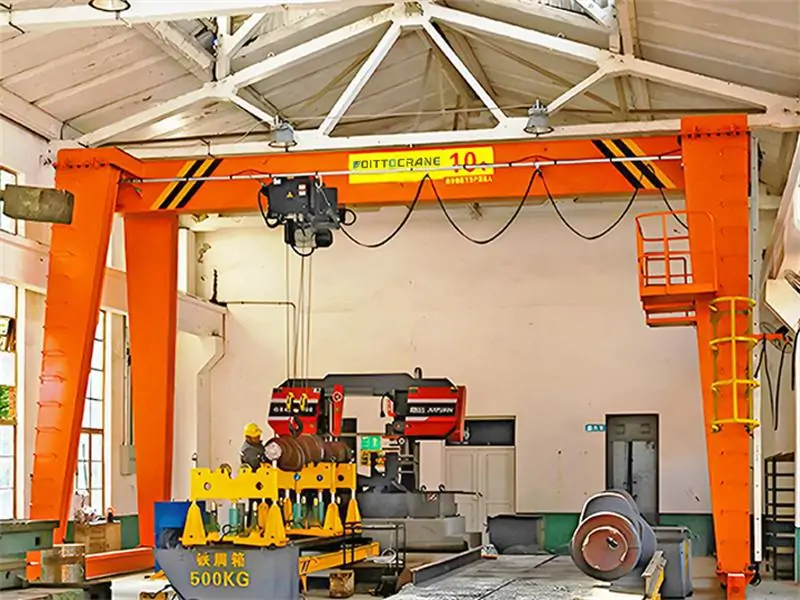
The single girder design uses one main horizontal beam on a gantry frame. It is economical, practical, and straightforward to install — the most common choice for light to medium-duty outdoor and semi-open applications.
Capacity: 2 – 32 tons Best for: Loading, unloading, and stacking in open or semi-open yards where loads stay within range and a cost-efficient solution is the priority.
Get QuoteDouble Girder Gantry Crane
Two parallel main beams provide the structural backbone of this configuration. The additional girder delivers greater rigidity, higher load capacity, and better performance across long spans.
Capacity: 5 – 800 tons Best for: Heavy industrial operations, large manufacturing plants, and any application where loads are consistently heavy or spans are long.
Portable Gantry Crane

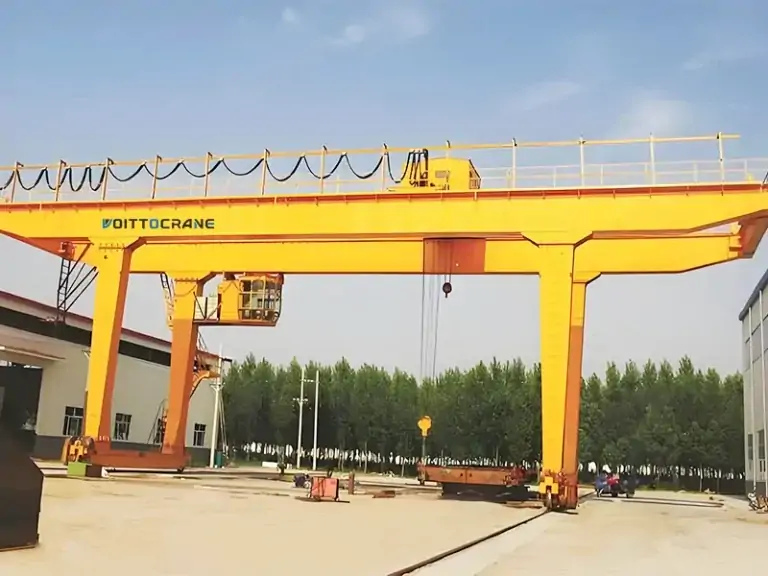
The portable design requires no fixed foundation. It can be assembled, repositioned, and dismantled quickly — making it the practical answer for temporary lifting tasks, workshop use, and outdoor jobs where a permanent installation is not warranted.
Capacity: 5 – 20 tons Best for: Temporary lifting tasks, maintenance operations, workshop handling, and sites where mobility between locations is required.
Get QuoteTruss Gantry Crane

The truss construction replaces a solid main beam with an open lattice framework. This reduces dead weight while maintaining structural strength, and the open frame performs better in wind-exposed environments.
Capacity: 3 – 100 tons Best for: Outdoor applications in exposed locations where wind resistance matters. Available in single and double beam configurations, customizable to specific site requirements.
BMH Semi Gantry Crane
The semi gantry crane uses one full support leg and one side that runs on an elevated rail mounted to an existing building wall or structure. This asymmetric design works where space is too limited for a full two-leg gantry.
Capacity: 2 – 16 tons Best for: Facilities with space constraints, boundary areas, or sites where full track laying is not feasible. Reduces construction cost by making use of existing building structure on one side.
Get Quote
Rail-Mounted Container Gantry Crane

This fixed-track configuration is purpose-built for container handling in ports, docks, and inland container yards. Large span, high carrying capacity, and precise positioning systems enable the high-throughput operations that container terminals demand.
Capacity: 35 – 70 tons Best for: Port terminals, container yards, and high-volume intermodal logistics hubs where consistent, repeatable container handling is the core operation.
RTG Container Gantry Crane (Rubber-Tired Gantry)
The RTG replaces fixed rails with rubber tires, giving it mobility across hardened ground surfaces. This flexibility allows it to serve multiple areas of a container yard without fixed infrastructure.
Capacity: 35 – 70 tons Lifting height: 15.58 – 18.5 m Best for: Container yards, distribution hubs, and warehouses where operational flexibility across multiple lanes or zones is more valuable than the precision of a fixed-rail system.
Get Quote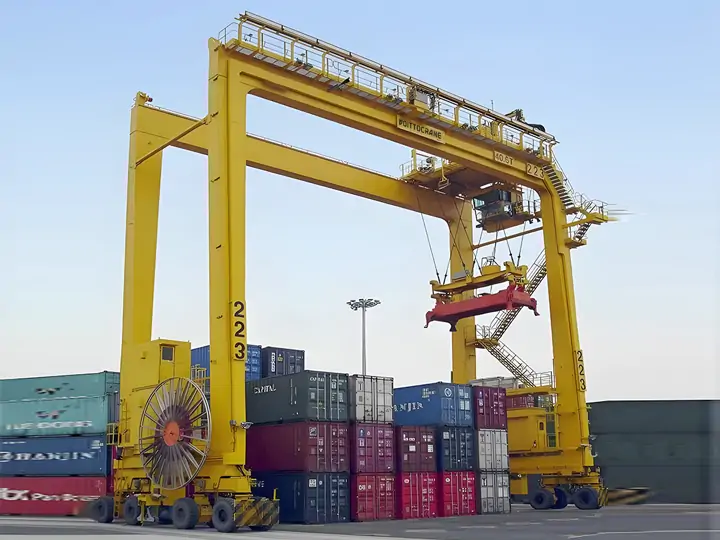
Gantry Crane Types at a Glance
| Type | Capacity | Key Advantage | Typical Application |
|---|---|---|---|
| Single Girder | 2–32 t | Low cost, simple structure | Outdoor yards, light industry |
| Double Girder | 5–800 t | High capacity, long span | Heavy manufacturing, large plants |
| Portable | 5–20 t | No fixed foundation needed | Temporary lifting, workshops |
| Truss | 3–100 t | Lightweight, wind-resistant | Exposed outdoor environments |
| BMH Semi Gantry | 2–16 t | Space-saving, one-side rail | Constrained sites, boundary areas |
| Rail-Mounted Container | 35–70 t | Precise positioning, high efficiency | Ports, container terminals |
| RTG Container | 35–70 t | Flexible, no fixed rail | Container yards, logistics hubs |
How Does a Gantry Crane Work?
A gantry crane moves loads through the coordinated operation of three motion axes:
Longitudinal travel — the entire bridge structure moves along ground-level rails, covering the full length of the working area.
Lateral travel — the trolley moves along the main beam, covering the full width of the span.
Vertical movement — the hoisting mechanism raises and lowers the hook to the required height.
By combining these three axes, the hook can be positioned precisely at any point within the three-dimensional space the crane covers — allowing loads to be picked up at one location and set down accurately at another.
The electrical system coordinates all three drives, with the control system — operated from a pendant, remote, or cabin — directing each movement.
Gantry Crane Parts
Every gantry crane is built from the same core components, regardless of type or size. Understanding each part is useful when specifying equipment or discussing maintenance requirements. For a complete part-by-part breakdown — covering main beam, support legs, lower crossbeam, hoisting mechanism, trolley travel mechanism, and electrical control system, with separate component lists for portable, semi-gantry, and RTG configurations — see our gantry crane parts guide.

| Component | Function |
|---|---|
| Main beam | Carries core components; determines the crane’s span |
| Support legs | Vertical columns supporting the main beam; ensure structural stability |
| Lifting mechanism | Moves the hook vertically — motor, gearbox, drum, wire rope, and hook |
| Trolley travel mechanism | Drives the trolley laterally along the main beam |
| Electrical system | Powers all drives and control functions |
| Cab | Operator control station for safe and precise crane operation |
| Ladders and platforms | Safe access for inspection and maintenance personnel |
| Buffers | Absorb impact at end-of-travel positions on bridge and trolley |
| Wind-proof device | Track clamps and anchoring devices prevent movement in high-wind conditions |
Custom Gantry Cranes from Voitto
Voitto designs and manufactures gantry cranes for clients across more than 70 countries. Standard configurations cover most applications. Where specific requirements apply — unusual lifting capacity, harsh operating environments, non-standard power supply, or specialized duty classifications — Voitto engineers to order.
Industries served include port logistics, railway freight, wind energy, heavy manufacturing, and shipbuilding. Each project starts with a review of the actual application requirements before any configuration is recommended.
For a customized solution, contact Voitto’s technical team with your load, span, lifting height, and site conditions.

Alan
Crane Solutions Specialist · Voitto Crane
Specialized in Overhead Crane, Gantry Crane, Jib Crane, Port Crane & EOT Crane export solutions. 10+ years helping global clients with pre-sales consultation, capacity selection and site-specific configurations.
Summary
A gantry crane is a self-supporting portal frame lifting system designed for large-scale, heavy-duty material handling — particularly in outdoor and open-area environments where building infrastructure cannot carry the load.
The seven main types cover the full range of industrial applications, from light portable units for temporary workshop use to massive rail-mounted container cranes handling thousands of lifts per day at major ports.
Selecting the right type comes down to three factors: the load it needs to carry, the environment it operates in, and the duty cycle it must sustain. Getting those three parameters right at the specification stage is the foundation of a crane that performs reliably throughout its service life.
FAQ
Q1: What is the difference between a gantry crane and an overhead crane?
The core structural difference is how each crane is supported. An overhead crane runs on runway beams mounted to building columns or walls — it relies on the building structure for support. A gantry crane is self-supporting, with its own legs running on ground-level tracks. This makes gantry cranes suitable for outdoor yards, open areas, and facilities where the building cannot carry the runway loads. Overhead cranes are generally preferred for indoor facilities with suitable structural support, while gantry cranes handle outdoor and large-scale operations.
Q2: How much can a gantry crane lift?
Lifting capacity varies widely by type. Portable gantry cranes typically handle 5–20 tons for light temporary work. Single girder units cover 2–32 tons for general yard and industrial use. Double girder configurations reach 5–800 tons for heavy industrial operations. Container gantry cranes — both rail-mounted and rubber-tired — typically operate in the 35–70 ton range for port and logistics applications. Truss designs cover 3–100 tons. The right capacity is determined by the maximum load, including the weight of any lifting attachment such as a grab or spreader bar.
Q3: Can a gantry crane be used outdoors?
Yes — outdoor use is one of the primary reasons gantry cranes are specified over overhead cranes. Their self-supporting structure requires no building infrastructure, and most configurations are designed for outdoor operation. For exposed environments, truss construction reduces wind loading on the structure. Wind-proof devices — track clamps and anchoring systems — are standard on outdoor gantry cranes to prevent uncontrolled movement in high-wind conditions. Electrical components should be specified with weatherproof enclosures appropriate to the local climate.
Q4: What is an RTG crane and how is it different from a rail-mounted gantry crane?
An RTG (Rubber-Tired Gantry) crane runs on rubber tires rather than fixed rails. This gives it the flexibility to move between different lanes or zones of a container yard without fixed track infrastructure. A rail-mounted container gantry crane runs on fixed ground rails, which limits it to a defined corridor but provides more precise and repeatable positioning. Rail-mounted cranes are typically used where operational lanes are fixed and throughput is high. RTG cranes are preferred where yard layouts change or operational flexibility across multiple areas is needed.
Q5: What maintenance does a gantry crane require?
Routine maintenance covers the main mechanical and electrical systems: lubrication of travel wheels, trolley bearings, and hoisting components; inspection of wire rope for wear and broken wires; checking rail condition and wheel flange wear; testing all limit switches and safety devices; and inspection of the structural frame for cracks or deformation. Maintenance frequency depends on duty cycle and operating environment. Outdoor cranes in harsh environments require more frequent checks than indoor equipment. Keeping maintenance records for each crane — tracking inspection dates, findings, and actions taken — is standard practice and supports compliance with applicable lifting equipment regulations.


 English
  Español
  Português
  العربية
  Français
  Русский