
In the world of material handling and heavy lifting, gantry cranes and bridge cranes are two of the most widely used and popular types of lifting machines. Although both excel in accurately moving large loads, their unique shapes and applications are somewhat different. This article takes a deep dive into the differences between the two types of cranes to help you determine and familiarize yourself with which type is best for your industrial needs.

Structural Differences between Bridge Crane and Gantry Crane.
When choosing a crane, it’s crucial to understand the structural differences between bridge cranes and gantry cranes. Although both types of cranes handle or move heavy loads, their structures and support mechanisms are very different. The structural differences between bridge cranes and gantry cranes will be explained in detail next:


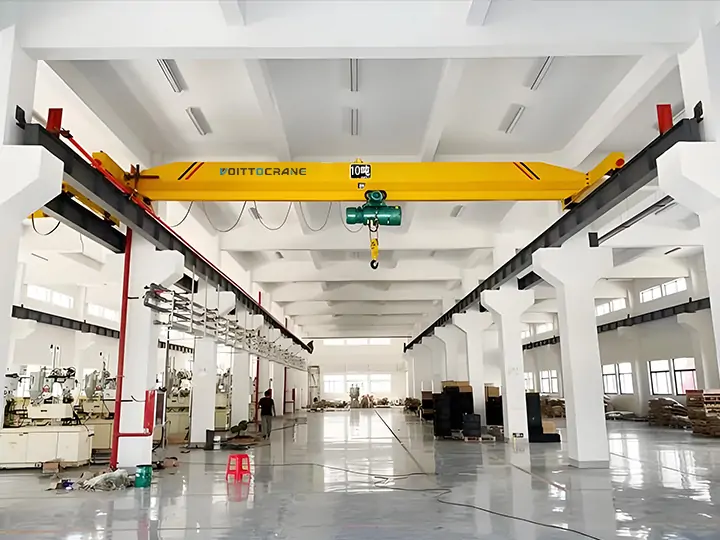
Bridge Crane: Bridge cranes are mainly composed of main beams, end beams, lifting trolleys or electric hoists, hoisting mechanisms, and other structures. Because its two ends are located in the concrete column or metal support, the shape is like a bridge, so it is called an overhead Travelling crane.
Gantry Crane: Gantry cranes have a gantry frame structure, consisting of a main beam spanning horizontally, outriggers supported vertically on both sides, and other structures such as a lifting mechanism. Its outriggers and main girder form a solid portal frame structure, so it is called a gantry overhead crane.
What is the difference between a gantry crane and a Bridge crane?
Bridge cranes are mainly used for material handling within workshops or warehouses. They have multiple functions and can efficiently complete the loading, unloading, handling, and stacking of goods in a limited space. In contrast, Gantry cranes are mainly used for outdoor large-scale material handling, hydropower engineering, railway manufacturing, and other projects. They usually operate outdoors and can effectively complete tasks such as loading, unloading, handling, and stacking heavy goods.
How often do Bridge cranes and gantry cranes need to be inspected?
Gantry cranes require more comprehensive environmental protection and foundation stability inspections due to their open-air mobile characteristics, while bridge crane maintenance focuses more on track accuracy and plant structure adaptability. The maintenance and overhaul cycle is also related to the frequency of crane use and the daily lifting capacity.
Possible power source for Bridge and Gantry cranes
Bridge cranes are mainly operated in fixed factories and are usually powered by busbars installed along the track. They are suitable for high voltage, large span, and frequent movement. Gantry cranes are mostly used in open-air sites and mainly rely on cable drums for power supply. The core difference between the two is that bridge cranes rely on busbars on fixed tracks, and the power supply is stable but limited to indoors, while gantry cranes use flexible cables or self-generation, which are more flexible and suitable for outdoor operations.
Gantry Crane Performance Characteristics
It can be used in severe environments such as strong winds and rainstorms.
Can be customized according to your usage needs
Often used for lifting heavy or large-sized goods in ports, yards, etc.
Customizable cantilever design, can be customized with a single-side cantilever or a double-side cantilever to extend the working range.
Adapt to complex terrain, the track can be laid in gravel and other harsh environments.
Universal handling equipment can be configured with a variety of spreaders to adapt to different materials.
Bridge Crane Performance Characteristics
Diversified environmental adaptation design, including dustproof, high temperature resistant, and other industrial scenarios, special models.
It can operate normally in a limited warehouse workshop without being affected by site restrictions
It can effectively utilize the space under the bridge, greatly improving the utilization rate of the limited space.
Wide lifting range, light, medium, or heavy lifting equipment can be customized according to the lifting capacity.
The overall structure is compact, which is convenient for later maintenance and repair.
Can be equipped with different lifting devices, such as a grab bucket, electromagnetic suction cup, etc., to grab different materials
Different Application Scenarios and Industries
Bridge cranes are mainly used in indoor fixed places, such as manufacturing workshops, warehouses, and power plants, and are suitable for high-precision lifting of heavy equipment or precision parts.
Gantry cranes are suitable for open-air or large-span sites, such as port terminals, shipyards, bridge construction, and wind power projects. They are good at loading and unloading large-sized and heavy goods such as containers and prefabricated bridges.


Conclusion
When selecting equipment, it is recommended that enterprises start from the actual demand, taking into account the site conditions, efficiency requirements and budget, and other factors. As a professional manufacturer in the field of lifting equipment, VOITTO Company has been committed to providing customers with efficient and safe lifting solutions with decades of technical accumulation and industry experience.
If you need more specific selection advice or personalized lifting solutions, please contact the VOITTO professional team. Our technical experts will provide you with a full range of professional consulting services, including equipment configuration, site planning, automation upgrades, etc., according to your actual working conditions, and customize the most cost-effective lifting equipment solutions for you.




 English
  Español
  Português
  العربية
  Français
  Русский