blog

crane-lifting-capacity-explained-tonnage-selection
01 September 2026

Crane Lifting Capacity Explained: How to Choose the Right Tonnage for Your Facility

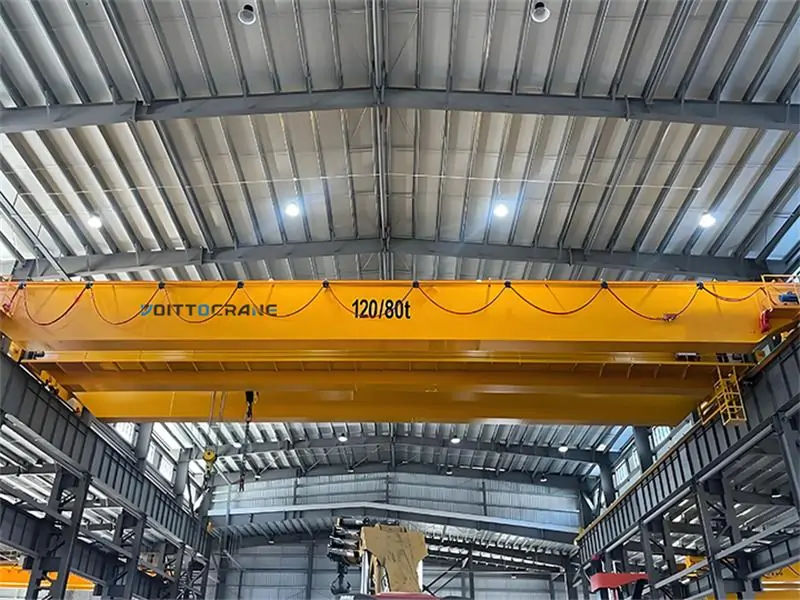
Most procurement teams get the lifting capacity number wrong — not because they can’t read a nameplate, but because they only look at the nameplate. Crane lifting capacity is not a single figure. It’s the result of at least four interacting variables: the weight of your heaviest load, the rigging and hook weight added on top of it, the duty class your operation demands, and the span your facility requires. Miss any one of those, and you’ll either under-specify a crane that fails early or over-specify one and spend money the project didn’t need. This guide is written for procurement managers and plant engineers sourcing industrial overhead cranes, gantry cranes, and EOT cranes. It walks through how rated lifting capacity is defined, what actually reduces it in real operating conditions, how to calculate the tonnage you need before you contact a supplier, and how Voitto Crane’s product ranges map to those requirements. If you already know your load weight and just need a quick product reference, jump to the capacity selection table in the section below. Quick Reference: Voitto Crane…

READ MORE
overhead crane troubleshooting
24 August 2026

The True Cost of Overhead Crane Servicing: Budget Planning and ROI of Preventive Maintenance

The sticker price on an overhead crane is the number everyone negotiates. The number that actually determines your total spend over 10 years is the annual servicing budget — and most buyers don’t model it until the first major breakdown arrives. For a 10-ton crane running at moderate duty in general manufacturing, the lifetime cost of operating and maintaining the equipment typically runs three to five times its purchase price. Most of that difference comes down to one decision: preventive servicing or reactive repair. This guide breaks down where overhead crane servicing costs actually come from, what a realistic annual budget looks like by duty class, and how to calculate the ROI of preventive maintenance in terms any finance team can follow. Where Overhead Crane Servicing Cost Actually Comes From Most maintenance budgets only capture the visible costs — the invoice from the service technician and the price of replacement parts. That covers roughly one third of what servicing truly costs. The full picture has three layers. Direct Servicing Costs: Labor, Parts, and Inspections Direct costs are what most buyers…

READ MORE
top 10 overhead bridge crane manufacturers in china
18 August 2026

Top 10 Overhead Bridge Crane Manufacturers in China (2026)

China has become one of the world’s most important manufacturing bases for overhead bridge crane manufacturers. When international procurement and sourcing lifting equipment for new or expanded facilities, they tend to prioritize Chinese suppliers. This position was not achieved overnight: Over the past several decades, China has made sustained investments in steel structure manufacturing, lifting equipment production, and electrical control system manufacturing, building a supply chain that few other regions can match in terms of cost and overall capabilities. For international procurement teams, the appeal of China overhead bridge crane manufacturers typically stems from a combination of strengths rather than a single advantage. Since raw materials, components, and complete units are often produced within the same industrial cluster, lead times and costs remain highly competitive even for custom designs. Chinese bridge crane suppliers can provide customized solutions based on users’ operational requirements, and buyers can request non-standard spans, specific duty classes, or explosion-proof configurations. Next, this article will introduce 10 well-known China overhead bridge crane manufacturers and provide practical procurement guidelines, along with answers to common procurement questions.Note: The companies…

READ MORE
what is an electric overhead travelling crane
10 August 2026

What Is an Electric Overhead Travelling Crane? Structure, Working Principle, and Applications

The electric overhead travelling crane is one of the most widely used material-handling solutions in industrial facilities. Mounted on overhead track beams above the work area, this equipment can move loads in three directions—up and down, left and right, and longitudinally—without occupying floor space. For plant managers, procurement teams, and engineers evaluating lifting equipment, understanding the structure and operating principles of electric overhead cranes is a crucial step in selecting a system that meets production needs, safety requirements, and long-term maintenance budgets. In the following sections, this article will cover the structure, operating principles, manufacturer selection criteria, and typical applications of electric overhead cranes, and compare them with mobile cranes. What Is an Electric Overhead Travelling Crane? An electric overhead traveling crane is also known as a bridge crane. This equipment operates on overhead tracks mounted on a building’s structure or on dedicated support columns. Its name accurately describes how the machine works: “electric” refers to the motor-driven hoisting and traveling mechanisms; “bridge” refers to the fact that it is located above the work area rather than on the ground;…

READ MORE
what is a bridge crane carriage
06 August 2026

What Is a Bridge Crane End Carriage? Structure, Components & Working Principle

A bridge crane end carriage is the structural assembly mounted at each end of a bridge crane’s main girder that houses the traveling wheels, wheel shafts, and drive mechanism. It is the component that allows the entire crane bridge to move back and forth along the runway rails installed on either side of the workshop. Without a properly functioning end carriage, a bridge crane cannot travel, no matter how strong the main girder or hoist may be. The main girder carries and lifts the load, the end carriage supports the girder and transfers that load down through the wheels, and the wheels roll along the runway system. Together, these parts form the crane’s traveling mechanism, making the end carriage essential to safe, stable, and efficient overhead crane operation. What Is a Bridge Crane End Carriage? A bridge crane end carriage is a welded steel structure positioned at each end of the crane’s main girder, perpendicular to it, that connects the girder to the traveling wheels. Structurally, it sits between the bridge and the runway rail, acting as both a support…

READ MORE
Double Girder EOT Crane
20 July 2026

EOT Crane for Sale: Factory-Direct Pricing, Types & Specs (2026)

Voitto Crane’s EOT crane for sale start at $3,000 for a 0.5-ton suspended unit and scale to over $1.7 million for a 800-ton heavy-duty double girder — a range wide enough that choosing the wrong series on your first RFQ costs real money and months of delay. This page covers all six Voitto series, their price ranges, technical specifications, and the three selection decisions that determine which configuration fits your facility. Factory procurement managers face two predictable pain points: they receive quotes with no clear rationale for why one configuration costs three times another, and they only discover span or headroom conflicts after a purchase order is signed. The sections below give you the numbers and the reasoning so both problems stay off your desk. By the end of this page you’ll know which Voitto EOT crane series matches your load, span, duty class, and any special environment requirements — and you’ll have a checklist to use when comparing competing supplier proposals. Quick Reference: Voitto EOT Crane Series & Price Ranges Series Type Capacity Span Lifting Height Price Range (Market…

READ MORE
Rigid Free Standing Workstation Double Girder Bridge Crane
14 July 2026

Light Crane System for Workstations: Freestanding Bridge Crane Guide

A light crane system is a modular overhead lifting solution built for workstation-level material handling — typically 0.25 to 2 tons, spans up to 12.5 meters, designed to keep the floor clear and move loads smoothly without the structural demands of a full-size overhead crane. The most practical form for facilities that can’t or won’t modify their ceiling structure is the freestanding bridge crane: a self-supporting aluminum-rail system that bolts to the floor and needs nothing from the building above. Factory-direct pricing for a complete freestanding bridge crane system typically runs $4,000 to $20,000+, depending on span, capacity, and hoist configuration. If your facility has weak ceilings, leased space, or a layout that changes periodically, this is almost certainly the configuration worth evaluating first. This guide covers how freestanding bridge cranes work, when they outperform ceiling-suspended alternatives, what the real specs look like, and what certification documents to request before placing an import order. Quick Reference: Freestanding Bridge Crane Specifications Parameter Specification Lifting Capacity 0.25 – 2 ton Span 1 – 12.5 m Lifting Height 3.7 – 13.5 m Rail…

READ MORE
lb-explosion-proof-overhead-crane
04 July 2026

Explosion-Proof Overhead Crane: Specifications, ATEX Certification & Selection Guide (2026)

Explosion-proof overhead cranes from Voitto start at $4,000 for a 1-ton LB single-girder unit and scale to $533,250 for a 320-ton QB double-girder configuration — a range wide enough that choosing the wrong series on the first RFQ is both common and expensive. If your facility processes petroleum, pharmaceutical solvents, coal dust, or paint-line vapors, a standard EOT crane is a compliance failure waiting to happen. This guide uses Voitto’s actual product data to show you exactly which series fits your hazard zone, how to read an Ex-grade nameplate, what documents to demand before signing a PO, and where the hidden cost traps sit. The single most frequent procurement mistake in Ex crane buying is treating explosion protection as a component-level upgrade — fitting an Ex-rated hoist onto a standard crane frame and assuming zone compliance. In a Zone 1 environment, that assumption fails because ignition risk lives in the whole electrical system: a non-Ex limit switch tripping under load, a standard pendant arcing on contact, or an unsealed cable entry. This article addresses that gap directly. By the end,…

READ MORE
Overhead Crane Span Lifting Height Diagram
10 July 2026

Overhead Crane Span & Lifting Height: Factory Layout Design Parameters Guide

Overhead crane span and lifting height are the two layout parameters that determine everything else in your factory crane design. Span is the horizontal distance between the centerlines of the runway rails; lifting height (also called hook travel) is the vertical distance the hook can rise from its lowest to its highest position. Get either wrong at the design stage and you will either waste structural budget on over-specified steel or — more expensively — discover on installation day that your loads cannot clear the machinery below the hook. Factory planners and equipment managers face the same two concrete questions: What span do I specify, given my building column spacing? And what lifting height do I need, given my building’s usable headroom? Both calculations look simple on the surface, but each hides a stack of deductions — end-beam protrusions, hoist body height, hook deadweight travel distance, top safety clearance — that add up to 700–1,000 mm or more of “lost” headroom that generic articles rarely quantify. This guide works through both calculations step by step, with real numbers, then shows…

READ MORE
QD Double Girder Overhead Trolley Crane application (1)
02 July 2026

Double Girder Overhead Crane Buyer’s Guide: Specs, Pricing & Selection (2026)

A double girder overhead crane typically costs between $7,900 and $1,772,500, depending on capacity, span, configuration, and duty class. Light-duty units — a 5-ton or 10-ton standard double girder — start at $7,900 and $8,500 respectively. Mid-range QD hook configurations covering 5–50 tons run $23,000–$149,000. Heavy-duty units above 100 tons start at $200,000, with the largest 320–800-ton configurations reaching $1,772,500 (all figures are ex-works market reference prices from Voitto Crane, excluding shipping and installation). If your operation regularly lifts loads above 20 tons, requires spans beyond 25 meters, or needs the hook to reach within 300–600 mm of the building end wall, a double girder crane is almost certainly the right direction. Below that threshold, a single girder crane may serve you more economically. This guide walks you through the complete decision process: what separates a double girder design from the alternatives, how specs translate into real prices, what certifications your import order must carry, and the five variables you need to confirm before sending a single RFQ. Quick Reference: Double Girder vs. Single Girder Overhead Crane Parameter Double Girder…

READ MORE
European-HD-Advanced-Overhead-Crane.
26 June 2026

Low Headroom Crane: Design Solutions for Tight Spaces

If your facility has a ceiling height under 6 meters — or existing pipework, ductwork, and structural ties that eat into the space between the roof beam and the floor — a standard overhead crane will likely leave you with insufficient hook travel to do useful work. A low headroom crane solves this by using a European-style hoist that sits beside or within the bridge beam rather than hanging below it, typically recovering 400–700 mm of vertical space compared to a conventional design. For most tight-space applications, a European-style single girder crane covers 1–12.5 tons, while European double girder configurations extend that range significantly — with market reference prices from $15,000 to $180,000+ depending on capacity, span, and configuration. The decision most buyers get wrong isn’t choosing between low headroom and standard — it’s assuming that the “minimum headroom” figure in a supplier’s datasheet represents their actual usable hook height. It doesn’t. This guide explains the engineering difference between European-style and conventional cranes, gives you a calculation framework to determine real hook height in your building, and walks through the…

READ MORE
explosion proof low headroom crane
18 June 2026

OSHA 1910.179 Overhead Crane: What Every Owner Must Know

If you operate an overhead crane in a U.S. general industry facility, 29 CFR 1910.179 is not one standard among many — it is your primary federal compliance obligation. It covers overhead cranes, gantry cranes, semi-gantry cranes, cantilever gantry cranes, and storage bridge cranes. Miss the requirements and you face citations ranging from $16,131 per serious violation to $161,323 per willful violation (2024 OSHA penalty schedule, adjusted annually). Most facilities that receive crane citations are not running visibly unsafe equipment. They are facilities where someone assumed that one annual inspection was enough, where the maintenance team didn’t know the OEM manual carries the force of OSHA law, or where an electrician updated wiring without checking Subpart S conductor color codes. This article works through each of those gaps — what the standard actually requires, why violations cluster where they do, and what a defensible compliance program looks like in practice. One note on scope before going further: 1910.179 covers top-running overhead and gantry cranes. It does not cover underhung bridge cranes, monorail systems, construction cranes (those fall under 29 CFR…

READ MORE
Top