
- 1 What You Need to Know Before You Choose
- 2 What Is an Overhead Crane?
- 3 The 5 Different Types of Overhead Cranes
- 4 What Are Overhead Cranes Used For?
- 5 What Are the Main Parts of an Overhead Crane?
- 6 Overhead Crane Price Reference
- 7 Custom Overhead Crane Solutions from Voitto
- 8 Summary
-
9
FAQ
- 9.1 Q1: What is the most common type of overhead crane for general industrial use?
- 9.2 Q2: How do I decide between a single girder and double girder overhead crane?
- 9.3 Q3: Can overhead cranes be used outdoors?
- 9.4 Q4: What certifications should an overhead crane meet?
- 9.5 Q5: How long does it take to receive a custom overhead crane?
What You Need to Know Before You Choose
Choosing the wrong overhead crane creates problems that show up long after installation — in downtime, maintenance costs, and operational limitations.
Overhead cranes are among the most widely used lifting systems in industrial facilities worldwide. They mount horizontally above the working area and move heavy loads accurately from point A to point B across the full floor coverage of a bay. But the different types of overhead cranes serve genuinely different purposes. A unit designed for a light-duty repair workshop is not the same machine as one built for a steel mill running three shifts.
This guide covers what each type is, where it works best, what it’s made of, and what it typically costs — based entirely on the actual product range available from Voitto Crane.
What Is an Overhead Crane?


An overhead crane is a lifting system mounted horizontally above a workshop, production line, or warehouse. It moves heavy objects stably and precisely across the full working area below.
The structure consists of one or two main girders, two end trucks, a hoisting mechanism, a travel drive, an electrical system, and associated safety devices. Because the bridge spans between two elevated runway rails — much like a bridge over water — this type of equipment is also called a bridge crane.
The defining advantage over other lifting methods is full-area coverage. A forklift works in aisles. A jib crane covers a fixed radius. An overhead crane serves the entire bay, which is why it remains the standard solution for production floors, warehouses, and heavy industrial operations.
The 5 Different Types of Overhead Cranes
Single Girder Overhead Crane
The single girder design uses one main beam, with the electric hoist running along its lower flange. It is the most common configuration for light to medium-duty applications.
Capacity: 1 – 32 tons Span: 3 – 34.5 m Best for: Production workshops, warehouses, repair workshops, construction sites, and logistics facilities where loads are within range and cycle frequency is moderate.
This type is widely used across machinery production, maintenance operations, warehouse logistics, and steel handling at lighter tonnages. Its compact structure keeps building load requirements low, and installation is straightforward compared to heavier configurations.
Key features: Compact size, low cost, stable operation, wide application range, and a good balance of load capacity relative to structural weight.

Double Girder Overhead Crane

Two parallel main girders carry the trolley between them. This arrangement handles significantly heavier loads, longer spans, and more demanding duty cycles than a single girder design.
Capacity: 5 – 320 tons (higher capacity available on custom builds) Span: 10 – 50 m Best for: Steel mills, heavy manufacturing, foundries, shipbuilding, ports, and any operation requiring large-tonnage or high-frequency lifting.
The double girder configuration supports a full range of lifting attachments — hooks, grabs, electromagnetic suckers — making it adaptable across industries. Key components follow a modular design, which simplifies maintenance and reduces downtime during servicing.
Key features: Strong carrying capacity, stable structure, smooth operation, safety and reliability, suitable for large-tonnage high-frequency operations, modular components for easier maintenance.
LX Type Electric Suspension Overhead Crane

Unlike top-running cranes that rest on runway beams supported by columns, the LX suspension crane hangs directly from the bottom flange of the building’s roof structure. No floor columns are required.
Capacity: 0.5 – 10 tons Span: 3 – 22.5 m Best for: Facilities where no columns are available to support a conventional overhead crane — including production areas requiring clear floor space and buildings being retrofitted with lifting capacity.
Capacity is limited to 10 tons, determined by the building’s roof load rating. This makes the suspension crane the right choice for lighter material handling in column-free environments, not for heavy industrial operations.
Key features: Space-saving design, simple installation and operation, lightweight and flexible, low production cost, easy maintenance.
European FEM Standard Overhead Crane
European FEM (Fédération Européenne de la Manutention) standard cranes meet European design specifications and incorporate advanced engineering compared to conventional bridge crane designs.
Capacity: 5 – 75 tons Span: 4.5 – 31.5 m Best for: Heavy industries, steel mills, power plants, ports, and heavy lifting applications where compactness, energy efficiency, and precise handling matter.
The key practical differences from traditional designs: the European electric hoist sits closer to the building wall, reducing the minimum approach distance. Headroom requirements are lower. The crane can operate closer to the end of the runway, making more of the facility’s floor area usable. Available in both single and double girder configurations.
Key features: Compact modular structure, small footprint, reduced operating limit dimensions, high load capacity, lower energy consumption.
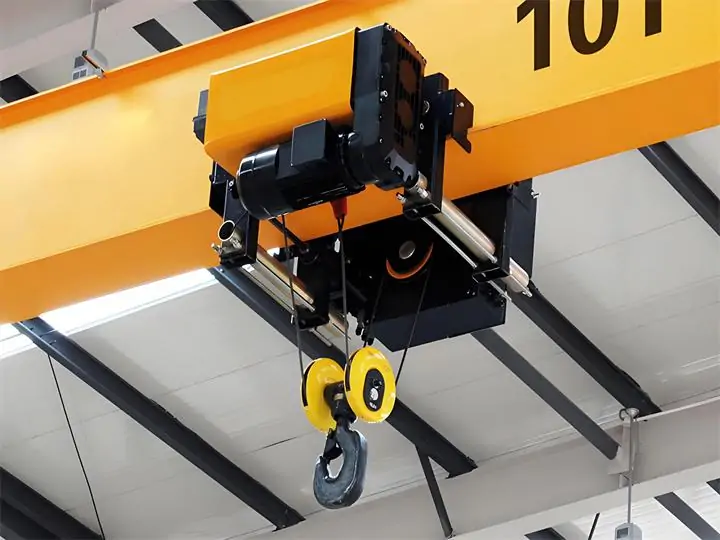
Explosion-Proof Overhead Crane
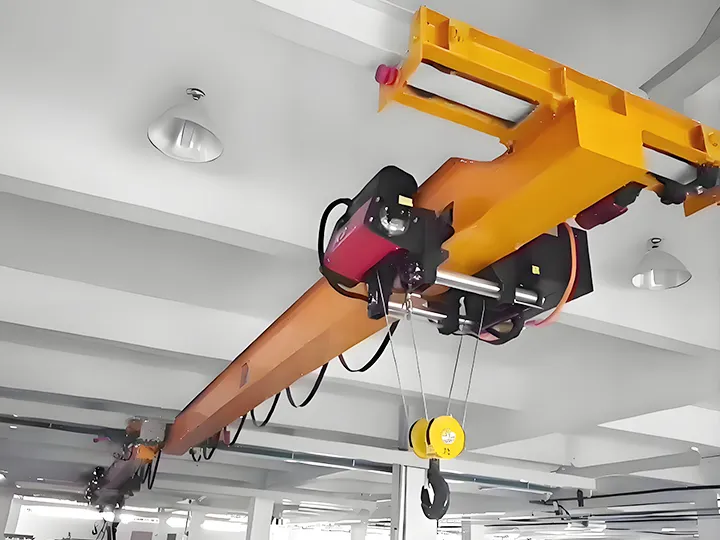
In environments with flammable gases, explosive vapors, or combustible dust, standard electrical equipment is a hazard. The explosion-proof overhead crane addresses this with all motors and electrical components manufactured to international explosion-proof standards and enclosed in certified housings.
Capacity: 5 – 75 tons Span: 7.5 – 31.5 m Best for: Petrochemical plants, chemical storage facilities, paint workshops, grain handling, and any area classified as a hazardous zone under applicable standards such as ATEX or IEC 60079.
Available in both single and double girder configurations to match the load requirements of different hazardous environments.
Key features: Certified explosion-proof structure, comprehensive safety protection, high sealing integrity, corrosion-resistant materials, stable operation, compliance with international explosion-proof certification standards.
What Are Overhead Cranes Used For?
These lifting systems appear across virtually every sector of heavy and medium industry. The main application areas are:
Machinery production workshops: Lift raw materials, semi-finished products, finished goods, and large components between processes to maintain production flow and improve efficiency.
Construction sites: Handle precast structural components, assist with steel structure installation, and manage building material logistics on site.
Warehouse and logistics: Load, unload, stack, and transport goods within the facility. Effective overhead lifting significantly improves warehouse space utilization compared to floor-level equipment.
Steel mill industry: Move raw materials, semi-finished products, and heavy equipment throughout steel mills and foundries, where loads regularly exceed what any other lifting method can handle safely.
Petrochemical industry: Equipped with explosion-proof models for equipment installation, storage tank lifting, and dangerous goods handling in classified hazardous zones.
Electronics industry: Work alongside automated production lines for high-precision assembly of components where positioning accuracy is critical.
Repair workshops: Support disassembly and reassembly of heavy equipment, component lifting, and maintenance operations — improving both efficiency and operator safety.
What Are the Main Parts of an Overhead Crane?
Every overhead crane — regardless of type — is built from the same core components. Understanding each part helps when specifying equipment or discussing maintenance with your supplier.
| Component | Function |
|---|---|
| Main girder(s) | Primary structural beam; carries the rails for trolley lateral travel |
| End trucks | Mount the crane travel mechanism; support bridge movement along the runway |
| Trolley travel mechanism | Drives the hoist laterally across the main girder |
| Bridge travel mechanism | Drives the crane longitudinally along the runway |
| Hoisting mechanism | Performs the vertical lift — motor, gearbox, drum, wire rope, and hook |
| Control system | Operates the crane via pendant, remote control, or operator cab |
| Electrical power system | Supplies power via motors, cables, and distribution units |
| Walkway | Provides safe access for inspection and maintenance personnel |
Overhead Crane Price Reference
Prices vary significantly based on capacity, span, lifting height, and specification. The table below gives indicative ranges for reference — actual pricing depends on confirmed parameters.
| Type | Capacity | Span | Main Applications | Price Range (USD) |
|---|---|---|---|---|
| Single Girder | 1–32 t | 3–34.5 m | Workshops, warehouses, construction, logistics, steel handling | $1,550 – $353,500 |
| Double Girder | 5–320 t | 10–50 m | Steel mills, heavy manufacturing, foundries, ports | Contact for quote |
| European FEM | 5–75 t | 4.5–31.5 m | Heavy industry, power plants, ports, precision lifting | $1,750 – $163,000 |
| Explosion-Proof | 5–75 t | 7.5–31.5 m | Petrochemical, chemical, hazardous zone operations | $1,800 – $157,500 |
| LX Suspension | 0.5–10 t | 3–22.5 m | Column-free facilities, retrofit installations | $1,200 – $12,200 |
Note: All prices are for reference only. Final pricing is subject to confirmed specifications.
Custom Overhead Crane Solutions from Voitto
Standard catalog models cover most applications. For facilities with specific requirements, Voitto engineers and manufactures to order. Parameters that can be customized include:
- Load capacity
- Span
- Lifting height
- Lifting speed
- Bridge travel speed
- Power supply type (electric, diesel, or hybrid)
- Environmental conditions (temperature, humidity, corrosive atmospheres)
- Safety features and automation levels
For a customized solution, contact Voitto’s technical team directly. They will review your requirements and recommend the most suitable configuration.

Alan
Crane Solutions Specialist · Voitto Crane
Specialized in Overhead Crane, Gantry Crane, Jib Crane, Port Crane & EOT Crane export solutions. 10+ years helping global clients with pre-sales consultation, capacity selection and site-specific configurations.
Summary
The different types of overhead cranes exist because different applications have genuinely different demands. Single girder units handle light to medium work cost-effectively. Double girder configurations carry what nothing else can. Suspension cranes solve the column-free problem. European FEM designs offer compactness and efficiency. Explosion-proof models go where standard equipment cannot.
Understanding the structural differences, application fit, and typical cost range of each type gives you a practical foundation for the right procurement decision — whether you’re equipping a new facility or replacing aging equipment in an existing one.
FAQ
Q1: What is the most common type of overhead crane for general industrial use?
The single girder overhead crane is the most widely used type for general industrial applications. Its load range of 1–32 tons covers the majority of production workshop and warehouse requirements, and its lower structural weight reduces building load demands compared to double girder designs. For applications that don’t require extreme tonnage or very high duty cycles, a single girder unit typically offers the best balance of capability and cost. Double girder designs become the standard recommendation once loads consistently exceed 20 tons or duty intensity is high.
Q2: How do I decide between a single girder and double girder overhead crane?
The primary decision factors are load capacity, duty cycle, and span. Double girder designs are recommended for loads above 20 tons, long spans, high-frequency operations, or applications requiring specialized attachments such as grabs or electromagnetic lifting devices. For loads below 20 tons in moderate-frequency operations, a single girder unit usually performs well at lower cost. Headroom is another factor — single girder cranes have a lower hook height for the same building height, while double girder designs allow the hook to travel higher relative to the floor.
Q3: Can overhead cranes be used outdoors?
Yes, with appropriate specification. Standard overhead cranes are designed for indoor use in ambient conditions. Outdoor or semi-outdoor applications require additional weatherproofing — sealed electrical enclosures, corrosion-resistant surface treatments, and in some climates, heating elements to prevent condensation in control panels. The specific requirements depend on the local environment. Voitto can configure equipment for outdoor use; this should be declared clearly when requesting a quote so the correct specification is applied from the outset.
Q4: What certifications should an overhead crane meet?
This depends on the destination country and industry. Common applicable standards include FEM (European), ASME B30 series (North America), GB/T standards (China), and ISO 4301 for duty classification. Explosion-proof equipment for hazardous environments must meet ATEX (Europe) or IEC 60079 certification requirements. When purchasing, confirm which standards apply to your facility and request documentation of compliance. CE marking is required for equipment placed on the European market. Voitto produces equipment meeting international standards and can provide relevant certification documentation on request.
Q5: How long does it take to receive a custom overhead crane?
Lead times depend on the specification and order volume. Standard configurations typically ship within 15–30 days. Custom builds with non-standard capacity, special environmental requirements, or complex control systems generally require 30–60 days from order confirmation. Longer lead times apply for very large or highly specialized equipment. When planning a new facility or production line, confirming crane specifications early in the project timeline avoids delays at the installation stage.




 English
  Español
  Português
  العربية
  Français
  Русский