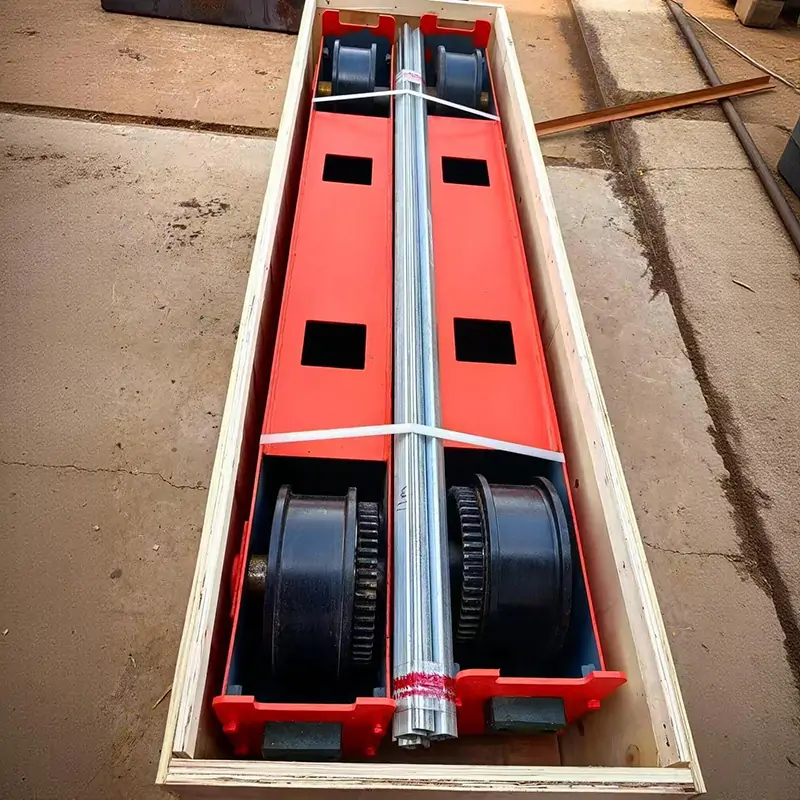
Every overhead and gantry crane relies on a dependable traveling unit — the crane end carriage. Our box-type welded frames, forged and precision-machined wheels, and matched drive systems keep your crane tracking straight along the runway rail, cycle after cycle.
A crane end carriage is a traveling mechanism mounted beneath the main girder of a bridge crane or gantry crane. This mechanism supports the entire crane structure and travels along the rails. Its rigid box-section frame, wheels, and drive system work together to enable the entire unit to move longitudinally. Featuring a modular design, this product can be bolted directly onto single- or double-girder crane structures without complex on-site modifications. The VOITTO engineering team can provide customized solutions based on the user’s operational requirements.
Product Description
A crane end carriage, sometimes called a crane end truck or crane travel unit, is the structural component fixed at each end of a crane’s main girder that connects the girder to the crane’s wheels. It supports the girder’s weight, transmits the combined load of the girder and lifted cargo to the runway rail or ground track, and drives the crane along that track through a motor-and-wheel assembly.
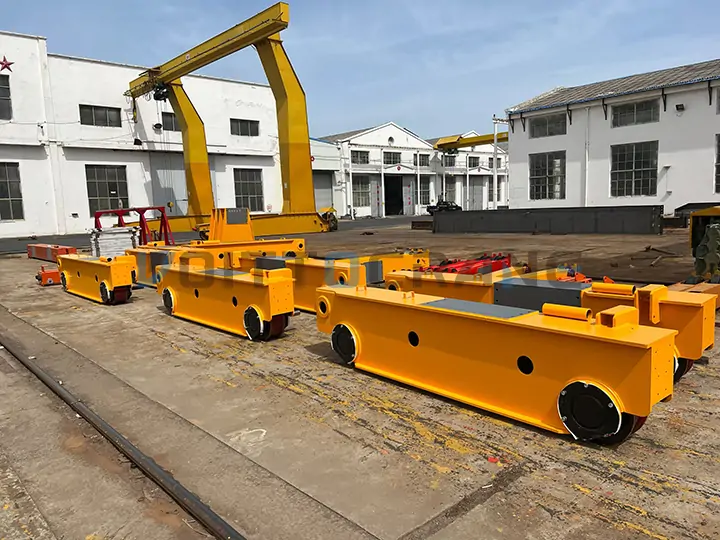
In an overhead crane, two end carriages bolt or weld onto the ends of the main girder, forming a bridge-like frame that spans the runway beams on either side of the workshop. In a gantry crane, the end carriage instead connects to the crane’s legs and travels on rails at ground level or on a paved surface. Because the end carriage carries the full traveling load, its rigidity, wheel alignment, and drive configuration directly determine how smoothly and safely the whole crane moves along the runway.
Types of Crane End Carriage
The specifications of crane end beams vary depending on the crane type, structure, and operating environment. The table below compares the four most common configurations offered by VOITTO, ranging from standard bridge crane end beams to heavy-duty end beams designed and manufactured specifically for continuous operation in ports and steel mills.
Type
Application
Features
Overhead Crane End Carriage
Single girder overhead crane; double girder overhead crane
Smooth runway traveling; compact structure
Gantry Crane End Carriage
Single girder gantry crane; double girder gantry crane
High load capacity; outdoor operation
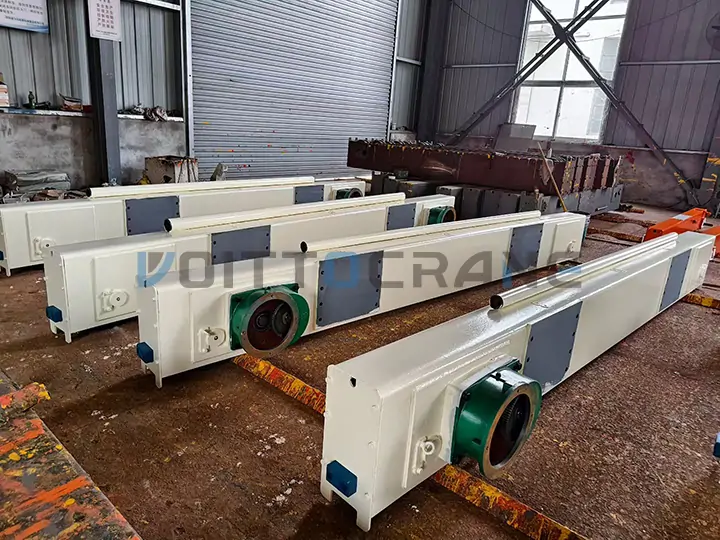
European Standard End Carriage
Overhead and gantry cranes requiring FEM-compliant components
Modular design; low noise; high precision
Heavy Duty Crane End Carriage
Steel plants; ports; heavy industry
High wheel load capacity; long service life
Parts of Crane End Carriage
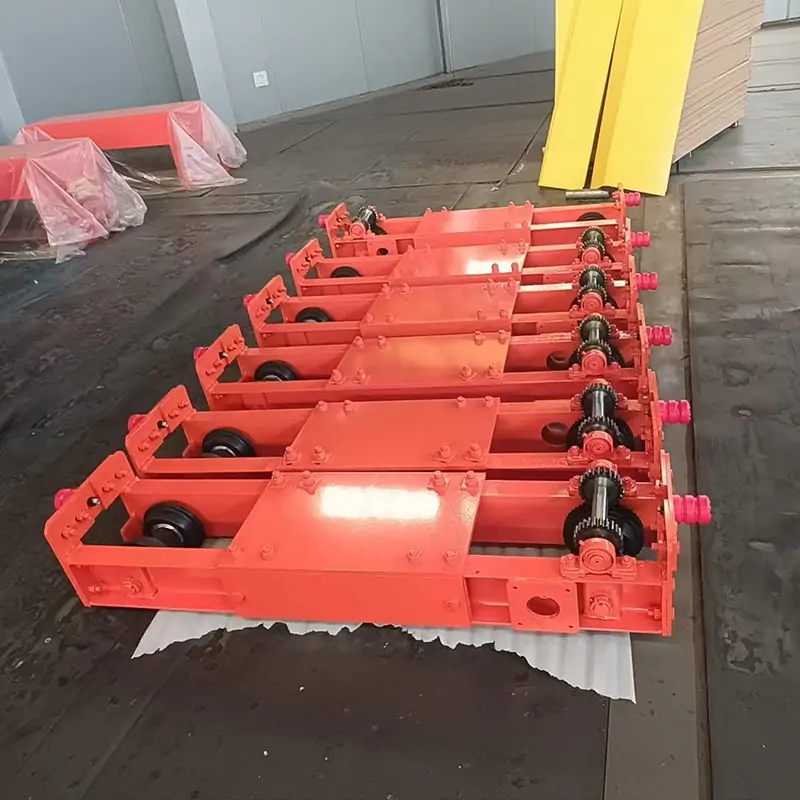
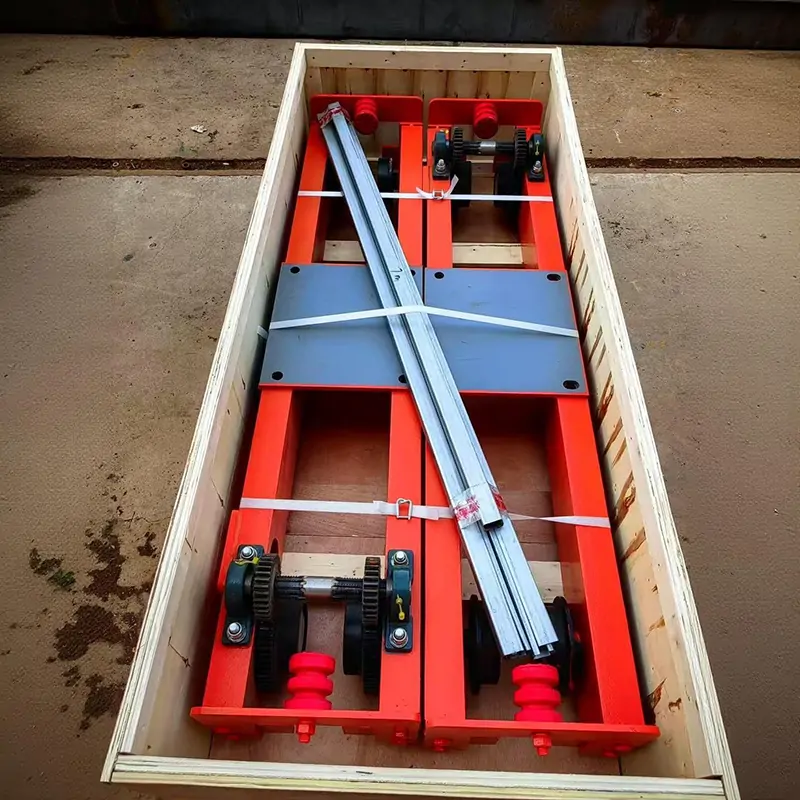
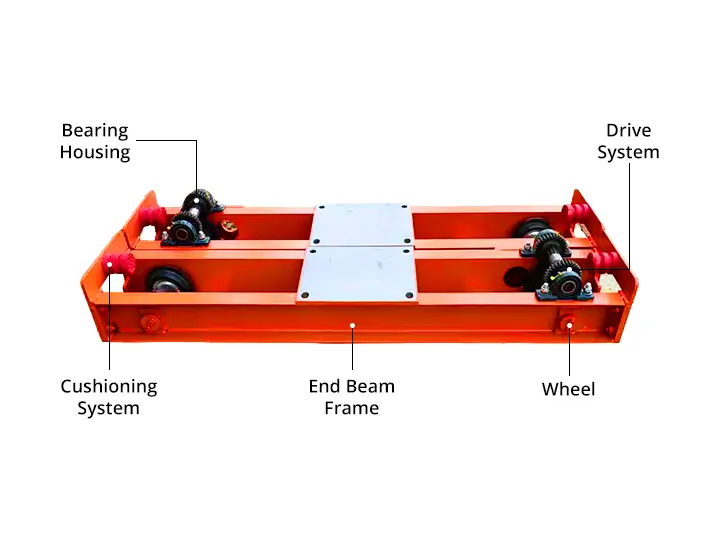
The crane end carriage consists primarily of the main frame, wheels, drive system, and buffer system components. These components work together to enable the equipment to move longitudinally.
End Girder Frame: The crane end carriage frame features a box-type welded structure manufactured from Q235B or Q355B steel plates.
Crane Wheels: These components come into direct contact with the rails and bear the entire machine’s load, enabling the equipment to move longitudinally.
Drive System: This system consists of a motor, a gear reducer, and a brake, and drives the crane end girder to travel along the rails at a controlled speed.
Connection System: The end girder is connected to the main girder via bolted joints or welding.
Bearing Housing: This component serves as the support element within the crane end girder wheel assembly; it is used to mount and secure the bearings, providing support for the wheel axle.
Buffer System: This component effectively reduces the impact generated during equipment operation.
Advantages and Features
Rigid Box-Type Structure: The box-type welded frame structure distributes operational loads evenly across the crane end beams, thereby reducing localized stress.
Precision-Machined Wheels: The forged steel wheels are manufactured using high-precision machining processes to ensure uniform contact between the wheel face and the full width of the rail.
Smooth and Stable Operation: Precise wheel alignment and a balanced drive layout ensure that the end beams travel in a straight line along the rails, minimizing deviation and lateral rail contact.
Modular Design and Easy Installation: The end beams are directly bolted to the main girder, eliminating the need for extensive on-site welding during installation and subsequent replacement. This modular design shortens the commissioning cycle and allows for the replacement of damaged end beams without dismantling the entire crane.
Low Maintenance Costs: Sealed bearings, wear-resistant wheel materials, and user-friendly connection point designs reduce the frequency and cost of routine maintenance.
Customization: VOITTO Crane offers customized solutions. This customized design ensures that wheel load, drive power, and structural dimensions are perfectly matched to actual operating conditions.
Crane End Carriage Manufacturer and Supplier
VOITTO Crane manufactures crane end carriages and complete overhead and gantry crane systems for industrial buyers across Europe, the Middle East, Southeast Asia, Africa, and South America. VOITTO engineers design each end carriage to meet project-specific capacity, span, and duty requirements rather than pulling it from a generic catalog.
With export experience across multiple regions, our team supports overseas customers through technical documentation, installation guidance, and after-sales spare parts supply for crane end carriages and related components. Please feel free to contact us for crane solutions.
Specialized in Overhead Crane, Gantry Crane, Jib Crane, Port Crane & EOT Crane export solutions. 10+ years helping global clients with pre-sales consultation, capacity selection and site-specific configurations.
A crane end carriage is the traveling unit mounted at each end of a crane’s main girder. It houses the wheels, drive system, and connection points that support the girder and move the crane along the runway rail or ground track.
What is the difference between a crane end carriage and an end truck?
Crane end carriage and crane end truck describe the same component. Both terms refer to the structural unit that connects the main girder to the crane wheels and drives the crane’s traveling motion along the rail.
How do I select the right crane end carriage?
When selecting a crane end girder, users must comprehensively consider the crane’s rated lifting capacity, span, duty class, travel speed, and operating environment. In addition, inspecting the condition of the rails is crucial, as the wheel alignment tolerance depends on the existing rail gauge and the condition of the rail surface.
Can crane end carriages be customized?
Yes. The wheel diameter, frame dimensions, drive type, and mounting configuration of this component can all be customized based on the crane’s lifting capacity, span, and duty class.
Do you supply complete crane components beyond end carriages?
Yes. Beyond crane end carriages, we supply complete overhead and gantry crane systems, main girders, hoists, and electrical components, so customers can source a full crane package or individual replacement parts.
Qualification and Honor
Engineered Strength, Global Crane Supplier
service
Exclusive and Considerable, Customer First.
01
Reliable and Customized Solutions
Our pre-sale team provides consultations, tailoring solutions to your needs and environment.
Offer customization options for lifting capacity, span and lifting height etc. to meet specific needs.
02
Updated Production Process
Real-Time Progress Updates: Weekly reports and PM communication.


 English
  Español
  Português
  العربية
  Français
  Русский