
Crane wheels for sale range from $30 to $2,000+ per unit — depending on diameter, material, flange type, and load rating. A W315×100 forged steel wheel for a 12–20 ton overhead crane typically costs $80–$180 FOB factory. A heavy-duty W800×180 forged 42CrMo wheel for port or metallurgical service can exceed $1,500.
Choosing wrong costs more than the wheel itself. A mismatched flange causes lateral drift under load. Insufficient surface hardness accelerates flat-spotting and rail gouging — forcing both the wheel and track to be replaced together. In a production facility running two shifts, a single unplanned shutdown can cost more than an entire set of replacement wheels.
This guide gives procurement managers and equipment engineers everything they need: the three flange types, full specification tables from W200 to W1000, a realistic price reference by size, a step-by-step selection checklist, and the questions every supplier should answer before you place an order.
- 1 Quick Reference: Crane Wheel Types & Price Ranges
- 2 What Is a Crane Wheel and Why Does It Matter?
- 3 Three Flange Types: Which One Does Your Crane Need?
- 4 Full Specification Table: W200 to W1000
- 5 How to Choose the Right Crane Wheel: A 5-Step Buyer’s Checklist
- 6 Application Scenarios: Where Crane Wheels Are Specified
- 7 الخلاصة
-
8
الأسئلة الشائعة
- 8.1 Q1: What does a crane wheel cost, and what drives the price difference?
- 8.2 Q2: Which material is best for high-temperature crane environments?
- 8.3 Q3: How do I know whether to order single flange, double flange, or flangeless?
- 8.4 Q4: Can crane wheels be manufactured to non-standard dimensions?
- 8.5 Q5: How often should crane wheels be replaced, and what are the early warning signs?
Quick Reference: Crane Wheel Types & Price Ranges
| نوع العجلة | Flange | الاستخدام النموذجي | Load Range | Price Range (FOB) |
|---|---|---|---|---|
| عجلة بدون حافة | لا يوجد | Follower/passive end of trolley | 5-50 طن | $30–$200 |
| عجلة ذات حافة واحدة | One side | آلية التنقل بالعربة | 5–80 t | $40–$500 |
| عجلة ذات حافة مزدوجة | كلا الجانبين | Crane bridge travel mechanism | 5–200 t | $50–$2,000+ |
| Wheel Block Assembly | Varies | Complete bolt-on unit with housing & bearings | 5–200 t | $150–$4,000+ |
Prices are indicative market references, FOB China factory. Final pricing depends on material grade, quantity, surface treatment, and customization requirements.

آلان
أخصائي حلول الرافعات · رافعة Voitto
10+سنوات الخبرة.5,000+الزبائن50+الدولمتخصصون في حلول تصدير الرافعات العلوية، والرافعات الجسرية، والرافعات الجيبية، ورافعات الموانئ، ورافعات الموانئ، ورافعات EOT. أكثر من 10 سنوات في مساعدة العملاء العالميين من خلال استشارات ما قبل البيع، واختيار السعة والتكوينات الخاصة بالموقع.

What Is a Crane Wheel and Why Does It Matter?


Function: Three Jobs at Once
A crane wheel is the primary load-bearing and travel component mounted at the base of a crane bridge or trolley, running directly on a steel rail. It performs three functions simultaneously:
- Load bearing — transfers the entire lifted weight through the wheel tread to the rail
- Travel — allows the crane or trolley to traverse the runway under motor drive
- Guidance — the flange (where present) keeps the wheel aligned on the rail and prevents lateral deviation
Because all three functions concentrate at the wheel-rail contact point — a zone no larger than a few square centimeters — the material and heat treatment specifications for crane wheels are considerably more demanding than for general industrial rollers.
Materials: Matching Steel Grade to the Job
The material choice directly determines hardness ceiling, load capacity, and service life. Here is how the standard grades compare:
| المواد | صلابة السطح (HRC) | قوة الشد | الأفضل لـ |
|---|---|---|---|
| 45# Steel | 40-50 | متوسط | Light-duty indoor cranes, low-cycle applications |
| 65Mn | 40–52 | عالية | General-purpose overhead and gantry cranes |
| 42CrMo | 45–58 | عالية جداً | Heavy-duty, high-cycle, metallurgical environments |
| 35CrMo | 42-55 | عالية | Large-diameter wheels, port and shipyard cranes |
| ZG340-640 (Cast) | 38–48 | عالية | Very large diameter wheels where forging is impractical |
| Nylon / Polyurethane | غير متاح | منخفضة | Light rail, clean-room, noise-sensitive environments |
For most industrial crane applications — overhead cranes from 5 to 50 tons — 65Mn forged is the standard choice. For cranes operating at high duty cycles (FEM Class A6–A8), in high-temperature environments such as steel mills and foundries, or at loads above 80 tons per wheel, 42CrMo with full quench-and-temper heat treatment is strongly recommended.
Manufacturing Process: Forged vs. Cast
Forged wheels are produced from billet steel pressed under high force, which aligns the grain structure and eliminates internal voids. The result is higher tensile strength, better impact resistance, and longer fatigue life. Forging is the standard for all load-bearing applications.
Cast wheels (ZG340-640 or similar) are used for very large diameters — typically above 700 mm — where forging equipment capacity becomes a constraint. Cast wheels require stricter quality inspection to catch internal porosity, and surface hardness is generally lower than equivalent forged grades.
Nylon and polyurethane wheels eliminate metal-on-metal contact, which suits clean rooms, food processing, and indoor logistics (AGV systems, electric hoist trolleys). They cannot be used on outdoor rail cranes or in high-temperature environments.
Three Flange Types: Which One Does Your Crane Need?
The flange is the raised rim on the side of the wheel that bears against the rail head and prevents the wheel from sliding off laterally. Different travel mechanisms use different flange configurations — and mixing them incorrectly is one of the most common procurement errors.
عجلة ذات حافة مزدوجة
A double flange wheel has raised rims on both sides of the tread. The flanges straddle the rail head, preventing lateral movement in either direction.
When to use it: The standard choice for crane bridge travel mechanisms — the end trucks that carry the main bridge along the runway rails. Double flanges are essential wherever a single wheel must maintain alignment independently, without relying on a paired wheel for guidance. They are also used in gantry crane leg assemblies running on ground-level rails, and in port crane travel mechanisms where rail spans are wide and lateral forces are significant.
Trade-off: The flanges create additional friction against the rail side face under lateral load. This is manageable at normal operating speeds but increases wear if the crane runway is not precisely level and parallel.
عجلة ذات حافة واحدة
A single flange wheel has a rim on one side only, with a plain tread on the other.
When to use it: Single flange wheels are typically used in pairs on رافعة علوية and gantry crane trolley travel mechanisms, where one wheel has the flange on the inside and its counterpart has it on the outside. Together they form a guided pair without double-flange friction on either side. The arrangement is called an “opposed flange” configuration.
Trade-off: Requires accurate pairing during installation. If both flanges are assembled on the same side by mistake, the trolley will walk off the beam.
عجلة بدون حافة
A flangeless wheel has a smooth cylindrical tread with no rim at all. It cannot guide itself on a rail — it depends entirely on its paired single-flange wheel for lateral restraint, acting purely as a load-bearing roller.
When to use it: Always in combination with a single flange wheel, never as a standalone. Common in trolley mechanisms where reducing rail friction is a priority, and in AGV handling systems running on flat floor tracks where guidance is provided by the track geometry or steering mechanism.
Trade-off: Zero tolerance for incorrect pairing. A flangeless wheel installed opposite another flangeless wheel will immediately walk off the rail under any lateral force.
Full Specification Table: W200 to W1000
The following table covers the standard crane wheel size range per common industry practice. All dimensions are nominal; actual certified drawings are issued per order.
| نموذج | القطر (مم) | عرض العجلة (مم) | ارتفاع الحافة (مم) | المواد | صلابة السطح (HRC) | سعة الحمولة (طن/وحدة) |
|---|---|---|---|---|---|---|
| 200 × 70 | 200 | 70 | 25 | 65Mn | 40-50 | 5-8 |
| W250×90 | 250 | 90 | 28 | 45# Steel | 40-50 | 8-12 |
| W315×100 | 315 | 100 | 30 | 42CrMo | 42-55 | 12-20 |
| W400×120 | 400 | 120 | 35 | 42CrMo | 45-55 | 20-32 |
| W500×130 | 500 | 130 | 40 | 65Mn | 42-50 | 32-45 |
| W600×150 | 600 | 150 | 45 | 42CrMo | 45-55 | 45-65 |
| W710×160 | 710 | 160 | 50 | ZG340-640 | 38-45 | 65-90 |
| W800×180 | 800 | 180 | 55 | 42CrMo | 45-55 | 90-120 |
| 900 × 200 | 900 | 200 | 60 | 42CrMo | 45-55 | 120-150 |
| W1000×220 | 1000 | 220 | 65 | 42CrMo | 45-55 | 150-200+ |
Load capacity values are per-wheel references under standard operating conditions. Actual rated load depends on crane class (FEM/ISO duty group), travel speed, and wheel arrangement. Consult engineering drawings for certified load ratings.
Price Reference by Size Tier
| Size Tier | Models | Indicative Price (FOB, per wheel) | الملاحظات |
|---|---|---|---|
| صغير | W200–W315 | $30–$180 | Standard material; high-volume availability |
| متوسط | W400–W600 | $150–$600 | 42CrMo standard; heat treatment included |
| كبير | W710–W1000 | $500–$2,000+ | Forged or cast; longer lead time; often custom |
| Wheel Block Assembly | Any size | Add $100–$2,000 | Includes housing, shaft, bearings, seals |
FOB China. Prices are market references as of 2026 and vary with steel commodity pricing, order quantity, and customization scope.
Ready to confirm your specification? Send your model number, load requirement, and rail type — we reply with a formal quotation within 24 hours.
آلان
أخصائي حلول الرافعات · رافعة Voitto
10+سنوات الخبرة.5,000+الزبائن50+الدولمتخصصون في حلول تصدير الرافعات العلوية، والرافعات الجسرية، والرافعات الجيبية، ورافعات الموانئ، ورافعات الموانئ، ورافعات EOT. أكثر من 10 سنوات في مساعدة العملاء العالميين من خلال استشارات ما قبل البيع، واختيار السعة والتكوينات الخاصة بالموقع.
How to Choose the Right Crane Wheel: A 5-Step Buyer’s Checklist
Step 1 — Confirm Your Wheel Load (Not Just Crane Capacity)
Start with the maximum wheel load, not the crane’s rated lifting capacity. The wheel load equals the crane capacity plus the dead weight of the crane bridge and trolley, divided by the number of load-bearing wheels. On a 20-ton overhead crane with four end truck wheels, the static wheel load is typically 8–12 tons per wheel — but dynamic factors (FEM class, travel speed, acceleration) push the design load 25–40% higher.
If you do not have the wheel load calculation, provide your crane’s rated capacity, span, bridge weight, and duty class to your supplier’s engineering team. Sizing from rated capacity alone routinely results in under-specified wheels.
Step 2 — Identify Your Rail Type
The wheel tread profile must match the rail head profile. The three common crane rail types are:
- QU rail (square head): Standard for heavy overhead and gantry cranes; flat tread wheel required
- I-beam flange (for light crane systems): Rounded or flat tread; verify with beam manufacturer
- Flat bar rail (light-duty): Used on monorail systems and some AGV tracks
A wheel-rail profile mismatch causes concentrated edge contact, which dramatically accelerates both wheel and rail wear.
Step 3 — Determine the Correct Flange Configuration
| آلية السفر | التكوين الموصى به للشفة |
|---|---|
| Crane bridge end trucks | Double flange on all four wheels |
| Trolley on bridge beam (light crane) | Single flange (inner) + Flangeless (outer) pairs |
| Trolley on bridge beam (heavy crane) | Single flange (inner) + Single flange (outer) opposed |
| Gantry crane legs on ground rail | فلانجة مزدوجة |
| AGV / light logistics on flat track | Flangeless or nylon wheel with guide rollers |
Step 4 — Specify the Operating Environment
Environmental conditions determine material and surface treatment:
- High temperature (foundry, steel mill, ladle crane): 42CrMo forged; avoid nylon; verify grease spec for bearing temperature range
- Outdoor, exposed to rain and salt air (port crane): 42CrMo with anti-corrosion surface treatment; sealed bearing units
- Clean room / food processing: Nylon or polyurethane tread; stainless shaft; no open grease nipples
- Standard indoor workshop: 65Mn or 42CrMo forged; standard grease-lubricated bearings
Step 5 — Wheel Only or Wheel Block Assembly?
Wheel only (bare wheel without shaft, housing, or bearings) is right when replacing a worn wheel on an existing travel mechanism with a serviceable housing and shaft. It requires on-site installation expertise and precise fit verification.
Wheel block assembly (complete unit including wheel, shaft, housing, bearings, and seals) is better for new crane builds, major refurbishments, or when your maintenance team prefers bolt-on replacement. It costs more per unit but eliminates alignment risk and reduces installation time substantially. Voitto’s crane wheel block assemblies are pre-aligned and tested before dispatch.
Application Scenarios: Where Crane Wheels Are Specified
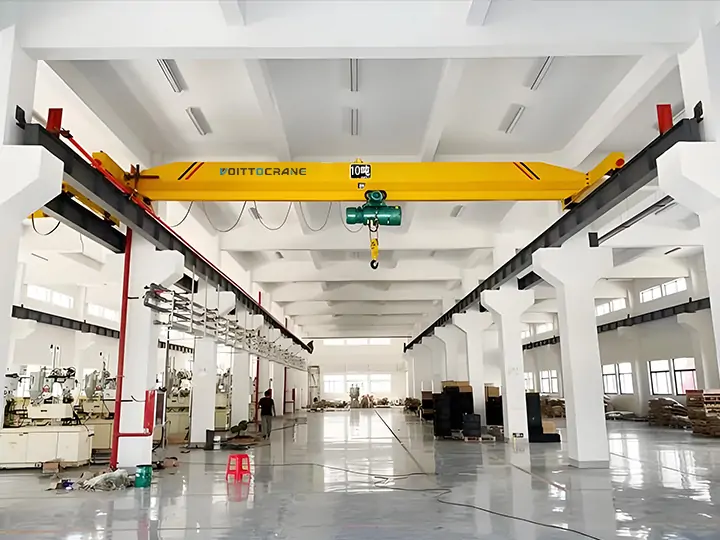
Overhead Cranes: Four double-flange end truck wheels on the bridge, plus two to four wheels on the trolley (single flange/flangeless configuration). Spans from 5 to 35 meters; capacity from 1 to 500 tons. The trolley wheel is frequently the first to wear due to higher cycle frequency. See the overhead crane product range for compatible configurations.
Gantry Cranes: Ground-level rail operation means outdoor exposure, higher contamination risk, and greater lateral force from wind load. Double-flange wheels are standard on all four legs. Rail-mounted gantry (RMG) cranes at container terminals use large-diameter steel wheels — often W630 to W900 range. See رافعة جسرية specifications.
Metallurgical and Foundry Cranes: Casting cranes and ladle cranes operate above molten metal at ambient temperatures that can exceed 200°C. Wheel material must be 42CrMo minimum; bearing grease must be rated for high-temperature service. These are the most demanding crane wheel applications in terms of material specification.
Port and Shipyard Cranes: Ship-to-shore quay cranes use very large wheel diameters (W800–W1000) with high load ratings. Rail gauges are wide, and wheels must handle significant dynamic loading from container grab and spreader operations.
Light Crane and Logistics Systems: Electric hoist trolleys, jib crane slewing rings, and AGV handling equipment running on I-beam or flat bar rails use smaller wheels (W160–W250), often in nylon or polyurethane for noise reduction and floor protection. These are the crane-on-wheels applications where material flexibility is highest. Stackers, reclaimers, and automated storage systems — where the entire crane with wheels traverses long runway systems — also fall into this category.
الخلاصة
The right crane wheel comes down to four confirmed inputs: wheel load (not just crane capacity), rail type, flange configuration, and operating environment. Get these four right, and the specification writes itself. Get one wrong, and you are looking at accelerated wear, unplanned maintenance, and in worst cases, a derailment event under load.
Three actions before you place an order:
- Pull your crane’s original wheel load calculation or request it from your crane OEM
- Verify the existing rail profile before ordering a replacement wheel
- Send your confirmed specs to a qualified supplier for engineering sign-off — not just a catalog selection
Voitto manufactures crane wheels from W200 to W1000, in forged steel, cast steel, and non-metallic materials, with standard and custom flange configurations. Rated capacity 5 to 200+ tons. Lead time for standard sizes: 20-30 days FOB. Custom sizes: 20–45 days.
آلان
أخصائي حلول الرافعات · رافعة Voitto
10+سنوات الخبرة.5,000+الزبائن50+الدولمتخصصون في حلول تصدير الرافعات العلوية، والرافعات الجسرية، والرافعات الجيبية، ورافعات الموانئ، ورافعات الموانئ، ورافعات EOT. أكثر من 10 سنوات في مساعدة العملاء العالميين من خلال استشارات ما قبل البيع، واختيار السعة والتكوينات الخاصة بالموقع.
الأسئلة الشائعة
Q1: What does a crane wheel cost, and what drives the price difference?
A standard small crane wheel (W200–W315, 65Mn forged) costs $30–$180 per unit FOB factory. Medium-range wheels (W400–W600, 42CrMo forged) run $150–$600. Large heavy-duty wheels (W710–W1000) start at $500 and can exceed $2,000 for custom configurations. The four main price drivers are:
(1) diameter — larger wheels require more raw material and larger forging equipment;
(2) material grade — 42CrMo costs more than 45# steel but lasts significantly longer under heavy load;
(3) heat treatment — full quench-and-temper with hardness certification adds cost but is non-negotiable for loads above 30 tons per wheel;
(4) quantity — unit pricing drops 20–35% for orders of 10+ wheels of the same spec. Wheel block assemblies (with housing, shaft, and bearings) add $100–$2,000 per unit depending on size.
Q2: Which material is best for high-temperature crane environments?
For cranes in foundries, steel mills, or near furnaces — casting cranes, ladle cranes, charging cranes — 42CrMo forged and heat-treated is the standard specification. It maintains structural integrity and surface hardness at elevated ambient temperatures where 65Mn and 45# steel begin to soften. ZG340-640 cast steel is used for very large diameters but has lower baseline hardness. Nylon and polyurethane wheels are not suitable above 80°C ambient. Bearing grease selection is equally critical — specify a grease with a dropping point above the maximum expected bearing temperature, and consult your supplier for the correct grade.
Q3: How do I know whether to order single flange, double flange, or flangeless?
The answer depends on the travel mechanism, not the crane type. Crane bridge end trucks almost always use double flange wheels. Trolley mechanisms on overhead cranes typically use paired single-flange and flangeless wheels in an opposed configuration. If replacing a worn wheel on an existing crane, the safest approach is to measure the worn wheel and match the flange configuration exactly — even if you suspect the original design was suboptimal. Changing flange configuration on an existing crane requires corresponding modifications to rail alignment and wheel spacing, which is a separate engineering task.
Q4: Can crane wheels be manufactured to non-standard dimensions?
Yes. While the W200–W1000 range covers most standard applications, non-standard diameters, widths, flange heights, bore sizes, and keyway configurations are routinely produced. Custom wheels require a dimensional drawing or the original wheel as a reference sample. Minimum order quantities for custom sizes are typically 2–4 units; lead time is 20–35 days FOB depending on diameter and material. Voitto’s engineering team can also reverse-engineer worn wheels from physical measurements if no drawing is available.
Q5: How often should crane wheels be replaced, and what are the early warning signs?
Replacement interval depends on crane duty class and load. A light-duty indoor overhead crane (FEM A3–A4) running 65Mn wheels may operate 5–8 years before replacement. A heavy-duty casting crane (FEM A7–A8) in a steel mill may require inspection every 12–18 months. Key wear indicators: (1) tread diameter reduction — replace when worn 15–20% from nominal; (2) flange thinning — a flange at less than 50% of original thickness is a derailment risk; (3) flat spots — caused by wheel lock-up under braking, increasing dynamic shock loads across the structure; (4) surface cracking — especially relevant for cast wheels. Scheduled inspection with measurement logging is the most cost-effective way to time replacements before failure.




 English
  Español
  Português
  العربية
  Français
  Русский