
The right overhead crane in the automobile industry is defined by production stage, not by tonnage alone. A stamping press needs a 20–32 t die-gripper crane with ±1 mm positioning accuracy. A trim-and-final assembly cell needs a 250–500 kg KBK aluminum rail system that operators can push by hand. Specifying one without the other wastes budget or creates a safety gap.
Automotive plants run 24 hours a day at duty class M5–M6 (per فيم 1.001), and unplanned crane downtime translates directly to line stoppage. Engineers and procurement managers need cranes matched to load, cycle frequency, and environmental conditions — not a generic “overhead crane for auto” catalog page.
This guide maps every major production stage to the correct crane type, key specifications, and compliance requirements. Use the table in the next section to shortcut your selection process.
TL;DR: Cranes in Automotive Production
- • Production Scope: Overhead cranes in the automobile industry support six distinct production stages, each requiring specific crane types and lifting capacities.
- • System Selection: Use double-girder bridge cranes (5–50 t) for stamping and body-in-white; utilize KBK rail systems and monorails for assembly lines under 2 t.
- • Safety Compliance: Explosion-proof cranes (ATEX Zone 1/2) are mandatory in paint shops; standard EOT cranes are strictly non-compliant.
Quick-Reference: Crane Type by Production Stage
| Production Stage | نوع الرافعة الموصى به | السعة النموذجية | Key Spec / Compliance |
|---|---|---|---|
| Steel Coil / Blanking | Double-girder EOT + C-hook or coil tong | 10–32 t | FEM 1.001 M5; coil tong rated to EN 13155 |
| Stamping / Die Shop | Double-girder with die gripper or spreader beam | 16–50 t | Positioning accuracy ≤2 mm; anti-sway control |
| Body-in-White (BIW) Welding | Single- or double-girder EOT | 5-20 t | CE/ISO 9927-1 inspection; inverter-drive trolley |
| Paint Shop | Explosion-proof overhead crane | 1–5 t | ATEX Zone 1/2 (IEC 60079-10); Ex-rated hoist |
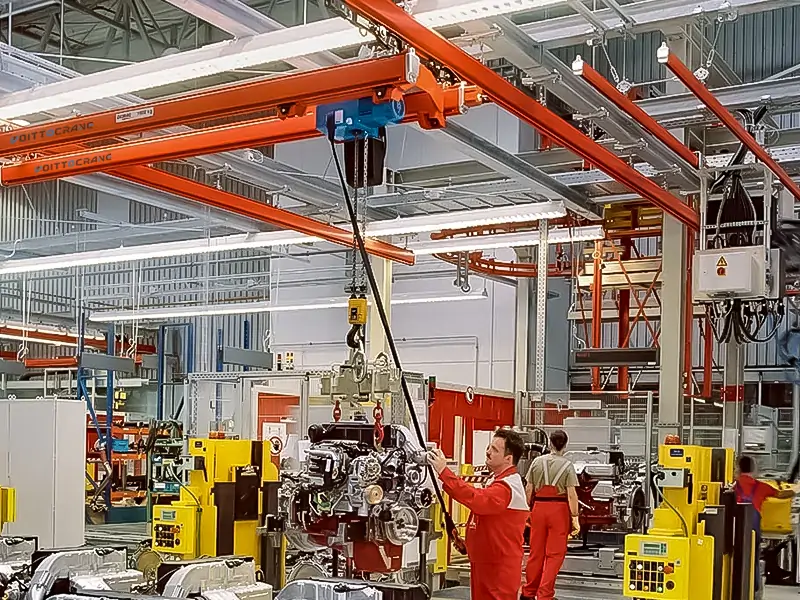
| Powertrain / Engine Assembly | Workstation KBK rail or jib crane | 125 kg–2 t | Aluminum rail; ergonomic balancer optional |
| Final Assembly / Trim Line | Monorail hoist or enclosed-track KBK | 125–500 kg | Low headroom; push-travel for operator control |
Selection rule: Identify the stage first, then specify capacity and duty class. Mismatching duty class is the most common cause of premature crane failure in high-volume automotive plants.
Crane Applications Across the Automotive Production Line

Steel Coil Handling and Blanking
Double-girder EOT cranes with C-hooks lift steel coils weighing 5–25 t from warehouse storage directly to blanking lines, eliminating forklift trips in congested aisles. The crane span typically matches the bay width (18–28 m), and the C-hook must be rated under EN 13155:2003+A2 for below-the-hook lifting devices. Duty class M5 (FEM 1.001) is the minimum; high-volume plants running three shifts should specify M6.
Stamping Die Changes
Overhead cranes in stamping shops are the most operationally demanding application in any automotive plant. Dies for large body panels weigh 15–40 t, and change cycles must be completed in under 10 minutes on a World Class Manufacturing (WCM) line. Cranes handling dies use gripper attachments or adjustable spreader beams sized to the die’s lifting lugs; variable-frequency drives (VFDs) provide micro-speed positioning at ≤0.5 m/min for final placement into the press bed. Anti-sway technology — either mechanical damping or closed-loop electronic control — is standard, not optional, to prevent die damage worth $200,000–$800,000 per unit.
Body-in-White Welding Cells
Single-girder overhead cranes (5–16 t) serve BIW welding bays by moving body assemblies between fixture stations. Inverter-driven trolleys allow smooth, jerk-free starts that protect sensitive welded assemblies. In robotic welding cells, the crane is often integrated into the plant automation network via PLC, with limit switches and encoders that confirm load position before the robot cycle begins.
Specialized Crane Requirements for Paint Shops and Assembly
Explosion-Proof Cranes in Paint Shops
Paint booths and primer application zones contain solvent vapors that create explosive atmospheres classified as ATEX Zone 1 or Zone 2 under IEC 60079-10-1. Standard EOT cranes cannot be used in these areas. Explosion-proof overhead cranes use Ex-rated hoists with spark-proof brakes, enclosed dust-tight electrical cabinets (IP55 minimum), and non-sparking hook materials. The entire crane — hoist, control pendant, runway conductors — must carry ATEX certification. Failure to comply exposes the plant to liability and insurance voidance; it is not a cost-reduction option.
KBK Rail Systems for Powertrain and Engine Assembly
KBK (Kombi-Kran-System) aluminum rail cranes handle loads from 125 kg to 2 t across powertrain assembly areas where floor space is tightly managed. The aluminum profile track — standardized under DIN EN 1090 fabrication tolerances — mounts to the building steel or a freestanding structure, keeping the floor clear for AGVs and operator carts. Pneumatic or electric balancers attached to KBK hoists allow one operator to guide a 500 kg engine block with finger-tip force, reducing musculoskeletal injury risk and improving cycle time by 15–25% versus manual jig methods (representative case data, automotive Tier 1 supplier, 2023).
Monorail and Enclosed-Track Systems for Final Assembly
Final assembly (trim, chassis, final line) relies on monorail hoists or enclosed-track KBK systems running at 125–500 kg capacity. These cranes move seats, instrument panels, and door assemblies from kitting areas to the moving line. The monorail hoist trolley runs on an I-beam or enclosed-profile track and is typically push-travel — the operator walks the part to the vehicle body without powered travel, preserving tactile control. Low headroom hoists are critical here: automotive final assembly areas have overhead conveyor systems, ventilation ducts, and lighting grids that leave as little as 3.5 m of usable height.
How to Select the Right Overhead Crane for Your Automotive Application
Four Parameters That Determine the Correct Specification
Selecting an overhead crane for an automotive plant correctly requires confirming four inputs before contacting any supplier:
- Maximum single lift load (tonnes): Include the heaviest fixture or tooling attached to the load, not just the part weight.
- Duty class (FEM 1.001 or ISO 4301/1): Calculate based on daily lift cycles. Most automotive production cranes fall in M4–M6; maintenance area cranes are typically M3.
- Environment classification: Standard, wash-down (IP54+), explosive atmosphere (ATEX), or cleanroom (Class 10,000 or better).
- Positioning accuracy required: General material movement tolerates ±50 mm; die placement and robot-integrated cells require ±1–2 mm, which means VFD drives and anti-sway are non-negotiable.
Automation Readiness Checklist
Modern automotive plants increasingly require cranes that integrate with MES (Manufacturing Execution Systems) and Industry 4.0 platforms. Before finalizing a crane specification, confirm with the supplier:
- PLC interface: Does the crane support EtherNet/IP, PROFINET, or Modbus TCP for plant network integration?
- Load monitoring: Is a real-time load cell output available for MES data logging?
- Anti-collision: Does the crane carry radar or ultrasonic anti-collision sensors for multi-crane bays?
- Remote diagnostics: Is the VFD accessible via cloud gateway for predictive maintenance alerts?
Cranes lacking these interfaces can be retrofitted, but retrofit costs (typically $8,000–$25,000 per crane) often exceed the cost difference of specifying the correct system upfront.
Compliance Milestones Before Commissioning
Every overhead crane in the automobile industry must pass the following compliance checkpoints before entering production service:
- اختبار التحميل: 125% of SWL (Safe Working Load) static test, per ISO 9927-1 / EN 13001-1
- CE Declaration of Conformity (required for EU-market facilities; increasingly required by global OEMs as supply chain standard)
- Annual inspection: Documented under ISO 9927-3, performed by a competent person
- ATEX certification (paint shops only): Full system certification including pendant, conductors, and hoist per IEC 60079-series
الخلاصة
Overhead crane selection in the automobile industry is a stage-by-stage decision, not a single-specification exercise. Die shops need heavy-duty, precision-controlled double-girder cranes rated M5–M6; assembly lines need ergonomic, low-headroom KBK or monorail systems rated M3–M4; paint shops need ATEX-certified explosion-proof cranes regardless of capacity. Get the stage mapping right before engaging a supplier, and use the table above as your first filter. If your plant is planning a new line or crane replacement, submit your production stage, maximum lift load, duty cycles per day, and environment classification — an engineering team can turn those four inputs into a complete specification within 48 hours.

آلان
أخصائي حلول الرافعات · رافعة Voitto
متخصصون في حلول تصدير الرافعات العلوية، والرافعات الجسرية، والرافعات الجيبية، ورافعات الموانئ، ورافعات الجسور العلوية الكهربائية. خبرة تزيد عن 10 سنوات في مساعدة العملاء العالميين من خلال الاستشارات قبل البيع، واختيار السعة، والتكوينات الخاصة بكل موقع.
الأسئلة الشائعة
Q1: What type of overhead crane is used in automotive paint shops?
Explosion-proof (Ex) overhead cranes certified to ATEX Zone 1 or Zone 2 (IEC 60079-10-1) are mandatory in paint booths where solvent vapors create explosive atmospheres. Standard EOT cranes are not compliant. The entire system — hoist, pendant, runway conductors — must carry individual ATEX certification, not just the hoist unit.
Q2: What capacity overhead crane is needed for die handling in a stamping press?
Stamping die overhead cranes typically range from 16 t to 50 t, depending on the press size and die weight. Large body-panel dies for B-segment and above vehicles weigh 20–40 t. The crane must also provide micro-speed positioning (≤0.5 m/min) and anti-sway control to place dies within the ±2 mm tolerance required for press alignment.
Q3: What is FEM duty class, and why does it matter for automotive cranes?
FEM 1.001 duty class defines how many hours of operation and lift cycles a crane is designed for. Automotive production cranes running three shifts should be specified at M5 (heavy) or M6 (very heavy); under-specifying duty class is the leading cause of premature gearbox and hoist failure. Maintenance area cranes that lift infrequently are typically M3.
Q4: Can KBK rail cranes be integrated with robotic assembly cells?
Yes. KBK systems with electric travel and PLC-controlled hoists can be integrated with robot cell safety circuits via dry-contact I/O or fieldbus (EtherNet/IP, PROFINET). The crane enters a defined “parked” position verified by an encoder before the robot cycle begins. This is standard practice in powertrain assembly cells at Tier 1 automotive suppliers.
Q5: What certifications should I require from an overhead crane supplier for an automotive plant?
Require: CE Declaration of Conformity (EN 13001 series), ISO 9927-1 load test documentation, FEM 1.001 duty class confirmation, and — for paint shop equipment — ATEX system certification per IEC 60079 series. For plants supplying global OEMs (Toyota, VW, GM), also confirm that the supplier’s quality management system is ISO 9001:2015 certified.




 English
  Español
  Português
  العربية
  Français
  Русский