A ponte rolante pórtico padrão europeu FEM é um dispositivo de elevação de alto desempenho. Projetada de acordo com as avançadas normas europeias FEM, esta unidade combina uma estrutura leve, recursos de eficiência energética e controle preciso. O equipamento é equipado com talhas elétricas de cabo de aço europeias, tecnologia de inversor de frequência (VFD) e uma estrutura de aço otimizada. Comparada às pontes rolantes pórtico tradicionais, oferece menor pressão sobre as rodas, maior altura de elevação, operação mais suave e menores requisitos de manutenção. Essas pontes rolantes estão disponíveis em configurações de viga simples e viga dupla, com capacidades de elevação que variam de 1 tonelada métrica a mais de 320 toneladas métricas, e podem ser personalizadas para atender às necessidades de diversas aplicações industriais.
A ponte rolante padrão FEM está disponível em duas configurações estruturais: sistemas de viga única com capacidades de elevação nominais que variam de 1 a 32 toneladas métricas e modelos de viga dupla com capacidades de elevação que variam de 5 a 320 toneladas métricas. Ambas as configurações atendem às normas FEM 1.001 e ISO 4305, são equipadas com sistemas de segurança redundantes e apresentam uma velocidade de elevação de 2 metros por segundo. Normalmente, os usuários operam este equipamento para realizar tarefas de movimentação de materiais nos setores de fabricação de aço, construção naval e montagem industrial. O equipamento possui certificação CE e foi projetado para uma vida útil de até 25 anos.
O que é um guindaste pórtico padrão FEM?
O guindaste pórtico padrão FEM é um sistema de elevação montado no piso. Este guindaste pórtico europeu apresenta uma combinação de uma viga principal de seção transversal soldada e vigas de extremidade aparafusadas, o que reduz o tempo de instalação em 30% em comparação com estruturas rebitadas. Além disso, o sistema de viga única tem um vão de 6 a 18 metros e ocupa um espaço horizontal mínimo, enquanto a configuração de viga dupla oferece um vão maior, de 15 a 35 metros. Graças à integração de freios limitadores de carga redundantes, pontos de suspensão duplos e células de carga de precisão, o sistema com certificação FEM atinge um tempo de atividade de 99,2%.
Pórtico rolante de uma viga
Pórtico rolante de dupla viga
Seu conceito de design modular permite o aumento da capacidade de elevação sem a necessidade de substituir a estrutura principal, estendendo assim a vida útil do equipamento para mais de 25 anos. Portanto, ao selecionar a configuração de viga adequada, os usuários devem considerar de forma abrangente o layout da fábrica, a frequência de carga e os requisitos de produção.
Tipos de pontes rolantes padrão FEM
Um guindaste pórtico de viga única apresenta uma única viga de aço soldada montada sobre quatro pernas. Possui capacidade de elevação de 1 a 32 toneladas métricas, vão de 6 a 18 metros e altura de elevação de 6 a 12 metros. Este sistema compacto é ideal para espaços com altura limitada, exigindo menos espaço livre do que os modelos de viga dupla. Além disso, os modelos de viga única apresentam um conjunto de carro de içamento simplificado, o que prolonga os intervalos de manutenção e reduz a necessidade de estoque de peças de reposição.
Os guindastes pórticos de viga dupla apresentam duas vigas principais paralelas. Este modelo possui capacidade de elevação que varia de 5 a 320 toneladas métricas, vão de 15 a 35 metros e altura de elevação de 10 a 25 metros. Este projeto distribui a carga por dois pontos de apoio, aumentando assim a estabilidade durante operações de elevação dinâmicas. Como resultado, o sistema de viga dupla é ideal para o manuseio de equipamentos pesados de fabricação, grandes componentes de construção naval e operações industriais contínuas.
Vantagens e características
Os pórticos rolantes europeus são projetados de acordo com as avançadas normas europeias FEM, combinando construção leve, desempenho com eficiência energética e tecnologia de controle inteligente. A seguir, descreverei as principais vantagens e características dos pórticos rolantes padrão FEM.
Design leveEm comparação com os guindastes de pórtico tradicionais, seu peso próprio é reduzido em até 30%, diminuindo efetivamente a carga sobre as rodas e reduzindo os custos de construção da fundação.
Viagem de Gancho MaiorO design com pé-direito baixo maximiza a altura de elevação.
Eficiente em termos energéticos e de alto desempenhoSistemas de acionamento avançados e motores de alta eficiência reduzem o consumo de energia em até 40%.
Controlo precisoO controle de frequência variável garante uma operação suave, posicionamento preciso e minimiza a oscilação da carga.
Baixos requisitos de manutençãoComponentes modulares e um sistema de acionamento confiável minimizam as necessidades de manutenção e o tempo de inatividade.
Longa vida útilComponentes de alta qualidade e um design estrutural otimizado garantem a durabilidade do equipamento.
Operação silenciosaA tecnologia avançada de acionamento reduz significativamente o ruído de funcionamento.
Suporte para Automação InteligenteOs guindastes pórticos europeus podem ser integrados com controle PLC, sistemas anti-oscilação, monitoramento remoto e soluções automatizadas de movimentação de materiais.
Aplicação
Os usuários operam um guindaste pórtico FEM Standard para realizar tarefas de movimentação de materiais nos setores de manufatura, logística, portuário, construção naval, energia eólica e indústria pesada.
FábricasUsuários operam pontes rolantes europeias em oficinas de produção para lidar com o transporte e a montagem de componentes de grande porte.
Indústrias de estruturas de aço e processamento de metaisOs operadores utilizam o guindaste pórtico padrão FEM para içar e transportar aço e componentes metálicos de grandes dimensões, bem como para movê-los entre as estações de soldagem.
Armazéns e centros logísticosOs guindastes pórticos europeus lidam com operações de carga, descarga, empilhamento e logística de cargas pesadas.
Portos e terminaisOs usuários utilizam guindastes pórticos europeus para realizar operações de carga, descarga e transbordo em terminais de contêineres e de carga a granel.
Estaleiros de construção e reparação navalOs operadores de estaleiros utilizam guindastes pórticos padrão FEM europeu para içar seções do casco do navio e grandes componentes estruturais.
Energia Eólica e Indústrias de Novas EnergiasOs usuários operam este equipamento para levantar pás de turbinas eólicas, componentes de grande porte, seções de torres e nacelles.
Componentes pré-fabricados e indústrias da construçãoOs operadores usam essa máquina para levantar vigas de concreto pré-moldado, componentes de concreto protendido e grandes módulos de construção.
Pátios de estocagem a céu aberto e pátios para materiais pesadosOs usuários operam esses guindastes para transportar aço, minério e equipamentos de grande porte.
Transporte Ferroviário e Construção de InfraestruturaOperadores utilizam guindastes pórticos padrão FEM para içar componentes estruturais de metrô, seções pré-fabricadas de pontes e grandes componentes estruturais para sistemas de transporte ferroviário.
Fábricas inteligentes e oficinas automatizadasPontes rolantes de estilo europeu movimentam materiais e programam operações em linhas de produção inteligentes e sistemas não tripulados.
Especificação
Parâmetro
Viga única 1–5 t
Viga única 5–16 t
Viga única 16–32 t
Viga dupla 5–100 t
Viga dupla 100–320 t
Capacidade de elevação
1–5 t
5–16 t
16–32 t
5–100 t
100–320 t
Largura do vão
4–6 m
6–12 m
8–18 m
15–25 m
25–35 m
Altura de elevação
6–8 m
6–10 m
8–12 m
10-18 m
12–25 m
Velocidade de elevação
2 m/s
2 m/s
2 m/s
2 m/s
2 m/s
Velocidade do carrinho
20-30 m/min
20-30 m/min
20–40 m/min
30–50 m/min
30–50 m/min
Viagem de ponte
15–20 m/min
15–20 m/min
20–25 m/min
20-30 m/min
20-30 m/min
Potência do motor
2,2 kW
3,7 kW
5,5 kW
15–37 kW
45–75 kW
Classe de serviço (FEM)
A5
A5
A5
A5
A5
Precisão da célula de carga
±0,5%
±0,5%
±0,5%
±0,5%
±0,5%
Fornecimento de energia elétrica
380–480 V trifásico
380–480 V trifásico
380–480 V trifásico
380–480 V trifásico
380–480 V trifásico
Padrões
FEM 1.001 ISO 4305
FEM 1.001 ISO 4305
FEM 1.001 ISO 4305
FEM 1.001 ISO 4305
FEM 1.001 ISO 4305
NotaAs especificações acima são padrão. A VOITTO Crane oferece soluções personalizadas e não padronizadas.
Componentes do Guindaste Pórtico Padrão FEM
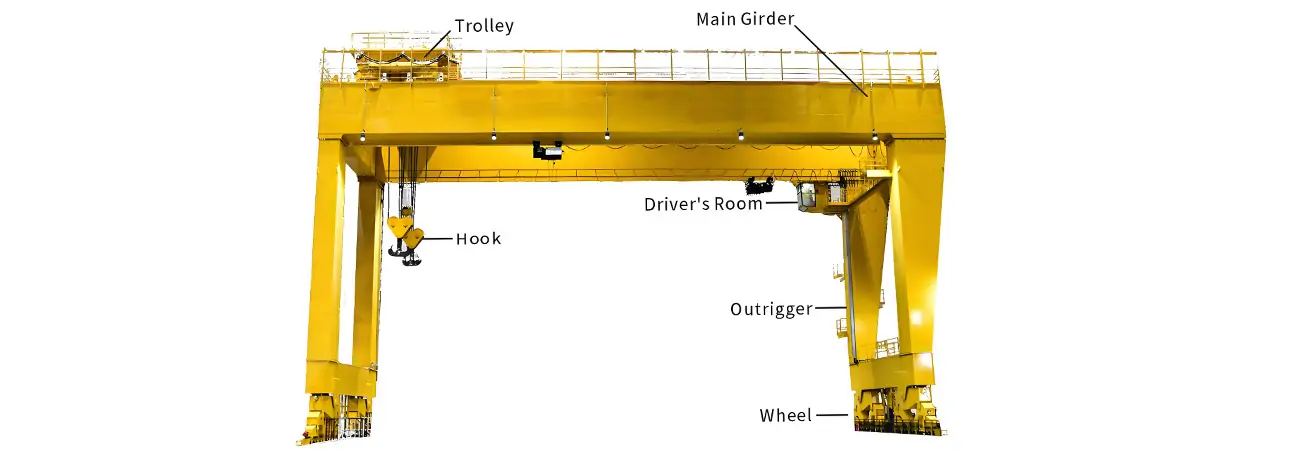
O guindaste pórtico padrão FEM integra doze componentes mecânicos, elétricos e estruturais principais, projetados para trabalhar em conjunto na execução de tarefas de elevação.
Viga principal (viga simples ou dupla): Vigas de aço soldadas com seção transversal em forma de caixa são utilizadas como os principais elementos de suporte de carga.
Vigas de extremidade: Carrinhos de quatro rodas montados nas pernas transferem a carga estrutural para a fundação.
Pernas e estrutura: Colunas estruturais de aço soldadas estendem-se da fundação até a altura da viga principal.
Conjunto do carrinho: Um carrinho de elevação com acionamento elétrico equipado com quatro rodas de aço retificadas com precisão, rolamentos de rolos cônicos selados e superfícies de contato com trilhos endurecidas.
Mecanismo de içamento: um sistema de enrolamento de tambor, cabo de aço ou corrente acionado por motor.
Sensor de carga: Um sensor de força de precisão montado no ponto de suspensão que transmite dados de peso para o sistema de controle em tempo real.
Sistema de frenagem: Freios eletromagnéticos com acionamento por mola e liberação pneumática.
Sistema de acionamento do motor: Motor de indução trifásico de gaiola de esquilo CA acoplado a uma caixa de redução.
Inversor de Frequência (VFD): Unidade de conversão de energia em conformidade com o nível de segurança funcional da norma EN 61800-5-1, que permite aceleração suave e desaceleração dinâmica.
Painel de Controle Elétrico: Um controlador lógico baseado em PLC, alojado em uma caixa de aço inoxidável em conformidade com as normas IEC 60529 IP55 e NEMA 4X, integrando relés, contatores e um módulo receptor sem fio.
Sistema de controle remoto sem fio: Um transmissor portátil alimentado por bateria com redundância de canal duplo e dispositivo de parada de emergência integrado.
Intertravamentos de segurança e chaves de limite: Uma combinação de chaves de limite de deslocamento elétricas (que abrangem içamento, deslocamento do carro e translação do pórtico) e dispositivos mecânicos de pino de cisalhamento para sobrecarga.
Guia de Preços Europeu de Pontes Rolantes
A seguinte matriz de preços abrangente detalha as faixas de capacidade, os parâmetros dimensionais e as estimativas de investimento para sistemas de viga simples e de viga dupla em aplicações industriais típicas.
Tipo
Capacidade
Vão (m)
Altura de elevação (m)
Faixa de preço (USD)
Viga única
1–5 toneladas
5–18
6–12
$8.000 – $25.000
Viga única
5–10 toneladas
8–22
6–15
$15.000 – $45.000
Viga única
10–20 toneladas
10–25
8–18
$30.000 – $80.000
Viga dupla
10–50 toneladas
10–30
8–20
$35.000 – $120.000
Viga dupla
50–100 toneladas
15–35
10–25
$80.000 – $250.000
Viga dupla
100–320 toneladas
18–45
12–35
$200.000 – $600.000
NotaOs preços acima são apenas para referência. Os custos reais dependem das especificações específicas.
Fabricante e fornecedor europeu de pontes rolantes
A VOITTO Crane fabrica pontes rolantes de viga simples e dupla em conformidade com as normas FEM e possui 25 anos de experiência profissional no setor de infraestrutura de elevação industrial. Nossa atuação abrange mercados na Europa, América do Sul, Sudeste Asiático e Ásia Central, e já entregamos com sucesso mais de 480 sistemas de pontes rolantes. O feedback dos clientes indica que, desde a entrada em operação dos equipamentos, a eficiência do ciclo operacional aumentou em 22%.
Além disso, temos a capacidade de personalizar soluções para condições operacionais especiais, incluindo ambientes severos como instalações de armazenamento refrigerado a -40 °C, ambientes marítimos com névoa salina e ambientes à prova de explosão em conformidade com a Diretiva ATEX. Portanto, seja qual for a sua necessidade, desde uma solução compacta de viga única para espaços confinados até um grande sistema de viga dupla para operações contínuas de alta exigência, podemos adaptar uma solução aos seus planos de produção. Se precisar de uma solução de ponte rolante pórtico padrão FEM, entre em contato conosco. contactar-nos.
Especialista em soluções para guindastes · Voitto Crane
10+Anos de experiência.
5,000+Clientes
50+Países
Especializada em soluções para exportação de pontes rolantes, pórticos rolantes, guindastes de braço, guindastes portuários e pontes rolantes EOT. Mais de 10 anos auxiliando clientes globais com consultoria pré-venda, seleção de capacidade e configurações específicas para cada local.
Qual é a principal diferença entre pontes rolantes padrão de viga simples e de viga dupla no modelo FEM?
Os sistemas de viga única (1–32 toneladas) consistem em uma única viga apoiada em quatro pernas, ocupando um espaço horizontal mínimo em vãos de 4 a 18 metros, ideais para instalações compactas. As configurações de viga dupla (5–320 toneladas) empregam duas vigas paralelas, permitindo vãos de 15 a 35 metros com estabilidade de carga superior.
Qual é o tempo médio de instalação de um guindaste pórtico padrão FEM?
A instalação de vigas simples requer de 6 a 10 dias úteis para fundações, montagem e testes de aceitação em fábrica (TAF). Sistemas com vigas duplas requerem de 10 a 16 dias úteis devido à maior complexidade estrutural. Além disso, a preparação das instalações — incluindo o tempo de cura do concreto — prolonga o prazo em 5 a 7 dias. Portanto, do pedido à operação completa, espere de 10 a 14 semanas para vigas simples e de 12 a 16 semanas para vigas duplas.
É possível adaptar sistemas de viga única com melhorias de capacidade para vigas duplas?
A conversão completa de viga simples para viga dupla exige a substituição estrutural total, o que não é economicamente viável. No entanto, sistemas de vigas auxiliares podem aumentar a capacidade de viga simples em 10 a 151 toneladas sem grandes modificações. Portanto, para o crescimento de capacidade previsto acima de 32 toneladas, recomendamos o planejamento inicial da instalação de viga dupla. Consequentemente, essa abordagem estratégica evita conversões dispendiosas no meio da vida útil.
Qual o cronograma de manutenção preventiva aplicável aos guindastes pórticos padrão da FEM?
A manutenção preventiva inclui inspeções visuais semanais, lubrificação mensal (viga simples: 2 pontos, viga dupla: 4 pontos), auditorias trimestrais do painel elétrico e ensaios não destrutivos (END) anuais de juntas soldadas, realizados por terceiros, conforme os protocolos ultrassônicos da norma EN 13134. Portanto, o cumprimento deste cronograma prolonga a vida útil de vigas simples em 2 a 3 anos e de vigas duplas em 3 a 5 anos.
Os guindastes pórticos padrão da FEM são adequados para ambientes externos ou marítimos?
Sim, a instalação ao ar livre exige aço galvanizado a quente (espessura mínima de 85 µm, conforme a norma EN ISO 1461) e invólucros elétricos em aço inoxidável NEMA 4X. Além disso, os controles sem fio devem estar em conformidade com a norma EN 60204-32 de imunidade eletromagnética industrial. Portanto, instalações costeiras e offshore se beneficiam de classificações para serviço marítimo (IEC 60721-3-3C5), que protegem os equipamentos contra a névoa salina. As configurações com viga simples e dupla permitem adaptações para atender às necessidades ambientais.
Qualificação e honra
Engineered Strength, fornecedor global de gruas
serviço
Exclusivo e considerável, o cliente em primeiro lugar.
01
Soluções fiáveis e personalizadas
A nossa equipa de pré-venda fornece consultas, adaptando as soluções às suas necessidades e ao seu ambiente.
Oferecem opções de personalização para a capacidade de elevação, o vão e a altura de elevação, etc., para satisfazer necessidades específicas.
02
Processo de produção atualizado
Actualizações de progresso em tempo real: Relatórios semanais e comunicação PM.
Testes antes da entrega: Verificações de carga e segurança 100%, relatórios pormenorizados.
03
Apoio pós-venda de confiança
3-5 anos de garantia e substituição gratuita para defeitos de não fabrico.
Suporte online 24 horas por dia, 7 dias por semana e assistência no local para problemas com gruas.
FAQ
Engineered Strength, fornecedor global de gruas
Como é que as grandes gruas pórtico são enviadas para o estrangeiro?
Grandes guindastes de pórtico são normalmente enviados para o exterior através de desmontagem modular, onde o guindaste é dividido em componentes principais (vigas, pernas, guinchos) para transporte em contentores. Para mega-guindastes, utilizamos navios especializados em cargas pesadas, equipados com conveses reforçados, e as peças críticas são protegidas com revestimentos anticorrosivos durante o transporte.
Que padrões de tensão as suas gruas de pórtico suportam?
Os nossos guindastes de pórtico suportam os padrões globais de voltagem para garantir um funcionamento sem falhas em todo o mundo. Resolva quaisquer preocupações que tenha sobre voltagem.
Pode ser personalizado?
Sim, a capacidade de elevação, o vão, a altura, o tipo de estrutura e as opções de guincho podem ser personalizados para corresponder a condições de trabalho específicas.
Você consegue projetar uma ponte rolante para condições externas extremas?
Sim, as nossas pontes rolantes podem ser utilizadas de forma estável em ambientes adversos, como ventos fortes ou baixas temperaturas, devido à sua construção especial e estrutura de materiais.
Fazem envios internacionais?
Sim, o envio internacional e o apoio à exportação estão disponíveis para clientes globais.
Entrar em contacto
Não hesite em deixar uma mensagem. Responderemos em 24 horas.
Queira especificar as suas necessidades com base nos seguintes aspectos:
De que produto de grua necessita?
Qual é a capacidade máxima de elevação (em toneladas) necessária para o seu projeto?
Pode especificar a altura de elevação (em metros) necessária?
Pode fornecer pormenores sobre o ambiente de trabalho, tais como condições do solo, limitações de espaço e eventuais obstáculos?
Qual é a frequência de utilização prevista e a duração do projeto?
produtos relacionados
Potência de precisão, solução de guindaste de personalização.




 English
  Español
  Português
  العربية
  Français
  Русский