blogue

gantry crane capacity
12 November 2026

Gantry Crane Capacity: Understanding Load Ratings and How to Choose the Right Capacity

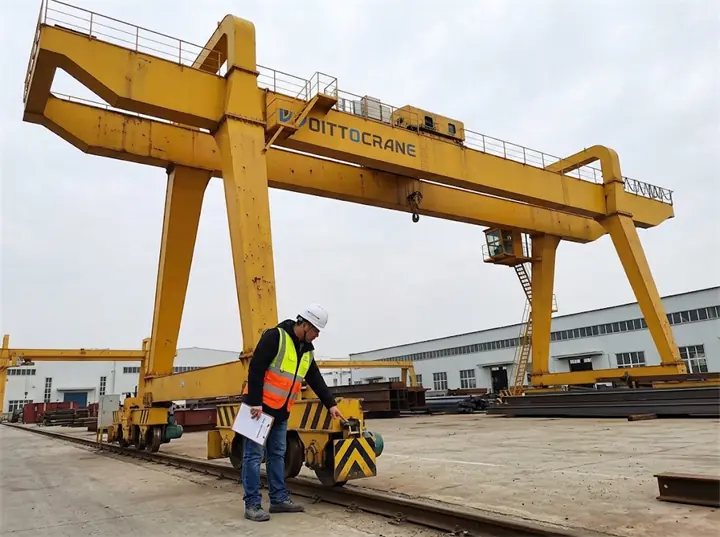
Gantry crane capacity is the maximum load a gantry crane may lift at the hook, as set by its crane manufacturer. Rated capacity depends on span, girder structure, duty class, and operating environment. When determining the appropriate specifications, the procurement team must calculate the total suspended load (i.e., the payload plus the combined weight of the lifting beam, slings, and rigging), and technical personnel must ultimately confirm the rated load. Next, this guide will introduce the calculation methods, key influencing factors, and common lifting capacity ranges related to gantry crane capacity. What Is Gantry Crane Capacity? Gantry crane capacity is the maximum load a gantry crane can lift safely under defined conditions of span, lifting height, duty class, and environment. The rating plate states this gantry crane’s lifting capacity, and the designer sizes the girder, legs, hoist, brakes, and wheels around it. Buyers often confuse three different numbers: the product weight, the weight on the hook, and the crane’s rating. Rated Capacity vs. Actual Lifting Load Rated capacity is a fixed design limit, while the actual lifting load changes with…

LER MAIS
single vs double crane hook
12 November 2026

Single vs Double Crane Hook: DIN 15401/15402 Standards & Engineering Guide

When users choose between a single crane hook (DIN 15401) and a double ramshorn crane hook (compliant with DIN 15402), their decision depends primarily on the rated lifting capacity, the symmetry of the load distribution on the lifting device, and the crane’s duty class. This single vs double crane hook guide compares load paths, forged and laminated construction, and DIN strength grades M, P, S, T, and V. For the broader overhead crane hook and crane hook set assembly topic, including SWL and replacement practice, read our core guide first, then use this article for geometry, stress, and standards decisions. Single Hook vs. Double (Ramshorn) Crane Hook: Mechanics & Tonnage Boundaries Single hooks (DIN 15401) carry the load on one saddle, so they rig quickly and have capacities of about 80–100 tons. Ramshorn double hooks (DIN 15402) split the load across two symmetrical saddles, which lowers the bending moment and weight per ton, and they dominate 100–500 t double-girder lifts. Single Crane Hooks (DIN 15401) — Eccentric Load Path & Fast Rigging The single hook is the universal standard up…

LER MAIS
ponte rolante de isolamento
11 November 2026

QY Insulation Overhead Crane: Voltage Classes, Insulation Points and Selection Guide for Power Substations and Transformer Workshops

A QY insulation overhead crane is a double-girder bridge crane with multiple built-in electrical isolation layers that prevent stray current from traveling through a lifted load back to the crane structure and operator. Market prices for factory-direct units typically range from $45,000 to $180,000+, depending on capacity (5–50 t), span (10.5–31.5 m), and the number of insulation layers specified. For power industry buyers — substation maintenance teams, transformer workshop managers, and EPC project engineers — the choice is not simply “do I need an insulated crane?” but rather which voltage class, which duty rating, and how many insulation points the application actually demands. The underlying hazard drives every specification decision: in electrolytic aluminum smelting halls, bus-bars carry 100,000–300,000 amperes of DC current at low voltage; in a 110 kV or 220 kV substation, the threat is high-voltage AC induced potential. These are different electrical environments, and they call for different insulation designs. Most supplier pages describe QY cranes only for “nonferrous metal smelting” — this guide covers both application families, so you can match the right spec to your site…

LER MAIS
ponte rolante monoviga
11 November 2026

Overhead Crane Lead Time: How Long It Really Takes From Order to First Lift

Overhead crane lead time from a Chinese manufacturer typically runs 20–70 days to complete production, then adds 1–6 weeks of sea freight and roughly 2–3 weeks for port clearance and inland delivery. Standard single girder units sit at the short end. Customized double girder and heavy-duty cranes sit at the long end. The problem is that two suppliers can quote “30 days” and mean different things. One counts from drawing approval, the other from the signed contract. One includes pre-shipment testing, the other stops at the factory gate. A buyer comparing quotes on the headline number alone ends up comparing different clocks. This guide breaks the overhead crane lead time into the stages that actually add up, shows typical ranges for each crane type Voitto Crane builds, and lists the documents and questions that turn a vague delivery promise into a schedule you can plan around. Quick Reference: Typical Production Time by Crane Type The ranges below are typical published windows for Chinese manufacturers, counted from confirmed specifications and approved drawings to ready-to-ship. They exclude shipping and installation. Exact slots…

LER MAIS
truss gantry crane vs box gantry crane
28 October 2026

Ponte rolante tipo pórtico treliçado vs. Ponte rolante tipo caixa: comparação de engenharia, detalhamento de custos e guia de seleção para uso externo.

Um guindaste pórtico com treliça supera um guindaste pórtico com viga-caixão em locais costeiros ou montanhosos sujeitos a ventos fortes, em vãos superiores a 25-30 metros, em pátios temporários de concreto pré-moldado e onde a capacidade de suporte do solo é baixa. A treliça aberta reduz o peso próprio da estrutura em 20 a 35 toneladas, elimina mais de 60 toneladas da área da superfície exposta ao vento e pode reduzir o custo total do projeto (guindaste mais fundação da pista de pouso civil) em 15 a 30 toneladas. Essas economias provêm da física, não de aço mais fino: a tensão de flexão é convertida em força axial nos membros da treliça, e o vento transversal passa pela estrutura em vez de carregá-la. Partindo dos principais fatores na decisão de compra de equipamentos de elevação para uso externo, este guia compara esses dois tipos de estrutura, incluindo características de carga de vento, carga sobre as rodas e custos de fundação, deflexão em grandes vãos, classes de serviço, proteção contra corrosão e manutenção, e realocação de equipamentos. Além disso, este guia identifica condições operacionais específicas para as quais pontes rolantes de treliça não são adequadas. Continue a leitura: Por que o projeto de treliças espaciais triangulares altera a economia da elevação externa? Uma viga treliçada é construída com cantoneiras de aço ou tubos estruturais dispostos em painéis triangulares. Cada elemento suporta principalmente…

LER MAIS
avaliação de risco de ponte rolante
23 de outubro de 2026

Avaliação de riscos de pontes rolantes: perigos ao nível do solo, modelo matricial e controles de engenharia.

A avaliação de riscos de uma ponte rolante deve começar no chão. Seus estabilizadores, vigas de base, rodas e sistemas de alimentação elétrica estão todos localizados ao nível do solo, compartilhando o mesmo espaço que pedestres e empilhadeiras, e sujeitos a fatores ambientais. Equipamentos móveis sofrem com a instabilidade de seus rodízios; equipamentos externos enfrentam cargas de vento; e equipamentos de grande vão podem apresentar desalinhamento dos estabilizadores. Precisamente por causa desses riscos ao nível do solo, um dos erros de conformidade mais comuns costuma ter um alto custo: simplesmente “copiar e colar” o plano de avaliação de riscos para pontes rolantes internas em pontes rolantes. Embora essa abordagem possa passar por uma auditoria interna, ela ignora quase todos os riscos reais de segurança que cercam as pontes rolantes e que representam uma ameaça para os funcionários. Nas seções a seguir, este guia fornece uma estrutura para identificar os riscos das pontes rolantes, uma matriz de risco de oito linhas pronta para uso e análises detalhadas para diferentes tipos de equipamentos. Além disso, o guia apresenta vários controles de engenharia que podem reduzir fundamentalmente os níveis de risco sem depender exclusivamente da vigilância do operador. Perfis de risco de pontes rolantes tipo pórtico versus pontes rolantes suspensas: por que a diferença é importante? Pontes rolantes…

LER MAIS
Como usar um guindaste pórtico
22 de outubro de 2026

Como usar um guindaste pórtico: operação passo a passo, procedimentos operacionais padrão de segurança e melhores práticas.

Saber operar um guindaste pórtico se resume a alguns hábitos repetidos a cada içamento. A operação inadequada no chão de fábrica frequentemente se manifesta como cargas oscilantes que representam riscos à segurança; danos aos guias dos cabos de aço causados por tração lateral; e deformação da estrutura do guindaste, o que pode levar ao surgimento de trincas na base das soldas onde os estabilizadores se conectam à viga principal meses depois. A grande maioria dessas falhas decorre de deficiências técnicas dos operadores, e não de uma capacidade de içamento insuficiente do próprio guindaste. Este guia aborda as diferenças entre equipamentos portáteis de oficina e equipamentos industriais pesados, um procedimento operacional padrão (POP) de 6 etapas, medidas de proteção contra vento em ambientes externos, a seleção dos modos de controle e os cinco erros mais comuns cometidos pelos operadores — erros que frequentemente resultam em altos custos de reparo e perdas por tempo de inatividade para as fábricas. Este guia foi desenvolvido especificamente para operadores, gerentes de planta e diretores de Meio Ambiente, Saúde e Segurança (EHS), e seu conteúdo está em conformidade com as normas e requisitos de classificação relevantes, como OSHA 1910.179, ASME B30.2/B30.17 e FEM/ISO. Conheça seu equipamento primeiro: Portátil…

LER MAIS
Ponte rolante de viga dupla
28 October 2026

Pontes rolantes e pórticos para mineração de cobre e ouro no Uzbequistão: Guia de seleção de concentradores, fundições e casas de tanques

For copper and gold mining facilities in Uzbekistan — including the Almalyk copper concentrator expansion and Muruntau gold mine operations in Navoi — overhead crane requirements split cleanly across four distinct working environments: ore processing, smelter ladle handling, electrolytic tankhouse, and open-pit stockyard. Each environment defines a different crane type, different duty class, and different engineering specification. Choosing the wrong configuration for any one bay does not just create a maintenance headache — it creates a compliance failure or a production stoppage in an environment where shutdowns carry serious cost. This guide maps each working environment to the crane type that actually fits it, explains the engineering logic behind each selection, and covers the certification requirements that Uzbekistan-bound project orders need to address. Quick Reference: Crane Configuration by Working Environment Working Environment Recommended Crane Type Duty Class Capacity Range Price Reference Concentrator — mill overhaul QD Double Girder Overhead Crane A5–A6 20–100T $35,000–$250,000 Smelter — ladle handling Steel Mill Crane (Ladle / Casting) A7–A8 50–320T $120,000–$600,000+ Tankhouse — copper electrolysis QY Insulation Overhead Crane A7–A8 5–100T $30,000–$200,000 Open-pit stockyard —…

LER MAIS
Example of the wheelbase for a bridge crane with a four-wheel configuration on one side
23 de outubro de 2026

Crane Span,Gauge & Base Distance: Meaning and Differences

Crane span, gauge and base distance are three different horizontal dimensions. Span is the distance between runway rail centerlines, gauge is the rail-to-rail distance of a travelling mechanism, and base distance is the spacing between support centerlines along the direction of travel. The three terms are easily confused. Some suppliers use “gauge” and “wheelbase” interchangeably, and some treat span and trolley gauge as the same thing. In reality each one measures a different direction on a different part of the crane. This guide defines each term, compares them side by side, shows how base distance is read on layouts from two to twelve wheels, and explains the reference plane all of them are measured from. After reading, you should be able to check a crane drawing and say which dimension is which. Base distance (symbol b or B) is the horizontal distance between a crane’s support centerlines, measured parallel to its direction of travel, as defined in crane terminology standards such as GB/T 6974.1. What Do Span, Gauge and Base Distance Mean? Span (S): The Distance Between Rail Centerlines Span…

LER MAIS
Crane Main Beam Deflection
20 October 2026

Crane Main Beam Deflection: Causes, Effects and How to Fix It

Crane main beam deflection is the permanent downward sag of a main beam below its original upward camber. Once the main beam drops below the horizontal line at mid-span under rated load, it generally needs straightening or retirement. For buyers and maintenance leads, the problem is rarely visible at first. The trolley still runs and the hoist still lifts, yet the main beam has quietly lost its built-in arch. By the time the trolley starts to struggle uphill toward mid-span or wear grooves appear on the rail, the damage is already well advanced. This guide explains what crane main beam deflection is, the six causes behind it, what it does to the trolley, rails and webs, and how flame straightening corrects it. It also covers the repair mistakes that make the main beam worse. What Crane Main Beam Deflection Really Means Camber vs. deflection: the definition Crane main beam deflection is the permanent downward set of a main beam that has lost its designed upward camber and may bow below the horizontal, as treated in crane design codes such as…

LER MAIS
Crane Model Codes Explained_ QD, MG, LD, LX & More
14 October 2026

Crane Model Codes Explained: QD, MG, LD, LX & More (Complete Chart)

If you have ever received a crane quotation with codes like QD, MG or LX, you may have wondered what the letters mean. Chinese crane manufacturers use short letter codes to describe the crane type, structure and hoisting attachment. Once you know the logic, a model name tells you the basics at a glance. This guide explains how crane model codes work, gives a full reference chart for the most common types, and shows how to use the codes when comparing suppliers. Are Crane Model Codes a Mandatory Standard? No. Older Chinese standards, such as GB/T 14405-93 for overhead cranes and GB/T 14406-93 for gantry cranes, did define code tables. Those standards have been withdrawn. Newer versions, including GB/T 14405-2011 and GB/T 14406-2011, no longer include a model-code system. Today, under China’s TSG 51-2023 safety technical code for lifting equipment, a crane “model” simply identifies cranes of the same type that may differ in main parameters. The code is made up of letters describing the product type, main structure and mechanism layout, and each manufacturer defines its own model code.…

LER MAIS
how does an electric hoist work
20 October 2026

Como funciona um guincho elétrico?

Um guincho elétrico funciona utilizando um motor elétrico e um mecanismo de transmissão para movimentar um cabo de aço ou corrente de carga, que sobe ou desce o gancho e a carga a ele conectada. O motor produz rotação. Uma caixa de engrenagens reduz essa rotação e aumenta sua força de giro. Um tambor de cabo ou roda dentada de corrente converte essa rotação em movimento retilíneo do cabo ou corrente. Outras peças mantêm esse movimento sob controle. Um freio segura a carga quando o guincho para, interruptores de limite restringem o curso do gancho e muitos guinchos incluem proteção contra sobrecarga. Este guia mostra como um guincho elétrico funciona na ordem em que os eventos ocorrem, do motor ao gancho. Se você deseja uma visão geral mais ampla do produto primeiro, leia nossa visão geral dos tipos e usos de guinchos elétricos. Como funciona um guincho elétrico? A maneira mais fácil de entender um guincho elétrico é seguir o caminho da transmissão de energia da fonte de energia até a carga. Energia elétrica → Motor elétrico → Caixa de engrenagens → Tambor de cabo ou roda dentada de corrente → Cabo de aço ou corrente de carga → Gancho e carga. O diagrama acima representa…

LER MAIS
Topo