
Explosion-proof overhead cranes from Voitto start at $4,000 for a 1-ton LB single-girder unit and scale to $533,250 for a 320-ton QB double-girder configuration — a range wide enough that choosing the wrong series on the first RFQ is both common and expensive. If your facility processes petroleum, pharmaceutical solvents, coal dust, or paint-line vapors, a standard EOT crane is a compliance failure waiting to happen. This guide uses Voitto’s actual product data to show you exactly which series fits your hazard zone, how to read an Ex-grade nameplate, what documents to demand before signing a PO, and where the hidden cost traps sit.
The single most frequent procurement mistake in Ex crane buying is treating explosion protection as a component-level upgrade — fitting an Ex-rated hoist onto a standard crane frame and assuming zone compliance. In a Zone 1 environment, that assumption fails because ignition risk lives in the whole electrical system: a non-Ex limit switch tripping under load, a standard pendant arcing on contact, or an unsealed cable entry. This article addresses that gap directly.
By the end, you will have a working specification framework, a supplier document checklist, and a clear price anchor for your budget submission — without having to read three separate product pages.
- 1 Quick Reference: LB vs QB Explosion-Proof Overhead Crane
- 2 What Is an Explosion-Proof Overhead Crane — and What Makes It Different?
- 3 LB vs QB: How to Choose the Right Series for Your Application
- 4 ATEX, IECEx & GB Certification: What to Demand Before You Sign
- 5 Specifications That Buyers Overlook: Duty Class and Hoist Selection
- 6 Typical Applications and Operating Environment Requirements
- 7 Conclusão
-
8
FAQ
- 8.1 Q1: What is the price difference between the LB and QB explosion-proof crane series?
- 8.2 Q2: What is the difference between ExdⅡBT4 and ExdⅡCT4, and how do I know which I need?
- 8.3 Q3: Can a single explosion-proof crane carry both ATEX and IECEx certification?
- 8.4 Q4: What is the correct duty class for my explosion-proof crane, and why does A3 not always apply?
- 8.5 Q5: What documents should I request before paying for an explosion-proof overhead crane?
Quick Reference: LB vs QB Explosion-Proof Overhead Crane
| Parâmetro | LB Single-Girder | QB Double-Girder |
|---|---|---|
| Capacidade de elevação | 1 - 20 toneladas | 5 – 320 ton |
| Span | 7.5 – 28.5 m | 10.5 – 37.5 m |
| Altura de elevação | 6 - 30 m | 10 – 24 m |
| Classe de deveres profissionais | A3 | A5–A7 (configuration-dependent) |
| Grau de proteção contra explosões | ExdⅡBT4 / ExdⅡCT4 | ExdⅡBT4 / ExdⅡCT4 |
| Aplicações típicas | Pharma, paint shop, fuel storage, light chemical | Heavy petrochemical, mining, large-span chemical plant |
| Price Reference (ex-works) | $4,000 – $25,000 | $24,000 – $533,250 |

Alan
Especialista em soluções para guindastes · Voitto Crane
10+Anos de experiência.5,000+Clientes50+PaísesEspecializada em soluções de exportação de pontes rolantes, pórticos, gruas, pórticos portuários e pontes rolantes EOT. Mais de 10 anos a ajudar clientes globais com consultoria pré-venda, seleção de capacidade e configurações específicas do local.

What Is an Explosion-Proof Overhead Crane — and What Makes It Different?


An explosion-proof overhead crane is a bridge-type lifting system in which every ignition-relevant component — motor, electrical cabinet, limit switches, pendant or remote control, cable entries — is individually engineered and certified to prevent spark generation, surface overheating, and static discharge in atmospheres containing flammable gases, vapors, or combustible dust, as classified under IEC 60079 and ATEX Directive 2014/34/EU.
System-Level Protection vs. Component-Level Retrofit
The structural platform of the LB series is identical to Voitto’s standard LD single-girder crane — same box-girder main beam, same end-beam geometry, same wheel and runway interface. What changes is every electrical touch point. A compliance-grade Ex crane replaces all of the following with certified alternatives:
- Mecanismo de elevação: Explosion-proof motor (Ex d flameproof enclosure) + reducer + drum, paired with an anti-static wire rope or chain hoist
- Sistema elétrico: Ex-rated control cabinet with certified gland fittings, Ex cables, Ex-rated limit switches for both travel and overload functions
- Control interface: Explosion-proof wireless remote (IP65, 32-bit security code, operating range up to 350 m) or Ex-rated pendant; driver’s cab available for large QB configurations
- Dispositivos de segurança: Explosion-proof overload limiter (trips at 110% rated load), Ex travel limiters at both bridge and trolley ends, non-sparking buffer stops
A crane where only the hoist carries an Ex rating while the pendant, limit switches, and cable routing remain standard is not Zone 1 compliant. This distinction matters at the customs clearance stage, at insurance underwriting, and most critically, during a plant safety audit.
Why the Gas Group (IIB vs IIC) Matters More Than the Tonnage
The explosion-proof grade — ExdⅡBT4 or ExdⅡCT4 — encodes two decisions that affect safety, cost, and lead time.
Gas group IIB covers the majority of industrial hazardous atmospheres: hydrogen sulfide, ethylene, propylene, and most petroleum and solvent vapors. It is the correct specification for petrochemical transfer, paint-line operations, pharmaceutical solvent handling, and fuel storage. Voitto’s standard LB and QB configurations ship with ExdⅡBT4 as the default.
Gas group IIC adds coverage for hydrogen and acetylene — the two most ignition-sensitive gases encountered in chemical synthesis, battery manufacturing, and certain mining applications. Specifying IIC when your hazard assessment only identifies IIB gases adds component cost and lead time without a measurable safety benefit. Specifying IIB when hydrogen is your primary hazard creates a genuine compliance gap. Your hazardous area classification document should state the gas group explicitly; if it does not, resolve that with your EHS team before contacting any supplier.
Temperature class T4 (surface temperature ≤135°C) applies to both LB and QB series and is appropriate for the ignition temperatures of virtually all common industrial solvents and gases. T4 is a standard specification, not a premium option.
LB vs QB: How to Choose the Right Series for Your Application
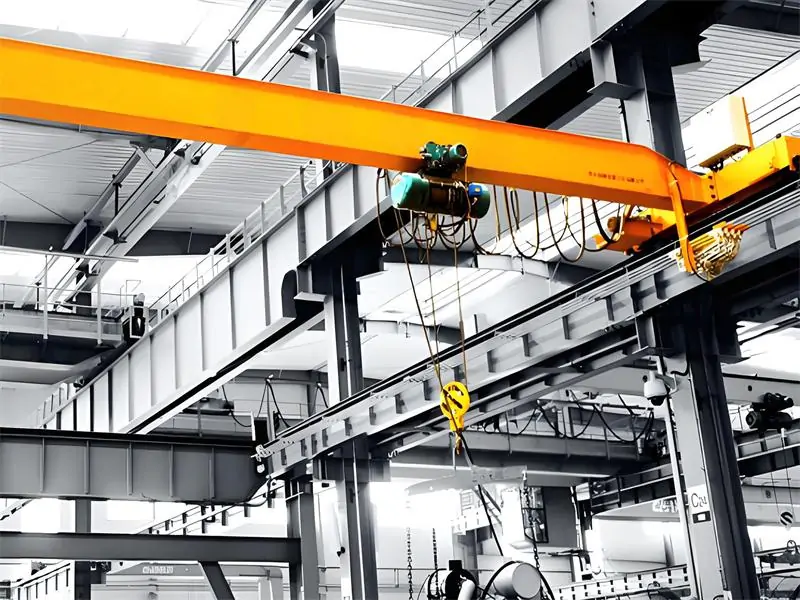

The single-girder LB and the double-girder QB are both full-compliance Ex platforms — the choice between them is a structural and duty decision, not a certification one.
When LB Single-Girder Is the Right Answer
The LB series covers loads from 1 to 20 tons across spans up to 28.5 meters at an A3 duty rating. A3 translates to light-to-medium use — roughly 63,000–125,000 total lift cycles over the crane’s service life, with meaningful recovery time between lifts. That profile matches the majority of Ex crane applications in practice:
- Pharmaceutical raw-material handling: batch-process lifts of 2–10 tons, typically 10–30 cycles per shift, with idle periods between batches
- Paint shop supply: drum and IBC handling at 1–5 tons, moderate frequency, short travel distances
- Fuel storage and gas-station facilities: infrequent lifts during installation, maintenance, and product transfer operations
- Light chemical and food-processing plants: dust-zone (Zone 21/22) applications where combustible powders rather than gases are the classified hazard
The structural simplicity of single-girder design has a direct maintenance implication in Ex environments: fewer Ex-rated component interfaces means fewer items on the periodic compliance inspection list. For a facility conducting annual Ex equipment audits, a simpler crane is a genuine operational advantage.
The LB series is priced from $4,000 (1 t / 7.5 m span) to approximately $25,000 (20 t / 28.5 m span), making it by far the most cost-accessible entry point for Ex overhead lifting.
When QB Double-Girder Is the Correct Specification
The QB series handles 5 to 320 tons across spans up to 37.5 meters. Double-girder construction provides two structural advantages that become engineering necessities at the heavy end: higher mid-span rigidity (lower deflection under full load) and closer hook approach to the runway end walls — typically within 300–500 mm versus 600–900 mm on a single-girder unit. In large-bay petrochemical plants where the crane needs to reach reactor vessel nozzles close to the building wall, that difference is not a preference — it is a functional requirement.
Heavy-duty Ex applications that consistently justify QB:
- Petrochemical reactors and pressure vessels: 20–100+ ton lifts during installation and maintenance turnarounds in Zone 1 classified areas
- Underground and surface mining: 20–50 ton lifts in methane-classified (IIB or IIC, depending on seam gas composition) environments
- Large-span chemical plant bays: spans beyond 28.5 meters where LB’s structural limit is exceeded
QB pricing reflects the heavier structure and certified drivetrain: $24,000 (5 t entry) to $533,250 (320 t, full-specification).
A 20-ton application that fits within a 28-meter span is a genuine LB/QB decision point — not because the LB can’t structurally carry 20 tons (it can, at the top of its range), but because the span, duty cycle, and lifting-height combination may push you toward QB. Submit those four inputs — load, span, lifting height, daily cycles — and Voitto’s engineering team will map them to the correct series within 48 hours.
ATEX, IECEx & GB Certification: What to Demand Before You Sign
Certification is where most Ex crane buyers leave the largest unmanaged risk. Receiving a brochure that lists “ATEX compliant” is not the same as receiving a compliant crane.
Which Certification System Applies to Your Market
ATEX (ATmosphères EXplosibles): Mandatory for any Ex equipment installed within EU member states. Governed by Directive 2014/34/EU, implemented through the EN 60079 standard series. The hexagonal “Ex” certification mark must appear on each individual certified component — motor, control cabinet, limit switches, pendant — not on the crane assembly as a whole. A Notified Body (an EU-designated testing organization) issues the certificate; the certificate number is publicly verifiable through the EU ATEX Equipment Database.
IECEx: The international equivalent, recognized in over 50 countries outside the EU — including Australia, GCC countries, Southeast Asia, and parts of South America. A single IECEx certificate is accepted across member countries without additional re-testing, which makes it the practical choice for export-market cranes or multi-region operations. Certificate numbers are verifiable through the IECEx OD-001 public register.
GB / CNEX: China’s national standard (GB 3836 series), certified through NEPSI. Required for cranes installed within China. GB is technically aligned with IEC 60079 but is a separate domestic certification pathway — an ATEX-only crane requires additional assessment for Chinese installation.
For international buyers sourcing from a Chinese manufacturer: specify ATEX for EU destination, IECEx for all other export markets. If your operation spans both, request dual certification upfront — adding a second certification after manufacturing is significantly more expensive.
The Supplier Document Checklist
Before issuing a purchase order for any explosion-proof crane, require these documents in writing:
- Declaração de Conformidade CE — formal declaration that the equipment meets ATEX Directive 2014/34/EU, referencing the specific crane model and serial number range, signed and dated
- Individual component Ex certificates — separate certificates for: (a) hoist motor, (b) electrical control cabinet, (c) travel limit switches, (d) pendant or wireless remote control, (e) cable gland fittings. A system-level declaration without component certificates is incomplete compliance.
- Certificate numbers for public verification — cross-check these against the EU ATEX database or IECEx OD-001 register before payment
- Overload protection test report — demonstrating the Ex-rated overload limiter trips at the rated threshold (typically 110% of SWL) under the actual Ex-configuration components, not under standard components
- ISO 9001 quality management certificate — with current validity dates. Voitto Crane holds ISO 9001 certification; request the active certificate version.
- IP rating documentation — electrical enclosures should carry minimum IP54; IP65 is preferable for dusty or outdoor-adjacent Ex environments. Voitto’s explosion-proof remote control carries IP65 as standard.
A supplier who cannot produce items 1–3 within a week of a formal inquiry is not operating as a compliant Ex crane manufacturer. This is not administrative overhead — it is the evidentiary basis that your crane will not become an ignition source in a Zone 1 environment.
Specifications That Buyers Overlook: Duty Class and Hoist Selection
Two specification decisions that regularly appear on Voitto’s inquiry forms under-specified — and both carry compliance and cost consequences in Ex environments.
Duty Class: A3 Is Not a Universal Answer
The LB series ships at A3 (ISO 4301 / FEM 1.001 duty classification). A3 is the correct duty class for batch-process industries with meaningful rest periods between lifts — pharmaceutical, paint, fuel storage, light chemical. It is the wrong duty class for a production-line application running continuous lifting cycles.
A concrete example of where A3 fails: a chemical plant running continuous reactor feed operations with 40+ lift cycles per hour, three shifts per day. That usage pattern corresponds to A5 or A6 duty. Installing an A3-rated Ex crane in that environment means the gearbox and hoist components are operating beyond their design fatigue life — leading to premature failure, unplanned maintenance in a Zone 1 area, and a safety event risk. The fix — specifying QB at the correct duty class — costs more upfront but avoids the shutdown scenario entirely.
Provide your daily lift cycle count, average load as a percentage of rated capacity, and shift pattern to any supplier. A manufacturer who quotes without asking for these inputs is not doing their job.
Explosion-Proof Hoist Selection: Chain vs Wire Rope


Voitto supplies the LB crane with two hoist options, each with different operating parameters:
Explosion-Proof Chain Hoist:
- Rated load: 1–20 ton
- Lifting height: 3–12 m
- Lifting speed: 1.8–8 m/min
- Work duty: M4 / M5 (medium-to-heavy hoist duty)
- Best suited for: shorter lifting heights in pharmaceutical, chemical, and dust-zone applications; M5 duty covers moderate continuous-use scenarios
Explosion-Proof Wire Rope Hoist:
- Rated load: 1–20 ton
- Lifting height: 6–45 m (significantly greater range than chain)
- Lifting speed: 5 / 0.8 m/min (two-speed operation)
- Work duty: M5
- Price reference: approximately $3,450–$4,050 for a 10-ton unit (ex-works)
- Best suited for: greater lifting heights, petrochemical and mining applications, two-speed precision lowering
The practical selection rule: if your lifting height is consistently within 12 meters and your loads are frequent but not the heaviest, chain hoist at M4/M5 is the simpler, lower-maintenance choice. Above 12 meters or where precision two-speed lowering is operationally important (reactor lid placement, reactor vessel nozzle alignment), wire rope at M5 is the correct specification.
Note that hoist duty class (M4/M5) and crane duty class (A3) are different classification systems covering different components — both must be specified correctly. A mismatch between a heavily-used M5 hoist on an A3-rated crane bridge can create structural fatigue at the trolley interface over time.
Typical Applications and Operating Environment Requirements
The LB and QB series operate across an operating temperature range of −20°C to +40°C as standard — matching the environmental classification of the explosion-proof chain hoist at the same temperature range. Below −20°C, low-temperature steel and cold-rated lubrication become specification requirements; above +40°C, motor thermal management and enclosure ventilation need engineering review. Both conditions should be flagged at RFQ stage.
Petrochemical plants: Reactor product transfer, finished-product movement, maintenance lifts during turnarounds. Zone 1 gas classification is typical; ExdⅡBT4 covers the majority of petroleum derivatives. Turnaround lifts often involve heavy loads at low frequency — a QB at moderate duty class is the common fit.
Pharmaceutical manufacturing: Raw-material drum handling, reactor charging, cleanroom-adjacent operations. Zone 1 or Zone 2 classification depending on solvent vapor concentration assessments. LB at 2–10 ton covers most applications. The pharmaceutical sector frequently requires documentation of material compatibility (stainless steel hook, non-sparking wire rope materials) — confirm with Voitto’s engineering team at specification stage.
Coal and metal mines: Zone 1 gas (methane) and Zone 21 dust environments. Mining applications often require ExdⅡCT4 to cover methane-rich seam atmospheres. Load cycles can be heavy — duty class specification is critical.
Paint and coating production: Zone 1 solvent vapor environments during production and storage handling. LB at 1–5 ton is the typical fit; ExdⅡBT4 covers standard paint-line solvents.
Grain processing and food-production dust zones: Zone 21 or Zone 22 dust classification. ExdⅡBT4 is generally applicable. LB at lighter capacities is the common specification.
Conclusão
The explosion-proof overhead crane selection decision reduces to four inputs: your hazard zone classification (Zone 1/2 for gas, Zone 21/22 for dust), your maximum lift load, your daily cycle count, and your installation market’s required certification standard (ATEX, IECEx, or both). Get those four right before contacting any supplier, and the series choice — LB at $4,000–$25,000 or QB at $24,000–$533,250 — follows logically from the specification rather than from a sales conversation.
Voitto’s explosion-proof overhead crane range covers 1–320 tons with ExdⅡBT4 and ExdⅡCT4 ratings across single-girder (LB) and double-girder (QB) platforms, spanning 7.5–37.5 meters, with full documentation packages including component-level Ex certificates and ISO 9001 quality records. For most Zone 1 gas and Zone 21 dust applications in petrochemical, pharmaceutical, paint, and mining environments, this range provides a factory-direct solution without the 20–40% distributor margin that appears in most import markets.
Three actions before you send an RFQ:
- Confirm your hazard zone classification and gas group (IIB or IIC) with your EHS team.
- Document your maximum lift weight, bay span, required lifting height, and daily lift cycle count.
- Decide your certification destination (ATEX / IECEx / both) — and make dual certification a line item in the inquiry if you operate across regions.
Alan
Especialista em soluções para guindastes · Voitto Crane
10+Anos de experiência.5,000+Clientes50+PaísesEspecializada em soluções de exportação de pontes rolantes, pórticos, gruas, pórticos portuários e pontes rolantes EOT. Mais de 10 anos a ajudar clientes globais com consultoria pré-venda, seleção de capacidade e configurações específicas do local.
FAQ
Q1: What is the price difference between the LB and QB explosion-proof crane series?
The LB single-girder series starts at $4,000 (1 ton, 7.5 m span) and reaches approximately $25,000 at the 20-ton upper limit. The QB double-girder series starts at $24,000 (5 ton) and scales to $533,250 for a 320-ton full-specification configuration. Both are ex-works market reference prices from Voitto Crane. The overlap zone — 5–20 ton loads that fit within LB’s structural range — is where duty class and lifting-height requirements typically drive the series decision, not capacity alone.
Q2: What is the difference between ExdⅡBT4 and ExdⅡCT4, and how do I know which I need?
Both are flameproof (Ex d) protection with a T4 surface temperature limit (≤135°C). The gas group is the key difference: IIB covers most industrial hazardous gases including petroleum vapors, hydrogen sulfide, and ethylene. IIC covers hydrogen and acetylene — the highest-risk gases in chemical synthesis and certain mining environments. Your facility’s hazardous area classification document should specify which gas group applies. If it does not, your EHS team or a hazardous area classification specialist needs to resolve that before any equipment is specified.
Q3: Can a single explosion-proof crane carry both ATEX and IECEx certification?
Yes — dual certification is available and is the recommended approach for manufacturers supplying both EU markets and international export destinations. ATEX and IECEx share the same underlying technical standard (EN 60079 / IEC 60079), so the engineering requirements are aligned. The cost difference between single and dual certification is modest relative to the total crane cost; specify dual certification at RFQ stage rather than adding it after manufacturing begins.
Q4: What is the correct duty class for my explosion-proof crane, and why does A3 not always apply?
Duty class (ISO 4301 / FEM 1.001) defines how many lift cycles and what load spectrum the structural and drivetrain components are designed for over the crane’s service life. A3 (the LB standard) is appropriate for batch-process operations with meaningful rest time between lifts — pharmaceutical, paint, light chemical. A5–A7 applies to continuous-process or high-frequency production lifting. Using A3-rated equipment in an A5 application causes premature gearbox and hoist wear — an unplanned shutdown in a Zone 1 area is both a safety event and a very expensive repair. Provide your daily cycle count, shift pattern, and average load percentage to Voitto before receiving a quote.
Q5: What documents should I request before paying for an explosion-proof overhead crane?
At minimum: (1) EC Declaration of Conformity naming the specific crane model; (2) individual Ex component certificates for motor, electrical cabinet, limit switches, pendant/remote, and cable glands — with certificate numbers you can verify through the EU ATEX database or IECEx OD-001 register; (3) overload protection test report in Ex configuration; (4) ISO 9001 quality management certificate with active validity dates; (5) IP rating documentation for all electrical enclosures (minimum IP54, IP65 preferred). These documents are not optional formalities — they are the evidence base that the equipment is compliant and safe for your hazardous-area installation.




 English
  Español
  Português
  العربية
  Français
  Русский