
Voitto Crane’s EOT crane for sale start at $3,000 for a 0.5-ton suspended unit and scale to over $1.7 million for a 800-ton heavy-duty double girder — a range wide enough that choosing the wrong series on your first RFQ costs real money and months of delay. This page covers all six Voitto series, their price ranges, technical specifications, and the three selection decisions that determine which configuration fits your facility.
Factory procurement managers face two predictable pain points: they receive quotes with no clear rationale for why one configuration costs three times another, and they only discover span or headroom conflicts after a purchase order is signed. The sections below give you the numbers and the reasoning so both problems stay off your desk.
By the end of this page you’ll know which Voitto EOT crane series matches your load, span, duty class, and any special environment requirements — and you’ll have a checklist to use when comparing competing supplier proposals.
- 1 Quick Reference: Voitto EOT Crane Series & Price Ranges
- 2 What Is an EOT Crane and How Does It Work
- 3 Selecting the Right EOT Crane Series: Four Decision Points
- 4 Certifications and Compliance: What to Verify Before Signing a PO
- 5 EOT Crane Applications by Industry
- 6 Conclusão
-
7
FAQ
- 7.1 Q1: What is the full form of EOT crane, and is it the same as an overhead crane?
- 7.2 Q2: What is the price range for an EOT crane for sale from Voitto?
- 7.3 Q3: How do I choose between a single girder and double girder EOT crane?
- 7.4 Q4: What certifications should I check when buying an EOT crane for international use?
- 7.5 Q5: Can Voitto customize an EOT crane to fit my existing building structure?
Quick Reference: Voitto EOT Crane Series & Price Ranges
| Series | Tipo | Capacidade | Span | Altura de elevação | Price Range (Market Reference) |
|---|---|---|---|---|---|
| LX | Single girder, suspension | 0.5–10 T | 7,5–22,5 m | 3–45 m | $3.000–$8.000 |
| LD | Single girder, top-running | 1–32 T | 7.5-31.5 m | 3–45 m | $3,100–$10,000 |
| LB | Single girder, explosion-proof | 1–20 T | 7.5-28.5 m | 6–30 m | $4,000–$10,000 |
| QD | Double girder, general-purpose | 5–800 T | 10.5–50 m | 10–40 m | $23,000–$1,722,500 |
| QY | Double girder, insulated | 5–320 T | 10.5–40 m | 10–24 m | $24,500–$533,750 |
| QB | Double girder, explosion-proof | 5–320 T | 10.5–37.5 m | 10–24 m | $24,000–$533,250 |
All prices are market reference ranges ex-works. Final price depends on span, lifting height, duty class, and control configuration. Contact Voitto for a project-specific quote.
Obter cotaçãoWhat Is an EOT Crane and How Does It Work


Um Guindaste EOT — short for Electric Overhead Travelling crane, also widely called an overhead crane or bridge crane — is a bridge-type lifting system that travels on fixed elevated rails along the length of a facility, as classified under ISO 4301 and FEM 1.001. The bridge spans the full width of the working area; a trolley moves laterally across the bridge; and the hoist mechanism moves the load vertically. Three-axis coverage means one crane can serve every square meter of floor space beneath it — which is why EOT cranes are the standard material handling solution in manufacturing plants, steel mills, warehouses, and power stations worldwide.
The term “overhead crane” is used interchangeably with EOT crane throughout this page. Both refer to the same product category; Voitto’s product range covers both top-running and suspension (underslung) configurations.
Single Girder vs Double Girder: The Core Structural Decision
The structural choice between single and double girder is the most consequential early-stage decision because it affects load capacity, duty class ceiling, lifting height, and long-term maintenance cost simultaneously.
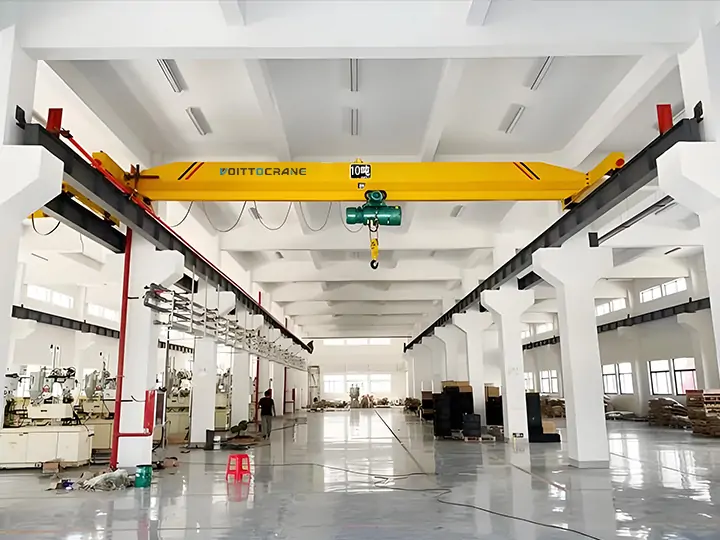
A single girder EOT crane runs one main beam, with the electric hoist hanging below it. This positions the hook lower relative to the rail level, which is an advantage in low-headroom facilities but also limits hook approach height and sets a practical load ceiling. Voitto’s single girder series (LD and LX) cover 0.5–32 tons at spans up to 31.5 m with duty classes up to A5. Below that ceiling, single girder units offer a lower capital cost and simpler installation — LD series starts at $3,100 versus $23,000 for the entry-level QD double girder.
A double girder EOT crane uses two parallel main beams with the trolley and hoist running on top, which raises the bridge profile but recovers 300–600 mm of hook approach height compared with an equivalent single girder unit at the same rail elevation. More practically, the dual-beam structure supports higher duty classes (A3–A7 on Voitto’s QD series) and load capacities up to 800 tons — ranges that single girder designs cannot safely reach. For any application above 20 tons or at spans beyond 31.5 m, double girder is the structurally correct choice, not a premium option.
The boundary case — loads between 10 and 32 tons — is where duty class should drive the decision rather than capacity alone. A 15-ton load lifted 50 times per day in a production line belongs in a double girder unit even though single girder can handle 32 tons in low-cycle applications.
Suspension (Underslung) vs Top-Running Configuration
The LX series uses a suspension configuration: the crane hangs from rails fixed to the ceiling structure rather than running on elevated runway beams mounted on columns. This eliminates the need for runway beam structures and column corbels, making it the lowest civil-works cost option. The trade-off is load ceiling (10 tons maximum) and reduced span (up to 22.5 m), because the ceiling structure must carry the crane’s dynamic loads. For light-duty workshops or facilities with existing ceiling structure, the LX is often the most cost-effective entry point at $3,000–$8,000.
Top-running cranes (LD, QD, QY, QB) sit on rails mounted above, and are the standard configuration for medium to heavy duty environments, spanning up to 50 m on the QD series.
Selecting the Right EOT Crane Series: Four Decision Points


Capacity and Span Define Your Series Bracket
The practical rule across Voitto’s range: single girder for loads up to 20 tons and spans up to 31.5 m; double girder for everything above. Within the double girder family, the standard QD covers 5–800 tons with spans up to 50 m — the broadest range in Voitto’s lineup and the right starting point for most general industrial inquiries.
Span deserves more attention than it typically gets at the RFQ stage. Building column spacing and crane span are not the same measurement: crane span is typically 1.0–1.5 m shorter than the center-to-center column distance, because runway beams, end-beam protrusions, and mandatory safety clearances of at least 100 mm per side consume space on each side. Submitting building span as crane span is one of the most common early-specification errors, and it results in a crane that cannot be installed without structural modification. Confirm the runway rail centerline distance before finalizing any specification.
Duty Class: The Most Frequently Underspecified Parameter
Voitto’s EOT cranes are rated from work duty A3 to A7, corresponding to the usage intensity classification in FEM 1.001 and ISO 4301. Duty class reflects how often the crane lifts, how close to rated load each lift is, and how long the design life must be — not just the maximum weight.
A warehouse doing 10–20 lifts per day at varying loads will typically fall into A3–A4. A production line cycling every few minutes at consistent high loads may need A5–A6. Heavy mill duty in steel processing typically requires A6–A7. The reason this matters commercially is that a crane specified at A3 for an A6 environment will reach fatigue limits years ahead of schedule, and replacement cost far exceeds the price difference between duty classes at purchase. Discuss your actual daily cycle count and load distribution with Voitto’s engineering team before confirming a duty class.
Special Environments: Explosion-Proof and Insulated Series
For facilities handling flammable gases, petroleum solvents, or combustible dusts, standard EOT crane electrical components are a compliance risk. Voitto’s LB (single girder) and QB (double girder) explosion-proof series use motors, control cabinets, limit switches, and cable entries rated to ExdIICT4 — meaning every component that could generate a spark or heat surface exceeding 135°C is individually certified. The explosion-proof grade covers gas groups IIB (petroleum vapors, hydrogen sulfide, ethylene) and IIC (hydrogen, acetylene) depending on configuration.
The critical procurement mistake in this category is treating explosion protection as a component upgrade — fitting an Ex-rated hoist onto a standard crane frame. In a Zone 1 or Zone 2 hazardous environment, the entire electrical system must be Ex-certified, not just the hoist motor. Voitto’s LB and QB series are engineered as complete Ex systems from the outset.
The QY insulated double girder series serves a different special environment: facilities where the load itself carries electrical current (most commonly electrolytic cells and battery manufacturing lines). The insulated design prevents current path through the crane structure.
Lifting Height and Headroom: The Calculation Most Buyers Skip
A standard wire rope hoist overhead crane typically consumes 1,500–2,000 mm of headroom above the required lifting height, accounting for hoist body height, hook approach (the dead travel before the hook reaches its highest usable position), and a minimum 200 mm top safety clearance. This means a facility with 10 m of usable height under the roof structure does not automatically achieve 10 m of lifting height — effective hook travel may be 8.0–8.5 m depending on the hoist configuration. Voitto’s engineering team can run the headroom calculation for your building dimensions during pre-sales consultation.
Certifications and Compliance: What to Verify Before Signing a PO
Certification is a procurement hard stop, not a nice-to-have. An EOT crane that arrives without the required documentation can be delayed in customs clearance, excluded from insurance coverage, or require costly retrofit certification — all scenarios that cost more than getting the paperwork right at source.
Required Certifications for Export EOT Cranes
For European markets and most international buyers referencing European standards, the core compliance benchmark is CE marking under the EU Machinery Directive (2006/42/EC). If your destination market requires CE, confirm at the RFQ stage that the supplier can provide a complete package — EC Declaration of Conformity, technical file, and risk assessment — rather than treating it as a post-order conversation.
Beyond CE, the relevant design and classification standards are FEM 1.001 (design rules for series lifting equipment) and ISO 4301 (crane duty class classification). The manufacturer’s quality system should be certified to ISO 9001 to ensure consistent production processes. For markets requiring EAC (Eurasian Customs Union) clearance, or for US facilities operating under OSHA 1910.179, confirm compliance documentation requirements at the RFQ stage — not after order placement.
For explosion-proof series (LB and QB), additionally request ATEX (Directive 2014/34/EU) or IECEx component certificates covering the motor, control cabinet, limit switches, and cable entries individually — not just a general manufacturer’s declaration.
Documents to Request from Any Supplier
Before issuing a purchase order, request and review the following:
Declaração de Conformidade CE (for CE-claimed cranes) — identifies the responsible manufacturer and the specific standards the crane is declared to meet. A supplier claiming CE compliance but unable to produce this document should be treated as a red flag.
Factory load test certificate — proof-tested at 125% of rated capacity prior to shipment. Request the actual test report, not a blank template.
Certificado ISO 9001 for the manufacturing facility — confirm the scope covers crane manufacturing specifically and that the certificate is current.
Safety device documentation — confirming overload protection, lifting height limiters, travel limiters, and emergency stop systems are fitted and functionally tested. These are required under standard industry practice regardless of which market standard applies.
EOT Crane Applications by Industry
Manufacturing and Assembly Workshops
Manufacturing plants are the primary application environment for Voitto’s LD and QD series. Single girder LD units handle component and subassembly movement in light to medium workshops (1–32 tons), while QD double girder cranes handle machine tool installation, mold transfer, and heavy component assembly up to 800 tons. The three-axis movement coverage means one crane can serve an entire bay without floor-level obstruction.
Steel Mills and Metallurgical Processing
Steel and metallurgical environments typically require double girder cranes with high duty classes — A5 to A7 — because lift cycles are frequent and loads are consistently near rated capacity. The QD series covers this range, with specifications confirmed to application. Ladle handling, billet transfer, and rolling mill maintenance are among the standard use cases. For environments where electrical insulation is required (electrolytic processes), the QY series is the applicable variant.
Petrochemical, Chemical, and Hazardous Environments
The LB and QB explosion-proof series serve facilities where standard electrical equipment creates an ignition risk. Petroleum refining, paint lines, chemical processing, and gas storage all fall into this category. The defining selection criterion is the facility’s classified hazard zone (Zone 1 or Zone 2 under IEC 60079-10), which determines the required Ex protection level and gas group.
Warehousing, Logistics, and Light Industrial
The LX suspension series and LD single girder are the practical choice for warehouses and light production environments handling loads up to 10–32 tons. Lower capital cost, simpler installation (particularly the LX’s ceiling-hung configuration), and minimal floor-space impact make these series well-suited to facilities where crane use is moderate rather than continuous.
Conclusão
Choosing the right EOT crane for sale comes down to four parameters in sequence: load capacity and span (which determine single vs double girder), duty class (which determines structural fatigue design), any special environment requirements (explosion-proof or insulated), and available headroom (which determines achievable lifting height). Voitto’s six series — LX, LD, LB, QD, QY, QB — cover the full range from a $3,000 light-duty suspension crane to a custom 800-ton heavy mill unit.
Three immediate actions for buyers evaluating an EOT crane purchase: measure your building’s runway rail centerline distance (not column spacing), confirm your daily lift cycle count to establish duty class, and request CE Declaration of Conformity and load test certificate from any shortlisted supplier before committing to a PO.

Alan
Especialista em soluções para guindastes · Voitto Crane
Especializada em soluções de exportação de pontes rolantes, pórticos, gruas, pórticos portuários e pontes rolantes EOT. Mais de 10 anos a ajudar clientes globais com consultoria pré-venda, seleção de capacidade e configurações específicas do local.
FAQ
Q1: What is the full form of EOT crane, and is it the same as an overhead crane?
EOT crane stands for Electric Overhead Travelling crane. It is the same product as an overhead crane or bridge crane — the terms are used interchangeably across different markets and industries. The structure, working principle, and application are identical; “EOT crane” is more commonly used in South Asian and export markets, while “overhead crane” or “bridge crane” is the standard term in European and North American contexts. Voitto’s product range covers all configurations under both names.
Q2: What is the price range for an EOT crane for sale from Voitto?
Voitto’s EOT cranes start at around $3,000 for a 0.5-ton LX suspension unit and reach over $1.7 million for a fully specified 800-ton QD double girder configuration. For the most common mid-range inquiry — a 5–20 ton single girder LD unit — the market reference range is $3,100–$10,000. A 10–20 ton double girder QD starts from around $23,000. Final price depends on span, lifting height, duty class, control system, and any special environment certification. Contact Voitto with your basic parameters for a specific quote.
Q3: How do I choose between a single girder and double girder EOT crane?
Single girder EOT cranes are the right choice for loads up to 32 tons, spans up to 31.5 m, and moderate duty cycles (typically A3–A5). Double girder is required for anything above 32 tons, spans beyond 31.5 m, or high duty class applications (A5–A7) — not because single girder cannot physically lift heavier in all cases, but because the structural design is not rated for the fatigue load at those duty levels. If your load is 15–32 tons but your daily cycle count is high, default to double girder.
Q4: What certifications should I check when buying an EOT crane for international use?
Ask your supplier for a factory load test certificate (125% rated capacity) and an ISO 9001 certificate for the manufacturing facility as a baseline. If your market requires CE marking, request the EC Declaration of Conformity and confirm the supplier can provide a complete technical file. For explosion-proof cranes, ask for ATEX or IECEx component certificates individually for the motor, control cabinet, and limit switches. For EAC markets, raise certification requirements at the RFQ stage. Rule of thumb: review actual documents before signing a PO, not after.
Q5: Can Voitto customize an EOT crane to fit my existing building structure?
Yes. Voitto offers customization across lifting capacity, span, lifting height, control system (pendant, remote, or cabin), and hoist type (wire rope or chain, standard or European-style). The standard customizable span range is 7.5–31.5 m for single girder and 10.5–50 m for double girder, with non-standard configurations available on request. Provide your runway rail centerline distance (not building column spacing), available headroom, maximum load, and daily cycle estimate — Voitto’s engineering team will confirm the viable configuration options.




 English
  Español
  Português
  العربية
  Français
  Русский