Os equipamentos para içamento de iates variam de preço entre cerca de £18.000 a bem mais de £500.000 — e escolher o tipo errado não significa apenas gastar demais, mas também comprar uma máquina que, legalmente, não pode realizar o trabalho necessário. As quatro principais categorias para uso comercial — guindaste de viagem, guindaste de braço para barco, guindaste pórtico para içamento de barco e guindaste pórtico para estaleiro — servem a tarefas fundamentalmente diferentes, e nenhuma flexibilidade orçamentária torna uma substituta para a outra.
Operadores de marinas, gerentes de estaleiros e equipes de compras de estaleiros enfrentam a mesma dificuldade fundamental: o termo "guindaste para iates" é usado de forma imprecisa em todo o setor, abrangendo desde um guindaste de 20 toneladas para componentes de cais até um guindaste móvel para superiates de 1.200 toneladas. O equipamento que realiza a retirada completa da embarcação da água para a aplicação rotineira de tinta anti-incrustante funciona com princípios totalmente diferentes do equipamento usado para a remoção do motor ou a instalação do mastro na doca.
Este guia abrange todos os tipos de elevadores para iates da gama VOITTO, os critérios de seleção importantes, as certificações necessárias antes de assinar qualquer pedido de compra e referências de preços realistas para 2026 para cada categoria.
- 1 Guia rápido: Tipos de elevadores para iates em resumo
- 2 Os 3 tipos de elevadores para iates e o que cada um realmente faz.
- 3 Como escolher o elevador de iate certo: 3 perguntas que determinam a resposta
- 4 Certificação e Conformidade: O que exigir antes de assinar qualquer ordem de compra
- 5 Conclusão
-
6
FAQ
- 6.1 P1: O que é um elevador para iates e qual a diferença entre ele e um elevador para barcos?
- 6.2 P2: Como escolher entre um guindaste de transporte e um guindaste pórtico para elevador de barcos para minha marina?
- 6.3 P3: Qual a capacidade do elevador de iates que uma marina típica precisa ter?
- 6.4 Q4: Qual o custo total de um elevador para iate, incluindo a instalação?
- 6.5 Q5: Que certificações um elevador de iates comerciais deve possuir?
Guia rápido: Tipos de elevadores para iates em resumo
| Tipo | Gama de capacidades | Tarefa principal | Faixa de preço de mercado |
|---|---|---|---|
| Elevador de viagem | 30T – 1.200T | Retirada e lançamento completos da embarcação | $40.000 – $500.000+ |
| Guindaste de lança de barco | 20T – 40T | Içamento de motores, mastros e equipamentos no cais | $18.000 – $65.000 |
| Guindaste de pórtico para estaleiros navais | 100T – 1.000T | Construção de grandes embarcações e içamento de cargas pesadas | $1.700.000– $40.000.000+ |
Os preços apresentados são faixas de referência de mercado para fornecimento direto da fábrica. O custo final depende da capacidade, do vão, do nível de certificação, da configuração do acionamento e dos requisitos específicos do local.
→ Não tem certeza de qual elevador de iates é o mais adequado para a sua operação? Entre em contato com a equipe de engenharia da VOITTO — respondemos em até 24 horas.
Obter cotaçãoOs 3 tipos de elevadores para iates e o que cada um realmente faz.

Plataforma elevatória: a única opção para içamento completo na água.
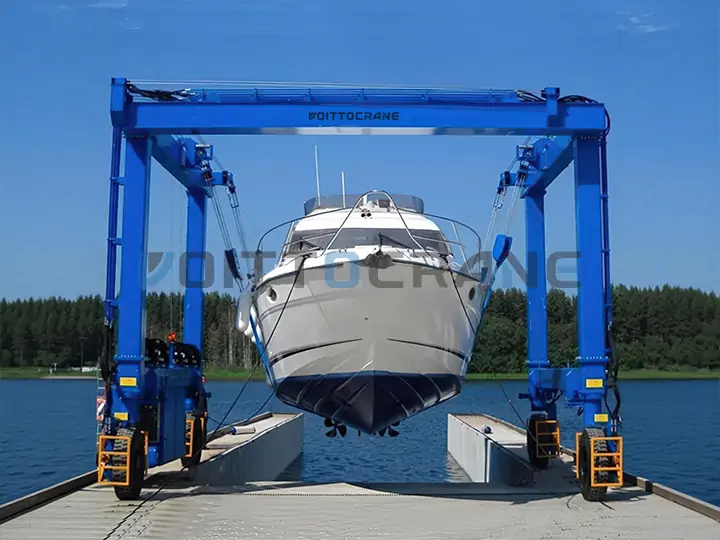
Um guindaste de transporte é o equipamento padrão para içar uma embarcação completa da água e transportá-la para terra firme — nenhum outro tipo de guindaste para iates realiza essa tarefa. A máquina se posiciona sobre a embarcação em uma doca de docagem construída especificamente para esse fim, coloca cintas de poliéster sob o casco por meio de um sistema de elevação hidráulico e conduz a embarcação sobre seu próprio chassi com pneus a velocidades de até 5 km/h para qualquer ponto do estaleiro. Não é necessária nenhuma infraestrutura fixa sobre trilhos, o que significa que o layout do estaleiro pode evoluir sem a necessidade de desativar a máquina.
A razão pela qual nenhum outro equipamento substitui o içamento da embarcação é estrutural, não comercial: um guindaste móvel levanta a embarcação por baixo do casco, utilizando lingas contínuas, distribuindo a carga por toda a sua extensão. Um guindaste de braço ou pórtico levanta a embarcação por cima, utilizando pontos de ancoragem fixos — adequado para componentes e pequenas embarcações, mas geometricamente incompatível com a necessidade de içamento de um veleiro de 25 metros. Se a sua empresa oferece serviços regulares como pintura de fundo, aplicação de anti-incrustante, inspeção de quilha ou manutenção do eixo da hélice, um guindaste móvel é essencial para a operação.
A série de guindastes de viagem da VOITTO abrange capacidades de 30T a 300T em quatro variantes padrão: a série Compact (30–80T, vão de 3–12m) para pequenas marinas de pista única que atendem embarcações de até 24m de comprimento total; a série Standard (80–200T, vão de 10–18m) para frotas mistas de recreio e comerciais; a série Wide (200–300T, vão de 16–25m) para grandes iates a motor e navios de patrulha; e a série Super (300–1.200T) para instalações de superiates e estaleiros navais, projetada sob medida para cada projeto. As opções de acionamento incluem diesel-hidráulico e totalmente elétrico; a variante elétrica reduz o ruído operacional em aproximadamente 12 dB(A) e é cada vez mais especificada para ambientes residenciais fechados ou adjacentes a marinas.
O custo da infraestrutura civil que os compradores subestimam constantemente: A instalação de um guindaste de plataforma móvel requer uma rampa de içamento reforçada com inclinação definida (normalmente de 1:10 a 1:15), piso firme dimensionado para suportar a carga das rodas da máquina com a embarcação suspensa e uma área de manobra ou faixa de circulação com largura suficiente para a máquina e a embarcação. Para novas instalações, as obras civis no local geralmente igualam ou superam o preço de compra da máquina em estaleiros menores. Inclua esse custo no orçamento do projeto antes de solicitar qualquer cotação de equipamento.
Guindaste de braço para barcos: içamento de componentes no cais para estaleiros em atividade.
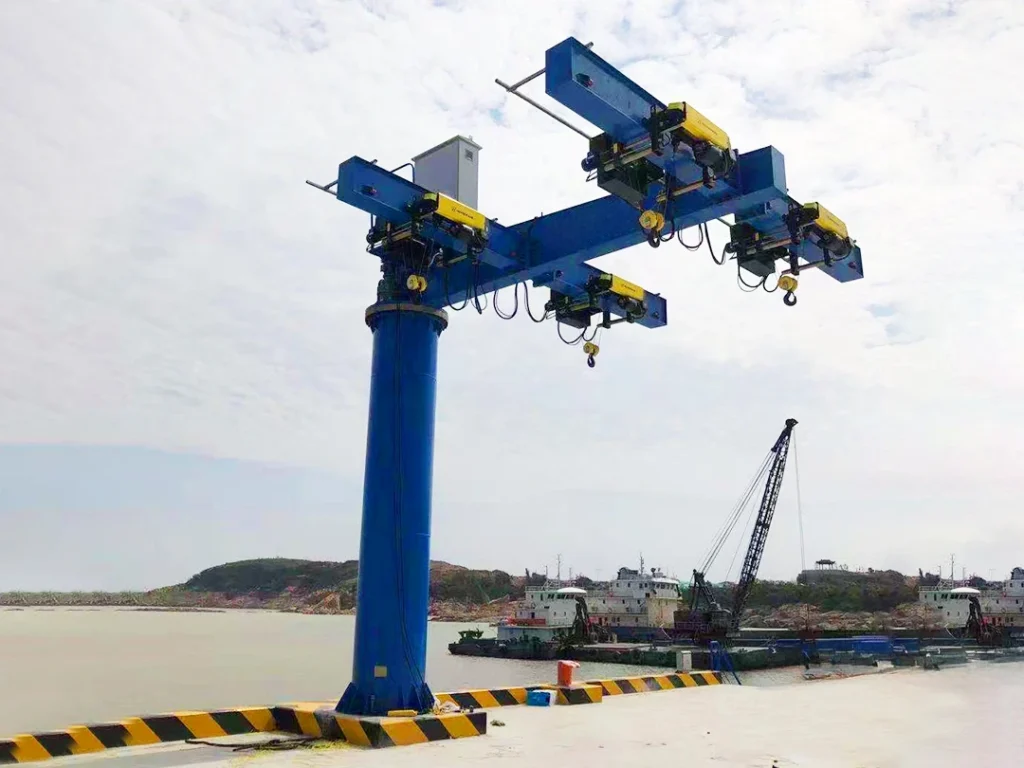
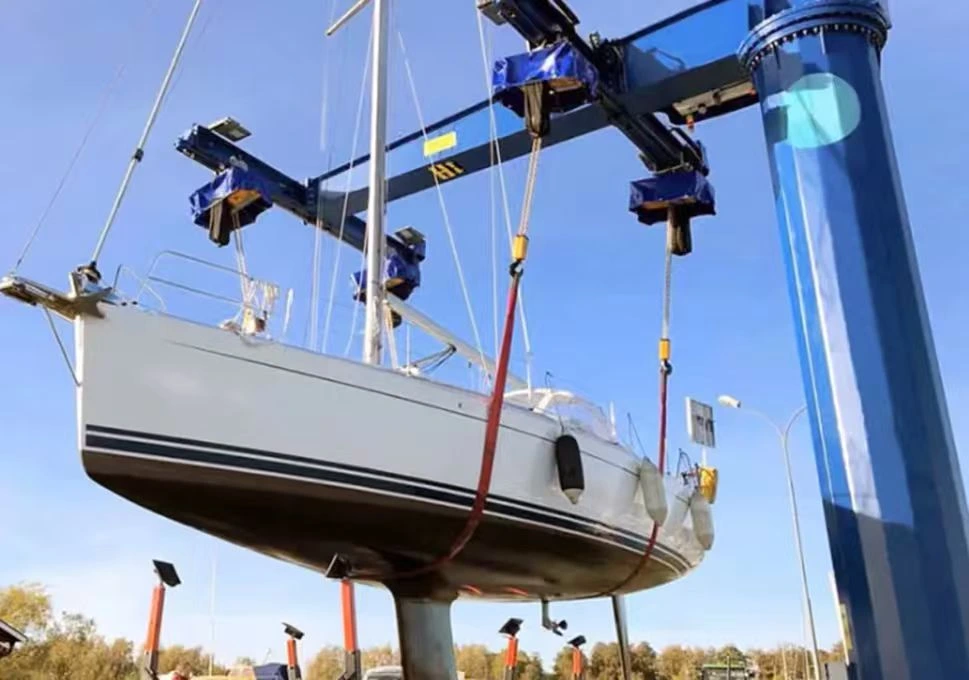
Um guindaste de lança para barcos é o tipo de guindaste ideal para içar iates quando a tarefa envolve o manuseio de componentes ou equipamentos no cais — e não a própria embarcação. Remoção de motor e caixa de câmbio, instalação e remoção de mastro, manutenção de motores de popa, movimentação de paletes de artigos náuticos: essas são aplicações do guindaste de lança para barcos. A linha da VOITTO abrange capacidades de 20T a 40T, com comprimentos de lança de 9.100 mm a 10.300 mm e alturas de elevação de até 7.450 mm.
A diferença estrutural em relação a um guindaste de braço industrial é crucial para a operação: o Guindaste de Braço para Barcos da VOITTO utiliza dois cilindros hidráulicos em vez de um sistema de elevação com tambor de cabo de aço. Isso elimina a necessidade de manutenção do tambor de cabo, mas, mais importante, permite que as lingas dianteira e traseira sejam operadas independentemente. Para um monocasco com quilha pesada e distribuição de carga assimétrica, o ajuste independente das lingas representa a diferença entre uma elevação controlada e equilibrada e um acidente com contato com o casco.
Onde esse tipo de produto atinge seu limite — e onde os compradores erram: O uso incorreto mais comum do guindaste de lança para barcos é especificá-lo para içamento completo de embarcações quando, na verdade, é necessário um guindaste de pórtico ou um guindaste móvel. Um guindaste de lança de 40 toneladas não consegue realizar o içamento de um veleiro de 35 toneladas porque o içamento é feito por cima da embarcação, com um gancho fixo, e não por baixo do casco, com lingas ajustáveis. A tarefa define a categoria do equipamento; a capacidade, por si só, não. Comprar um guindaste de lança de alta capacidade para evitar o custo das obras civis de instalação de um guindaste móvel é um dos erros de aquisição mais caros no setor de içamento marítimo — o guindaste chega e a operação de içamento ainda não pode ser realizada.


Guindaste pórtico para estaleiro: infraestrutura de içamento de cargas pesadas para construção naval.
Um guindaste pórtico para estaleiro é uma infraestrutura de elevação fixa de grande escala para construção naval comercial, reparos e instalações navais — não para equipamentos de marinas de recreio. A gama da VOITTO abrange capacidades de 100T a 1.000T, com vãos de 50m a 185m e alturas de elevação de até 78m. Equipamentos dessa escala são projetados sob medida para cada projeto, em vez de serem selecionados de um catálogo padrão, e a aquisição normalmente envolve um processo de especificação e projeto estrutural em várias etapas.
Esta categoria está incluída aqui porque as equipes de compras que avaliam grandes expansões de instalações às vezes precisam de um limite claro: se a maior embarcação que seu estaleiro opera ultrapassa 50 toneladas de deslocamento e requer montagem completa de seções estruturais, você está no território dos guindastes pórticos para estaleiros. Se a operação for uma marina ou estaleiro que presta serviços a embarcações de recreio e comerciais leves, o guindaste pórtico para transporte ou elevação de barcos é o mais adequado — o guindaste pórtico para estaleiros é uma categoria de produto completamente diferente.

Alan
Especialista em soluções para guindastes · Voitto Crane
Especializada em soluções de exportação de pontes rolantes, pórticos, gruas, pórticos portuários e pontes rolantes EOT. Mais de 10 anos a ajudar clientes globais com consultoria pré-venda, seleção de capacidade e configurações específicas do local.
Como escolher o elevador de iate certo: 3 perguntas que determinam a resposta
Pergunta 1 — O que está sendo içado: o vaso ou um componente?
Essa simples pergunta elimina duas das quatro categorias de equipamentos antes mesmo de qualquer outra análise ser necessária. Se a tarefa de içamento exigir que a embarcação inteira seja retirada da água, o equipamento adequado é um guindaste pórtico para içamento de embarcações. Se a tarefa for içar um componente ou peça de equipamento — um motor, mastro, motor de popa, berço ou carga — o guindaste de lança para embarcações atende à aplicação com uma fração do custo de capital e da complexidade das obras civis.
Teste prático: desenhe o percurso de içamento em um diagrama do local. Se o ponto de fixação da linga ou do gancho precisar ser... sob Se o casco estiver em movimento a qualquer momento, você precisa de um guindaste de deslocamento ou pórtico. Se o gancho se fixa a um ponto de içamento definido no componente e nunca entra em contato com o casco, um guindaste de lança para barcos é a ferramenta certa. Essa distinção parece óbvia quando escrita, mas é a origem dos erros mais caros na seleção de equipamentos no setor de marinas — motivados por pressão orçamentária, não por ignorância técnica.
Pergunta 2 — Qual é a carga bruta no gancho, incluindo todos os acessórios de amarração?
A capacidade nominal do guindaste é o peso total no gancho — não o deslocamento da embarcação sem acessórios ou o peso dos componentes. Cada linga, manilha, viga espaçadora e estrutura de içamento personalizada contribui para a carga no gancho. Para um guindaste móvel, isso significa o deslocamento da embarcação na condição de içamento mais o peso do conjunto de lingas; para um guindaste de lança para barcos, o peso dos componentes mais todo o equipamento de içamento.
A regra prática é a seguinte: adicione de 10 a 151 TP3T à carga mais pesada que você jamais levantará como uma margem mínima de segurança para o equipamento de içamento ao selecionar a classe de capacidade. Para embarcações multicasco ou içamentos complexos em múltiplos pontos com estruturas de içamento projetadas especificamente para essa finalidade, solicite uma tabela detalhada do peso do equipamento de içamento antes de confirmar as especificações do guindaste — o equipamento de içamento pode representar de 5 a 81 TP3T do deslocamento da embarcação em aplicações com grandes catamarãs, e subdimensionar o guindaste por essa margem constitui uma violação das normas legais, não uma escolha de projeto conservadora.
Pergunta 3 — O que a geometria do terreno permite?
Para um guindaste de deslocamento: o vão da máquina deve exceder a boca da embarcação mais larga em pelo menos 800 mm de cada lado para garantir espaço suficiente para o posicionamento das lingas. Especificar o vão com base na frota atual, sem considerar a maior embarcação que provavelmente será operada durante os 15 a 20 anos de vida útil da máquina, é um erro comum e dispendioso — o vão não pode ser ajustado posteriormente sem a substituição completa da máquina.
Para um guindaste de lança articulada: o alcance da lança deve posicionar o gancho. diretamente sobre o ponto de içamento da carga no raio de operação necessário — não aproximadamente sobre ele. Meça do centro da coluna da grua até a posição mais distante necessária do gancho, adicione uma folga de 300 a 500 mm e, em seguida, verifique o diagrama de carga do fabricante para esse raio. A capacidade nominal diminui com o aumento do alcance em uma relação não linear; o valor da capacidade nominal se aplica ao alcance máximo nominal, e a capacidade utilizável no seu raio de operação real pode ser significativamente menor.
Certificação e Conformidade: O que exigir antes de assinar qualquer ordem de compra
A certificação é um ponto de controle rigoroso no processo de aquisição, não uma mera formalidade administrativa. A falta de documentação impede a aprovação da instalação pela autoridade portuária, invalida a cobertura do seguro comercial em caso de incidente e gera responsabilidade pessoal para o operador da instalação. O momento de confirmar o pacote de certificação necessário é antes de fazer o pedido — não depois da entrega, quando a documentação para adaptação é cara, demorada e, às vezes, estruturalmente impossível.
Para plataformas elevatórias e guindastes pórticos para elevadores de barcos em instalações comercializadas na Europa ou internacionalmente., O pacote de documentação padrão inclui quatro itens: Declaração de Conformidade CE, referenciando as normas de projeto estrutural EN 13001 e os requisitos de equipamentos mecânicos EN 13135; classificação do grupo de serviço FEM 1.001 documentada na instalação e compatível com a sua contagem anual de ciclos de elevação confirmada; certificado de teste de carga de fábrica com carga de trabalho segura (SWL) de 125%, com opção de testemunha de terceiros; e documentação de conformidade com a norma ISO 9927-3, que é a norma específica do produto aplicável a guindastes móveis para barcos. A série de guindastes móveis da VOITTO é fornecida com este pacote completo como padrão.
Para guindastes de lança de barco, O pacote de documentação principal inclui: Declaração de Conformidade CE; relatório de cálculo estrutural com dados de força de reação na base (exigido pelo seu engenheiro civil para o projeto da fundação — nenhum fornecedor de boa reputação deve reter essa informação); certificado de teste de carga com SWL 125%; e documentação da classe de serviço FEM compatível com a sua frequência de içamento real. Para instalações em estruturas flutuantes, é necessária uma etapa adicional de coordenação entre o fornecedor do guindaste e o projetista do pontão ou arquiteto naval antes da formalização do pedido — os momentos de tombamento dinâmicos em uma plataforma flutuante diferem significativamente dos momentos de tombamento estáticos em um cais, e essa questão não deve ser resolvida após a entrega.
ISO 9001:2015 em nível de fábrica é um indicador básico de qualidade de fabricação, separado da certificação CE do produto. Solicite o certificado atual, verifique se o seu escopo abrange a fabricação de guindastes e confirme a sua validade. Uma fábrica que não consegue produzir um certificado CE atual Certificado ISO 9001 Não se trata necessariamente de fabricar equipamentos de qualidade inferior, mas sim de eliminar uma das camadas de verificação padrão nas quais as equipes de compras experientes confiam.
Como verificar de fato — e não apenas solicitar: Solicite documentos, não apenas garantias. Especificamente: a Declaração de Conformidade CE, indicando o responsável e listando as diretivas aplicáveis; o certificado de teste de carga, mostrando a data do teste, a carga testemunhada, a organização responsável pelo teste e o número de série do guindaste; e o certificado ISO 9001, indicando o organismo emissor e o período de validade atual. Qualquer fornecedor que não possa fornecer esses três documentos em resposta a uma solicitação de pré-encomenda representa um risco de aquisição, independentemente do preço cotado.
Conclusão
A seleção de um guindaste para iates começa com uma pergunta fundamental: o que será içado? A partir daí, a escolha se desenvolve considerando a carga bruta no gancho, a geometria do local, o orçamento para infraestrutura civil e os requisitos de certificação. O guindaste móvel é a única opção para a retirada completa da embarcação da água; o guindaste de lança para barcos é ideal para o içamento de componentes e equipamentos no cais; o guindaste pórtico para barcos abrange operações multifuncionais no estaleiro; e o guindaste pórtico para estaleiros é a solução adequada para a construção e reparo de grandes embarcações comerciais.
Três etapas a serem concluídas antes de contatar qualquer fornecedor para solicitar um orçamento de elevador para iates:
- Descreva a tarefa de içamento em termos precisos — o que está sendo içado, peso bruto incluindo os equipamentos de içamento, ponto de içamento e descida, frequência máxima de içamento por semana.
- Meça a geometria do local — vão ou alcance da lança, orçamento disponível para obras civis, incluindo fundação e rampa.
- Confirme o pacote de certificação necessário junto à sua autoridade portuária ou seguradora marítima.
A equipe de engenharia da VOITTO especificou e forneceu equipamentos de elevação para iates em todas as quatro categorias para marinas comerciais, instalações navais e estaleiros em mais de 50 países. Envie-nos a definição da sua tarefa de elevação e a geometria do local — responderemos com uma recomendação específica de equipamento e uma especificação preliminar em até 24 horas.
Alan
Especialista em soluções para guindastes · Voitto Crane
Especializada em soluções de exportação de pontes rolantes, pórticos, gruas, pórticos portuários e pontes rolantes EOT. Mais de 10 anos a ajudar clientes globais com consultoria pré-venda, seleção de capacidade e configurações específicas do local.
Autor: Alan, Especialista em Soluções para Guindastes · VOITTO Crane Última atualização: setembro de 2026 · Ciclo de revisão recomendado: 12 meses (preços e padrões de certificação) Aviso: A seleção final do equipamento deve ser confirmada por um engenheiro certificado e estar em conformidade com as normas locais para equipamentos de elevação.
FAQ
P1: O que é um elevador para iates e qual a diferença entre ele e um elevador para barcos?
Um elevador para iates é um equipamento profissional de elevação marítima — incluindo elevadores de barcos, guindastes de lança e guindastes de pórtico — usado em marinas, estaleiros e outros locais para movimentação, manutenção e lançamento de embarcações. O termo "elevador para barcos" geralmente se refere a equipamentos instalados em docas residenciais para pequenas embarcações de recreio com menos de 5 toneladas. Em contextos comerciais e industriais, os termos se sobrepõem, mas a escala operacional difere significativamente: os equipamentos comerciais de elevação para iates começam em 20 a 30 toneladas e chegam a 1.200 toneladas ou mais. Se a instalação for uma marina ou estaleiro comercial que presta serviços regularmente a embarcações com mais de 10 metros de comprimento, o equipamento de elevação para iates de uso comercial é a categoria aplicável.
P2: Como escolher entre um guindaste de transporte e um guindaste pórtico para elevador de barcos para minha marina?
Escolha um guindaste de viagem quando a retirada completa da embarcação da água for um serviço essencial — pintura de fundo, aplicação de anti-incrustante, inspeção da quilha e serviços no eixo exigem que a embarcação seja totalmente içada para fora da água. Escolha um guindaste pórtico para barcos quando a principal necessidade for o manuseio do casco dentro do estaleiro, carregamento em berço ou içamento de embarcações já em terra. O guindaste pórtico tem um custo de infraestrutura civil substancialmente menor, já que não requer rampa de içamento, mas não se compara à capacidade de lançamento e recuperação na água do guindaste de viagem. Para a maioria das marinas comerciais ativas que atendem embarcações com mais de 12 metros de comprimento, ambos os tipos de guindaste acabam se tornando necessários à medida que o volume de embarcações aumenta — comece com o guindaste de viagem se os serviços de içamento forem a prioridade em termos de receita.
P3: Qual a capacidade do elevador de iates que uma marina típica precisa ter?
Para marinas de recreio que atendem veleiros monocasco e lanchas de até 18-20 m de comprimento, a faixa de 35T a 80T cobre a grande maioria da frota. Marinas que atendem regularmente grandes iates a motor, multicascos ou embarcações comerciais na faixa de 20-30 m devem considerar 100T como um mínimo prático para evitar operações com capacidade limitada durante a alta temporada. Sempre verifique a embarcação mais pesada da sua frota regular em relação à Carga Máxima de Trabalho (CMT) — e considere a embarcação mais pesada que provavelmente será atendida durante a vida útil da máquina. Subdimensionar um guindaste de viagem cria um gargalo operacional que é caro de resolver sem a substituição completa do equipamento.
Q4: Qual o custo total de um elevador para iate, incluindo a instalação?
O preço da máquina é apenas parte do custo do projeto. Um guindaste de pórtico compacto de 30 a 80 toneladas custa entre £40.000 e £120.000 (apenas a máquina); as obras civis para a rampa de acesso para uma nova instalação adicionam entre £30.000 e £100.000 (ou mais), dependendo das condições do local. Um guindaste de lança para barcos de 20 a 40 toneladas custa entre £18.000 e £65.000 (apenas o equipamento), com as obras civis da fundação adicionando entre £5.000 e £15.000 (apenas a fundação). Um guindaste pórtico para elevação de barcos de 50 a 300 toneladas custa entre £60.000 e £200.000 (ou mais) apenas a máquina, com as obras civis da fundação sobre trilhos adicionando entre £20.000 e £60.000 (apenas a fundação). Elabore um orçamento completo para o projeto — incluindo equipamentos, frete, obras civis, instalação e comissionamento — antes de se comprometer com qualquer compra.
Q5: Que certificações um elevador de iates comerciais deve possuir?
Para instalações europeias e com comércio internacional, são necessários: Declaração de Conformidade CE com referência às normas EN 13001 e EN 13135; documentação do grupo de serviço FEM 1.001 compatível com os ciclos de elevação anuais; certificado de teste de carga com SWL 125%; e, para elevadores de barcos móveis, documentação de conformidade com a norma ISO 9927-3. A certificação ISO 9001:2015 em nível de fábrica é um indicador de qualidade básico padrão. Para aplicações navais, offshore ou regulamentadas por sociedades classificadoras, a aprovação da DNV, Lloyd's ou Bureau Veritas pode ser adicionalmente exigida — confirme com a sua autoridade portuária e seguradora no início do projeto, e não após a seleção do equipamento.




 English
  Español
  Português
  العربية
  Français
  Русский