
A foundry crane is an overhead lifting system built for the heat, dust, and repetitive heavy loads of metal casting. Depending on the specific needs of the workshop, this equipment can be used to charge furnaces, handle and tip ladles containing molten metal, move molds and castings, or assist with equipment maintenance. However, not all foundry cranes are required to handle molten metal; therefore, when selecting a crane, buyers should first clarify their lifting requirements and, based on specific operating conditions and relevant standards, confirm the crane’s rated load, duty class, heat-resistant protection measures, hoisting and braking system designs, and safety protection devices.
- 1 What is a Foundry Crane?
- 2 Main Types of Foundry Cranes
- 3 Applications of Foundry Cranes
- 4 Key Technical Requirements for Foundry Cranes
- 5 How to Choose the Right Foundry Crane
- 6 Why Choose VOITTO for Foundry Crane Solutions?
- 7 Conclusão
-
8
FAQ
- 8.1 What is the difference between a foundry crane and a standard overhead crane?
- 8.2 What types of cranes are commonly used in foundries?
- 8.3 What working class is suitable for a foundry crane?
- 8.4 Can a standard overhead crane be used in a foundry?
- 8.5 Is a ladle crane the same as a foundry crane?
What is a Foundry Crane?
A foundry crane is a type of lifting equipment specifically configured for lifting operations in foundry shops. In foundry shops, metal is melted, poured into molds, and ultimately processed into castings. This term refers to a specific application rather than a single, standardized design. In one factory, this equipment might be a double-girder crane used to handle molds; in another, it might be a ladle crane used to transport molten metal. Nota: Although the terms “foundry crane,” “casting crane,” and “ladle crane” are related, they are not interchangeable.


| Aspecto | Standard overhead crane | Guindaste de fundição |
|---|---|---|
| Ambiente | Ambient workshop conditions | Radiant heat, dust, fumes, sometimes spatter |
| Loads | Components, packages, equipment | Charge materials, molds, castings and, on some cranes, molten metal |
| Duty | Often light to medium cycles | Often high cycle counts; the class comes from the load spectrum |
| Heat protection | Generally not required | Shielding and heat-rated components as exposure requires |
| Hoist and brakes | General crane standard | Upgraded for molten metal duty, with redundancy per the applicable standard |
| Safety and control | Standard limits and overload protection | Added interlocks, monitoring and fine-speed control |
Main Types of Foundry Cranes
Foundry crane configurations overlap: a ladle crane, for example, is usually also a double-girder crane. The right choice depends on what the crane lifts, how often, and how close it works to molten metal.
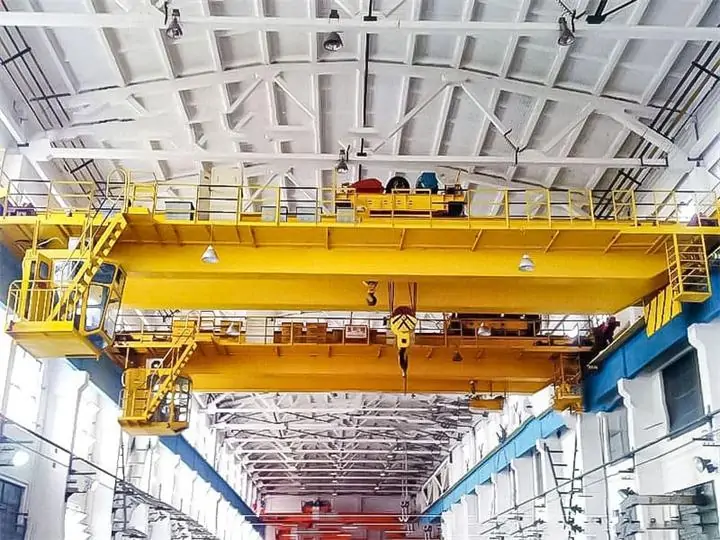
Foundry Overhead Crane
Most foundry cranes are bridge-type overhead cranes running on rails along the building bays, which keeps floor space free for furnaces, molding lines, and pouring stations. A foundry overhead crane can be a single girder unit for light, non-molten tasks. However, as load, span, or duty increase, it becomes a double girder unit. Over a pouring bay, it also faces radiant heat.
Obter cotação
Double Girder Foundry Crane
In double-girder foundry cranes, the trolley and hoisting mechanism are mounted on two parallel main girders. This design not only enables greater lifting capacity and longer spans but also provides space for installing additional hoisting mechanisms, maintenance walkways, and thermal insulation. Consequently, steel mills utilize this equipment for operations such as heavy-duty charging and the handling of molten steel ladles. However, this configuration is not a strict requirement but rather a choice based on specific needs; whether a crane is suitable for molten metal operations depends on its thermal insulation, the design of its hoisting and braking systems, and its duty class. We invite you to review the basic configurations of the VOITTO double-girder bridge crane series.
Obter cotação
Guindaste de concha
A ladle crane is a specialized foundry or metallurgical crane that lifts, carries, and, where required, tilts ladles of molten metal. It typically combines a main hoist for the ladle with an auxiliary hoist for tilting, plus heat protection, braking, and safety features matched to the consequences of failure. As a molten metal handling crane, it is one type of foundry crane, not a synonym for all of them. For steel melt shops, see the guia de seleção de guindastes para siderúrgicas.
Obter cotação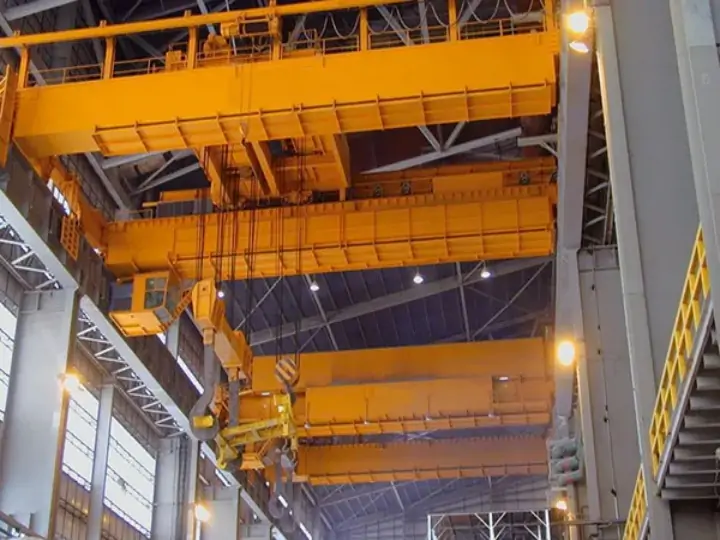
Fundição de pontes rolantes
“Casting crane” is a term commonly used in the industry, but it does not represent a classification with uniform standards. This term typically refers to overhead cranes used in casting or pouring operations, where the objects being handled may include molten metal, casting molds, or castings. Therefore, foundry crane suppliers must confirm with the procurement team the specific objects to be lifted and the frequency of use. Steel
Obter cotaçãoApplications of Foundry Cranes
Foundry lifting falls into two groups that the procurement team should specify separately: ordinary material handling and molten metal handling. They share a building, but not a risk profile.
Molten Metal Handling
In foundries, the handling of molten metal poses extremely high safety requirements. Cranes are responsible for transporting steel ladles (or pouring ladles) from the furnace to the pouring area; during this process, a failure in the hoisting mechanism, braking system, or structural components could lead to serious consequences. Therefore, engineers select cranes specifically based on the type of metal, the weight of the steel ladle, and the transport route. Note: Regardless of a crane’s rated load capacity, it is strictly prohibited to use a crane that was not originally designed for this type of operation.
Casting and Pouring Operations
At the pouring station, a crane moves the ladle into position above the mold or along the pouring line. If pouring requires tilting the ladle, this is typically accomplished at low speed by the equipment’s auxiliary hoisting mechanism. Smooth, low-speed control—sometimes supplemented by an anti-sway drive system—reduces the risk of molten metal splashing.
Mold and Casting Handling
Outside the melting area, cranes are responsible for lifting sand cores, molds, castings, and related tooling; loading furnace charge into hoppers; and transporting castings that are in the cooling or finishing stages. Operators use chains, lifting clamps, beams, magnetic lifting devices, or grabs to secure these loads, and the choice of lifting equipment dictates corresponding operational requirements. Note: In this area, the effects of dust and impact may be more significant than those of high temperatures.
Foundry Equipment Maintenance
During equipment maintenance, cranes are used to lift furnace components, refractory materials, ladle parts, and pump equipment. Although these lifting operations are not frequent, they often involve the heaviest loads in the plant. Therefore, these maintenance-related lifting requirements sometimes determine the crane’s rated load capacity.
Key Technical Requirements for Foundry Cranes
The environmental conditions in a foundry include high temperatures, dust, vibration, and frequent crane operations. A foundry crane manufacturer should first quantify these factors and classify the relevant requirements by source, including recommended practices, owner specifications, and mandatory requirements in applicable standards or local laws.
Heat Resistance and Thermal Protection
The heat to which cranes are exposed primarily comes from radiation emitted by furnaces and ladles, hot air beneath the roof, and spatter. Protective measures may include installing heat shields, using insulated cables, employing heat-resistant wire ropes, and equipping motors and control systems with cooling devices. The protection rating should be determined based on the actual measured temperature at the crane’s location, rather than solely on the designation “foundry.” Therefore, it is essential to clearly specify the design temperature.
Nota: Heat-resistant design is not the same as explosion-proof design. The two address different hazards; therefore, if an explosive atmosphere is present, separate requirements must be specified.
Lifting Capacity and Working Duty
The rated lifting capacity refers to the maximum load that a piece of equipment can lift under specified conditions, including all lifting accessories. For a molten ladle crane, this includes the empty ladle with its lining, the metal inside the ladle, the slag, and components such as the hook or crossbeam.
The duty class is a classification system based on the number of load cycles a crane performs and the intensity of the loads it carries (as a percentage of the rated load). Standards such as FEM 1.001, ISO 4301-1, and GB/T 3811 all use a rating system ranging from A1 to A8. The duty class of a foundry crane depends on the actual load profile, specifically including: the number of lifts per hour, daily operating hours, shift schedules, and the ratio of actual load to rated load. For example, the operating conditions for continuously lifting molten steel ladles across multiple shifts are entirely different from those for handling molds only a few times per hour.
Hoisting and Braking Systems
The hoisting mechanism determines whether a crane can reliably lift and hold heavy, high-temperature loads. The procurement team should evaluate its speed range, the motor and gearbox rated parameters, and the braking system configuration. In operations involving molten metal, projects typically require a redundant braking design to ensure that a load will not fall even if one set of brakes fails. Specific configuration plans should comply with relevant standards and the technical specifications provided by the owner.
Safety Devices and Operational Control
Foundry crane safety relies on devices that reduce the chance of an incident and limit its consequences. Typical items include overload protection, limit switches, emergency stop, buffers, anti-collision protection on shared runways, and warning devices. In hot areas, brake or motor temperature monitoring may be justified. Likewise, an insulated cab or remote control keeps operators out of the hottest zone. Because the applicable standard and risk assessment set the required devices, confirm them per project.
How to Choose the Right Foundry Crane
Work from the process outward. An accurate description of the lift is worth more than any catalogue figure.
Identify the Material and Load Characteristics
Start with what the crane lifts: molten metal, charge materials, molds, castings, or equipment. Record weight, including attachments, shape, temperature, and rigging method. Separate molten metal lifts from ordinary handling, because they drive crane type, hoist design, and safety specifications.
Determine Lifting Capacity and Span
Set the rated capacity to the heaviest lift, including accessories. Then confirm the span, lifting height, and hook approach, and check whether several cranes will share the bay.
Evaluate Working Frequency and Duty Class
Collect lifts per hour, operating hours, shifts, average and maximum load, and expected service life. Next, ask the supplier to calculate the duty class from these inputs and to name the classification system. If you expect another shift or pouring line, size for it now.
Consider the Operating Environment
Record ambient and radiant temperatures, dust and sand loading, humidity, corrosive fumes, power supply, and any explosive-atmosphere requirements. If one crane serves several zones, design for the harshest one. Finally, plan how your team will inspect the crane in the hot zone.
Select a Reliable Foundry Crane Manufacturer
A foundry crane manufacturer should explain why a design fits your load spectrum, not just quote a capacity. Evaluate these points:
- Engineering experience: foundry or metallurgical duties and failure modes.
- Customization: capacity, span, height, hoists, electrical systems, and protection.
- Technical documentation: calculations, drawings, test records and standards applied.
- Manufacturing capability: controlled fabrication, component sourcing and factory testing.
- Installation support: installation, commissioning and operator training.
- After-sales service: spare parts, response times, and inspection support.
- Finally, verify references from comparable duties.
Why Choose VOITTO for Foundry Crane Solutions?
VOITTO Crane is a Henan, China-based manufacturer of overhead, gantry, jib and other cranes. For foundry work, our relevant strengths are:
- Personalização: VOITTO Crane offers customized lifting capacities, spans, and lifting heights based on the specific conditions of each customer’s facility; a comprehensive assessment of the operating environment and working conditions is conducted during the consultation phase.
- Configurations: We offer two models: single-girder (1 to 32 tons) and double-girder (5 to 800 tons). Customers can choose from a variety of configurations, including hooks, dual trolleys, grabs, electromagnetic pads, and insulation devices.
- Metallurgical Series: Designed to meet the needs of steel mills, we offer a variety of configurations for molten steel handling, casting, and charging operations, with hoisting mechanisms and electrical systems precisely matched to specific operating conditions. Our double-girder molten steel handling cranes are also suitable for molten metal handling operations in foundries.
- Delivery and Support: We conduct 100% full-load testing and safety inspections prior to delivery; provide weekly progress updates; and offer on-site installation, commissioning, operator training, and 24/7 online technical support.
Conclusão
Foundry cranes keep casting moving, from charging and pouring to mold handling and maintenance. Because the term covers many configurations, start from the real lift: what it is, how heavy, how often and how hot. Then derive capacity, duty class, heat protection, and safety from operating data and applicable standards, with a manufacturer that can validate them.
Planning a new foundry crane or reviewing an existing one? Share your load, span, duty and temperature details with VOITTO for an engineering consultation or a customized crane solution. Contact our engineering team.

Alan
Especialista em soluções para guindastes · Voitto Crane
Especializada em soluções de exportação de pontes rolantes, pórticos, gruas, pórticos portuários e pontes rolantes EOT. Mais de 10 anos a ajudar clientes globais com consultoria pré-venda, seleção de capacidade e configurações específicas do local.
FAQ
What is the difference between a foundry crane and a standard overhead crane?
A standard overhead crane suits ambient workshop conditions and general loads. A foundry crane is configured for heat, dust, and frequent cycles and, with molten metal, for stricter hoist, brake, and safety requirements.
What types of cranes are commonly used in foundries?
Single and double girder overhead cranes are most common, fitted with hooks, grabs, magnets, or ladle hooks. Ladle cranes handle molten metal. Gantry or jib cranes sometimes serve yards and workstations.
What working class is suitable for a foundry crane?
No single class applies. The class follows from the load spectrum: lifts per hour, hours per day, and share of rated load. Continuous ladle service may justify A7 or A8, but light, intermittent mold handling may not.
Can a standard overhead crane be used in a foundry?
Yes. If the crane’s rated specifications meet the on-site dust and temperature conditions, it may be used in areas away from high temperatures. However, it must not be used in operations involving molten metal; such conditions require a crane specifically designed for that purpose. A temperature assessment must be conducted for areas near the furnace.
Is a ladle crane the same as a foundry crane?
No. A ladle crane is a specialized crane for molten metal ladles. A foundry crane is the broader term for any crane serving foundry operations, including cranes that never lift molten metal. Not every foundry crane is a ladle crane.


 English
 Español
 Português
 العربية
 Français
 Русский