A gantry crane risk assessment has to start at the floor. Its outriggers, base beams, wheels, and power supply systems are all located at ground level, sharing the same space as pedestrians and forklifts, and are subject to environmental factors. Mobile equipment suffers from instability in its casters; outdoor equipment faces wind loads; and long-span equipment may experience outrigger skew.
Precisely because of these ground-level hazards, one of the most common compliance errors often comes at a high cost: directly “copying and pasting” the risk assessment plan for indoor overhead cranes onto gantry cranes. While this approach may pass an internal audit, it overlooks nearly all of the genuine safety hazards surrounding gantry cranes that pose a threat to personnel.
In the following sections, this guide provides a framework for identifying gantry crane hazards, a ready-to-use eight-row risk matrix, and in-depth analyses for different types of equipment. Additionally, the guide introduces various engineering controls that can fundamentally reduce risk levels without relying solely on operator vigilance.

Grúa pórtico monohaz

Grúa pórtico birraíl
Gantry Crane vs. Overhead Bridge Crane Risk Profiles: Why the Difference Matters
Bridge cranes are mounted on track beams within the building structure; their wheels do not touch the ground. The building structure provides stability, and overhead rails supply power. The primary risk of injury stems from the suspended load and the rigging located above personnel.
Gantry cranes, on the other hand, employ a completely different structure: their legs rest on the ground or on ground-level tracks, with the lower crossbeam and wheels operating at ground level; stability is maintained by the crane’s own geometric structure and foundation. This structural difference results in a shift in risk characteristics, primarily reflected in the following three aspects:
- Ground-level travel path: The end beams and wheels move within aisles used by pedestrians and forklifts, with no overhead barriers.
- Self-supporting stability: The spacing of the outriggers, the load-bearing capacity of the ground, and the condition of the casters or tracks determine whether the frame can remain upright.
- Environmental impacts: For outdoor gantry cranes, the main girder and outriggers are directly subjected to wind loads; mobile equipment, on the other hand, may face adverse conditions such as ground cracks, slopes, and debris.
| Risk Factor | Indoor Overhead Bridge Cranes | Freestanding Gantry Cranes (Portable, RMG, RTG) |
|---|---|---|
| Runway Location | Elevated runway beams on building columns or wall brackets | Floor-level rails, embedded track, or free rolling on casters and tires |
| Pedestrian/Forklift Interaction | Low at floor level; the hazard is the suspended load path overhead | Direct: legs, sill beams, and wheels share the floor with people and forklifts, creating crush and pinch points at ankle height |
| Structural Tip-Over Potential | Negligible; the building structure carries and braces the runway | Real: depends on leg base, load chart, floor flatness, ground bearing, and brake or caster integrity |
| Weather Exposure | Sheltered indoors | Outdoor RMG and RTG units take full wind load on girder and legs; portable units in yards face wind, rain, and uneven ground |
| Power Feeding Hazards | Enclosed conductor bar or festoon above head height | Trailing cables, cable reels, and floor trenches exposed to forklifts, standing water, and over-tension |
If you manage runway-mounted indoor bridge cranes, read our dedicated guide: How to Conduct an Overhead Crane Risk Assessment. The rest of this article covers only what that guide does not: hazards created where the crane meets the ground.
Core Gantry Crane Risk Assessment Matrix (Ready-to-Use RAMS Template)
Each hazard is scored using the following formula: Probability (1–5) × Severity (1–5). “Initial risk” refers to the score before control measures are implemented; “residual risk” refers to the score after the listed control measures have been implemented and verified. The risk level ranges are: 1–5 (Low), 6–11 (Medium), 12–19 (High), 20–25 (Extremely High). Engineering controls can reduce the likelihood of occurrence, but they typically do not alter the severity of crushing or rollover incidents; therefore, to achieve a lower residual risk score, the likelihood of occurrence must be reduced to 1 and maintained at that level.
| Hazard Category | Specific Failure Scenario | Initial Risk | Engineering Controls (Hardware) | Administrative Controls (SOP) | Residual Risk |
|---|---|---|---|---|---|
| 1. Sill Beam & Wheel Crushing | Gantry travels into a pedestrian, forklift, or stacked material along the floor track; the load or a leg blocks the operator’s view | Extreme (4×5=20) | Laser/ultrasonic zone scanners; rail sweeps with contact bumpers; travel beacon and audible alarm; rail-end buffers | Floor-marked exclusion zone; spotter for blind travel; forklift traffic segregation | Bajo (1×5=5) |
| 2. Portable Tip-Over & Caster Collapse | Frame rolls under load on sloped concrete or floor cracks; swivel casters left unlocked; caster overloaded | Alta (3×5=15) | Polyurethane caster swivel locks and wheel brakes; casters rated for load plus dynamic margin; outriggers or leveling feet; load plate on frame | Floor flatness and slope survey; load lowered before travel; no travel above rated load | Bajo (1×5=5) |
| 3. Outdoor High-Wind Runaway & Overturning | Gust pushes a rail-mounted gantry along the track beyond brake capacity, or overturns an unclamped crane | Extreme (4×5=20) | Anemometer interlock; electro-hydraulic rail clamps; mechanical storm anchoring pins; rail-end stops | Storm-parking procedure; forecast check each shift; anchor pin inspection | Bajo (1×5=5) |
| 4. Long-Span Leg Skewing & Derailment | Rigid and flexible legs travel out of sync; rail binding, wheel flange cracking, and structural stress follow | Alta (4×4=16) | VFD closed-loop skew correction with encoders on both legs; skew limit trip; spherical flexible-leg joint; flange guide rollers | Periodic rail gauge and alignment survey; stop travel on any skew alarm | Bajo (1×4=4) |
| 5. Ground-Level Power Supply Electrocution | Forklift crushes a trailing cable; flooded trench energizes the track; over-tensioned cable reel snaps | Alta (3×5=15) | Motorized cable reels with torque-limited drive; forklift-rated trench covers with drainage; RCD protection; cable ramps | Cable-path floor marking; trench inspection after rain; lockout before cable work | Bajo (1×5=5) |
| 6. Side Pulling & Hoist Rope Guide Failure | Off-center lift shatters the rope guide; wire rope birdcages or leaves the drum groove | Alta (4×4=16) | Rope guide matched to duty (cast iron for heavy duty, nylon for light duty); fleet-angle limit; slack-rope switch; overload limiter | Hook centered over load before lifting; no angled pulls; rope guide wear check | Bajo (1×4=4) |
| 7. Two-Blocking & Uncontrolled Load Swing | Hook block hits the drum or sheaves; pendulum swing strikes a support leg | Alta (3×4=12) | Dual upper limit switches (geared rotary plus weighted lever); anti-sway control; overload limiter | Leg clearance and swing-radius rule; no hoisting to the limit; operator competency sign-off | Bajo (1×4=4) |
| 8. Unnoticed Structural & Mechanical Fatigue | Corroded outdoor bolts, worn wheel flanges, or degraded wire rope go unnoticed until failure | Alta (4×4=16) | Galvanized fasteners with torque-indicator paint; flange wear gauges; rope condition monitoring | Pre-shift and periodic inspection; findings recorded against this matrix | Bajo (1×4=4) |
The residual risk associated with Hazard #8 can only be maintained at a “low” level if gantry crane operators perform the required inspections. Issues such as outdoor bolt corrosion, flange wear, and rope performance degradation develop relatively slowly; these potential hazards can be detected in a timely manner through documented inspections. Please use our “Lista de verificación para la inspección de grúas pórtico” as a mandatory procedure for pre-shift and periodic inspections, and record the inspection results under the entry corresponding to “Hazard #8” in this matrix.
Deep Dive by Equipment Type: Where Hidden Risks Lurk
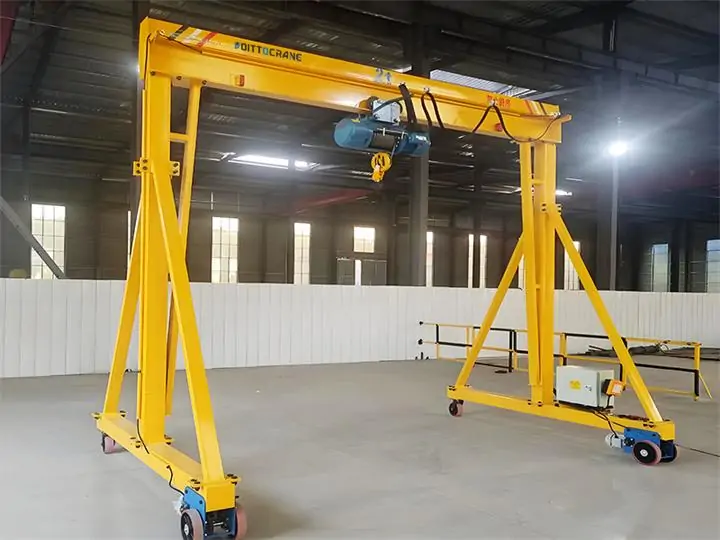
1. Portable & Adjustable Workshop Gantry Cranes (0.5T–10T)
The frame of a height-adjustable gantry crane relies on locking pins inside the telescoping legs to support the load. If the locking pins become bent, the mounting holes are deformed or stretched, or the locking pins lack secure fasteners, the pins may shear and break when subjected to impact loads, causing the crossbeam—along with the load it is carrying—to fall. Users should select double-shear locking pins equipped with retaining devices; if deformation of the locking pins is detected, they must be immediately scrapped and replaced.
The risk of overturning for mobile gantry cranes depends primarily on the choice of casters and the condition of the floor surface. Polyurethane casters roll smoothly and protect the floor, but they are prone to compression deformation under sustained loads, resulting in a flat, worn surface. Furthermore, their rated load capacity is lower than that of forged steel casters. Although forged steel casters have a higher load capacity, they offer greater rolling resistance, can easily damage concrete edges, and are highly prone to getting stuck when encountering floor cracks or expansion joints. Regardless of the type of caster used, the floor along the travel path must be kept level, clean, and free of cracks.
Manually pushing the crane under heavy loads can easily cause dynamic instability in the frame structure. If thrust is applied high on the frame, an overturning moment is generated; furthermore, when a caster becomes jammed in a floor crack, the load swings forward, causing the center of gravity to rise at the most inopportune moment. Therefore, operators should lower the load to the minimum height above the ground and apply thrust at the bottom of the frame. If the load approaches the rated load capacity, it is recommended to prioritize electric drive and use a locking mechanism on the swivel casters.
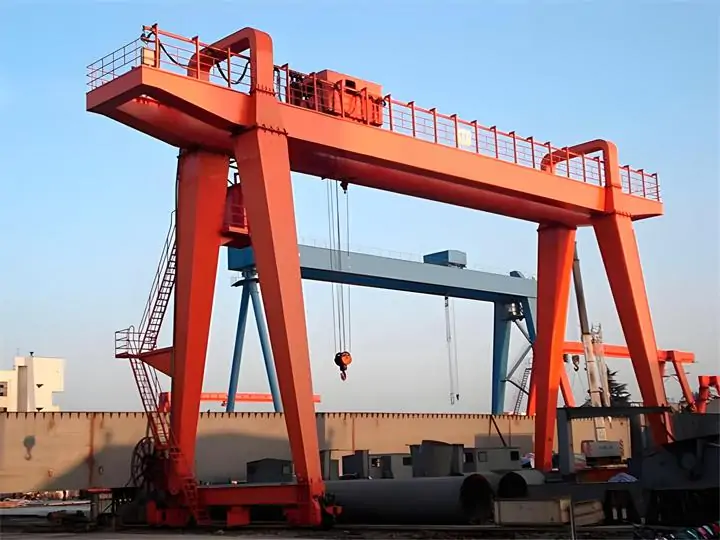
2. Heavy-Duty Rail-Mounted (RMG) & Semi-Gantry Cranes (10T–500T+)
Uneven settlement may occur in the track foundation. Even a difference in settlement of just a few millimeters can alter the track gauge and track elevation, which in turn directly leads to leg misalignment and flange wear. Gantry crane maintenance personnel should measure track elevation and track gauge at established intervals; if a leg misalignment alarm is triggered, it should first be investigated as a foundation issue rather than immediately attributed to the drive system.
On a semi-gantry crane, one side of the outriggers runs on ground-level tracks, while the other side rests on elevated track beams or wall brackets. The lower crossbeam and wheels on the open side are exposed, and this area happens to be the only route workers take to access the rack area or machinery zones. Therefore, track clearances and fixed protective devices must be installed on this side, and clearly defined passageways must be established.
In precast component yards or steel storage yards, stacked products, bundled steel, and the crane’s own outriggers can create blind spots, preventing operators—whether in the cab or using a pendant controller—from clearly seeing the location of personnel. During equipment operation, relying solely on rearview mirrors is often insufficient to effectively eliminate these blind spots. It is recommended that users install area scanners, radar, or camera monitoring systems on both lower crossbeams, along with operational alarm devices, to address these safety hazards.
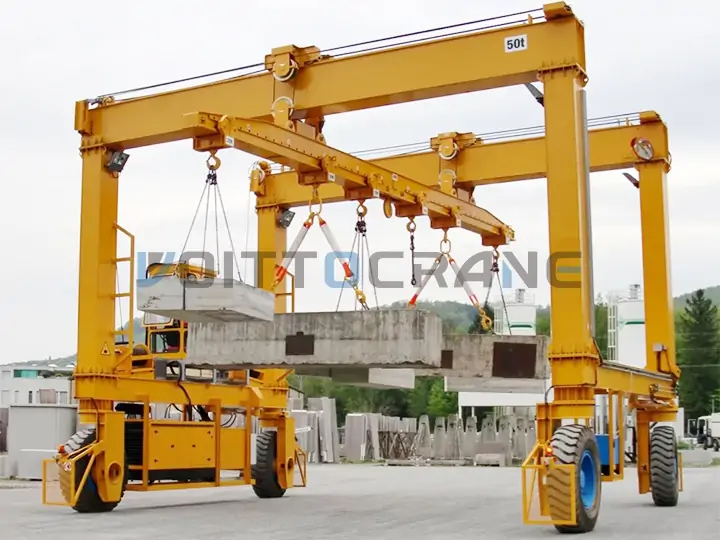
3. Rubber-Tired Gantry Cranes (RTG)
A tire blowout can cause the load to shift to the remaining wheels and cause the chassis to tilt toward the side where the tire failed. The evaluation should include the following: monitoring tire pressure, ensuring uniform tire wear, and verifying stability under “single-tire failure” conditions.
In both 90° steering mode and swing (circular) steering mode, proper alignment of the hydraulic steering system is critical. If the steering cylinders are not properly aligned, it can lead to tire wear (friction), cause the crane to veer off course while traveling, and subject the wheel assemblies to lateral loads. After any hydraulic system maintenance, the steering sensors must be calibrated, and the equipment’s ability to travel in a straight line must be verified.
Ground bearing pressure equals the wheel load divided by the tire’s contact area. An RTG crane under load concentrates pressure beneath each tire. Road surfaces originally designed to withstand truck traffic may become damaged under repeated passage by the crane. Inspectors should request wheel load data during the specification phase and use it to verify the suitability of the yard pavement.
Applying the Hierarchy of Controls: Upgrading Hardware to Eliminate Human Error
In crane safety management, the hierarchy of control measures is well-founded: engineering controls take precedence over administrative controls. Warning signs, floor markings, and operator vigilance all rely on human attention. However, during long work shifts, human attention inevitably wanes. In contrast, hardware interlocks never experience fatigue. Selecting appropriate control measures during the procurement phase can fundamentally reduce the risk level in the risk matrix, eliminating the need to rely on front-line employees to maintain a high level of vigilance every day to ensure safety.
- Laser/ultrasonic collision avoidance systems, area scanners, and rail obstacle removal devices: Designed to meet the collision avoidance needs of rail-mounted gantry cranes, area scanners trigger deceleration or a stop when personnel or vehicles enter hazardous zones. Rail obstacle removal devices physically clear obstacles from the rails at wheel height.
- Variable Frequency Drive (VFD)-Based Closed-Loop Alignment and Anti-Sway System: This system is responsible for correcting the gantry crane’s alignment during operation. Encoders installed on both side legs assist the drive system in correcting alignment before the crane becomes jammed on the track. The anti-sway control function prevents the suspended load from colliding with the crane’s support columns.
- Two-stage wind safety protection system: To meet the wind protection requirements for outdoor gantry cranes, an anemometer triggers audible and visual alarms when wind speeds reach Beaufort Scale 5 (approximately 8–10.7 meters per second). When wind speeds reach Beaufort Scale 6 or higher (10.8 meters per second or higher), the system automatically cuts off the power supply, activates the electro-hydraulic rail clamps, and allows the operator to insert mechanical wind-proof anchoring pins.
- Industrial-Grade Wireless Remote Control: Operators can move outside the hazardous ground area (crushing zone) and remain outside the load’s fall radius while ensuring a clear view of the crane’s path of travel.
Conclusión
An effective gantry crane risk assessment focuses on where the crane meets the ground and the environment, not only on the hook in the air. Sill beam crushing, caster collapse, wind runaway, leg skewing, and ground-level power hazards do not exist on a bridge crane, so a copied bridge crane assessment cannot control them. Eight scored hazards, matched to engineering controls, give auditors and operators a record that reflects the actual machine.
Ready to specify it right? EHS managers, plant engineers, and procurement teams can contact Voitto Crane for custom-engineered portable, semi-gantry, RMG, or RTG cranes built with OSHA, CE, and ASME safety redundancies. For gantry crane solutions, please póngase en contacto con VOITTO Crane.

Alan
Especialista en Soluciones de Grúas · Voitto Crane
Especializados en soluciones de exportación de grúas puente, grúas pórtico, grúas de pluma, grúas portuarias y grúas EOT. Más de 10 años ayudando a clientes internacionales con consultoría de preventa, selección de capacidad y configuraciones específicas para cada emplazamiento.
PREGUNTAS FRECUENTES
How does a gantry crane risk assessment differ from an overhead bridge crane risk assessment?
A gantry crane risk assessment centers on ground-level travel, freestanding stability, wind, caster or tire condition, and floor-level power supply. A bridge crane assessment centers on the elevated runway and the suspended load path. Gantries share rigging and hoist hazards with bridge cranes but add crushing, tip-over, and skewing risks.
What is the highest-risk hazard on a portable workshop gantry crane?
Tip-over and caster collapse while moving under load. Sloped or cracked floors, unlocked swivel casters, and overloaded casters can destabilize the frame, and the load swings as the frame tilts. Swivel locks, correctly rated casters, and a surveyed floor reduce this risk most.
At what wind speed must outdoor gantry crane operations be stopped according to safety standards?
No single universal figure applies. The manufacturer’s rated maximum in-service wind speed governs. Many outdoor rail-mounted gantries stop at Beaufort 6 (10.8–13.8 m/s), with an alarm at Beaufort 5. Once stopped, the crane should be parked, clamped, and pinned for storm conditions.
How do engineering controls prevent ground-level gantry crane collisions in busy yards?
Laser or ultrasonic zone scanners detect people and vehicles in the travel path and slow or stop the crane automatically. Rail sweeps clear the track at wheel height, and beacons with audible alarms warn bystanders. These controls act without depending on operator attention.
When must a gantry crane risk assessment be updated or re-evaluated?
Update it after any modification, relocation, change in lifted loads or lifting tasks, foundation or rail repair, incident or near miss, or change in site traffic layout or applicable regulations. Review it on a fixed schedule as well, at least annually in most safety management systems.


 English
 Español
 Português
 العربية
 Français
 Русский