Portador a horcajadas El mantenimiento es el programa estructurado de trabajo preventivo, predictivo y correctivo aplicado al sistema de elevación hidráulico, el separador, el conjunto de neumáticos y ruedas, el bastidor estructural y el sistema eléctrico/de control de una grúa pórtico. Actualmente, no existen normas internacionales específicas para los diversos subsistemas de las grúas pórtico que prescriban intervalos de mantenimiento específicos. El mantenimiento de una grúa pórtico se rige principalmente por los principios generales de inspección y los manuales de servicio del fabricante del equipo original (OEM).


En la práctica, los equipos de compras y mantenimiento suelen aplicar directamente los programas de mantenimiento de las grúas puente para gestionar la flota de carretillas pórtico, lo cual es un error común: las carretillas pórtico integran un mecanismo de elevación con un tren de rodaje móvil y neumáticos, y sus características de desgaste son más similares a las de la maquinaria pesada móvil que a las de las grúas puente fijas. Por lo tanto, los planes de mantenimiento deben tener en cuenta ambas características. A continuación, este artículo le proporcionará una lista de verificación clave para el mantenimiento de las carretillas pórtico, programas de mantenimiento y consejos prácticos.
- 1 Fundamentos del mantenimiento de grúas pórtico: definición y alcance de la inspección.
- 2 Mantenimiento a nivel de componentes: Sistemas de pórticos para carretillas elevadoras y puntos de desgaste
- 3 Cómo funciona una grúa pórtico y por qué el ciclo de trabajo determina los intervalos de mantenimiento.
- 4 Lista de verificación de procedimientos del operador y mantenimiento preventivo
- 5 Solución de problemas comunes en grúas pórtico
- 6 Conclusión
- 7 Fabricante y proveedor de grúas pórtico
-
8
PREGUNTAS FRECUENTES
- 8.1 ¿Con qué frecuencia se debe cambiar el aceite hidráulico de una grúa pórtico?
- 8.2 ¿Qué causa el desgaste irregular de los neumáticos en un transportador de pórticos?
- 8.3 ¿Es obligatoria la inspección estructural anual de una grúa pórtico para contenedores?
- 8.4 ¿Se puede aplicar una misma tabla de intervalos de mantenimiento preventivo a diferentes terminales?
Fundamentos del mantenimiento de grúas pórtico: definición y alcance de la inspección.
Esta sección define los tres tipos de mantenimiento que componen el plan de mantenimiento preventivo para las grúas pórtico portacontenedores: mantenimiento preventivo, mantenimiento basado en la condición y mantenimiento correctivo, y describe cómo se utilizan las clasificaciones organizativas para establecer intervalos de inspección de referencia.
Definición: Tres categorías de mantenimiento
El mantenimiento de las carretillas pórtico se divide en tres categorías que suelen generar confusión durante las negociaciones de adquisición. El mantenimiento preventivo se basa en el tiempo calendario o las horas de funcionamiento y debe realizarse independientemente del estado real del equipo. El mantenimiento predictivo, por otro lado, se basa en parámetros de monitorización específicos (como el recuento de partículas de aceite, la profundidad de la banda de rodadura de los neumáticos o la caída de presión hidráulica). Cuando un parámetro supera un umbral preestablecido, se activa la acción de mantenimiento correspondiente. El mantenimiento correctivo se realiza tras la detección de una avería.
La inspección es una categoría de actividad independiente: es responsable de generar los datos necesarios para el mantenimiento predictivo, que abarca las comprobaciones visuales y funcionales diarias realizadas por los operarios, así como las inspecciones estructurales periódicas y las pruebas no destructivas (END) llevadas a cabo por los técnicos.
Principio: Por qué la clasificación establece la base
La clasificación de la inspección es importante porque establece el intervalo de referencia. En la clasificación de mecanismos, la clase de servicio asignada a los mecanismos de elevación y desplazamiento determina el nivel de mantenimiento preventivo de referencia del fabricante, que suele estar estructurado en etapas como 250, 500, 1000 y 2000 horas de funcionamiento. Los intervalos más cortos abarcan los cambios de fluidos y filtros, y los intervalos más largos, la revisión estructural y del sistema de transmisión.
Condiciones aplicables
Este marco de clasificación está diseñado específicamente para condiciones de operación en las que los equipos de manipulación de materiales realizan operaciones de elevación y transporte de carga. Si el equipo se utiliza únicamente para mover palés vacíos, su clase de servicio es inferior. En estas condiciones de operación, el equipo puede requerir intervalos de mantenimiento más prolongados en comparación con equipos similares utilizados para operaciones de apilamiento continuo.
Límite y excepción
La excepción a la programación basada en horas es la inspección de grietas estructurales en las juntas soldadas de soporte de carga y en el bastidor del separador. Independientemente de la clase de servicio o las horas de funcionamiento, los técnicos suelen programar esta inspección según un calendario anual fijo (o más corto, en un astillero naval con alta corrosión), ya que la iniciación de grietas por fatiga se relaciona con el número de ciclos de carga y la exposición ambiental, en lugar de solo con las horas de funcionamiento del motor o la bomba.
Mantenimiento a nivel de componentes: Sistemas de pórticos para carretillas elevadoras y puntos de desgaste
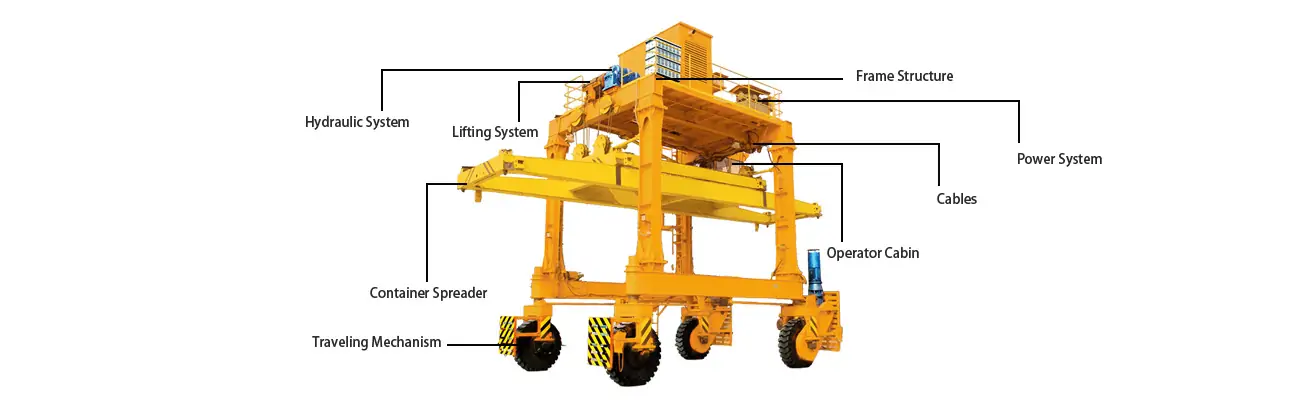
La mayor parte del tiempo de inactividad de las grúas pórtico para contenedores se debe a los siguientes seis subsistemas: circuitos hidráulicos de elevación y dirección, conjuntos de neumáticos y ruedas, accesorios de elevación y mecanismos de bloqueo giratorio, bastidores y bogies estructurales, sistemas eléctricos y de control, y sistemas de frenado. Cada subsistema tiene sus propios modos de fallo primarios y métodos de inspección específicos, que se resumen a continuación.
| Sistema | Tiposcal PM Disparador | Modo de fallo primario | Método de inspección |
|---|---|---|---|
| Elevador/dirección hidráulico | 250–500 horas de funcionamiento (manual del fabricante) | Desgaste de los sellos, contaminación, deriva de la válvula de alivio | Manómetro en el puerto de prueba; recuento de partículas |
| Neumático y rueda | Umbral de profundidad de la banda de rodadura, por ejemplo, ≥2 mm en servicio de puerto. | Desgaste irregular debido a la desviación de la alineación | Medidor de banda de rodadura; comprobación de alineación de ruedas |
| Separador / cierre giratorio | Recuento cíclico o anual | Desgaste del actuador de bloqueo giratorio, distorsión del marco | Prueba funcional bajo carga nominal |
| Bastidor estructural / bogie | Calendario anual fijo | Agrietamiento por fatiga en las soldaduras | Visual + END (tinte penetrante o MT) |
| Eléctrico / control | Trimestral | Corrosión por contacto, daños en el aislamiento del cable | Prueba de continuidad/aislamiento |
| Sistema de frenado | Mensual a trimestral | Desgaste del revestimiento, fugas hidráulicas/neumáticas | Prueba de distancia de frenado/presión |
Punto de vista intuitivo inverso: el desgaste de los neumáticos no es el principal riesgo.
El desgaste de la banda de rodadura de los neumáticos hasta alcanzar el límite es un elemento de reemplazo conocido y presupuestado. Por lo tanto, el desgaste visible de la banda de rodadura no representa el modo de falla de mayor riesgo en este subsistema. El desgaste oculto en los cojinetes del cubo de la rueda y los parámetros de alineación a menudo provocan que el vehículo se desvíe hacia un lado mucho antes de que la profundidad de la banda de rodadura alcance un umbral crítico; dado que las inspecciones visuales rutinarias de la banda de rodadura no pueden detectar estos problemas, esta es la causa más común de tiempo de inactividad no planificado. Si un programa de mantenimiento solo verifica la profundidad de la banda de rodadura y descuida las mediciones regulares de la holgura de los cojinetes del cubo de la rueda, está inspeccionando la métrica incorrecta.
Límite de condición: Vida útil del sello hidráulico frente a la temperatura ambiente.
Las temperaturas ambiente de funcionamiento limitan la vida útil de los sellos hidráulicos. La vida útil de los sellos especificada por los fabricantes de equipos originales (OEM) se basa en rangos de temperatura ambiente específicos. Durante las operaciones en el muelle, donde las temperaturas de la cubierta o la superficie del patio superan con frecuencia estas condiciones de diseño, la degradación del rendimiento de los sellos se acelera. Por lo tanto, los equipos de mantenimiento deben acortar los intervalos de inspección de sellos y mangueras en consecuencia, en lugar de programar las inspecciones basándose únicamente en los valores nominales que figuran en los manuales del producto.
Cómo funciona una grúa pórtico y por qué el ciclo de trabajo determina los intervalos de mantenimiento.
Esta sección abarca el principio de funcionamiento de una grúa pórtico y explica por qué el número de ciclos de elevación, y no solo las horas de funcionamiento, debe determinar los intervalos de mantenimiento hidráulico y de los cables de acero.
Principio de funcionamiento
El operario controla la grúa pórtico para desplazarla sobre un contenedor, utiliza el dispositivo de elevación superior para sujetarlo, lo sube al bastidor de la grúa y, finalmente, lo coloca en un patio, un remolque o un vagón de ferrocarril. La función de elevación se logra mediante un cabrestante hidráulico o de cable instalado en el bastidor superior. La movilidad se consigue gracias a la dirección independiente de las ruedas, por lo que la alineación de estas y el estado de los neumáticos influyen directamente en la maniobrabilidad del vehículo y la estabilidad de la carga.
Principio: Recuento de ciclos frente a horas de funcionamiento
Este principio explica por qué programar el mantenimiento basándose únicamente en las horas de funcionamiento no es suficientemente completo. Dos máquinas de manipulación de materiales con el mismo número de horas de funcionamiento pueden presentar niveles de desgaste muy diferentes. Si una realiza muchos ciclos de elevación por hora durante operaciones intensivas de apilamiento, mientras que la otra dedica la mayor parte de su tiempo de funcionamiento a reposicionamientos poco frecuentes, sus condiciones de desgaste diferirán significativamente. Los componentes hidráulicos y los cables de acero son muy sensibles al número de ciclos de funcionamiento: el daño por fatiga y el desgaste de los sellos se acumulan con cada operación de carga y descarga, en lugar de depender únicamente del tiempo de funcionamiento acumulado del motor.
Condiciones aplicables
Un plan de mantenimiento ajustado al ciclo de trabajo se aplica principalmente a las operaciones de terminales o puertos con un alto número de ciclos de elevación por turno. Las operaciones en patios ferroviarios o de posicionamiento de baja frecuencia generalmente pueden seguir el intervalo horario/calendario base del fabricante sin ajustes, siempre que la terminal registre el número de elevaciones para confirmar esta suposición en lugar de asumirla por defecto.
Caso límite: Exposición a la corrosión costera
Incluso las grúas pórtico que operan a bajas frecuencias en entornos costeros corrosivos requieren inspecciones periódicas de sus conectores eléctricos y revestimientos estructurales, ya que la corrosión inducida por cloruros no está relacionada con el número de operaciones de elevación ni con las horas de funcionamiento.
Lista de verificación de procedimientos del operador y mantenimiento preventivo
Esta sección distingue entre las inspecciones previas al uso realizadas por el operador y el mantenimiento preventivo periódico (MP) realizado por el técnico, y proporciona criterios para garantizar la objetividad de los resultados de la inspección.
Las inspecciones previas al turno realizadas por el operador constituyen la primera línea de defensa, centrándose en comprobaciones funcionales y visuales en lugar de un diagnóstico exhaustivo de fallos. Los elementos estándar de la inspección previa al turno incluyen: respuesta del freno y recorrido del pedal; fugas visibles de fluido hidráulico en mangueras y vástagos de pistones de cilindros; estado y presión de los neumáticos; activación de los mecanismos de bloqueo de los accesorios de elevación y estado de las luces de advertencia; y respuesta de los controles para las funciones de dirección y elevación.
Cada elemento de inspección debe tener criterios claros de "fuera de tolerancia" para evitar depender de juicios subjetivos. Estos criterios deben basarse en el manual de operación del fabricante del equipo original (OEM), en lugar de decisiones improvisadas en el sitio. Algunos ejemplos incluyen el límite máximo de recorrido del pedal de freno o una caída específica en la presión hidráulica durante el ralentí. Los operadores son responsables de reportar anomalías, pero no de ajustar la configuración de las válvulas de alivio ni de reemplazar componentes hidráulicos, ya que estas tareas corresponden a técnicos de mantenimiento certificados.
La lista de verificación de inspección previa al turno del operador complementa —y de ninguna manera reemplaza— el mantenimiento preventivo periódico (MP) a nivel técnico mencionado anteriormente. Incluso si un dispositivo de manipulación de materiales supera todas las inspecciones previas al turno, es posible que haya alcanzado el intervalo de mantenimiento de 1000 horas para el reemplazo del elemento del filtro hidráulico. Estos dos niveles de mecanismos de inspección se centran en prioridades diferentes: el primero se centra en "si el funcionamiento actual es seguro", mientras que el segundo se centra en "si los componentes han alcanzado sus hitos de vida útil previstos".“


Solución de problemas comunes en grúas pórtico
| Síntoma | Causa probable | Paso de verificación |
|---|---|---|
| Deslizamiento del esparcidor bajo carga | Derivación interna del cilindro o junta desgastada | Prueba de presión en el puerto de prueba según las especificaciones del fabricante. |
| Desgaste irregular o rápido de los neumáticos | Alineación de las ruedas o juego de los rodamientos, no solo la antigüedad de la banda de rodadura. | Verificación de alineación y medición de la holgura de los cojinetes |
| Retraso en la dirección o respuesta retardada | Aire en el circuito hidráulico o desgaste de la válvula | Circuito de purga, tiempo de respuesta de la prueba |
| Disparo por sobrecarga del polipasto durante cargas normales | Desviación o descalibración de la celda de carga | Recalibrar con respecto al peso de prueba certificado |
| Código de avería de control intermitente | Conector suelto o corroído, no siempre indica una falla del módulo. | Prueba de continuidad/aislamiento antes de reemplazar la pieza. |
El error de diagnóstico más común se produce cuando los usuarios reemplazan componentes señalados por el sistema sin verificar previamente la ruta de la señal. Por ejemplo, en el caso de códigos de falla de control intermitentes, el problema suele deberse a conectores corroídos en lugar de a un módulo de control defectuoso. Si el personal de mantenimiento realiza primero una prueba de continuidad, puede evitar reemplazos innecesarios de módulos y el consiguiente tiempo de inactividad.
Conclusión
Dado que las grúas pórtico combinan una gran capacidad de elevación con un sistema de vehículo móvil, sus estrategias de mantenimiento deben considerar exhaustivamente el rendimiento hidráulico, el estado de los neumáticos y las ruedas, la fatiga estructural, la fiabilidad del sistema eléctrico y las condiciones de funcionamiento reales. Al implementar planes de mantenimiento estandarizados basados en las recomendaciones del fabricante de equipo original (OEM), los datos de inspección y las condiciones de funcionamiento reales, los operadores pueden reducir el tiempo de inactividad no planificado, controlar los costos operativos y mejorar la eficiencia operativa general de la terminal.
Antes de adquirir o gestionar una flota de grúas pórtico, el personal de compras debe colaborar con fabricantes cualificados para obtener planes de mantenimiento detallados, documentación técnica y asistencia técnica a largo plazo. Un plan de mantenimiento científicamente sólido y razonable no solo prolonga la vida útil del equipo, sino que también garantiza operaciones de manipulación de contenedores seguras y eficientes durante todo su ciclo de vida.
Fabricante y proveedor de grúas pórtico
VOITTO Crane es un fabricante y proveedor profesional de grúas pórtico. Para las terminales que evalúan la compra de grúas pórtico o contratos de servicio, el equipo de ingeniería de VOITTO puede ajustar las especificaciones del equipo y proporcionar soluciones personalizadas según las condiciones operativas reales del usuario.
Si necesita una solución para su proyecto de grúa pórtico para contenedores, no dude en contactarnos. Contacto.

Alan
Especialista en Soluciones de Grúas · Voitto Crane
Especializada en soluciones de exportación de grúas puente, grúas pórtico, grúas pluma, grúas portuarias y grúas EOT. Más de 10 años ayudando a clientes de todo el mundo con asesoramiento preventa, selección de capacidad y configuraciones específicas para cada emplazamiento.
PREGUNTAS FRECUENTES
¿Con qué frecuencia se debe cambiar el aceite hidráulico de una grúa pórtico?
No existe una cifra universal. El manual del fabricante establece un rango de referencia (generalmente unos pocos cientos de horas de funcionamiento para los filtros y más para los cambios de aceite completos), y el equipo de mantenimiento debe acortar ese rango cuando la temperatura ambiente, el polvo o la densidad de ciclos de elevación superen las suposiciones de diseño del fabricante.
¿Qué causa el desgaste irregular de los neumáticos en un transportador de pórticos?
El desgaste de la banda de rodadura suele ser un síntoma, no la causa principal. La desalineación de las ruedas o la holgura de los cojinetes son las causas subyacentes más comunes, por lo que una inspección centrada únicamente en la banda de rodadura puede pasar por alto el problema hasta que este se manifieste en la dirección o la estabilidad.
¿Es obligatoria la inspección estructural anual de una grúa pórtico para contenedores?
La inspección de soldaduras estructurales y bastidores se realiza normalmente según un calendario anual fijo, independientemente de las horas de funcionamiento, ya que la fisuración por fatiga refleja los ciclos de carga y la exposición a la corrosión, en lugar de las horas de motor. En zonas costeras con alta corrosión, puede ser necesario un intervalo más corto.
¿Se puede aplicar una misma tabla de intervalos de mantenimiento preventivo a diferentes terminales?
Esto podría no ser fiable. Los programas de mantenimiento diseñados para las condiciones operativas y el entorno específicos de una terminal en particular pueden resultar en un mantenimiento insuficiente o excesivo si se aplican a grupos de equipos con diferentes densidades de ciclos de elevación o niveles de exposición a la corrosión. Los parámetros de referencia proporcionados por los proveedores de grúas pórtico deben servir como punto de partida y ajustarse en función de los datos operativos reales en la planta.


 English
  Español
  Português
  العربية
  Français
  Русский