Crane remote control systems are control devices used for remotely or locally operating a crane. The crane remote control systems transmit operating commands to the crane control system via pendant control, or Radio means, enabling the equipment to perform lifting, lowering, traveling, slewing, and luffing movements.
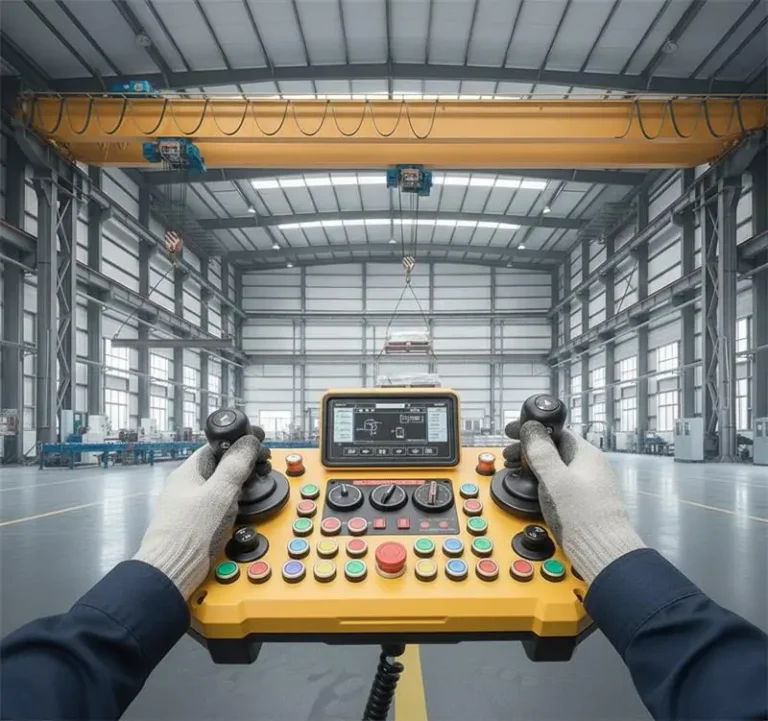
Crane remote control systems are control devices used for remotely or locally operating a crane. The crane remote control systems transmit operating commands to the crane control system via pendant control, or Radio means, enabling the equipment to perform lifting, lowering, traveling, slewing, and luffing movements. This crane remote control is flexible to operate, rainproof, and dustproof, featuring large buttons that ensure even operators wearing thick gloves can use it without difficulty.
Crane Push Button Remote
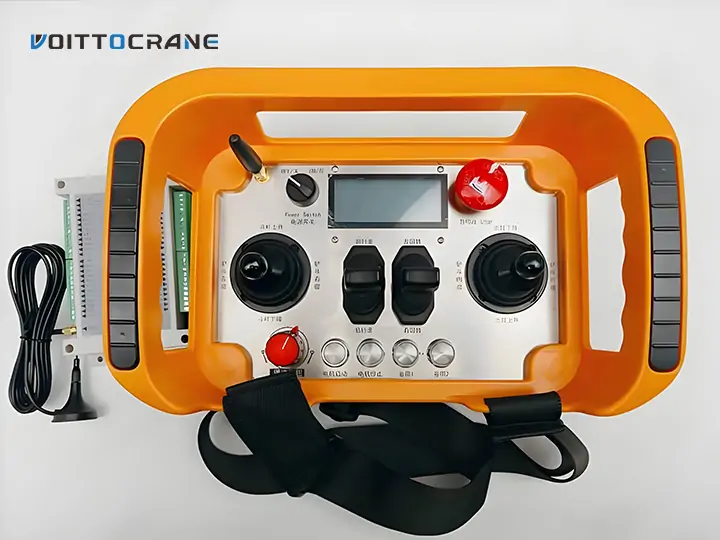
Crane Joystick Controls
VOITTO cranes can customizing with various types of crane remote controls, according to the customer’s technical requirements, such as wireless crane remote control, crane pendant control, and explosion-proof type crane remote control designs for special environments.
There are two primary categories of industrial remote controllers for cranes based on their operation method and control method. One type is a crane push button remote, and the other is a crane joystick controls. Below, I will explain the characteristics of these two types of crane remote controls.
Crane Push Button Remote
Crane push button remote use buttons as the primary method of operation and are available in single-speed or dual-speed versions. Operators can perform lifting, lowering, forward and backward movement, left and right travel, and stopping by pressing the corresponding function buttons. Button-type remote controls have an intuitive and easy-to-use operating logic, making them suitable for applications where moderate operating precision is required.
Notice: Users can choose between a wired or wireless version of the crane button remote control, depending on their usage needs.
Crane joystick controls systems use a joystick as the primary input method, with the operator pushing or tilting the joystick to control the equipment. Compared to push button remote controls, joystick-type remote controls enable smoother starting and stopping, and more precise speed adjustment, making them suitable for applications requiring high operational accuracy, coordination, and work efficiency. The joystick-style crane controller offers a more premium feel. Typically, users employ it to control large lifting equipment, port cranes, and metallurgical cranes.
Notice: Users can choose between a wired or wireless version of the crane joystick controls, depending on their usage needs.
8A sealed relay output (with AC 250V/10A relays, 10A fuse)
Control Distance
Up to 350m
Safety Code
32 bits (4.3 billion)
Temperature Range
-40℃~85℃
Note: Customization is available.
Explosion-proof Type Crane Remote Control
This Explosion-proof crane remote controls is designed specifically for flammable and explosive hazardous environments. Their casing, circuitry, and wireless modules all comply with international explosion-proof standards, effectively preventing electrical sparks or high temperatures from triggering explosions. Users utilize explosion-proof crane remote controls in petrochemical plants, natural gas facilities, coal mines, dusty environments, and hazardous materials storage facilities. Typically, the explosion-proof rating of the remote control is determined by the equipment it is used with.
8A sealed relay output (with AC 250V/10A relays, 10A fuse)
Control Distance
Up to 350m
Safety Code
32 bits (4.3 billion)
Temperature Range
-40℃~85℃
Explosion-proof Class
ATEX、IECEx
Note: Customization is available.
Features of Crane Remote Control Systems
Remote Control: Operators can control the crane from a safe location with a clear view.
High Safety: This equipment is equipped with an emergency stop button, loss-of-control protection, automatic shutdown upon signal interruption, and anti-misoperation logic.
Anti-interference: The crane remote control manufacturer uses industrial-grade communication technology to effectively avoid co-channel interference and false triggers.
High Efficiency: Eliminates the limitations of the driver’s cab and control cables, reducing personnel movement and communication costs.
Reasonable Design: Lightweight, with a reasonable button or joystick layout, supporting single-hand or two-hand operation.
Diverse Types: VOITTO Cranes offers crane push button remote type, crane joystick controls type, crane pendant control, crane radio remote control, and explosion-proof models crane remote control.
Strong Adaptability: The equipment features dustproof, waterproof, shockproof, and high/low-temperature resistance.
Easy Maintenance: The remote control is highly compatible with the crane control system, easy to install, and has low maintenance costs.
Customizable: Users can customize the number of buttons, function logic, communication distance, and safety level according to the crane’s functions.
Wide Range of Applications: The equipment can be used on bridge cranes, gantry cranes, jib cranes, port cranes, and in metallurgical and explosion-proof environments.
Crane Remote Control Price
Model
Control Distance
Price
Push Button Remote
100 m ( Supported Customization)
$25 ~ $500, depending on Configuration
Joystick Controls
350 m ( Supported Customization)
$100 ~ $1000, depending on Configuration
Explosion-proof Type Crane Remote Control
350 m ( Supported Customization)
$100 ~ $1000, depending on Configuration
Note: The prices above are for reference only.
Remote Control Crane for Sale
VOITTO is a professional crane parts supplier in the customized design and manufacturing of crane remote control systems. We can design the crane remote control according to your specific needs, such as the working environment, product materials, control distance, and wired or wireless version etc.
3-5 years warranty and free replacement for non-manufacturing defects.
24/7 online support and on-site assistance for crane issues.
FAQ
Engineered Strength, Global Crane Supplier
What’s included in your after-sales service?
We offer comprehensive after-sales service, including regular maintenance, rapid technical support, and spare parts supply. The standard warranty period is 1 year, with options for extension based on your needs.
What’s the delivery time for an overseas order?
Transit time varies depending on many factors, including the destination of the goods, distance, shipping method and shipping service provider, etc. Generally speaking, international shipping may take about a month.
Get In Touch
Please feel free to leave a message. We will reply in 24 hours.
Please specify your requirement by referring to the following aspects:
Which crane product do you need?
What is the maximum lifting capacity (in tons) required for your project?
Could you specify the lifting height (in meters) needed?
Can you provide details on the working environment, such as ground conditions, space limitations, and any obstacles?
What is the expected frequency of use and the duration of the project?





 English
  Español
  Português
  العربية
  Français
  Русский