VOITTO steel mill cranes are specifically designed for production environments. Whether for ladle transport, continuous casting, furnace charging, or coil handling, each crane is custom-configured based on your plant’s actual operating cycles, facility layout, and process flow.
A steel mill crane is a heavy-duty lifting device specifically designed for the demanding conditions of steelmaking facilities, where typical operating environments involve sustained high temperatures, heavy loads, and frequent work cycles. Unlike general-purpose industrial overhead cranes, steel mill cranes are specifically engineered to handle tasks such as molten steel ladles, continuous casting operations, furnace charging, and the transfer of finished steel products.
These cranes typically have a duty class of A7–A8 to meet the demands of continuous, heavy-duty operations in steelmaking. Their structural components, hoisting mechanisms, and electrical systems are all manufactured from high-temperature-resistant materials, and they are equipped with an anti-sway control system and multiple overload protection features. The steel mill cranes designed by VOITTO have lifting capacities ranging from 5 to 500 metric tons, spans from 7.5 to 31.5 meters, and lifting heights from 6 to 30 meters. Each configuration is tailored to the specific layout, production processes, and material handling requirements of the plant.
Steel Mill Crane Description
A steel mill crane is a heavy-duty lifting device specifically designed for the demanding operating conditions of steel production facilities. They are capable of handling raw materials, molten metal, and finished steel products with precision and reliability. As critical equipment in steel production, these cranes are engineered to withstand high temperatures, heavy loads, and the demands of handling finished products and are characterized by their heat resistance, safety, reliability, and intelligent features.
Ladle Crane
Grab Overhead Crane
Given the wide variety of equipment types available, users must select the appropriate model based on their specific application requirements to ensure that production operations are both efficient and safe. The following section will introduce the different types and specifications of steel mill cranes, as well as the specialized designs of their key components.
Types Of Steel Mill Crane
Steel mill cranes come in various types and sizes, depending on the specific requirements of the steel mill. The most common types of steel mill cranes are overhead cranes and gantry cranes. Each type has its unique features and benefits and is designed for specific applications within the mill.
QD Double Girder Overhead Crane
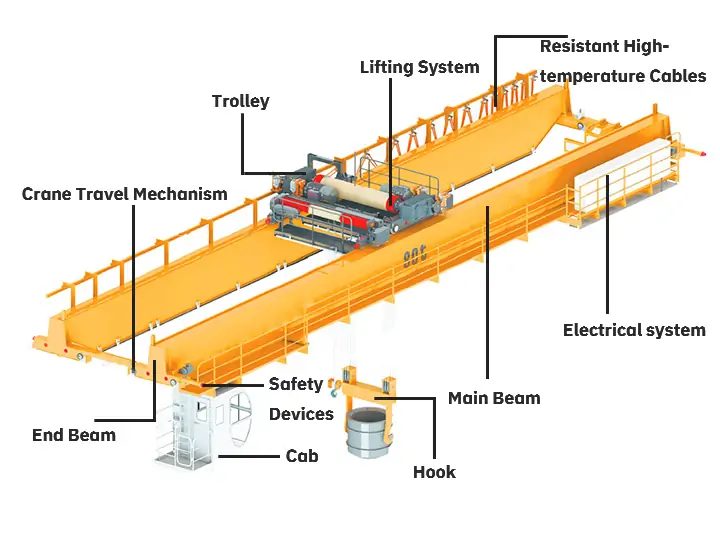
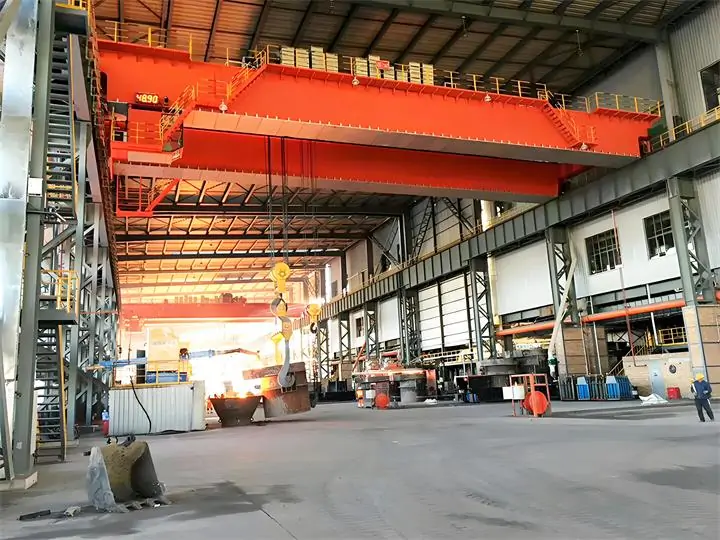
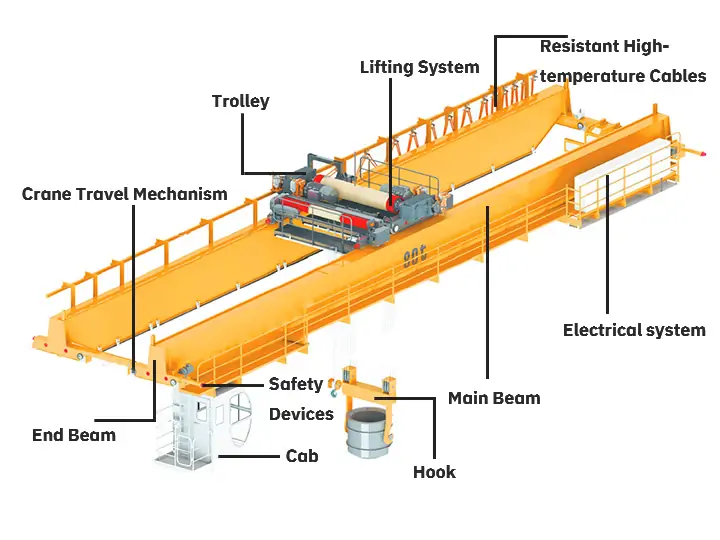
Steel mill overhead cranes are primarily used in steel mills for material transfer within workshops, lifting molten metal, and heavy equipment maintenance. They feature a sturdy double-beam structure, high load capacity, smooth and precise operation, and are equipped with high-temperature resistance, anti-magnetic interference, and multiple safety protection systems.
A grab bridge crane is suitable for metallurgy, building materials, the chemical industry, coal, and other industries. It is engaged in the loading and unloading of ore, slag, and other bulk materials in the workshop, warehouse, or open air. For the client facility, the VOITTO crane manufacturer can provide you with a single-girder grab crane or a double-girder grab crane.
Electromagnetic overhead cranes are equipped with removable electromagnets and are suitable for handling magnetic materials such as steel plates and scrap steel, offering high loading and unloading efficiency. They are mainly used in steel mill rolling production lines, finished product warehouses, stamping workshops, etc.
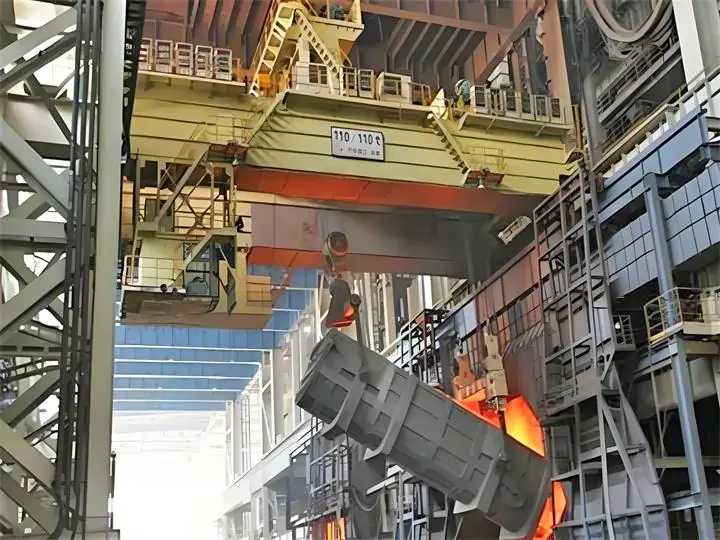
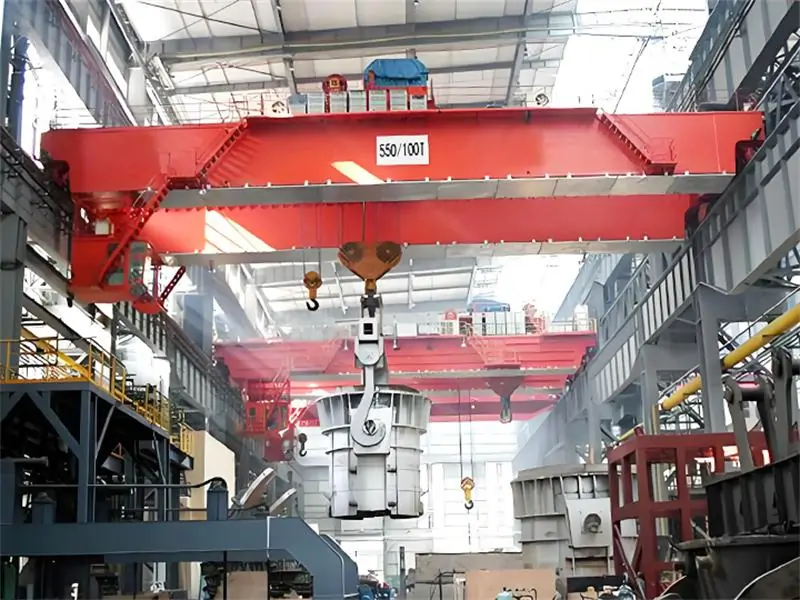
As a key piece of equipment in steelmaking and continuous casting processes, the overhead ladle crane is primarily used in steelmaking shops to lift ladles containing molten steel near refining furnaces or continuous casting machines; it is also suitable for use in foundries to handle molten metal and other high-temperature materials.
Casting overhead cranes are mainly used to deliver molten iron to converters or lift molten steel to the continuous casting ladle turret, etc. The overall structure can be divided into double girders with double tracks, four girders with four tracks, four beams with six tracks, and other types.
LD-type single-girder overhead cranes are primarily used in steel mills to handle raw materials and transport materials during the production process. These cranes feature a compact design and operate efficiently, making them ideal for use in small steel mills.
Typically, steel mill workers operate gantry cranes for tasks such as transporting raw materials and storing finished products. This equipment is characterized by its large span, high load-bearing capacity, resistance to high temperatures, and dust- and corrosion-resistant properties.
Floor-mounted slewing jib cranes are widely used in steel mills for light material handling, production support, and equipment maintenance. Their advantages include high space utilization, precise positioning, and good environmental adaptability.
Steel mill cranes are widely used in the five core processes of steelmaking: ladle transfer, continuous casting, furnace charging, coil handling, and scrap yard operations. Each application has different requirements for the cranes.
Application
Working Environment
Lifting Requirements
Why It Fits
Ladle Handling Crane
Steelmaking workshop near refining furnaces and continuous casting machines; sustained radiant heat.
Heavy-duty, A7-A8 cycle; precise low-speed positioning for controlled pouring.
Heat-resistant build plus anti-sway and fine-hoist control for safe, repeatable molten steel transport.
Casting Crane
Continuous casting bay, servicing converters and the casting ladle turret.
High capacity up to 500 tons; double- or four-girder configurations.
Reinforced structure and A7-A8 rating sustain uninterrupted, high-load casting cycles.
Charging Crane
Furnace charging area; radiant heat and dust from raw material handling.
Moves scrap and raw-material buckets through high-frequency cycles.
Dust-resistant components and automated positioning cut manual repositioning.
Coil Handling Crane
Finished product warehouse, rolling line, stamping workshop.
Precise, gentle handling of coil loads via C-hook or electromagnetic attachment.
Fine positioning and electromagnetic lifting protect coil surface finish.
Scrap Handling Crane
Scrap yard; outdoor or semi-open bulk material areas.
Grab bucket or electromagnetic attachment; high cycle frequency, weather exposure.
Corrosion-resistant components and multi-flap grab handle irregular scrap efficiently.
Intelligent Features Of Steel Mill Crane
Steel mill cranes can be equipped with a variety of smart features to improve safety, efficiency, and productivity. Some of these smart features include:
Intelligent Control System
Technical Explanation: PLC-based control architecture manages hoisting, trolley, and bridge motion through variable-frequency drives, with remote monitoring interfaces that report crane status and load data in real time to a control room or handheld device.
Customer Benefit: Reduces operator fatigue and positioning error across repetitive ladle and casting cycles.
Anti-Sway Technology
Technical Principle: The electronic anti-sway control system suppresses load sway during operation by adjusting the acceleration and deceleration characteristics of the trolley. Combined with load sensors, this system ensures stability under varying load conditions.
Customer Benefits: This feature effectively improves positioning accuracy at the melting furnace and pouring stations, while reducing the risk of material splashing or collisions with the plant’s fixed structures.
Smart Safety Protection
Technical Description: The integrated safety system combines overload protection, upper and lower limit switches, an emergency stop circuit, and anti-collision sensors for shared-track cranes, supplemented by redundant braking and load-holding protection in the event of a power failure.
Customer Benefits: It effectively ensures the safety of personnel and equipment in workshops where molten metal is handled and mechanical failures are absolutely unacceptable.
Condition Monitoring System
Technical Explanation: Sensors on wire ropes, brakes, motors, and structural connections continuously report wear indicators and operating temperatures to a central monitoring platform, with historical trend data flagging components approaching maintenance thresholds.
Customer Benefits: The purpose of this component is to shift the maintenance approach from reactive to preventive, thereby reducing unplanned downtime on the continuous casting line.
Automated Operation Capability
Technical Description: The semi-automatic positioning program uses preset coordinates and sensor feedback to correct the path, enabling the crane to perform repeatable sequences of operations.
Customer Benefits: On high-throughput production lines, this feature improves the consistency of operation cycles.
High Temperature Adaptation
Technical Description: For the motor and control panel, heat-resistant materials, an insulated enclosure, and cooling measures are employed to ensure the equipment can operate continuously and stably in environments exposed to radiant heat from molten steel and furnace areas.
Customer Benefits: The equipment maintains reliable operation and extends component service life even in harsh environments that would otherwise compromise the performance of standard industrial cranes.
Precision Load Handling
Technical Description: Fine-tuned lifting speed control and micro-positioning modes enable operators to achieve the precise positioning required for ladle pouring in continuous casting machines and accurate alignment during the charging process; at the same time, the load-sensing feedback mechanism supports controlled, incremental movement at critical process points.
Customer Benefits: This is particularly important in the steelmaking process, as it effectively reduces process fluctuations and material loss.
Specification
Type
QD Steel Mill Overhead Crane
Loading capacity
5 ~ 500 tons
Lifting height
7.5 ~ 31.5 m
Lifting speed
Varies with lifting capacity
Span
7.5 ~ 31.5 m
Lifting mechanism
Winch trolley
Working class
A7/A8
Working temperature
-20 ~ +60 ℃
Power supply
AC-3Phase-220//230380/400/415/440V-50/60Hz
Control voltage
DC-36 / 48V
Motor protection class
IP54 IP55 IP65
Control way
Cabin, wireless remote, pendant push button
Safety device
Buffer,current overload protection,overload device, power failure protection
Application area
Factory, steel mill, workshop, warehouse, power station, logstic,etc.
Painting color
Yellow, Red or Customzied
Customization Steel Mill Crane
VOITTO Crane specializes in the custom design and manufacturing of steel mill cranes.
Load Capacity: 5 ~ 500 tons or More
Span: 7.5 ~ 31.5 m
Lifting Height: 6 ~ 30 m
Steel Mill Crane Type and Configuration and Explosion-proof Standard
Control Mode: Cab or Remote, or Automation
Special Lifting Devices: Hook or Ladle Hook or Electromagnetic Chuck or Slab Clamp, or Grab Bucket
Power Source: 3-Phase A.C. 380V 50Hz
Steel Mills Overhead Bridge Crane Manufacturer
VOITTO is a leading enterprise specializing in the customized design and manufacturing of steel mill cranes. We deeply integrate the harsh working environment of the steel industry and provide a full range of customized solutions centered on professional engineering design.
If you have any specific requirements or need further assistance, please feel free to contact our team of experts, who will provide you with custom solutions and professional support.
Specialized in Overhead Crane, Gantry Crane, Jib Crane, Port Crane & EOT Crane export solutions. 10+ years helping global clients with pre-sales consultation, capacity selection and site-specific configurations.
Steel mills typically use overhead cranes (including configurations for molten steel ladles, casting, charging, and coil handling) as well as gantry cranes for yard operations.
What duty class is required for steel mill cranes?
Steel mill cranes typically require A7 or A8 working duty classification under FEM 1.001 and ISO 4301, reflecting continuous, heavy-service operation. Duty class affects structural design and component lifespan and should match your plant’s actual cycle frequency.
Can steel mill cranes handle molten steel?
Yes. Ladle cranes and casting cranes are specifically designed for transporting molten steel and feature heat-resistant structural components, anti-sway control systems, and precise low-speed hoisting capabilities.
How much does a steel mill crane cost?
Pricing depends on lifting capacity, span, duty class, and application-specific features such as heat resistance or electromagnetic attachments. Share your load and site requirements, and our engineering team will provide a project-specific quotation.
What safety systems are required?
Required safety features include overload protection, upper and lower limit switches, emergency stop circuits, anti-collision devices between cranes on shared runways, and power-failure load-holding protection.
Qualification and Honor
Engineered Strength, Global Crane Supplier
service
Exclusive and Considerable, Customer First.
01
Reliable and Customized Solutions
Our pre-sale team provides consultations, tailoring solutions to your needs and environment.
Offer customization options for lifting capacity, span and lifting height etc. to meet specific needs.
02
Updated Production Process
Real-Time Progress Updates: Weekly reports and PM communication.
3-5 years warranty and free replacement for non-manufacturing defects.
24/7 online support and on-site assistance for crane issues.
FAQ
Engineered Strength, Global Crane Supplier
How do I choose the right overhead crane for my facility?
A: Consider these factors:
Load Capacity (Max weight to lift, including rigging).
Span Width (Distance between runways).
Lifting Height (Hook path elevation).
Duty Cycle (Frequency of use: light, moderate, or severe service).
Power Supply (Electric, manual, or hybrid options).
For more detailed answers, please contact our engineers as soon as possible. Our engineers will be based on your use of the scene to give you the most professional program for you to choose!
Can you customize an overhead crane to my specific needs?
Yes, we can customize an overhead crane to meet your specific business needs. We can design and manufacture complete crane systems or upgrade existing systems.
What’s included in your after-sales service?
We offer comprehensive after-sales service, including regular maintenance, rapid technical support, and spare parts supply. The standard warranty period is 1 year, with options for extension based on your needs.
What’s the delivery time for an overseas order?
Transit time varies depending on many factors, including the destination of the goods, distance, shipping method and shipping service provider, etc. Generally speaking, international shipping may take about a month.
Get In Touch
Please feel free to leave a message. We will reply in 24 hours.
Please specify your requirement by referring to the following aspects:
Which crane product do you need?
What is the maximum lifting capacity (in tons) required for your project?
Could you specify the lifting height (in meters) needed?
Can you provide details on the working environment, such as ground conditions, space limitations, and any obstacles?
What is the expected frequency of use and the duration of the project?







 English
  Español
  Português
  العربية
  Français
  Русский