
Overhead crane lead time from a Chinese manufacturer typically runs 20–70 days to complete production, then adds 1–6 weeks of sea freight and roughly 2–3 weeks for port clearance and inland delivery. Standard single girder units sit at the short end. Customized double girder and heavy-duty cranes sit at the long end.
The problem is that two suppliers can quote “30 days” and mean different things. One counts from drawing approval, the other from the signed contract. One includes pre-shipment testing, the other stops at the factory gate. A buyer comparing quotes on the headline number alone ends up comparing different clocks.
This guide breaks the overhead crane lead time into the stages that actually add up, shows typical ranges for each crane type Voitto Crane builds, and lists the documents and questions that turn a vague delivery promise into a schedule you can plan around.
- 1 Quick Reference: Typical Production Time by Crane Type
- 2 What Overhead Crane Lead Time Actually Includes
- 3 Overhead Crane Lead Time by Crane Type
- 4 What Stretches Overhead Crane Lead Time
- 5 Certifications, Documents and Inspection Time
- 6 From Factory Gate to First Lift
- 7 Conclusão
-
8
FAQ
- 8.1 Q1:How long does it take to make an overhead crane?
- 8.2 Q2:How long does it take to ship an overhead crane from China?
- 8.3 Q3:What delays overhead crane delivery the most?
- 8.4 Q4:Does overhead crane lead time include installation?
- 8.5 Q5:What certificates should I ask for before ordering an overhead crane?
- 8.6 Q6:How can I get an accurate price and delivery date for my crane?
Quick Reference: Typical Production Time by Crane Type
The ranges below are typical published windows for Chinese manufacturers, counted from confirmed specifications and approved drawings to ready-to-ship. They exclude shipping and installation. Exact slots depend on the factory’s order book, so confirm with us before you fix a project date.
| Crane type | Typical Voitto range | Standard production | Customized production |
|---|---|---|---|
| Ponte rolante de viga única | 1–32 t, span 7.5–31.5 m | 15–30 days | 30–50 days |
| Ponte rolante de viga dupla | 5–800 t, span 10–50 m | 30–45 days | 45–70 days |
| Steel mill crane | 5–500 t, span 7.5–31.5 m | 50–80 days | 80–120 days |
| Electric hoist, domestic standard | Capacity per model | 7–15 days | 15–30 days |
Short on time? For a standard single or double girder crane, ask for a written ex-works date and the date it is counted from.
Obter cotaçãoWhat Overhead Crane Lead Time Actually Includes
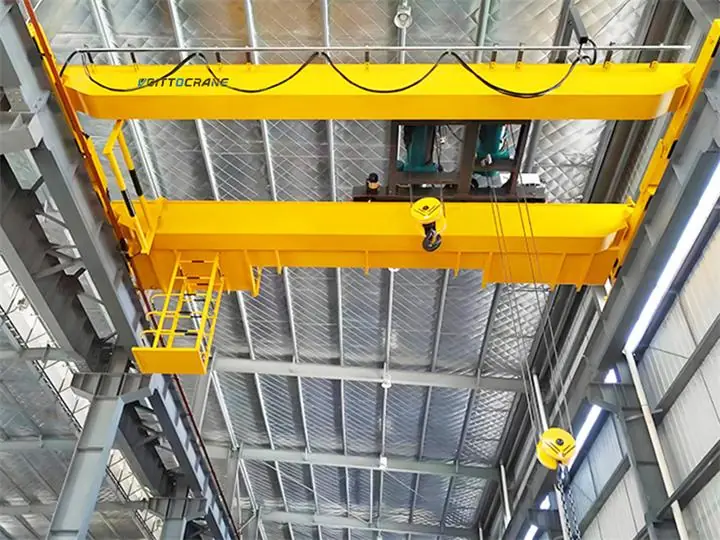
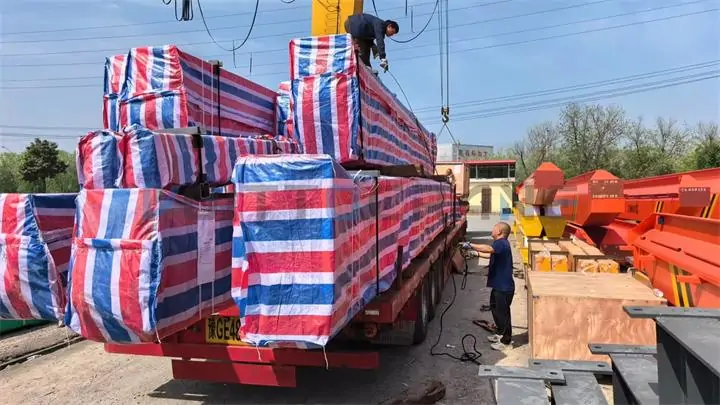
A quoted lead time is only useful once you know which stages it covers. Four separate clocks run between “we want a crane” and “the crane lifts its first load.”
Overhead Crane Lead Time Is Four Clocks, Not One
Production time is the shortest of the four clocks and the only one most quotes state. The others are the pre-production clock, the delivery clock, and the commissioning clock.
The pre-production clock covers specification, quotation, contract and drawing approval. It is typically 1–4 weeks and sits almost entirely on the buyer’s side of the table, because fabrication cannot start until drawings are signed off. The production clock is the factory’s cycle. The delivery clock covers inspection, packing, sea freight, customs and inland transport. The commissioning clock covers installation, load testing and handover, typically 1–3 weeks for a standard crane once the site and runway are ready.
Because these clocks run in sequence, a short production figure can hide a long project. A buyer who budgets only for the 30 days on the quote and ignores the other three will usually miss the date.
A Worked Example: Adding the Clocks Together
An illustrative standard double girder crane shipped to Southeast Asia lands at about 11–18 weeks from contract to ready for use, if each stage runs in sequence.
The arithmetic uses the typical ranges in this guide: 1–2 weeks for drawing approval, 30–45 days (about 4.5–6.5 weeks) for production, 2–4 weeks for inspection and documents, 3–7 days of sea freight, 2–3 weeks for port clearance and inland delivery, and 1–2 weeks for installation. This is a planning example built from published ranges, not a delivery commitment for a specific order. In practice some stages overlap, for example documents are prepared while the crane is being built, so the real total can come in shorter.
Fix the Starting Date in the Contract
Agree in writing whether lead time starts at contract signature, receipt of the deposit, or approval of the final drawings. These three dates can sit weeks apart, and the choice decides whether a crane is “late” or on schedule.
Buyers who leave this open often discover the gap at the worst moment, when the supplier says the 30 days only began once the drawings were approved. A clear start event costs nothing to write down and removes the most common source of delivery disputes. Also state whether the quoted time ends at the factory gate, at the port of loading, or at the buyer’s site.
Overhead Crane Lead Time by Crane Type
Lead time rises with structural complexity, capacity and the number of non-standard features. The same reasoning holds across the range, but the effect is different for each type.
Single Girder Overhead Cranes: The Shortest Cycle
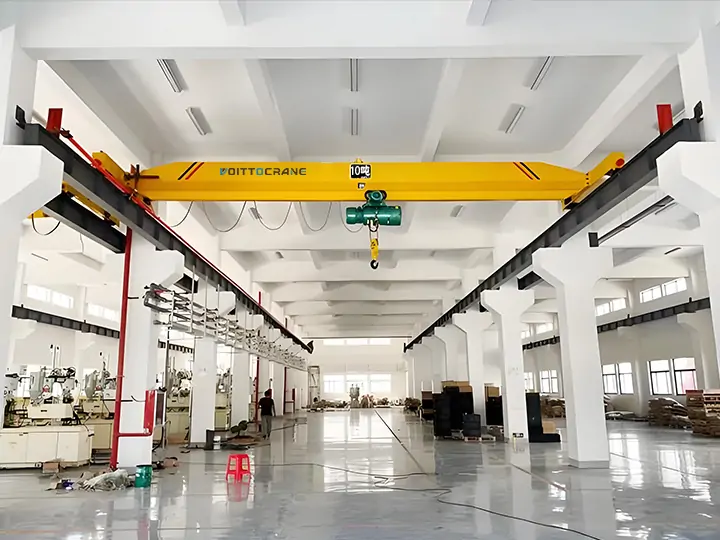
Standard single girder cranes are the fastest to build because the structure and trolley follow mature designs. Typical production is 15–30 days, extending to 30–50 days when the span, lifting height or duty class falls outside the standard range.
The reason is parts availability. A standard single girder crane pairs a box or I-beam girder with an off-the-shelf hoist and end carriages, so fabrication and assembly run almost in parallel. Customization breaks that parallel path: a special span means new girder drawings, and a corrosion-protection requirement adds surface treatment steps. The practical rule is to stay inside standard spans and heights wherever the building allows, since that choice shortens the schedule more than any amount of rush-ordering later.
Double Girder and Steel Mill Cranes: Where Weeks Add Up
Double girder cranes typically take 30–45 days in standard form and 45–70 days when customized, while heavy steel mill cranes run 50–80 days and can reach 120 days.
Heavier girders need more welding, more stress relief and more inspection before assembly. Capacities above roughly 50 t and spans beyond about 30 m call for reinforced structures and extra quality checks, which is why those orders move to the upper end of the range. Metallurgical duty adds heat-resistant components and tougher testing.
Electric Hoists and Electrical Equipment Often Set the Pace
A domestic standard electric hoist is usually ready in 7–15 days, but a specified imported-brand hoist can add 4–8 weeks when assembled locally and 8–16 weeks or more when fully imported.
Hoist choice is therefore a schedule decision as much as a technical one. If the project specification names a particular imported brand, the crane body can be finished long before the hoist arrives. Confirm the hoist type and brand before the order is placed, and compare it with the FEM-standard electric hoists e equipamento elétrico para guindastes we can supply from our own range. Buying the girder, hoist and control system as separate packages from different suppliers also extends the total, because every hand-off adds waiting time.
What Stretches Overhead Crane Lead Time
Most delays come from a short list of avoidable causes. Fixing them early usually saves more time than a faster factory could.
Slow Drawing Approval Is the Most Controllable Delay
Production starts after drawings are approved, so every day of internal review is a day added to the overhead crane lead time. Review cycles can take days or weeks depending on how many people must sign.
The fix is organizational rather than technical. Name one person with authority to approve, set an internal review deadline, and send a complete specification up front: capacity, span, lifting height, duty class, hoist type, power supply and control mode. Incomplete specifications trigger rounds of questions, and each round resets the clock. Providing the building drawing and runway details at the quotation stage also prevents redesign after approval.
Non-Standard Voltage and Control Options Add Time
Cranes built for non-standard voltage or advanced control often take longer than the base figure, because the electrical components have to be sourced or customized. Some manufacturers add roughly 10–15 days for a different voltage, and projects adding PLC integration or automation can add several weeks.
This matters because many buyers choose voltage and control features last, after the mechanical specification is settled. Confirm the local supply voltage and frequency, such as 380V 50Hz three-phase or a different standard, before quotation. Choosing pendant or remote control from the standard range rather than a bespoke automation package is another quick way to hold the standard cycle.
Factory Capacity and Peak Season
A full order book can delay even a standard crane. Large factories give stable output but may carry a queue, particularly in peak construction periods.
Ask for the production slot, not only the production duration. A 30-day build that starts in eight weeks is a 12-week wait. If your project date is fixed, reserve capacity early and agree a deposit date that locks the slot.
Certifications, Documents and Inspection Time
A crane that is built on time but arrives without the right paperwork can still be held at customs or refused at site, so certification belongs in the schedule from day one.
Which Standards and Certificates Apply
The core references for an overhead crane are CE marking under the EU Machinery Directive 2006/42/EC for European destinations, FEM design rules, the ISO 4301 crane classification series, and a manufacturer quality system certified to ISO 9001. Destination markets add their own requirements, such as EAC for Eurasian Customs Union countries, and operator-side rules such as OSHA 1910.179 and ASME B30.2 in the United States.
These are the general reference points, not a promise that any specific unit already carries a given certificate. Which ones you need depends on the country of installation, so state the destination in your enquiry and ask the supplier to confirm the applicable set.
Why Missing Paperwork Costs More Than Weeks
Missing or unclear conformity documents can stall customs clearance, affect insurance and weaken your position if a claim arises, and the delay usually appears after the crane has already shipped. Including documents and third-party inspection in the plan typically adds 2–4 weeks, and a supplier who prepares them in parallel with fabrication keeps that time off the critical path.
For EU-bound orders, allow extra time for the technical file and declaration to be prepared and checked. Documents prepared late are one of the few causes of delay that no amount of factory speed can recover.
What to Ask the Supplier to Provide
Ask for actual documents rather than verbal assurance. For a typical order the request list includes:
- An EC Declaration of Conformity and the technical file reference where CE applies.
- The manufacturer’s ISO 9001 certificate.
- Load test and overload test records for the crane being built.
- A list of safety devices fitted, such as overload limiter, travel limit switches, and load indication.
- A third-party inspection report if your project or insurer requires one.
Write the required documents into the contract with their delivery date. Our team can confirm which certificates and test reports apply to your configuration; the final set should always be verified against the documents issued for your order.
From Factory Gate to First Lift
Shipping, clearance and installation often take as long as the build itself, so plan them alongside production rather than after it.
Typical Sea Freight Times
Port-to-port sea freight from China ranges from about 3–7 days to nearby Asian ports up to 40–50 days to the east coast of South America.
| Destination region | Typical port-to-port transit |
|---|---|
| East and Southeast Asia | 3–7 days |
| Middle East | 18–25 days |
| South Asia | 20–28 days |
| Mediterranean | 28–35 days |
| Northwest Europe | 32–40 days |
| North America, west coast | 14–18 days |
| North America, east coast | 25–35 days |
| South America, east coast | 40–50 days |
Transshipment adds 5–7 days per stop, and congestion between August and January can add one to two weeks. Add 2–3 weeks on top of transit for port handling, customs and inland transport, and keep a buffer of 10–20% for unexpected delays.
Plan Installation Before the Crane Ships
Installation typically takes 1–3 weeks, but only if the runway, power supply and rigging team are ready when the crane arrives. A crane waiting for a runway is lead time you pay for twice.
Check rail alignment, building clearance and the power connection point while the crane is in production. Oversized girders may need special transport, so confirm route and unloading equipment early. For a larger project, ask whether our engineers can supervise installation and commissioning, and what the site must provide.
How to Shorten Overhead Crane Lead Time
The shortest schedules come from decisions made before the order: standard spans and heights, a confirmed hoist and voltage, a named approver for drawings, and documents prepared in parallel with fabrication.
None of these requires paying a premium. They remove waiting rather than speeding up work. If the project date cannot move, combine them with an early deposit to lock the production slot, and ask whether critical components can ship separately in advance.

Alan
Especialista em soluções para guindastes · Voitto Crane
Especializada em soluções de exportação de pontes rolantes, pórticos, gruas, pórticos portuários e pontes rolantes EOT. Mais de 10 anos a ajudar clientes globais com consultoria pré-venda, seleção de capacidade e configurações específicas do local.
Conclusão
The most reliable way to manage overhead crane lead time is to treat it as four sequential clocks, fix the start date in the contract, and ask for every quoted figure to state what it includes. Standard cranes often ship within 20–45 days, customized and heavy cranes take longer, and shipping, documents and installation add several more weeks.
Before you compare suppliers, list the four clocks, confirm the hoist and voltage, and request the conformity documents in writing. For a schedule built around your own project, talk to our engineers about your overhead crane lead time.
FAQ
Q1:How long does it take to make an overhead crane?
A standard overhead crane typically takes 15–45 days to produce, depending on type. Single girder units usually sit at 15–30 days and double girder units at 30–45 days. Customized designs extend this to roughly 30–70 days, and heavy steel mill cranes can reach 80–120 days. These figures exclude shipping and installation, so ask your supplier whether the quote counts from the contract, the deposit or drawing approval.
Q2:How long does it take to ship an overhead crane from China?
Sea freight takes about 3–7 days to Southeast Asia and 32–40 days to Northwest Europe, port to port. Allow another 2–3 weeks for port handling, customs and inland transport. Transshipment and seasonal congestion can add more, so a 10–20% buffer is sensible for projects with a fixed commissioning date.
Q3:What delays overhead crane delivery the most?
Slow drawing approval and late specification changes are the most common causes. Non-standard voltage, imported-brand hoists and missing conformity documents are the next most frequent. Confirm these items before the order, and the production figure on the quote becomes much more reliable.
Q4:Does overhead crane lead time include installation?
Usually not. Quoted production time normally stops at the factory gate, while installation and commissioning typically add 1–3 weeks on site. Ask in writing whether installation, testing and handover are included, and who provides the rigging team and power connection.
Q5:What certificates should I ask for before ordering an overhead crane?
Ask for the EC Declaration of Conformity where CE applies, the manufacturer’s Certificado ISO 9001, and load test records for your crane. Destination rules may add EAC or operator-side requirements such as OSHA 1910.179. Request the actual documents and a delivery date for them in the contract.
Q6:How can I get an accurate price and delivery date for my crane?
Send capacity, span, lifting height, duty class, voltage and destination country. With those details we can confirm the specification, a production slot and the document list. Complete information at the quotation stage is the quickest way to avoid redesign and to receive a firm delivery date.




 English
 Español
 Português
 العربية
 Français
 Русский