
Shipyards need more than a generic crane — they need the right lifting solution matched to each production zone. A double girder overhead crane covering a steel-plate fabrication hall operates under completely different load cycles and environmental stresses than a gantry crane straddling an open dry dock. Get the match wrong and you’re looking at chronic production delays, accelerated corrosion failure, or a crane that physically can’t reach what it needs to lift.
For most mid-size shipbuilding yards, the core fleet typically spans two to four crane types: overhead cranes for indoor fabrication bays, gantry or rail gantry cranes for block assembly and dry docks, and jib cranes for outfitting stations and quayside repair. Market reference prices from Chinese manufacturers start around $15,000–$35,000 for industrial-grade overhead cranes and rise to $80,000–$300,000+ for heavy gantry systems — depending on capacity, span, and corrosion protection grade.
This guide walks through each crane type used in shipbuilding, the key specs that determine fit, what corrosion and duty ratings to demand, and how to verify compliance before signing a purchase order.
- 1 Quick Reference: Cranes for Shipbuilding by Application Zone
- 2 Types of Cranes Used in Shipbuilding and What Each One Does
- 3 Principais especificações a confirmar antes da compra
- 4 Certifications and Compliance for Shipbuilding Cranes
- 5 Conclusão
-
6
FAQ
- 6.1 Q1: What type of crane is most commonly used in shipbuilding yards?
- 6.2 Q2: What lifting capacity do shipbuilding cranes typically need?
- 6.3 Q3: How much do shipbuilding cranes cost?
- 6.4 Q4: What certifications should a shipbuilding crane have?
- 6.5 Q5: What corrosion protection is required for outdoor shipyard cranes?
Quick Reference: Cranes for Shipbuilding by Application Zone
| Application Zone | Recommended Crane Type | Capacidade típica | Extensão típica | Price Reference (FOB) |
|---|---|---|---|---|
| Steel plate / beam storage yard | Pórtico rolante de dupla viga | 5–50 t | 12–35 m | $40,000–$120,000 |
| Indoor fabrication hall | Ponte rolante de viga dupla | 5–100 t | 15–35 m | $20,000–$150,000 |
| Block pre-assembly area | Pórtico sobre carris | 20–150 t | 18–35 m | $80,000–$280,000 |
| Dry dock / open yard | Pórtico rolante de dupla viga | 50–800 t | 20–50 m | $150,000–$500,000+ |
| Outfitting bay / engine installation | EOT Crane or Jib Crane | 1-32 t | 7.5–25 m | $15,000–$60,000 |
| Quayside repair & maintenance | Grua de lança | 1–20 t | — | $8,000–$30,000 |
Prices are market reference ranges based on Chinese factory-direct supply. Final cost depends on span, hook height, duty class, and corrosion protection specification.
Obter cotação
Types of Cranes Used in Shipbuilding and What Each One Does
Double Girder Overhead Crane for Fabrication Halls


O ponte rolante biviga is the backbone of any enclosed shipbuilding workshop — handling steel plates, subassemblies, and module pre-fitting within fabrication halls where ceiling clearance allows a top-running configuration.
The reason double girder is standard rather than single girder comes down to load capacity and hook height. Shipyard halls regularly move 10–100-tonne loads, and the double girder structure provides the higher top-hook position needed to clear large hull sections during rotation and assembly. Frequency inverter-controlled hoists allow micro-speed positioning — typically down to around 0.1–0.5 m/min — which is essential when aligning prefabricated ship blocks within tight assembly tolerances. For salt-air environments, sealed gearboxes and IP55-rated electrical enclosures are the minimum acceptable specification; IP65 is preferred for yards within 500 metres of open water.
Voitto’s double girder overhead crane covers 5–800 tonnes capacity and 10-50 m span — sufficient to cover the widest fabrication bays without intermediate columns.
Gantry Crane and Rail Gantry Crane for Open Yards and Dry Docks
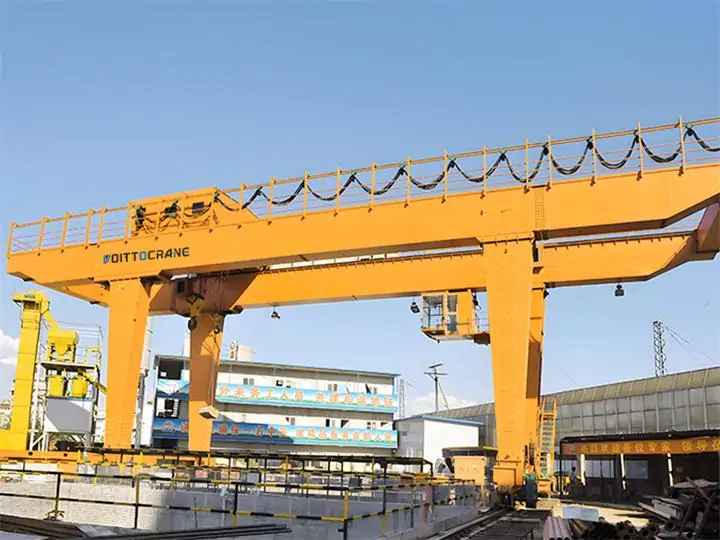
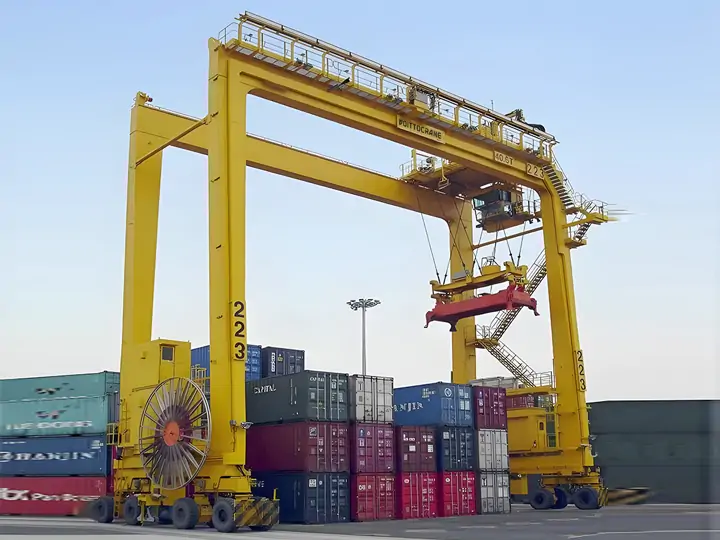
Gantry and rail gantry cranes handle lifting in areas where overhead runway rails cannot be installed: open block-assembly yards, pre-fabrication staging areas, and dry docks.
The distinction between a standard double girder gantry crane and a rail gantry crane matters for shipyards. A standard gantry works well for storage yards and lighter pre-assembly work (capacity typically 5–150 tonnes, span up to 40 m). A rail gantry crane — running on fixed embedded rails — is the correct choice when you’re lifting 20–150-tonne hull sections repeatedly across a defined path; the fixed-rail design delivers better lateral stability under eccentric loads and reduces wheel wear on heavy-cycle operations. For outdoor shipyard environments, hot-dip galvanised rail clips, stainless fasteners, and C4 or C5 anti-corrosion paint systems (per ISO 12944) are standard requirements — not optional upgrades.
Voitto’s rail gantry crane covers 20–150 tonnes e 15–35 m span with lifting heights to 40 m, matching the geometry of most mid-size dry docks and block-staging areas.
Jib Crane for Outfitting Stations and Repair Quays
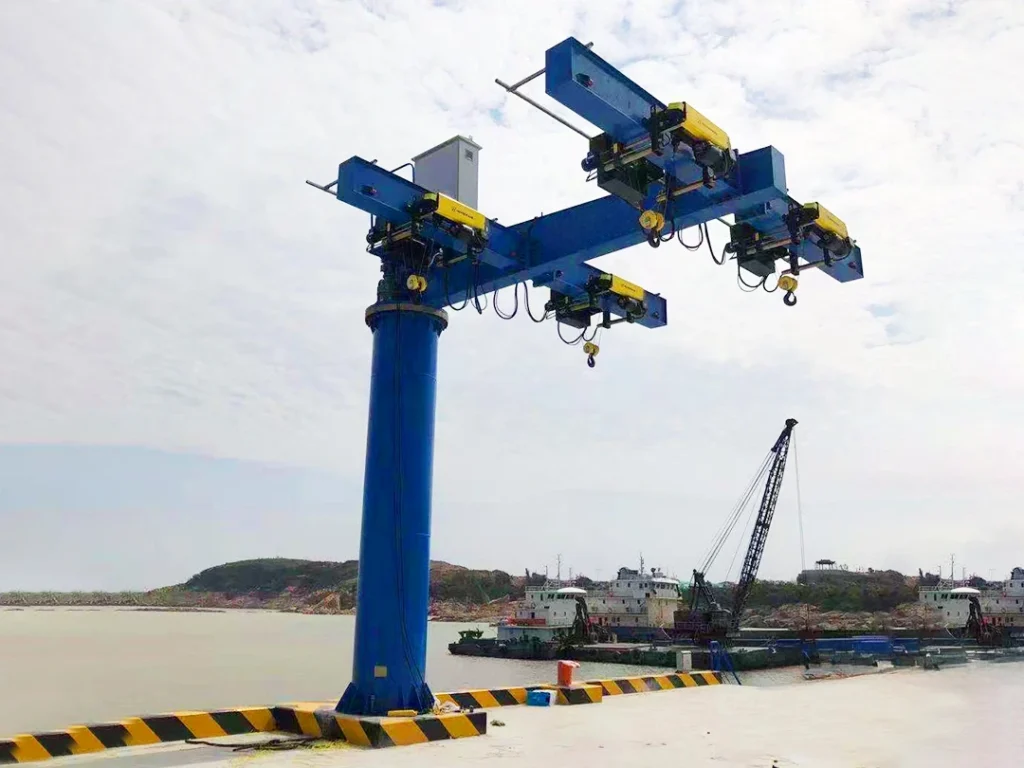
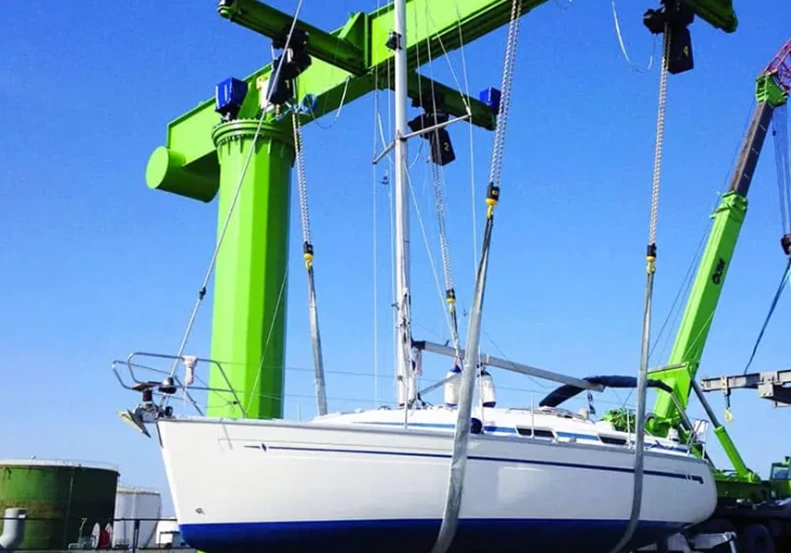
Guindastes de lança serve localised lifting tasks that overhead and gantry systems can’t reach efficiently: engine installation pits, quayside equipment handling, pipe and cable routing during outfitting, and small-craft maintenance stands.
A freestanding jib crane with 270°–360° slewing covers a work radius of 3–8 m and handles 1–20 tonnes — enough for lifting marine engines, generator sets, and deck equipment without committing a full bay overhead crane to the task. Their compact footprint and independent column mounting make them practical in areas where runway beams cannot be installed or where the ceiling structure is already occupied. The key selection variable is whether the jib is wall-mounted (limiting slew to 180–270°) or freestanding (full 360°); quayside locations almost always require freestanding to avoid conflicts with vessel superstructure.
Voitto’s jib crane range covers the standard capacity and reach requirements for outfitting and maintenance applications.
EOT Crane for Engine and Equipment Bays


An Electric Overhead Travelling (EOT) crane — functionally equivalent to a standard overhead crane but frequently specified under the EOT designation in South and Southeast Asian procurement — is well suited to engine installation bays, paint shops, and equipment fitting areas within enclosed shipyard structures.
EOT cranes in shipbuilding contexts are typically specified at 1–32 tonnes with spans of 7.5–25 m — matching the geometry of enclosed bays where large machinery is positioned but outright structural loads remain below heavy-fabrication levels. Duty class M5 (FEM 1.001) is generally the minimum for moderate-frequency lifting in outfitting; M6 is appropriate for higher-cycle environments like engine installation lines.
Principais especificações a confirmar antes da compra
Corrosion Protection Grade
Shipyard cranes fail early most often not from overloading but from corrosion neglect. The correct specification depends on the crane’s position relative to open water and the local climate.
For indoor fabrication halls in moderate climates, C3 corrosion category (ISO 12944) is typically adequate. For outdoor gantry cranes in coastal yards or high-humidity tropical environments, C4 or C5-M (marine) is required — this means a multi-layer paint system with a minimum total dry film thickness of 200–320 µm, plus stainless or hot-dip galvanised hardware on all exposed fasteners. Electrical cabinets must carry at minimum IP55 for outdoor installations; anything below that in a marine environment is a maintenance liability from day one. Always ask the supplier to specify the corrosion category and paint system in writing in the technical proposal — not just on a marketing datasheet.
Duty Class and Lifting Cycle Ratings
A crane sized only by safe working load (SWL) without a confirmed duty class is undersized for shipbuilding use. Shipyard overhead cranes typically operate at M5–M7 duty class under FEM 1.001 or ISO 4301, reflecting moderate-to-heavy lifting frequencies across multi-shift operations.
The consequences of under-specifying duty class are structural: a crane rated M4 running at M6 duty accumulates fatigue damage in girder welds and end carriage connections far ahead of its design life. Before placing an order, ask the supplier to confirm the duty class against your actual estimated lifts-per-hour and annual operating hours — this calculation, not the SWL alone, determines whether the crane will last 15 years or 6.
Span and Hook Height vs. Your Actual Building Geometry
The single most common sizing mistake in shipyard crane procurement is specifying span and hook height from drawings rather than from a surveyed as-built measurement. Building columns settle, runway beams deflect, and existing equipment competes for headroom. For any new crane installation, measure clearance to the underside of roof trusses, confirm column spacing at both ends of the runway, and calculate the minimum hook height needed to clear the tallest load at maximum lift — then add a safety margin of at least 500 mm before specifying.

Alan
Especialista em soluções para guindastes · Voitto Crane
Especializada em soluções de exportação de pontes rolantes, pórticos, gruas, pórticos portuários e pontes rolantes EOT. Mais de 10 anos a ajudar clientes globais com consultoria pré-venda, seleção de capacidade e configurações específicas do local.
Certifications and Compliance for Shipbuilding Cranes
Which Certifications to Require
Shipbuilding cranes supplied to most international markets require documentation covering design, manufacture, and load testing. The core certifications to request are: Marcação CE under the Machinery Directive 2006/42/EC (mandatory for European-destination equipment), ISO 9001 covering the manufacturer’s quality management system, and an overload test certificate (typically at 125% of SWL) from a third-party inspection body. For yards operating under MEF design standards, confirm the applicable FEM section (FEM 1.001 for crane mechanisms) is cited in the design documentation. For markets in Russia, Kazakhstan, or Belarus, EAC certification is additionally required. For US-based operations, confirm compliance with ASME B30.2 (overhead cranes) or ASME B30.3 (gantry cranes).
Why It Matters in Practice
Missing CE marking on a European shipyard installation can halt commissioning: port authorities and insurance underwriters routinely request the EC Declaration of Conformity before authorising crane operation over active dock areas. An ISO 9001 certificate without a current validity date (check the expiry — typically three-year cycles with annual surveillance audits) provides no meaningful assurance of ongoing manufacturing quality.
How to Verify Before You Pay
Request the following documents before final payment, not after delivery: the EC Declaration of Conformity (signed, in English or the target-market language), the overload test certificate from a third-party inspector (Lloyd’s, SGS, BV, or equivalent), the ISO 9001 certificate with current validity, and the manufacturer’s technical file showing the crane design calculation basis. Any supplier that cannot provide these on request should be treated as a compliance risk, regardless of price.
Conclusão
Choosing the right cranes for the shipbuilding industry comes down to matching equipment type and specification to each production zone — not buying a single crane type and hoping it covers everything. Double girder overhead cranes for enclosed fabrication halls, rail gantry cranes for block staging and dry docks, and jib cranes for outfitting stations form the practical core of most mid-size shipyard crane fleets. Get the corrosion specification, duty class, and geometry right before finalising any purchase order, and insist on verifiable certification documents before release of final payment.
Three actions to take now:
- Map your yard’s lifting zones and identify which crane type serves each one
- Confirm the corrosion category and duty class required for each location
- Request a technical proposal — including certifications checklist — from your supplier
Voitto Crane manufactures heavy-duty cranes for the shipbuilding industry with factory-direct pricing and full CE / ISO 9001 documentation support.
Alan
Especialista em soluções para guindastes · Voitto Crane
Especializada em soluções de exportação de pontes rolantes, pórticos, gruas, pórticos portuários e pontes rolantes EOT. Mais de 10 anos a ajudar clientes globais com consultoria pré-venda, seleção de capacidade e configurações específicas do local.
FAQ
Q1: What type of crane is most commonly used in shipbuilding yards?
Double girder overhead cranes and gantry cranes are the two most widely used crane types in shipbuilding. Overhead cranes serve enclosed fabrication halls; gantry cranes cover open block-assembly yards and dry docks. Most mid-size shipyards operate both types, with jib cranes added at outfitting and repair stations for localised lifting tasks that full-bay cranes cannot serve efficiently.
Q2: What lifting capacity do shipbuilding cranes typically need?
Shipbuilding cranes generally range from 5 tonnes (outfitting bays) to 800 tonnes or more (major dry dock gantry systems) depending on the production stage. Fabrication hall overhead cranes are most commonly specified between 10 and 100 tonnes. The correct capacity is determined by the heaviest single lift at each zone — not the average load — with a minimum 25% overload test margin factored in.
Q3: How much do shipbuilding cranes cost?
Market reference prices from Chinese manufacturers range from approximately $15,000–$35,000 for overhead cranes in the 5–20 tonne range, rising to $80,000–$300,000+ for heavy rail gantry cranes at 50–150 tonnes. Large dry dock gantry systems above 200 tonnes are project-quoted and can exceed $500,000 depending on span and corrosion specification. These are FOB China reference figures; freight, installation, and commissioning add to the total.
Q4: What certifications should a shipbuilding crane have?
At minimum: CE marking (EC Declaration of Conformity) under Machinery Directive 2006/42/EC for European-destination equipment, an ISO 9001 manufacturer certificate with current validity, and a third-party overload test certificate at 125% SWL. FEM 1.001 design documentation and ASME B30 compliance are additionally required for EU/FEM-standard and US-market projects respectively.
Q5: What corrosion protection is required for outdoor shipyard cranes?
Outdoor cranes in coastal shipyard environments should meet ISO 12944 corrosion category C4 or C5-M (marine), with a multi-layer paint system achieving a minimum 200–320 µm dry film thickness. Exposed fasteners should be stainless steel or hot-dip galvanised, and electrical cabinets should carry IP55 rating as a minimum. Indoor cranes in non-marine environments can typically be specified at C3.


 English
  Español
  Português
  العربية
  Français
  Русский