
When choosing between rail vs trackless electric transfer carts, users should not simply compare their rated load capacities. Two electric transfer carts with the same rated load capacity may have vastly different requirements in terms of floor conditions, facility layout, and power systems. Typically, six factors determine the selection: load capacity, transport routes, floor conditions, steering requirements, power supply method, and total installation and long-term operating cost. If you are planning or evaluating an industrial transfer cart solution for your factory, the following comparison will help you make a more informed selection decision. Please Continue Reading:
- 1 Rail vs Trackless Electric Transfer Cart: Quick Engineering Comparison
- 2 Load Capacity and Workshop Floor Requirements
- 3 Workshop Layout, Transport Routes, and Steering Flexibility
- 4 Duty Cycle and Power Supply Selection
- 5 Installation Cost and Total Cost of Ownership
- 6 Which Transfer Cart Is Right for Your Application? Three Typical Scenarios
- 7 Conclusão
-
8
FAQ
- 8.1 What is the main difference between a rail transfer cart and a trackless transfer cart?
- 8.2 Is a trackless transfer cart suitable for loads above 150 tons?
- 8.3 What type of floor is required for a trackless transfer cart?
- 8.4 Can a rail transfer cart operate without a continuous rail power supply?
- 8.5 Which transfer cart is more economical for a factory?
Rail vs Trackless Electric Transfer Cart: Quick Engineering Comparison

Rail-Transfer Cart

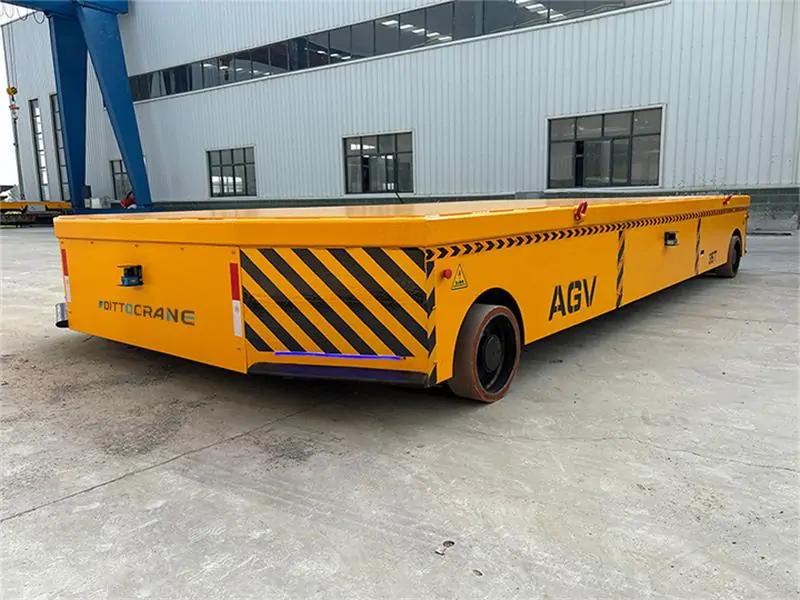
Trackless Electric Transfer Cart
Three differences matter most. Rail transfer carts reach a higher rated capacity, but the more useful distinction is where the load ends up: on rails and a designed foundation, or on wheels on the existing floor. Route logic differs too, since rails fix the path while polyurethane wheels free it. Finally, rails add infrastructure work, whereas trackless transfer carts shift attention to floor inspection and batteries.
Obter cotação| Parâmetro | Carrinho de transferência ferroviária | Carrinho de transferência sem trilhos |
|---|---|---|
| Capacidade de carga | 0,5-500 toneladas | 0.5–300 tons |
| Wheels and guidance | Steel wheels on pre-installed steel rails | Polyurethane rubber wheels, no track |
| Ground requirements | Prepared rail foundation | Hard, level, load-bearing floor |
| Route flexibility | Fixed route: straight, L-shaped or S-shaped track | Free path between workstations |
| Direção | Follows the installed rails | Lateral movement, stationary rotation or normal turning, depending on configuration |
| Running speed (heavy load / standard) | 0–20 / 20–50 m/min | 0–15 / 15–45 m/min |
| Fonte de alimentação | 36V/48V DC low-voltage rail, cable reel or battery | Battery (lead-acid, gel or lithium iron phosphate) |
| Instalação | Rail laying, alignment and foundation work | No permanent rails; floor inspection needed |
| Typical applications | Steel mills, foundries, heavy machinery workshops, precast concrete plants | Mold manufacturing, automotive assembly, machining workshops, multi-station handling |
Load Capacity and Workshop Floor Requirements
When users operate electric transfer carts on fixed routes with loads exceeding 150 tons and at high operational frequencies, it is generally recommended to prioritize rail transfer carts. However, the 150-ton figure is for reference only and is not a strict cutoff. For example, 200-ton trackless electric transfer carts are not necessarily unsuitable; the key is to first assess the ground conditions.
The key metric is “wheel pressure” (i.e., the vertical force transmitted to the ground by each wheel). Wheel pressure depends on the total load, the number of support wheels, and the load’s distribution—if the load is off-center, it will cause some wheels to bear greater pressure. Wheel pressure is distinct from “contact pressure on the wheel surface,” which also depends on the contact area of the polyurethane wheel surface.
Therefore, the floor requirements for a trackless transfer cart ultimately depend on the floor thickness, concrete strength, reinforcing steel configuration, and foundation conditions. If the floor’s load-bearing capacity is insufficient, concrete cracking, surface damage, or uneven settlement may occur in frequently used aisles. Before the procurement team places an order for a trackless transfer cart, a structural engineer should verify the floor structure based on the calculated wheel load data.
Even the use of tracks cannot completely eliminate this problem, as tracks concentrate the load along their length. Heavy-duty rail transfer carts also require a dedicated track foundation, which must undergo specialized design verification; one should never assume that the track foundation automatically ensures uniform load distribution.
Workshop Layout, Transport Routes, and Steering Flexibility
Carrinho de transferência ferroviária
Rail carts follow a fixed path, which works well when material shuttles between the same stations all day. Tracks can run straight or in L-shaped and S-shaped layouts, and positioning along the route repeats consistently. However, rails occupy the floor and can interfere with forklifts and pedestrians, so crossings, intersections, and clearances need planning before installation.
Obter cotação

Carrinho de transferência sem trilhos
Trackless carts move between workstations without a laid route. They travel forward and in reverse, and, depending on configuration, may also move laterally at 90 degrees or rotate in place through 360 degrees. In workshops with tight space, many stations or changing layouts, lateral movement and stationary rotation can reduce the manoeuvring room a cart needs. These carts can also serve indoor and outdoor routes.
Obter cotaçãoDuty Cycle and Power Supply Selection
The duty cycle describes the frequency and duration of an industrial transfer cart’s operation while carrying a load. The power supply method, in turn, determines the source of energy required for these operations.
Rail electric transfer carts primarily have three power supply options: 36V/48V low-voltage DC rail power supply, suitable for scenarios requiring continuous, uninterrupted operation; cable reel power supply, suitable for enclosed environments with fixed routes; battery-powered systems, which are suitable for locations requiring flexible deployment and no fixed power infrastructure.
Battery-powered material handling vehicles can use lead-acid batteries, maintenance-free gel batteries, or lithium iron phosphate (LiFePO₄) batteries. Lead-acid and gel batteries have lower initial costs and are technologically mature; lithium iron phosphate batteries, on the other hand, are lighter, have a longer service life, and support fast charging, making them ideal for high-frequency, long-duration operations. The Battery Management System (BMS) monitors voltage, temperature, and state of charge to ensure safety (which is particularly important for lithium-ion batteries). Before making a selection, procurement teams should comprehensively consider factors such as operating time, travel distance, load capacity, charging schedules, and production plans.
Installation Cost and Total Cost of Ownership
Note: Total cost of ownership includes installation, infrastructure, energy, maintenance, downtime, and the costs associated with future layout adjustments.
Carrinho de transferência ferroviária
Rail transfer carts may incur rail procurement, floor cutting or foundation preparation where required, rail installation and alignment, grouting, power supply infrastructure, and installation downtime. Existing infrastructure can reduce these costs or add to them, depending on slab condition and underground services.
Obter cotação

Carrinho de transferência sem trilhos
Trackless transport vehicles shift the costs to the vehicles themselves: this involves more complex steering systems, battery systems, drive and control equipment, maintenance or replacement of polyurethane wheels, and inspections of the floor surface (which may need to be reinforced if necessary). In return, they do not require the installation of fixed tracks, offer flexible travel paths, are easy to relocate when factory layouts are adjusted, and generally require minimal infrastructure modifications.
Note: Trackless industrial transfer carts do not completely eliminate the need for civil engineering work. Furthermore, total costs and wheel replacement cycles vary by project, and there is no uniform standard. Specific costs depend on load, operating time, installation environment, wheel wear, and maintenance practices. Therefore, the procurement team must evaluate and compare quotes based on data reflecting their actual operating conditions.
Obter cotaçãoWhich Transfer Cart Is Right for Your Application? Three Typical Scenarios
Scenario 1: Steel Mill – Heavy Steel Coil or Ladle Transport
A rail electric transfer cart is usually the better fit for heavy loads on fixed routes with repetitive cycles. Match the power supply to frequency: low-voltage rail for near-continuous work, cable reel for enclosed fixed routes, battery where fixed power is impractical. For hot material, thermal protection and load-support structures need specific engineering.
Scenario 2: Automotive Workshop – Mold Handling
Molds need to be moved frequently between the press, the mold testing area, and the storage area, and the layout of the workspace often changes. A trackless transfer cart is ideal for this type of operation; with specific configurations, it can move laterally and rotate in place, allowing the mold to be precisely positioned at workstations in narrow aisles. In addition, users must verify the floor’s load-bearing capacity to ensure it can support the combined weight of the transfer cart (including its load) and the heaviest mold.
Scenario 3: Heavy Machinery Factory – Indoor and Outdoor Material Transfer
A trackless transfer cart can establish a connection between production areas and outdoor workstations without the need to install tracks at the entrance. However, the procurement team must verify the strength and levelness of the outdoor ground surface, the condition of thresholds and transition areas, and whether the slope is within the vehicle’s climbing capacity, as well as ensure that electrical components have appropriate weatherproofing measures in place.
Decision Summary: If transport routes are fixed, loads are heavy, and frequency is high, a rail-based solution should be chosen; if workstation layouts may change, fixed tracks cannot be installed, and ground conditions meet the requirements, a trackless solution should be chosen.
Conclusão
A rail transport cart is typically suitable for heavy-load applications with fixed routes and repetitive transport needs. In contrast, trackless transport vehicles are better suited for scenarios requiring flexible routes, involving movement between multiple workstations, or where site conditions make it impractical to install fixed rails. When choosing between a rail vs trackless electric transfer cart, users should comprehensively consider the actual load, floor conditions, transport routes, operating frequency, and total installation costs. Before finalizing a solution, procurement teams must assess the actual conditions of the workshop, focusing particularly on wheel load and floor load-bearing capacity, and use these factors as the basis for establishing equipment technical specifications. VOITTO Crane is committed to providing you with valuable information.
Obter cotação
Alan
Especialista em soluções para guindastes · Voitto Crane
Especializada em soluções de exportação de pontes rolantes, pórticos, gruas, pórticos portuários e pontes rolantes EOT. Mais de 10 anos a ajudar clientes globais com consultoria pré-venda, seleção de capacidade e configurações específicas do local.
FAQ
What is the main difference between a rail transfer cart and a trackless transfer cart?
A rail transfer cart runs on steel wheels along pre-installed rails and follows a fixed route. A trackless cart uses polyurethane wheels, moves freely over a suitable floor, and needs no permanent track, but relies on the floor’s load-bearing capacity.
Is a trackless transfer cart suitable for loads above 150 tons?
It can be, but 150 tons is a screening reference, not a limit. VOITTO’s trackless range reaches 300 tons. Suitability depends on wheel loads and the floor’s thickness, strength, reinforcement, and subgrade, all verified before installation.
What type of floor is required for a trackless transfer cart?
The floor must be hard, level, and strong enough to carry the fully loaded cart. Engineers check slab thickness, concrete strength, reinforcement, and subgrade against calculated wheel loads. Cracked, soft, or uneven areas need repair or reinforcement first.
Can a rail transfer cart operate without a continuous rail power supply?
Yes. Besides 36V/48V DC low-voltage rail power, a rail transfer cart can use an electric cable reel or battery power. Battery operation suits layouts without fixed power infrastructure, though you should plan charging time against operating frequency.
Which transfer cart is more economical for a factory?
Neither is always cheaper. Rail electric transfer carts add rail and foundation work, while trackless transfer carts may need floor inspection, reinforcement, batteries, and wheel upkeep. Compare total cost of ownership using your load, route, operating hours, and layout. Please contact VOITTO for the best solution.



 English
 Español
 Português
 العربية
 Français
 Русский