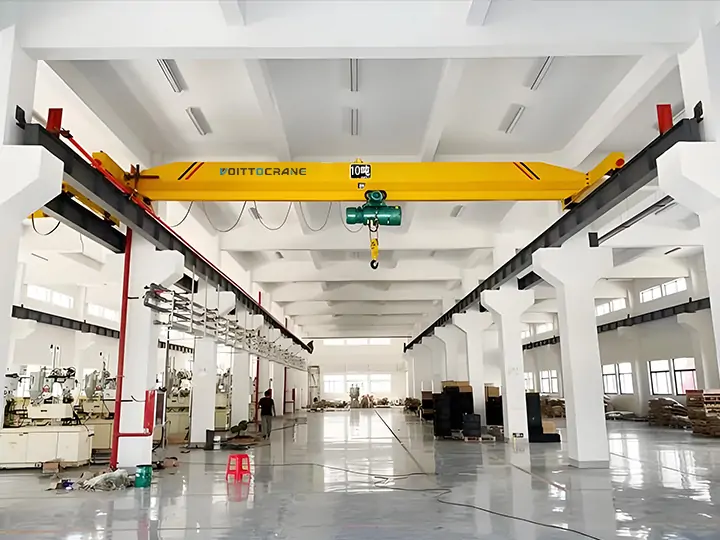
The LX warehouse suspension crane is a kind of warehouse lifting equipment widely used in industrial and warehousing fields. The LX type single-girder suspension crane is renowned for its design that requires no support. Users utilize the LX suspension crane in warehouses, logistics centers, and production workshops of various sizes.
The LX warehouse suspension crane is a kind of warehouse lifting equipment widely used in industrial and warehousing fields. The LX underhung crane has a compact design and is easy to operate. The warehouse overhead crane adopts a single-beam structure and works with a wire rope hoist. It can complete the lifting, transportation, and stacking tasks of goods in a warehouse environment.
The LX type single-girder suspension crane is renowned for its design that requires no support. Suspended from the roof structure, this equipment effectively reduces installation costs and saves floor space. Users utilize the LX suspension crane in warehouses, logistics centers, and production workshops of various sizes. In addition, VOITTO crane manufacturer provides non-standard, customized LX suspension crane solutions.
Structure and Components of Suspension Crane
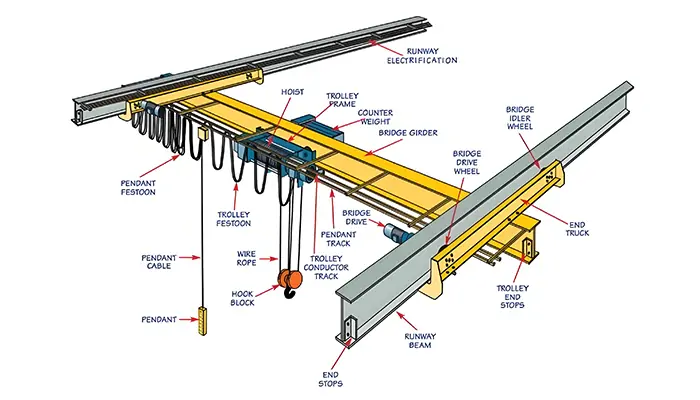
A suspension crane consists of a metal structure, a travelling system, a lifting system, an electrical control system, and safety devices. Next, I will introduce the components of an underhung bridge crane.
Main Beam: Made of high-strength steel, with High resistance to deformation.
End Beam: Connects the main beam to form a stable bridge structure.
Wire Rope Hoist: The user controls it to lift and lower goods.
Control System: The operator uses a crane remote control to control the longitudinal movement of the crane and the lateral, lift, and lower movement of the lifting mechanism.
Safety Devices: Include overload limiter, travel limiter, emergency stop button, etc.
Electrical System: The power source for the entire equipment.
Advantages
Efficient Handling: Users can quickly complete lifting and transportation of goods using the warehouse suspension crane.
High Flexibility: The lifting system and bridge crane mechanisms work in conjunction.
High Space Utilization: No ground space is required.
Easy Operation: Simple operation and user-friendly interface.
Convenient Maintenance: Modular design for easy disassembly and maintenance.
Customized Solutions: VOITTO provides customized solutions based on warehouse layout and cargo characteristics.
Safe and Reliable: Equipped with multiple safety protection devices.
Product Application
Suspension bridge cranes, with their compact structure, no floor space requirements, and high load capacity, are commonly used by users in warehouses or workshops. Below, I will list some common application scenarios for this equipment.
Warehouse: The suspension crane is used for the storage, outbound storage, stacking, and picking of goods.
Logistics Center: The logistics distribution center completes the classification, packaging, and transportation of goods.
Machinery Manufacturing: In the machinery manufacturing process, it is mainly used for the assembly and commissioning of large components.
Production Workshop: On the production line, it is used for the handling of raw materials, semi-finished products, and finished products.
E-commerce Warehouse: In the e-commerce industry, it can handle the rapid sorting and delivery of large orders.
Cold Chain Logistics: In the cold storage, it can handle temperature-sensitive goods such as frozen foods and medicines.
Specification
Product Mode
LX Suspension Crane
Lifting Capacity
0.5~10 ton
Span
3~22.5 m
Lifting Height
6~30 m
Work Duty
A3-A4
Lifting Speed
8/0.8 m/min
Long Travelling Speed
20 m/min
Cross Travelling Speed
20/30 m/min
Working Temperature
-20~40℃
Control Model
Pendant Push Button or Crane Joystick Controls
Suspension Cranes’ Maintenance Precautions
Under Running Systems overhead crane
1. Regular Inspection: Regularly inspect the mechanical and electrical components of the crane.
2. Explosion-proof Maintenance: Ensure the explosion-proof performance of all explosion-proof components, such as explosion-proof motors, explosion-proof electrical components, etc.
3. Lubrication and Maintenance: Regularly lubricate the operating mechanism and transmission components to reduce wear and extend service life.
4. Safety Device Testing: Regularly test the function of the safety device to ensure its sensitivity and reliability.
5. Operation Training: Train operators on explosion-proof knowledge and operating skills.
6. Environmental Management: Keep the working environment clean to avoid the accumulation of flammable and explosive substances.
7. Fault Handling: Stop using the equipment immediately if you find a fault, and ask professionals to repair it.
8. Record Management: Record inspection, maintenance and repair conditions, and formulate a reasonable maintenance plan.
Suspension Crane Supplier
VOITTO’s Suspension Crane can be customizable to match your plant’s specific requirements—including lifting capacity, span, and crane control types.
For detailed technical specifications or industry-specific solutions, please feel free to contact us. We are dedicated to providing customers with detailed product information to help you make an informed choice.
Qualification and Honor
Engineered Strength, Global Crane Supplier
service
Exclusive and Considerable, Customer First.
01
Reliable and Customized Solutions
Our pre-sale team provides consultations, tailoring solutions to your needs and environment.
Offer customization options for lifting capacity, span and lifting height etc. to meet specific needs.
02
Updated Production Process
Real-Time Progress Updates: Weekly reports and PM communication.
3-5 years warranty and free replacement for non-manufacturing defects.
24/7 online support and on-site assistance for crane issues.
FAQ
Engineered Strength, Global Crane Supplier
How do I choose the right overhead crane for my facility?
A: Consider these factors:
Load Capacity (Max weight to lift, including rigging).
Span Width (Distance between runways).
Lifting Height (Hook path elevation).
Duty Cycle (Frequency of use: light, moderate, or severe service).
Power Supply (Electric, manual, or hybrid options).
For more detailed answers, please contact our engineers as soon as possible. Our engineers will be based on your use of the scene to give you the most professional program for you to choose!
Can you customize an overhead crane to my specific needs?
Yes, we can customize an overhead crane to meet your specific business needs. We can design and manufacture complete crane systems or upgrade existing systems.
What industries are your EOT cranes suitable for?
Our overhead cranes are suitable for use in a variety of industries, including manufacturing, construction, metallurgy, logistics, and transportation etc. We specialize in providing customized solutions to multiple industries.
What’s the price range for a standard overhead bridge crane?
The price of an overhead EOT crane ranges from $ 1,550 to $ 353,500. Usually, the price is determined by the configuration. Contact us now to get a more professional quote!
Get In Touch
Please feel free to leave a message. We will reply in 24 hours.
Please specify your requirement by referring to the following aspects:
Which crane product do you need?
What is the maximum lifting capacity (in tons) required for your project?
Could you specify the lifting height (in meters) needed?
Can you provide details on the working environment, such as ground conditions, space limitations, and any obstacles?
What is the expected frequency of use and the duration of the project?






 English
  Español
  Português
  العربية
  Français
  Русский