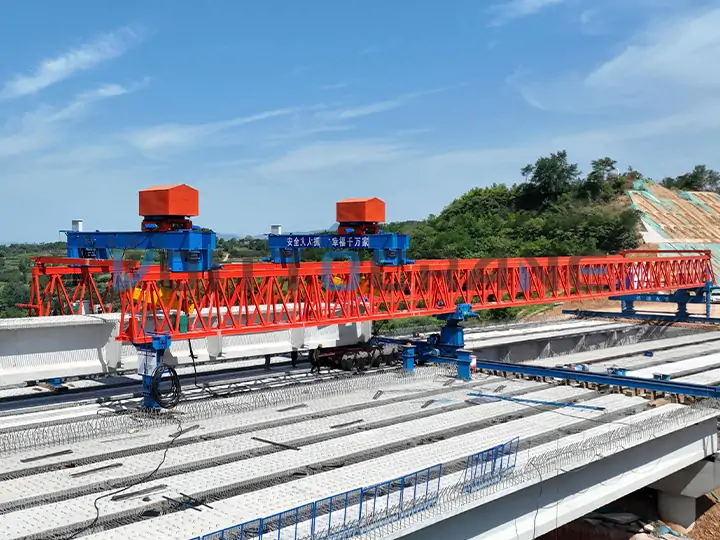
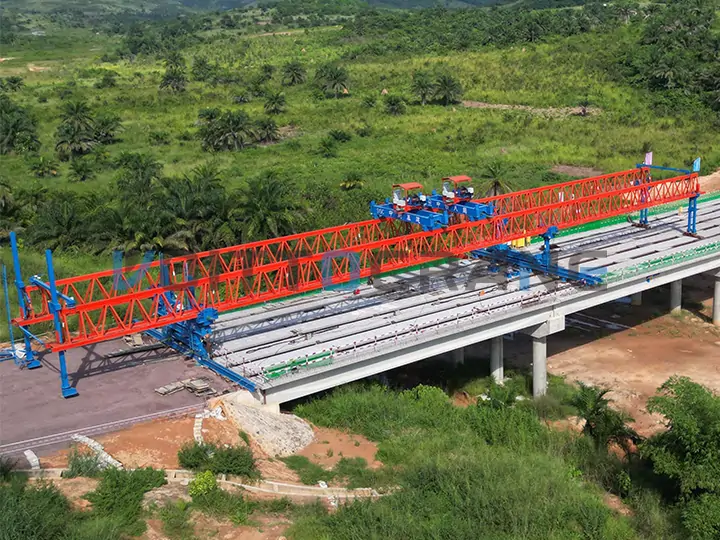
A bridge girder launcher is a piece of equipment specifically designed to lift and install precast beams. Featuring a heavy-duty steel structure, an advanced hydraulic lifting system, and synchronized control technology, it ensures operational stability and precise beam positioning throughout the entire construction process. Launching girders can be customized to accommodate different bridge structures, construction methods, span requirements, and on-site conditions and are widely used in highway bridges, railway bridges, urban elevated bridges, and large-scale infrastructure projects.
A bridge girder launcher is a type of heavy-duty bridge construction equipment. Users employ this equipment during bridge construction to install precast concrete girders with spans ranging from 20 to 50 meters and weights ranging from 60 to 900 metric tons. This equipment is used in highway, railway, and urban rail transit infrastructure projects around the world. Simply put, a bridge girder launcher is a machine responsible for safely and precisely hoisting precast bridge girders onto bridge piers.
Product Description
A bridge girder launcher is a type of lifting equipment. This device is responsible for lifting precast box girders, I-beams, T-beams, and U-beams and placing them directly onto bridge piers. Its single-lift capacity typically ranges from 60 to 900 metric tons. General-purpose cranes cannot meet the requirements of such operations because the bridge girder launcher must perform repetitive tasks above incomplete, elevated structures. Crane manufacturers verify the structural load-bearing capacity of each unit through load tests before it leaves the factory. This equipment combines transportation and installation functions, enabling it to move and install girders directly from the ground to their final positions without additional cranes. Launching girders are the preferred solution for constructing long-span highway or railway bridges.
Type of Bridge Girder Launcher
There are three main configurations of bridge girder launchers, which differ in terms of girder transport methods and structural layout. Each configuration is suitable for different construction site conditions, span lengths, and load-bearing requirements. Therefore, bridge construction contractors select the appropriate type based on the specific constraints of the project. Below, I will introduce these three different types of beam launcher cranes and their definitions.
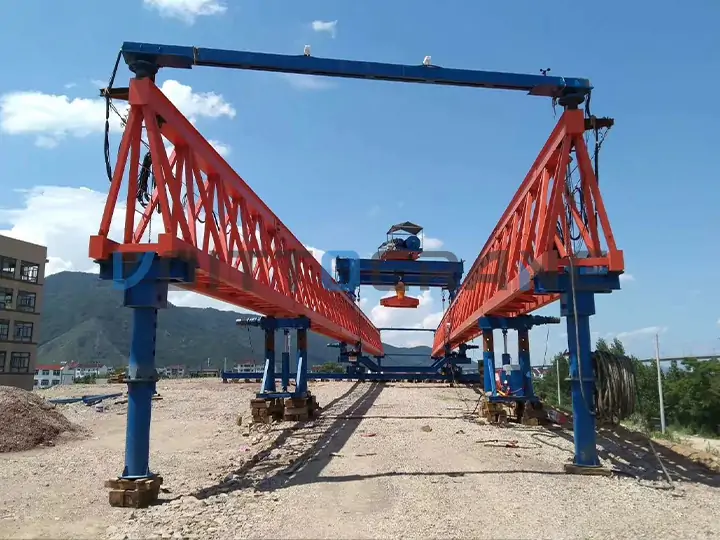
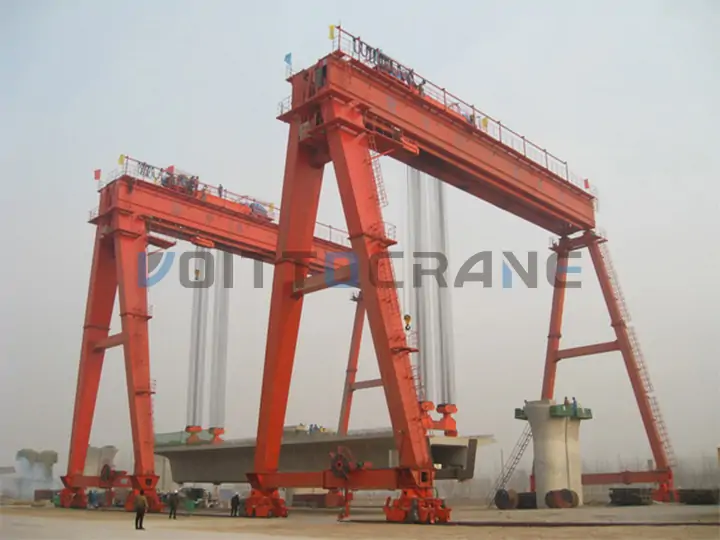
Single Girder Bridge Girder Launcher: This equipment features a single-girder structure and is characterized by its light weight, simple installation, and cost-effectiveness. It is capable of lifting, transporting, and positioning bridge girders with high precision. Single-girder bridge girder launchers are suitable for bridge projects with medium spans and moderate lifting requirements. Typically, the load-carrying capacity of this equipment ranges from 60 to 300 metric tons.
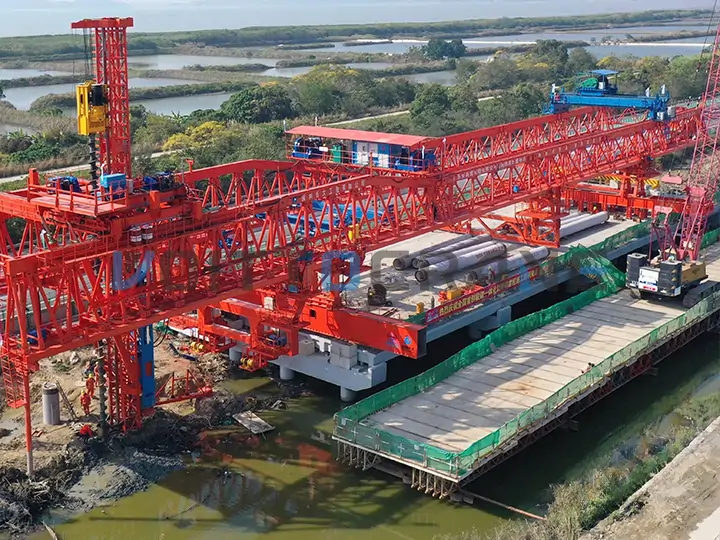
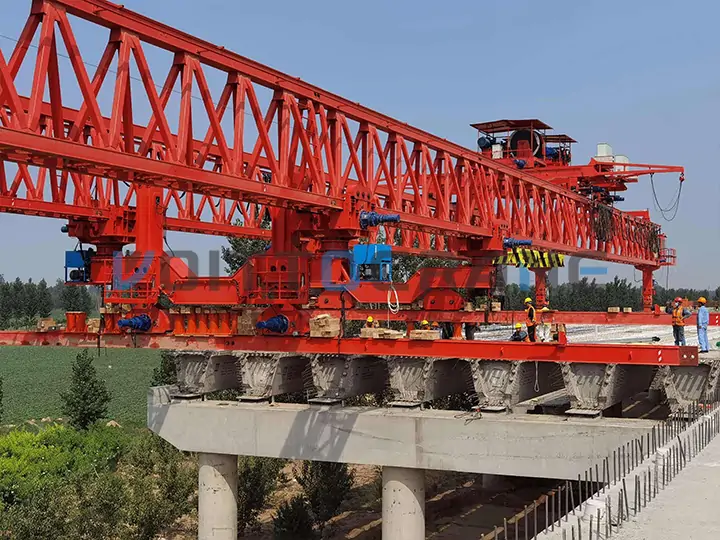
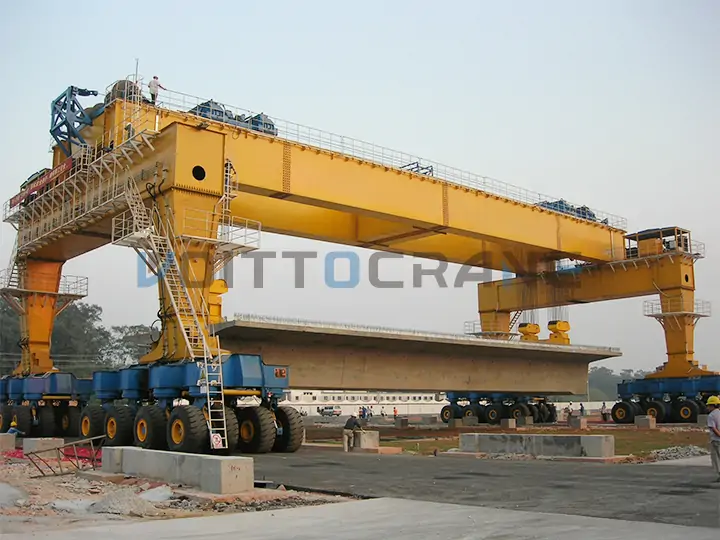
Double Girder Launcher: The equipment features a double-girder structural design. Designed specifically for high-speed rail, expressway, and large-scale infrastructure projects, this equipment is capable of steadily hoisting precast bridge sections across large spans and in complex construction environments. Its load-bearing capacity can reach up to 900 metric tons. The double-girder bridge erector can easily handle heavy-duty bridge construction projects.
Segmental Girder Launching: This type is specifically designed to enhance the construction of segmental bridges. Operators use this equipment to lift, position, and assemble precast concrete segments. Unlike single-girder or double-girder bridge erectors, which are primarily used to install precast beams for entire spans, the segmental bridge erector supports precise, segment-by-segment erection, making it the preferred solution for long-span elevated bridges, curved bridges, and bridge projects spanning rivers, valleys, or densely populated urban areas. With its advanced positioning capabilities, high-precision erection performance, and minimal reliance on ground-based lifting equipment, this equipment enables safe and efficient construction operations in complex environments.
Features
Girder launcher features center on load capacity, structural stiffness, and safety redundancy built into every subsystem.
High Load-Carrying Capacity: This equipment is capable of transporting, lifting, and erecting precast bridge segments.
High Adaptability: This equipment can span rivers, canyons, roads, and railways to carry out bridge construction tasks.
Reduced Reliance on Ground-Level Construction: There is no need for large cranes to occupy the space beneath the bridge for extended periods.
High-Safety Design: The equipment features a stable support structure and a precise control system.
Modular Design: The equipment typically employs a modular design, facilitating transportation, installation, disassembly, and relocation.
Precise Installation and Positioning: Equipped with a hydraulic system and intelligent control devices, the equipment enables precise horizontal, longitudinal, and lateral adjustments of the bridge girders.
Suitable for Various Bridge Types: The system meets the installation requirements for simply supported beams, continuous beams, and precast segmental beams.
Reduced Construction Costs: Compared to traditional hoisting methods, it reduces the need for large lifting equipment and lowers labor costs.
Continuous Operation: The equipment enables assembly-line-style beam installation, making it suitable for high-speed railways, expressways, and large-scale bridge projects.
Customization: The equipment can be custom-designed based on bridge span, beam weight, and site conditions.
Application
Bridge girder launcher applications span three primary infrastructure sectors: highway construction, railway construction, and urban transit systems.
Highway Bridge Construction: Contractors operate this equipment to lift and install precast beams for highways.
High-Speed Rail Construction: Users operate this equipment to precisely install high-speed rail box girders, T-beams, and precast segmental beams.
Urban Elevated Bridge Construction: This equipment is used in the construction of urban interchanges, overpasses, and urban expressways.
River-Crossing Bridge Projects: This equipment is suitable for bridge construction over rivers, lakes, and other bodies of water.
Mountainous Bridge Construction: Contractors use this equipment to carry out bridge installation tasks in canyons, mountainous areas, and complex terrain.
Railway Bridge Renovation Projects: This equipment is used for the expansion and renovation of existing railway lines, as well as the installation of new bridge structures.
Precast Beam Yard Projects: Users employ this equipment to perform continuous lifting and installation of precast beams from the transport site to the bridge location.
Large Continuous Beam Bridge Construction: Contractors operate this equipment to install multi-span continuous beams, continuous rigid-frame bridges, and large bridge structures.
Overseas Infrastructure Projects: Contractors utilize this equipment for bridge construction in large-scale transportation infrastructure projects such as the “Belt and Road” Initiative.
Specification
Parameter
Typical Range
Lifting Capacity
60 – 900+ tons
Applicable Bridge Span
20 – 50 m
Applied Slope
2%
Turning Radius
200, 250, 300, 350 m
Trolley Lifting Speed
1.2/0.6 m/min
Trolley Lengthways Movement
6/0.6 m/min
Trolley Horizontal Movement
6/0.6 m/min
Crane Lengthways Movement
6/0.6 m/min
Crane Horizontal Movement
6/0.6 m/min
Carrier-carrying Cart Moving Speed
6/0.6 m/min
Power supply
3-phase, 380–440V, 50/60Hz
Parts and Component
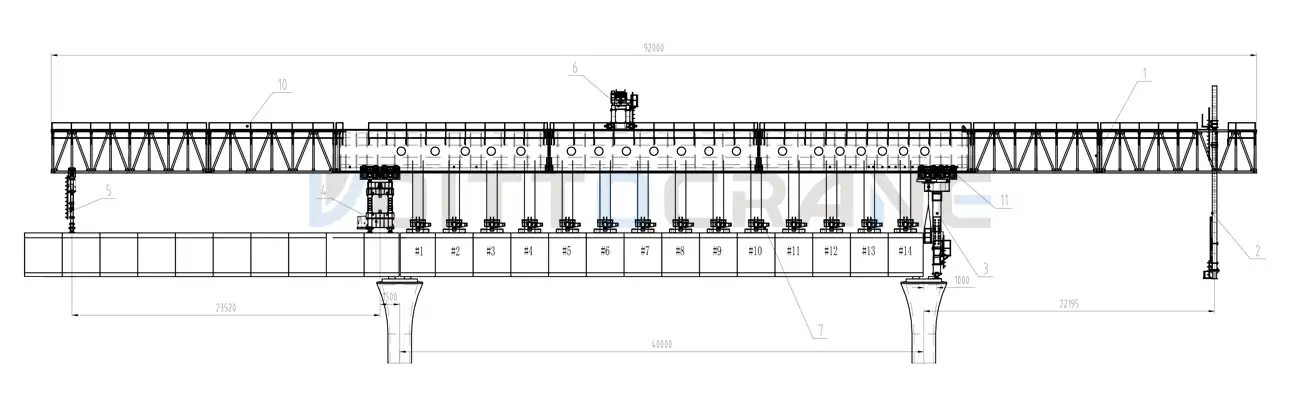
A bridge girder launcher crane consists primarily of six major components: the main girder, front and rear outriggers, hoisting trolley, auxiliary outriggers, hydraulic system, and electro-hydraulic control system.
The main girder is positioned between the outriggers, with rails laid on its upper flange to allow the hoisting trolley to travel along it.
The dual winches integrated into the trolley can lift both ends of the girder simultaneously, ensuring that the load remains level during transport.
The front and rear outriggers (some of which feature a foldable C-shaped column structure) can be hydraulically adjusted in height to accommodate the elevation of the bridge piers.
Additionally, the auxiliary outriggers are used to maintain structural stability during girder transport, while the electro-hydraulic control system, operated via a central control console, controls movements such as outrigger raising and lowering, lateral translation, and the machine’s self-propelled forward movement.
Bridge Girder Launcher Manufacturer and Supplier
VOITTO Crane manufactures and supplies bridge girder launchers rated from 60 to over 900 tons for highway, railway, and urban transit projects across South America, Southeast Asia, Central Asia, Africa, and Europe.
Furthermore, VOITTO Crane’s engineering team configures span, feeding method, and control system around project-specific site conditions instead of shipping a fixed standard model. For project solutions, please contact VOITTO Crane.
Specialized in Overhead Crane, Gantry Crane, Jib Crane, Port Crane & EOT Crane export solutions. 10+ years helping global clients with pre-sales consultation, capacity selection and site-specific configurations.
This equipment is used during bridge construction to lift precast beams and place them onto bridge piers. It is widely used in highway, railway, and urban rail transit projects, capable of handling beams weighing 60 to 900 metric tons with spans of up to 50 meters without the need for ground-based support.
What is the lifting capacity of a girder launcher crane?
Its lifting capacity typically ranges from 60 metric tons to 900 metric tons. The specific capacity depends on the type of girder and the span. Models with a capacity of 100 to 160 metric tons are commonly used in highway projects, while high-speed rail bridge construction often requires equipment with a lifting capacity of 200 metric tons or more.
Can a beam launcher operate on curved or oblique bridges?
Yes. Many models feature foldable rear outriggers to reduce the lateral footprint, allowing them to adapt to curved and oblique alignments. The equipment can be customized to meet the erection requirements for straight, curved, and oblique bridges.
Qualification and Honor
Engineered Strength, Global Crane Supplier
service
Exclusive and Considerable, Customer First.
01
Reliable and Customized Solutions
Our pre-sale team provides consultations, tailoring solutions to your needs and environment.
Offer customization options for lifting capacity, span and lifting height etc. to meet specific needs.
02
Updated Production Process
Real-Time Progress Updates: Weekly reports and PM communication.
3-5 years warranty and free replacement for non-manufacturing defects.
24/7 online support and on-site assistance for crane issues.
FAQ
Engineered Strength, Global Crane Supplier
Do you ship internationally?
Yes, international shipping and export support are available for global customers.
How are large gantry cranes shipped overseas?
Large gantry cranes are typically shipped overseas through modular disassembly, where the crane is broken down into major components (beams, legs, hoists) for containerized transport. For mega-cranes, we use specialized heavy-lift vessels equipped with reinforced decks, and critical parts are protected with anti-corrosion coatings during transit.
Have your gantry cranes been used in major infrastructure projects?
Yes, our gantry cranes have participated in large-scale bridge construction projects and railroad construction in Brazil, Pakistan, Indonesia, Malaysia, Egypt, and other countries, in which we have played a particularly key role and contributed to these construction projects!
Are you a manufacturer or supplier?
VIOTTO is a heavy duty lifting scissor platform manufacturer and supplier, providing factory-direct solutions and custom options.
Get In Touch
Please feel free to leave a message. We will reply in 24 hours.
Please specify your requirement by referring to the following aspects:
Which crane product do you need?
What is the maximum lifting capacity (in tons) required for your project?
Could you specify the lifting height (in meters) needed?
Can you provide details on the working environment, such as ground conditions, space limitations, and any obstacles?
What is the expected frequency of use and the duration of the project?




 English
  Español
  Português
  العربية
  Français
  Русский