This precast girder lifting gantry crane lifts and transports concrete girders up to 450 tons for bridge construction, elevated rail, and highway overpass projects. Featuring a synchronized dual-hoist system, VFD control, and full safety protection for demanding infrastructure applications worldwide.
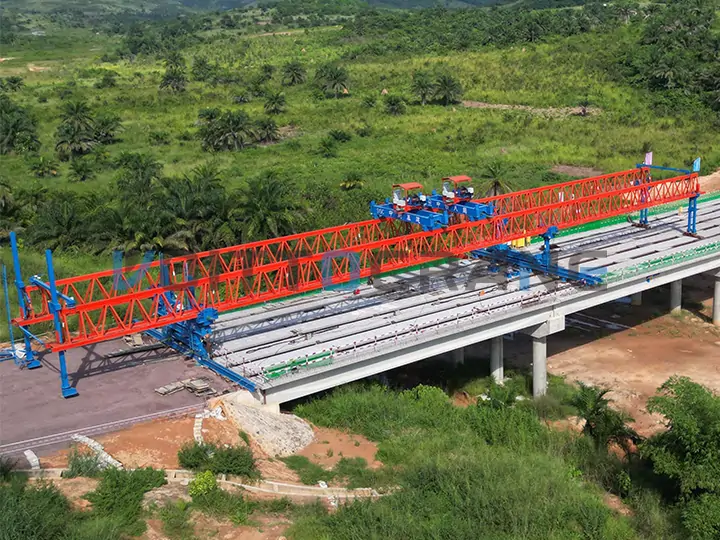
A precast beam lifting gantry crane is a type of heavy-duty lifting equipment. This mechanical device is specifically designed for the lifting and handling of precast concrete beams in bridge construction, elevated rail transit, and highway interchange projects. The equipment features a rigid box-girder structure and a synchronized control system for dual hoisting mechanisms, ensuring a smooth lifting process with millimeter-level positioning accuracy. VOITTO Crane is available in span configurations ranging from 15 to 30 meters.
Product Description
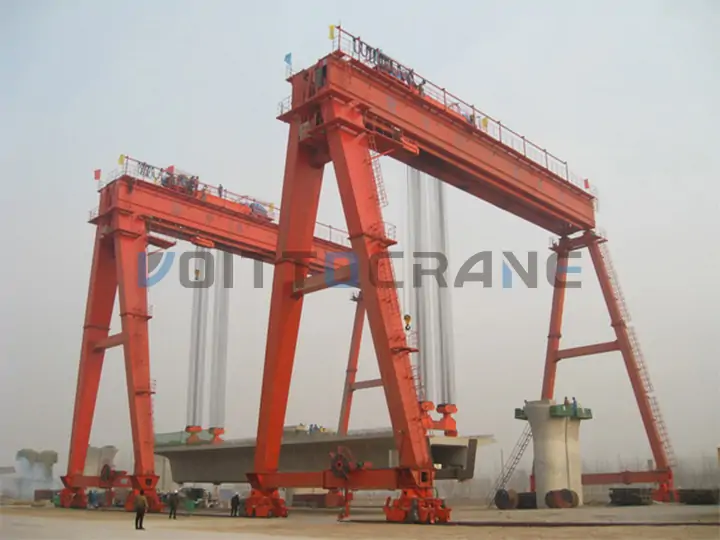
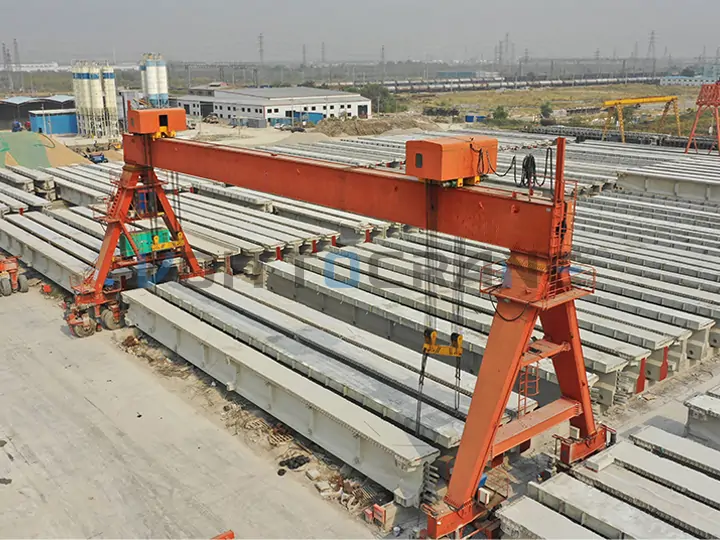
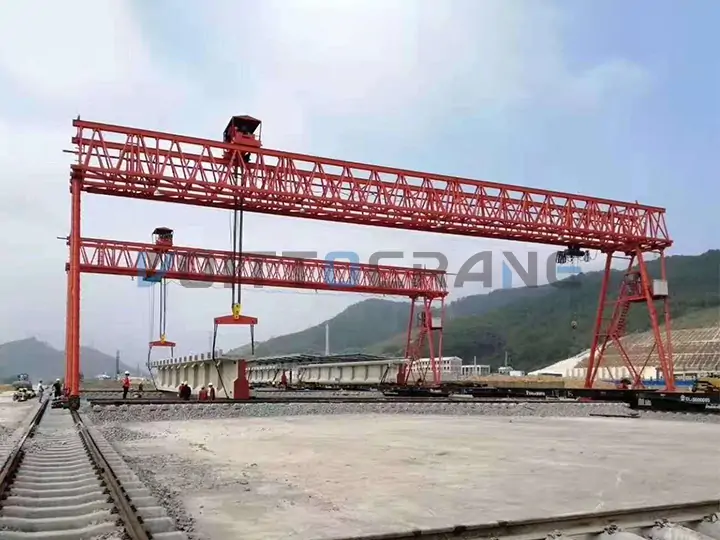
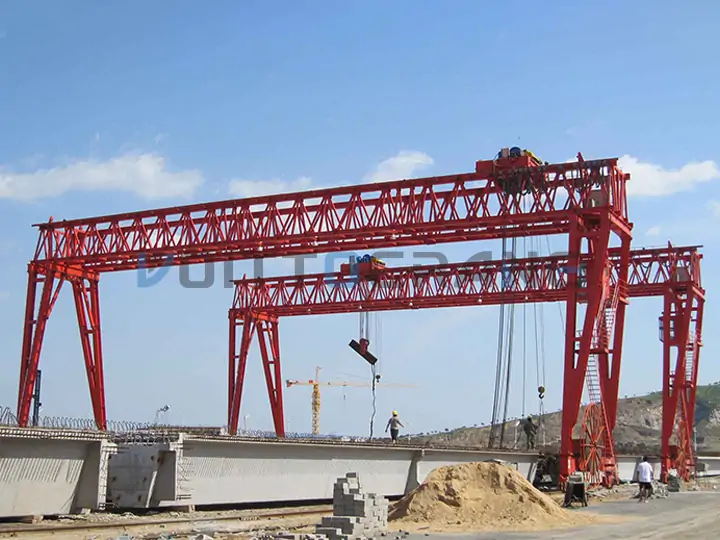
A Precast girder lifting gantry crane is specialized lifting equipment. This equipment is specifically designed for the lifting, transport, and placement of large precast concrete beams during the construction of bridges and elevated structures. Unlike overhead cranes used in workshops, precast beam gantry cranes must operate outdoors on uneven ground or temporary tracks. Therefore, their structure must be capable of withstanding wind loads, accommodating uneven terrain, and withstanding high-intensity repetitive operational cycles.
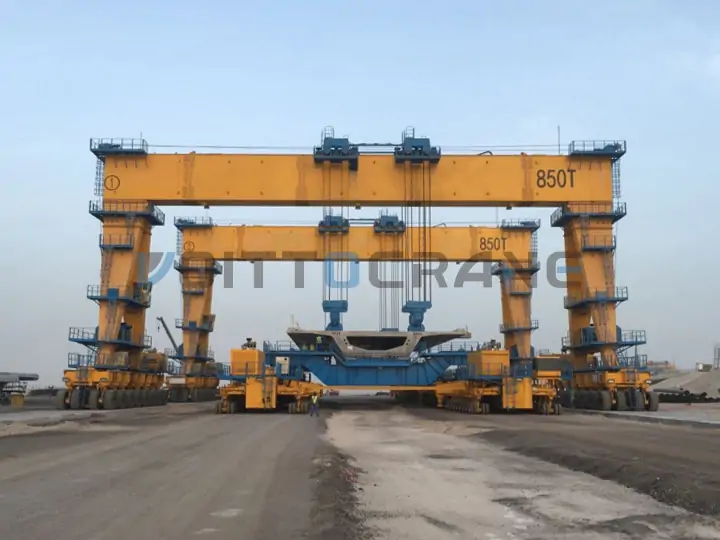
This crane typically features a box-section main girder supported by two rigid outriggers, forming a gantry frame that spans the precast beam casting or storage area. The equipment is equipped with a synchronized dual-hoist mechanism that allows for the even lifting of precast beams from both ends, thereby preventing tilting during transport. In particular, a single unit has a maximum load capacity of 450 tons, and when two units operate together, their combined maximum load capacity reaches 900 tons.
Features
This precast beam lifting crane incorporates a number of engineering features. Below, I will explain its features and advantages.
Robust Structure: The main girder features a welded box-section design, with reinforcing webs welded inside the box girder at regular intervals. This highly rigid design ensures that, even under rated full load, the girder deflection is kept within 1/800 of the span.
Synchronized Lifting System: This configuration ensures that the girder remains level throughout the lifting process, typically limiting the height difference between lifting points to within 50 mm.
Precise Positioning: The equipment is equipped with variable frequency drive (VFD) control. Both the hoisting and traveling mechanisms are driven by VFD motors, supporting stepless speed regulation from creep speed to rated full speed.
Wide Adaptability: Depending on on-site infrastructure conditions, the crane can operate on a standard 380V/50Hz three-phase power supply or, in remote areas without grid coverage, be powered by an onboard diesel generator set.
High Safety: Safety features include an overload limiter, anti-collision sensors, and upper and lower limit switches.
What is the Working Principle of a Precast Beam Lifting Gantry Crane?
The user operates the heavy-duty girder lifting system to hoist precast concrete beams from the storage area. The crane then travels along the tracks or a designated path to transport the suspended beams to their intended locations (such as beam transport vehicles or storage racks), where they are precisely positioned and safely lowered. Throughout the entire operation, synchronized lifting, synchronized travel, intelligent control, and multiple safety protection systems work in concert to complete the precast beam lifting task.
Specifications
The table below lists standard parameters for this precast girder lifting gantry crane; the actual configuration is adjusted to project span, capacity, and site conditions.
Parameter
Specification
Lifting Capacity
Single Set
450 t (without spreader)
Double Set
450 + 450 t
Span
20-38 m (custom spans available)
Lifting Height
15 – 30 m
Center Distance Between Two Rails
1500 mm
Lifting Speed
0.05 – 0.5 – 1 m/min
Trolley Traveling Speed
0.2 – 2 – 4 m/min
Gantry Traveling Speed
0.5 – 5 – 10 m/min
Working Duty
A5 – A6 (FEM 2m – 3m)
Power Supply
380V / 50Hz, 3-phase (customizable)
Total Weight
410 t
Max, Wheel Load
360 KN
Parts and Components
A precast girder lifting gantry crane primarily consists of a steel structure system, a hoisting system, a travel system, an electrical control system, and a safety protection system. Below, I will provide examples of its components:
Main Beam: The main beam forms the horizontal load-transfer path connecting the two outriggers. It bears the full rated load under bending conditions and must withstand wind loads and impact loads during outdoor operations.
Hoisting Mechanism: The hoisting mechanism consists of a wire rope drum, a pulley block, and a gear reducer. This system is responsible for raising and lowering the main girder. In precast component lifting applications, a dual-hoist synchronous system is typically included as standard equipment to maintain a level load.
Trolley Assembly: The trolley carries the hoisting mechanism along the main girder to allow for horizontal positioning of the main girder before final placement.
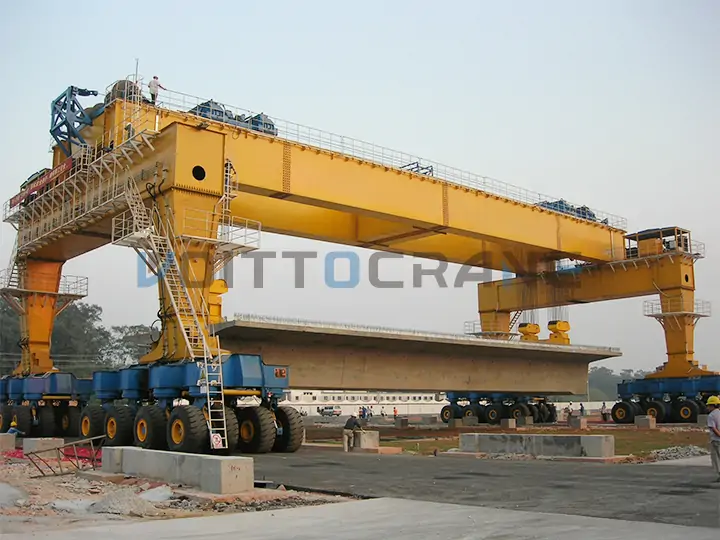
Outriggers and End Beams: Two rigid outriggers support the main girder and transfer the load to the end beams. The end beams run on rails or, in wheeled versions, travel on paved surfaces. The outrigger spacing determines the crane’s clear span.
Electrical Control System: The central control cabinet houses a PLC, variable frequency drives (VFDs), and safety relays. Operators use this control system to coordinate hoisting, trolley travel, and overall crane travel.
Crane Travel System: This component enables the equipment to move along fixed tracks or within the worksite. Operators use the controls to transport precast beams to designated locations.
Precast Beam Lifting Gantry Crane Manufacturer and Supplier
With over 30 years of experience in the manufacture of lifting equipment, VOITTO Crane exports gantry cranes, overhead cranes, and travel lifts to construction and shipbuilding companies in South America, Southeast Asia, Central Asia, Africa, and Europe.
As a precast girder lifting gantry crane manufacturer, the company designs each unit around project-specific span, capacity, and site conditions rather than offering a single fixed configuration. All cranes are manufactured in strict compliance with relevant certification standards, and internal structural calculations and third-party load testing are completed before shipment. Please contact us for precast beam handling solutions.
Specialized in Overhead Crane, Gantry Crane, Jib Crane, Port Crane & EOT Crane export solutions. 10+ years helping global clients with pre-sales consultation, capacity selection and site-specific configurations.
What is the maximum lifting capacity of a precast beam gantry crane?
A single unit can lift up to 450 tons. When two units operate simultaneously, the maximum lifting capacity reaches 900 tons. The actual lifting capacity is determined by the beam weight, span, and on-site operational cycle requirements specified in the project drawings.
How is the span of a precast beam lifting crane determined?
The span is determined by the spacing between precast formwork stations, the row spacing in the beam storage area, or the distance between bridge piers and typically ranges from 20 to 30 meters. Before finalizing the crane’s structural design, engineers perform comprehensive calculations to determine the span, wheel load, and ground bearing capacity.
Can this precast girder lifting gantry crane operate without a fixed power source?
Yes. In addition to being powered by the utility grid, it can be equipped with a diesel generator set, making it suitable for highway or railway construction sites in remote areas. During normal operation while connected to the utility grid, power is supplied to the hoist trolley via the drum system.
What safety standards do precast beam lifting gantry cranes comply with?
Most manufacturers’ products come standard with overload limiters, collision sensors, and parking brake systems equipped with wind speed monitoring capabilities.
Why do bridge construction companies prefer to use girder lifting gantry cranes rather than mobile cranes for beam installation?
Precast beam lifting gantry cranes enable repetitive and precise positioning during installation, eliminating the need to readjust outriggers for each span, as is required with mobile cranes. This not only reduces disruption to traffic on open roads but also shortens the lifting cycle for multi-span bridges and elevated railway projects.
Qualification and Honor
Engineered Strength, Global Crane Supplier
service
Exclusive and Considerable, Customer First.
01
Reliable and Customized Solutions
Our pre-sale team provides consultations, tailoring solutions to your needs and environment.
Offer customization options for lifting capacity, span and lifting height etc. to meet specific needs.
02
Updated Production Process
Real-Time Progress Updates: Weekly reports and PM communication.
3-5 years warranty and free replacement for non-manufacturing defects.
24/7 online support and on-site assistance for crane issues.
FAQ
Engineered Strength, Global Crane Supplier
Do you ship internationally?
Yes, international shipping and export support are available for global customers.
How are large gantry cranes shipped overseas?
Large gantry cranes are typically shipped overseas through modular disassembly, where the crane is broken down into major components (beams, legs, hoists) for containerized transport. For mega-cranes, we use specialized heavy-lift vessels equipped with reinforced decks, and critical parts are protected with anti-corrosion coatings during transit.
Have your gantry cranes been used in major infrastructure projects?
Yes, our gantry cranes have participated in large-scale bridge construction projects and railroad construction in Brazil, Pakistan, Indonesia, Malaysia, Egypt, and other countries, in which we have played a particularly key role and contributed to these construction projects!
Get In Touch
Please feel free to leave a message. We will reply in 24 hours.
Please specify your requirement by referring to the following aspects:
Which crane product do you need?
What is the maximum lifting capacity (in tons) required for your project?
Could you specify the lifting height (in meters) needed?
Can you provide details on the working environment, such as ground conditions, space limitations, and any obstacles?
What is the expected frequency of use and the duration of the project?




 English
  Español
  Português
  العربية
  Français
  Русский