The electric hoist rubber tyred gantry crane is a flexible, mobile lifting solution. Its hoisting mechanism can utilize an electric wire rope or a hoist trolley, with a design lifting capacity ranging from 1 to 50 tons and a span of up to 35 meters. This equipment is primarily used for industrial material handling in precast concrete plants, steel structure fabrication shops, machinery manufacturing plants, logistics centers, and construction sites.
An Electric Hoist Rubber Tyred Gantry Crane is a mobile lifting system that pairs a rubber-tyred gantry structure with an electric hoist. This equipment has a lifting capacity ranging from 1 to 50 tons and a span of up to 35 meters. It is commonly used in precast concrete plants, steel structure manufacturing workshops, and steel yards.
What is an Electric Hoist Rubber Tyred Gantry Crane?
This equipment is a lifting device that utilizes a rubber-tired travel mechanism. Its hoisting mechanism is equipped with an electric wire rope hoist or chain hoist, with a rated lifting capacity of 1 to 50 tons and a duty class ranging from M3 to M6. Unlike container rubber-tired gantry cranes (RTG cranes), which are specifically designed for continuous stacking operations, this model is primarily used for general industrial lifting operations in precast concrete plants, steel structure manufacturing workshops, and various storage yards. Because its gantry legs use rubber tires rather than fixed rails, operators can flexibly reposition the crane within the site without the need to lay tracks, thereby saving on track installation costs.
Types of Electric Hoist RTG Crane
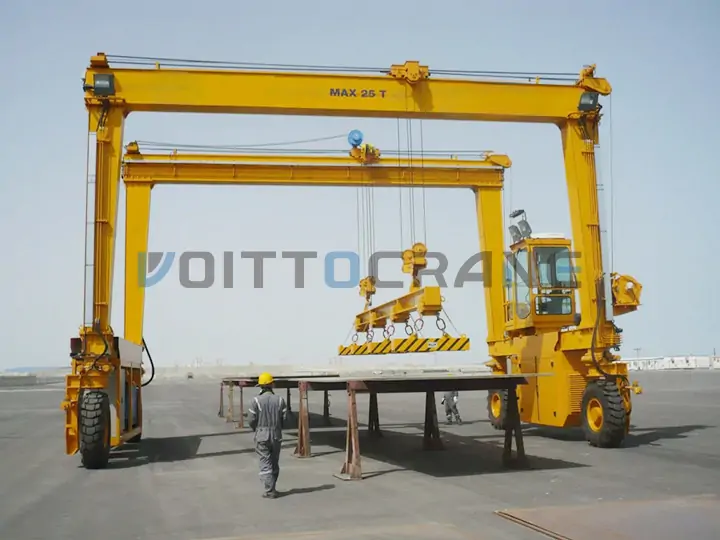
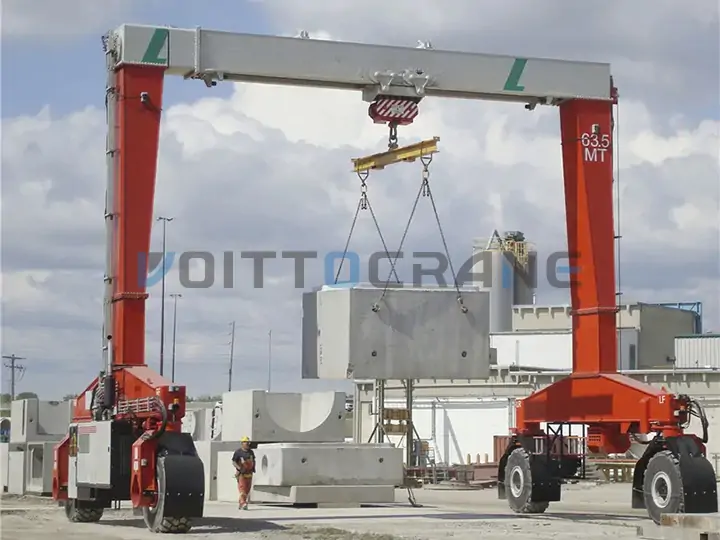
This RTG crane, which uses an electric hoist as its lifting mechanism, is available in both single-girder and double-girder configurations, which differ in lifting capacity and main girder design.
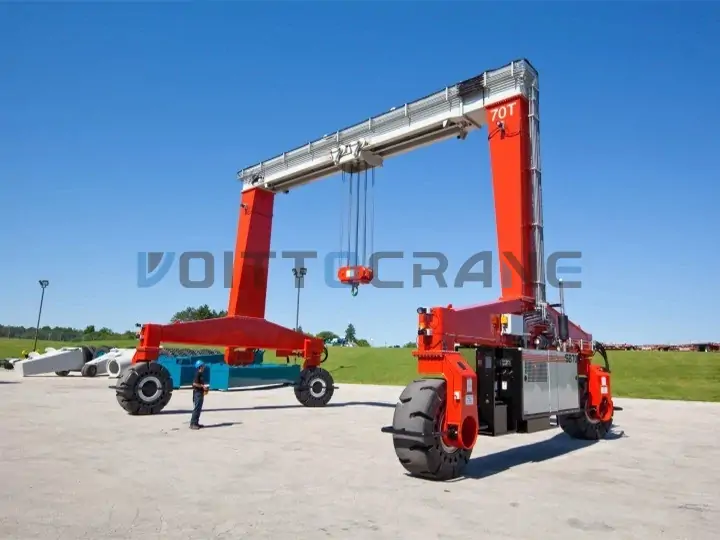
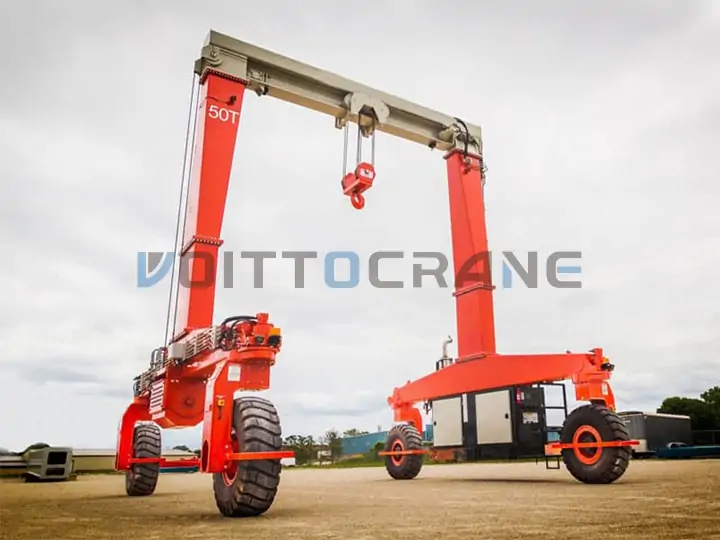
Single Girder Rubber Tyred Gantry Crane: The single-girder type typically handles 1 to 20 tons using one box-girder bridge on two rubber-tyred legs. Depending on the required clear height and working class, users can choose to configure either a CD/MD-type wire rope electric hoist or a European electric hoist as the lifting system.
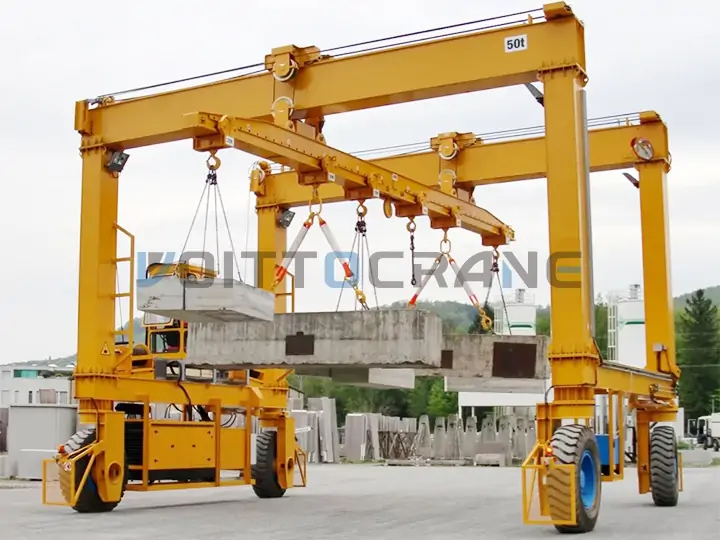
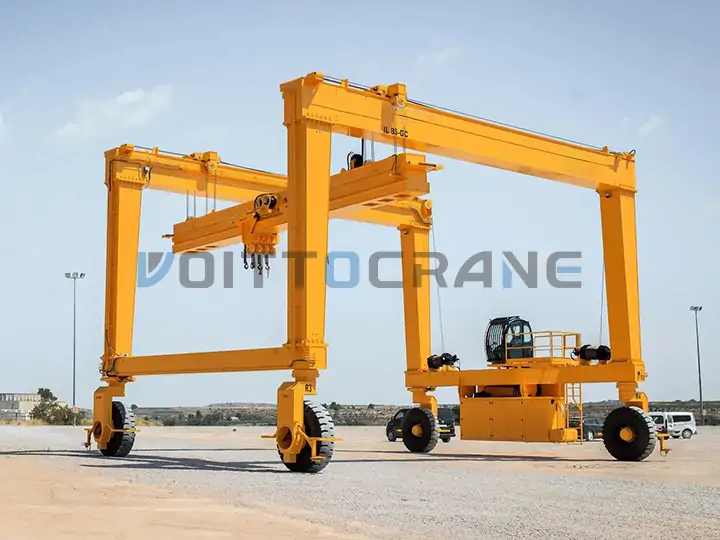
Double Beam Rubber Tyred Gantry Crane: This double-girder structure has a load-bearing capacity of 5 to 50 tons and features two parallel box girders, providing greater structural strength and rigidity. For precast beams of equal length or asymmetrical loads, where optimal load distribution is required, users can choose to install a single hoist trolley above the main girder or install one independent electric hoist at each of the four corners to achieve synchronized multi-point lifting.
Advantages
This electric hoist rubber tyred gantry crane is characterized by high mobility, high efficiency, and strong adaptability to various site conditions. Compared to rail-mounted gantry cranes, it does not require the installation of fixed tracks and can be moved freely on rubber tires, making it suitable for different work areas and temporary stockpile sites. Their key features include:
High Flexibility: This electric hoist rubber tyred gantry crane utilizes a rubber-tired travel system, enabling it to operate and move within the area without the need for fixed rails.
Simple Design and Low Maintenance Costs: This electric hoist features a more compact design, minimizing the use of complex mechanical transmission components. The lifting mechanism utilizes standardized lifting components, making maintenance convenient and ensuring a stable supply of spare parts.
Low Investment Cost: This equipment features a single- or double-girder structure and an electric hoist lifting system, which reduces the weight of the steel structure and the overall manufacturing complexity of the machine.
Wide Range of Applications: This equipment is suitable for precast concrete plants, steel structure factories, logistics yards, machinery manufacturing plants, and other similar settings.
Stable Operation and Precise Control: Equipped with an advanced electrical control system, this equipment ensures smooth lifting and operation.
High Adaptability to Site Conditions: This equipment does not require a fixed operating route and can adapt to various ground conditions and open work areas.
Energy-Efficient, Environmentally Friendly, and Low Operating Costs: This equipment is electrically powered, featuring low energy consumption and minimal noise during operation.
Quick Installation and Flexible Deployment: Its modular design facilitates transportation, installation, and commissioning.
Applications
Typically, operators use an electric hoist rubber tyred gantry crane to lift materials in precast concrete plants, steel structure fabrication shops, and machinery manufacturing facilities.
Precast Concrete Component Plants: Precast concrete manufacturers use electric hoist RTG cranes to handle precast beams, tunnel segments, concrete wall panels, and other large components.
Steel Structure Manufacturing Plants: Steel structure manufacturers use electric-hoist rubber-tyred gantry cranes to lift H-beams, steel plates, steel structure modules, and other materials.
Steel Storage Yards: Users employ this equipment for the loading, unloading, and stacking of steel coils, steel pipes, structural steel, and other metal materials.
Railway Engineering and Mass Transit Facilities: Railway project contractors use this equipment to handle sleepers, precast bridge components, subway tunnel segments, and other mass transit components.
Industrial Manufacturing Facilities: Operators use electric hoist double-girder RTG cranes to handle large equipment components, machine parts, and workpieces.
Logistics Centers and Inland Storage Yards: Logistics operators and warehousing companies use electric hoist RTG cranes for cargo stacking, loading and unloading, and on-site transfer operations.
Shipbuilding and Offshore Engineering Facilities: Shipbuilding companies use electric hoist rubber-tyred gantry cranes to handle ship hull sections, steel structure modules, and large equipment components.
Large-Scale Construction Project Sites: Construction companies use electric hoist RTG cranes to handle bridge components, building materials, and construction equipment.
Specifications
Specifications vary by girder configuration, with capacity ranging from 1 to 50 tons and span from 6 to 35 meters.
Parameter
Single Girder
Double Girder
Capacity
1–20 t
5–50 t
Span
6–20 m
10–35 m
Lifting Height
6–12 m
8–18 m
Work Duty (ISO 4301)
M3–M5 (A3–A5)
M4–M6 (A4–A6)
Hoisting Speed
3–8 m/min
2–7 m/min
Traveling Speed
15–25 m/min
10–20 m/min
Hoist Type
CD/MD wire rope hoist or European-standard wire rope hoist
Single hoist trolley or four synchronized electric hoists
Power Supply
380/400/415V, 50/60Hz, 3-phase
380/400/415V, 50/60Hz, 3-phase
Parts and Components
This electric hoist rubber tyred gantry crane consists primarily of a main girder, rubber-tired gantry legs, an electric hoist, a travel mechanism, an electrical control system, and safety devices. The various subsystems work together to perform lifting operations.
Main Girder: The main girder forms the load-bearing structure. This component ensures sufficient resistance to bending and torsion under rated loads.
Gantry Legs: The gantry legs support the main girder using an A-frame or rigid leg structure.
Electric Hoist: The electric hoist is a lifting mechanism installed above or below the main girder. Optional configurations include CD/MD-type wire rope hoists, European-standard wire rope hoists, or, for double-girder models, hoist trolleys and four hoists operating in synchronized mode.
Travel Mechanism: This component consists of drive wheels, a motor, and a gear reducer and is primarily responsible for propelling the crane across the ground. The system employs variable-frequency drive technology to effectively suppress load sway during material handling.
Electrical Control System: The electrical control system uses a control cabinet to manage hoisting, travel, and safety interlock functions via a pendant controller or wireless remote control.
Safety Devices: Safety devices include overload limiters, hoisting limit switches, anti-collision buffers, and emergency stop controls.
Electric Hoist Rubber Tyred Gantry Crane for Sale
VOITTO Crane is a supplier and manufacturer of electric hoist rubber tyred gantry crane. VOITTO Crane offers customization services for span, lifting height, and hoist configurations. Our products are exported to markets in Africa, Southeast Asia, and South America. As a result, buyers can access a one-stop service covering engineering design, manufacturing, and after-sales support, without incurring the additional costs associated with trading intermediaries. Please feel free to contact us for project solutions.
Specialized in Overhead Crane, Gantry Crane, Jib Crane, Port Crane & EOT Crane export solutions. 10+ years helping global clients with pre-sales consultation, capacity selection and site-specific configurations.
Users employ this equipment to lift and transport heavy loads between precast concrete plants, steel structure manufacturing workshops, and storage yards. Unlike bridge cranes, it does not require the installation of fixed tracks and offers a high degree of mobility and flexibility.
How does this crane differ from a container RTG crane?
Unlike container RTG cranes, which are specifically designed for handling containers, this equipment is intended for general industrial lifting applications. It features a lighter-duty cycle and a smaller footprint, and offers lifting configurations suited for precast concrete, steel, and manufacturing environments.
Can the hoist configuration be customized on a double girder crane?
Yes, double girder models accept either a single hoist trolley or four independent electric hoists positioned at the corners, allowing synchronized multi-point lifting for long or asymmetric loads such as precast beams.
Is a rail foundation required for installation?
No, because the crane travels on rubber tyres rather than fixed rails, installation generally needs only a level, load-bearing surface, which reduces civil engineering costs and the time needed before operation begins.
Qualification and Honor
Engineered Strength, Global Crane Supplier
service
Exclusive and Considerable, Customer First.
01
Reliable and Customized Solutions
Our pre-sale team provides consultations, tailoring solutions to your needs and environment.
Offer customization options for lifting capacity, span and lifting height etc. to meet specific needs.
02
Updated Production Process
Real-Time Progress Updates: Weekly reports and PM communication.
3-5 years warranty and free replacement for non-manufacturing defects.
24/7 online support and on-site assistance for crane issues.
FAQ
Engineered Strength, Global Crane Supplier
Do you ship internationally?
Yes, international shipping and export support are available for global customers.
Have your gantry cranes been used in major infrastructure projects?
Yes, our gantry cranes have participated in large-scale bridge construction projects and railroad construction in Brazil, Pakistan, Indonesia, Malaysia, Egypt, and other countries, in which we have played a particularly key role and contributed to these construction projects!
How are large gantry cranes shipped overseas?
Large gantry cranes are typically shipped overseas through modular disassembly, where the crane is broken down into major components (beams, legs, hoists) for containerized transport. For mega-cranes, we use specialized heavy-lift vessels equipped with reinforced decks, and critical parts are protected with anti-corrosion coatings during transit.
What voltage standards do your gantry cranes support?
Our gantry cranes support global voltage standards to ensure seamless operation worldwide. Solve any concerns you have about voltage.
Are mobile hoist cranes suitable for outdoor use?
Mobile hoist cranes can be used outdoors if designed with weather-resistant materials and proper surface conditions. For outdoor applications, features such as corrosion-resistant coatings, durable wheels, and stable braking systems are important.
Get In Touch
Please feel free to leave a message. We will reply in 24 hours.
Please specify your requirement by referring to the following aspects:
Which crane product do you need?
What is the maximum lifting capacity (in tons) required for your project?
Could you specify the lifting height (in meters) needed?
Can you provide details on the working environment, such as ground conditions, space limitations, and any obstacles?
What is the expected frequency of use and the duration of the project?


 English
  Español
  Português
  العربية
  Français
  Русский