Un élévateur de bateau est un type d'équipement de levage utilisé pour les yachts. Conçu spécifiquement pour la mise à l'eau, la sortie de l'eau et l'entretien des yachts, bateaux et autres embarcations de petite et moyenne taille, cet équipement de manutention spécialisé est largement utilisé dans les ports de plaisance, les chantiers navals, les centres de réparation et les zones d'amarrage pour yachts de luxe. Doté d'une structure en acier haute résistance et d'un système d'élingues flexible, il garantit un levage et un transport stables et efficaces tout en préservant la coque.
Un élévateur mobile (également appelé élévateur de yacht ou élévateur marin) est un élévateur de bateau automoteur. Cet équipement est spécialement conçu pour les marinas et les chantiers navals, permettant les opérations de levage, de manutention et de mise à l'eau des navires. La gamme d'élévateurs mobiles VOITTO offre des capacités de levage standard de 30 à 300 tonnes (avec des configurations sur mesure jusqu'à 1 200 tonnes) et des portées de 3 à plus de 25 mètres, pour une hauteur de levage maximale de 20 mètres. Cette gamme d'équipements est conforme aux normes internationales telles que CE, ISO 9927-3, FEM 1.001 et EN 13135 et est largement utilisée dans les marinas, les installations navales et les chantiers de rénovation de yachts du monde entier.
Qu'est-ce qu'un ascenseur de voyage ?
Un élévateur de coque mobile est un appareil de levage mobile. Classé selon la norme EN 13001-1, il utilise des roues électriques à pneus en caoutchouc pour se déplacer au-dessus de la coque, soulève la coque hors de l'eau à l'aide d'élingues en polyester et la transporte vers différents endroits du chantier naval à des vitesses allant jusqu'à 5 km/h.
Contrairement aux élévateurs à bateaux fixes, un élévateur de bateaux mobile ne nécessite aucune structure de piste permanente, permettant ainsi aux opérateurs de chantier de positionner les navires n'importe où dans l'enceinte. Le système d'entraînement utilise une transmission hydrostatique aux quatre roues, avec différents modes de direction : crabe, coordonnée et indépendante. De ce fait, la précision de manœuvre dans les espaces restreints du chantier atteint généralement ±50 mm.
La gamme de monte-bateaux VOITTO est dotée d'un châssis en acier de construction S355 haute résistance entièrement soudé. Chaque treuil d'élingue est équipé d'un système de freinage hydraulique à double redondance, et l'architecture de commande repose sur des automates programmables Siemens ou Schneider. Ainsi, les opérateurs peuvent surveiller la charge en temps réel grâce à des capteurs de force certifiés (classe de précision C3 selon la norme EN 45501) et à un écran SCADA embarqué.
TYPES ET VARIANTES
VOITTO a divisé sa gamme de grues pour yachts en quatre lignes de produits standard, chacune optimisée pour des types de navires et des configurations de chantiers navals spécifiques, avec des capacités de levage allant de 30 tonnes à plus de 1 200 tonnes.
Modèle
Détails
Élévateur de voyage compact (30–80 T)
Portée de 3 à 12 m. Conçu pour les petits ports de plaisance accueillant des voiliers et des bateaux à moteur jusqu'à 24 m de longueur hors tout. Son gabarit étroit permet une navigation dans des chenaux étroits à voie unique.
Grue de yacht standard (80–200 T)
Envergure de 10 à 18 m. La variante la plus répandue pour les navires de plaisance et commerciaux de taille moyenne. Disponible avec une propulsion diesel-hydraulique ou entièrement électrique.
Transport maritime - Largeur de levage (200–300 T)
Portée de 16 à 25 m. Conçu pour les grands yachts à moteur, les patrouilleurs et les bateaux de travail. La structure à double élingue répartit la charge conformément au groupe M5 de la méthode des éléments finis (FEM 1.001).
Bateau élévateur de voyage - Super (300–1 200 T)
Portées de plus de 25 mètres. Conception sur mesure pour superyachts, navires d'ingénierie offshore et navires militaires. Une certification structurelle par analyse par éléments finis (FEA) est fournie pour chaque projet.
Caractéristiques principales
L'élévateur mobile pour bateaux VOITTO répond à un large éventail de normes de sécurité et de productivité. Chacune d'elles est vérifiée avant la livraison conformément aux normes de conception EN 13135 et FEM 1.001.
Système d'entraînement hydrostatique : Des pompes à pistons axiaux à cylindrée variable sont installées aux quatre coins, permettant un contrôle de vitesse progressif de 0 à 5 km/h, éliminant ainsi les chocs sur la coque lors des changements de vitesse.
Assemblage d'élingue en polyester : Des élingues à œillet plat conformes à la norme ISO 6405-2 sont utilisées, avec un coefficient de sécurité minimal de 7:1. La fonction de compensation de charge de l'angle de l'élingue est automatiquement calculée et ajustée par le système PLC.
Protection contre les surcharges : Chaque point de levage est équipé de deux capteurs de charge (conformes à la norme EN 45501). Une alarme sonore et visuelle se déclenche lorsque la charge atteint 90% de la charge maximale d'utilisation (CMU), et le treuil s'arrête automatiquement lorsqu'elle atteint 110%.
Système de direction indépendant à quatre roues : Offre trois modes de direction — “ crabe ”, “ coordonné ” et “ indépendant ” — permettant un positionnement latéral précis à ±50 mm près, même dans des allées étroites aussi étroites que la largeur plus 800 mm.
Option entièrement électrique : Utilise un système de propulsion entièrement électrique zéro émission, associé à une technologie de freinage régénératif, pour récupérer jusqu'à 181 TP3T d'énergie potentielle de levage. Particulièrement adapté aux environnements clos ou sensibles au bruit des ports de plaisance.
Diagnostic à distance : Une passerelle 4G/Wi-Fi embarquée transmet en temps réel les données de pression hydraulique, de température du moteur et de charge historique à la plateforme cloud de l'équipement afin de générer des alertes de maintenance prédictive.
Aapplication
Grâce à leur capacité de levage fiable et à leur excellente maniabilité, les utilisateurs emploient des grues mobiles pour yachts afin d'effectuer des opérations de levage dans les scénarios suivants.
Mise à l'eau et sortie de l'eau : Les utilisateurs se servent de cet équipement pour mettre les yachts à l'eau depuis le quai ou pour les hisser à terre.
Entretien de la coque : Le personnel de maintenance utilise cet équipement pour la peinture, le traitement anticorrosion, le nettoyage et les réparations mécaniques une fois le navire sorti de l'eau.
Transport maritime terrestre : Les utilisateurs se servent de cet équipement pour déplacer les bateaux dans les chantiers navals, les quais ou les zones de stockage.
Stockage de yachts à long terme : Les utilisateurs se servent de grues pour yachts afin de hisser les yachts à terre pour un stockage et une protection à long terme.
Construction et livraison de nouveaux navires : Les opérateurs de chantiers navals l'utilisent pour soulever et transporter les navires nouvellement construits pendant les phases de production, de mise en service et de livraison.
Opérations dans les bassins confinés : Les utilisateurs s'en servent pour des manœuvres agiles et des déplacements précis dans les docks ou les chantiers navals à espace limité.
Manutention des navires de fort tonnage : Les opérateurs l'utilisent pour soulever et transporter en toute sécurité de grands yachts, des multicoques et des navires lourds.
Déploiement de navires de sauvetage d'urgence : Les utilisateurs l'emploient pour le lancement et le déploiement rapides de navires d'urgence tels que des bateaux de sauvetage et des patrouilleurs.
Gestion de yachts haut de gamme : Les utilisateurs l'utilisent pour la manutention, l'amarrage et la gestion de la maintenance de haut niveau des yachts de luxe.
Logistique des exportations maritimes : Les utilisateurs contrôlent cet équipement pour exécuter les opérations de chargement, de transbordement et de transport logistique des navires destinés à l'exportation.
SPÉCIFICATIONS TECHNIQUES
Toutes les données de performance ci-dessous correspondent aux configurations d'usine standard.
Paramètres
Autonomie standard
Notes personnalisées
Capacité de levage (SWL)
30 t – 300 t
Personnalisable, jusqu'à 1 200 tonnes.
Span — Petits yachts
3 m – 15 m
Convient aux navires jusqu'à environ 15 m de longueur hors tout.
Span — Yachts de taille moyenne/grande
15 m – 25 m
Yachts à moteur, patrouilleurs, catamarans
Span — Superyachts
25 m+
Analyse structurelle par éléments finis personnalisée selon la norme EN 13001-3
Hauteur de levage
3 m – 20 m
Mesuré du sol au point d'accroche de l'élingue
Vitesse de déplacement (chargé)
0 – 5 km/h
Commande hydrostatique progressive
Vitesse de levage
0 – 3 m/min
Variable, dépendant de la charge
Système d'entraînement
Diesel-hydraulique / Entièrement électrique
Option hybride disponible ; certification ATEX sur demande
Modes de direction
Crabe / Coordonné / 4 roues indépendantes
Sélection via la cabine ou la télécommande
Quantité d'élingues
2 à 4 élingues standard
Configuration à 6 élingues pour les modèles de plus de 300 tonnes
Coefficient de sécurité des élingues
7:1 (ISO 6405-2)
Œillet plat en polyester ; manchon anti-abrasion standard.
Surveillance de la charge
Capteurs de force de classe C3 (EN 45501)
Alarme à 90% SWL ; coupure à 110% SWL
Qualité structurale
Acier à haute résistance S355
Galvanisation à chaud ou peinture de qualité marine en option.
Groupe de service FEM
M4 – M6
Adapté aux cycles de levage annuels lors de la mise en service
Température de fonctionnement
-20 °C à +50 °C
Pack arctique jusqu'à -40 °C disponible
Pièces pour ascenseur de voyage
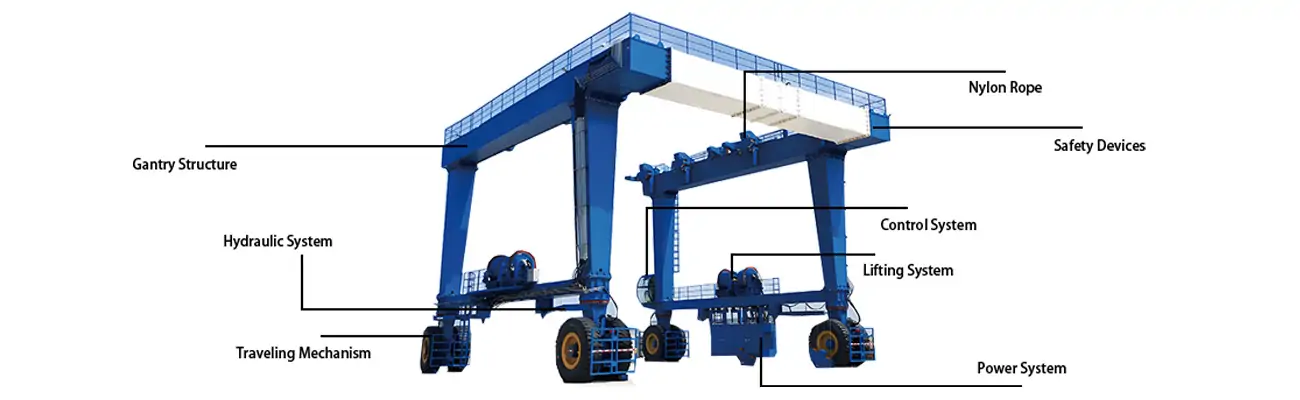
Un élévateur maritime pour bateaux se compose principalement d'une structure en portique, d'un système de levage, d'un mécanisme de déplacement, d'un système hydraulique, d'un système de commande, d'un système d'alimentation, de cordes en nylon et de dispositifs de sécurité. Ces composants fonctionnent ensemble pour soulever et déplacer le navire.
Structure du portique : La structure du portique assure le support global et l'espace nécessaire à l'élévateur à bateaux.
Système de levage : Le système de levage utilise une corde en nylon, des poulies et des mécanismes de levage pour soulever la coque.
Mécanisme de déplacement : Le mécanisme de marche se compose d'une transmission multiroues et d'un dispositif de direction.
Système hydraulique : Le système hydraulique fournit la puissance nécessaire au levage, à la direction et à la propulsion.
Système de contrôle : L'opérateur contrôle l'ensemble de l'équipement depuis la cabine ou par télécommande.
Système d'alimentation : Le système d'alimentation assure le fonctionnement hydraulique, le levage et le déplacement de l'équipement.
Corde en nylon : En tant qu'élément porteur flexible, la corde en nylon répartit uniformément la contrainte sur la coque.
Dispositifs de sécurité : Inclure des interrupteurs de fin de course, une protection contre les surcharges et un arrêt d'urgence.
Ascenseur de voyage à vendre
VOITTO Crane est un fabricant spécialisé dans les solutions de levage de charges lourdes pour les secteurs maritime, industriel et des infrastructures. Fort d'un engagement indéfectible envers la précision d'ingénierie et la fiabilité opérationnelle, VOITTO conçoit, fabrique et met en service une vaste gamme de ponts roulants, de portiques, de systèmes de levage et d'équipements de manutention portuaire pour ses clients.
Chaque produit expédié de notre usine est accompagné d'une documentation technique CE complète et d'un certificat d'essai de charge en usine. Un interlocuteur dédié au service après-vente est également attribué. Notre équipe d'ingénieurs travaille en étroite collaboration avec les autorités portuaires, les sociétés de classification et les exploitants de terminaux afin de garantir une intégration parfaite de chaque grue de levage pour bateaux dans son environnement d'exploitation. Si vous recherchez une solution de levage pour yachts, n'hésitez pas à nous contacter. nous contacter à tout moment.
Spécialisés dans les solutions d'exportation de ponts roulants, portiques, grues à flèche, grues portuaires et ponts roulants. Plus de 10 ans d'expérience dans l'accompagnement de clients internationaux : conseils avant-vente, choix de la capacité et configurations sur mesure.
Quelle est la capacité de levage maximale d'un monte-charge mobile ?
Les modèles de production standard couvrent une capacité de levage de 30 à 300 tonnes. Cependant, la gamme sur mesure étend cette capacité jusqu'à 1 200 tonnes pour les super-yachts et les navires offshore.
Comment choisir la portée appropriée pour ma marina ?
Le choix de la portée dépend de la largeur maximale du navire que votre chantier naval peut accueillir, et il faut prévoir un dégagement d'au moins 800 millimètres de chaque côté pour le passage des élingues. Par conséquent, si le quai est principalement utilisé pour la mise à l'eau de bateaux à moteur d'une largeur de 10 mètres, une portée de 12 à 13 mètres est généralement préconisée.
Un ascenseur de voyage peut-il fonctionner sur des surfaces non pavées ou en pente ?
Oui, les élévateurs mobiles VOITTO supportent des pentes jusqu'à 4% (en charge) et 8% (à vide), à condition que la portance du sol respecte les spécifications de charge par roue indiquées dans le rapport de mise en service. La plupart des aires de stationnement en gravier compacté ou en asphalte conviennent donc ; en revanche, les sols meubles ou gorgés d'eau nécessitent généralement des dalles en béton sous les voies de circulation afin de répartir les charges ponctuelles.
Quelle norme de certification s'applique aux élingues de levage pour chariots élévateurs ?
Nous fournissons des élingues à œillet plat en polyester certifiées ISO 6405-2 avec un coefficient de sécurité minimum de 7:1. Les élingues sont identifiées par un code couleur selon leur capacité, conformément à la norme EN 1492-1, inspectées tous les 12 mois et remplacées dès les premiers signes d'abrasion ou de dégradation par les UV. Des manchons anti-abrasion sont fournis de série sur tous les modèles d'une capacité de charge supérieure à 80 tonnes.
Un élévateur de cabine entièrement électrique constitue-t-il une alternative pratique aux modèles diesel-hydrauliques ?
La série TL 100 % électrique de VOITTO offre un couple de levage équivalent grâce à ses moteurs à aimants permanents, réduit le bruit de fonctionnement d'environ 12 dB(A) et élimine les émissions polluantes sur les quais fermés. De plus, le levage régénératif permet de récupérer jusqu'à 181 Tp³ d'énergie lors des cycles de descente, réduisant ainsi sensiblement les coûts d'électricité annuels.
Qualification et honneur
Engineered Strength, fournisseur mondial de grues
service
Exclusif et considérable, le client d'abord.
01
Des solutions fiables et personnalisées
Notre équipe de prévente propose des consultations, en adaptant les solutions à vos besoins et à votre environnement.
Offrir des options de personnalisation pour la capacité de levage, la portée et la hauteur de levage, etc. pour répondre à des besoins spécifiques.
02
Processus de production actualisé
Mise à jour des progrès en temps réel : Rapports hebdomadaires et communication avec les PM.
Essais avant livraison : 100% contrôles de charge et de sécurité, rapports détaillés.
03
Un service après-vente digne de confiance
Garantie de 3 à 5 ans et remplacement gratuit en cas de défaut de fabrication.
Assistance en ligne 24 heures sur 24, 7 jours sur 7, et assistance sur place pour les problèmes liés aux grues.
FAQ
Engineered Strength, fournisseur mondial de grues
Les grues mobiles à palanquée peuvent-elles être utilisées à l'extérieur ?
Les grues mobiles à palan peuvent être utilisées à l'extérieur si elles sont conçues avec des matériaux résistants aux intempéries et dans des conditions de surface appropriées. Pour les applications extérieures, des caractéristiques telles que des revêtements résistants à la corrosion, des roues durables et des systèmes de freinage stables sont importantes.
Êtes-vous fabricant ou fournisseur ?
VIOTTO est un fabricant et fournisseur de plateformes élévatrices à ciseaux robustes, proposant des solutions directes d'usine et des options personnalisées.
Peut-il être personnalisé ?
Oui, la capacité de levage, la portée, la hauteur, le type de structure et les options de levage peuvent être personnalisés pour répondre à des conditions de travail spécifiques.
Peut-il être utilisé à l'intérieur ?
Oui, la plupart des modèles de plateformes élévatrices pour entrepôts sont conçus pour les environnements intérieurs d'entrepôts et industriels.
Les grues mobiles à palan peuvent-elles être personnalisées pour des applications spécifiques ?
Oui, la plupart des fabricants proposent des grues mobiles sur mesure pour répondre à des besoins opérationnels spécifiques. Les options personnalisées comprennent le réglage de la hauteur, de la portée, de la capacité de charge, du type de roue et de la configuration du palan. Nous sommes spécialisés dans les solutions de levage sur mesure, aidant les clients internationaux à adapter l'équipement aux conditions de travail locales et aux exigences uniques des projets.
Prendre contact
N'hésitez pas à nous laisser un message. Nous vous répondrons dans les 24 heures.
Veuillez préciser vos besoins en vous référant aux aspects suivants :
De quel produit de grue avez-vous besoin ?
Quelle est la capacité de levage maximale (en tonnes) requise pour votre projet ?
Pouvez-vous préciser la hauteur de levage nécessaire (en mètres) ?
Pouvez-vous fournir des détails sur l'environnement de travail, tels que l'état du sol, les limites de l'espace et les obstacles éventuels ?
Quelle est la fréquence d'utilisation prévue et la durée du projet ?




 English
  Español
  Português
  العربية
  Français
  Русский