


expérience
30
+Années
expérience en matière d'exportation à l'échelle mondiale
client
3500
+
un équipement couvrant 80 pays
exportations
70
%
les exportations se concentrent sur les marchés émergents
service
24
H
réponse au service en ligne


Voitto Crane has been dedicated to the design, manufacturing, and supply of high-quality crane systems for over three decades.
expérience
30
+Années
expérience en matière d'exportation à l'échelle mondiale
client
3500
+
un équipement couvrant 80 pays
exportations
70
%
les exportations se concentrent sur les marchés émergents
service
24
H
réponse au service en ligne

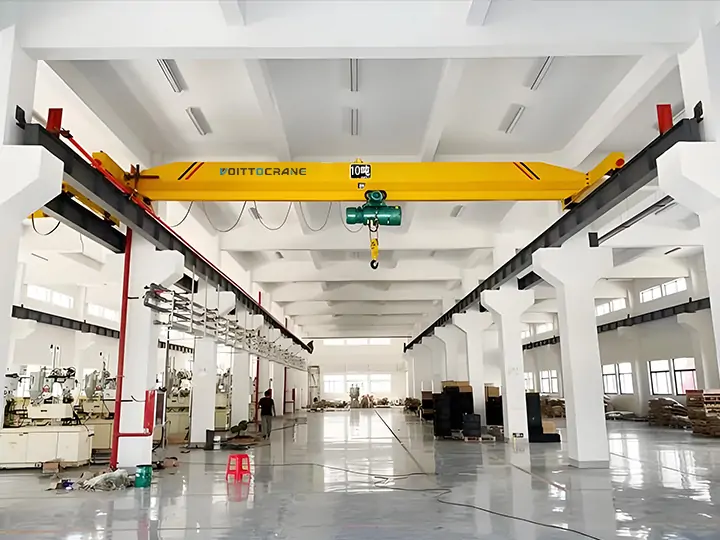


Selecting an electric hoist for an overhead crane is fundamentally different from purchasing an electric hoist separately. The hoist must not only meet the lifting requirements for the rated load but also be compatible with the crane’s main girder structure, operate within the limited headroom, function on a trolley that matches the crane’s rails or flanges, have a duty class that corresponds to the crane’s actual operating conditions, and share a compatible electrical and control system with the crane’s other mechanisms. Before purchasing a hoist, users should first clarify the following key information: crane type (single-girder, double-girder, or underslung), rated and maximum lifting capacity, required lifting height and available headroom, trolley configuration, expected duty cycle, required lifting speed, and operating environment. Next, this article will explain in detail, step by step, how to select the right electric hoist for a bridge crane to ensure smooth operation under various working conditions, improve production efficiency, and reduce downtime. 1. Start With the Overhead Crane Configuration Before selecting a lifting mechanism, the procurement team should first determine the crane’s structural type, as this…
Ceiling crane system terminology is often used inconsistently across suppliers, with “ceiling crane,” “ceiling suspended crane,” and “underhung crane” used interchangeably, even though they describe related but distinct concepts. Plant managers and procurement teams researching overhead material handling benefit from understanding these differences before comparing suppliers. The sections below walk through the terminology, the operating principle, and the factors that separate one configuration from another. What Is a Ceiling Crane System? A ceiling crane system is an overhead material handling solution in which the crane’s supporting runway is mounted to, or suspended from, the upper structure of a building — roof trusses, ceiling steelwork, or a dedicated support frame — rather than attached to freestanding columns or a floor-supported runway structure. Because the runway draws its support from the building’s overhead structure, the system occupies airspace above the work area instead of adding new support columns at floor level. This matters most in older workshops, narrow production bays, or buildings where floor-mounted crane columns would interfere with existing machinery, walkways, or production lines. “Ceiling crane system” is commonly used as…
Crane wheel flange wear — the progressive damage caused by sustained contact between the wheel flange and the side of the running rail — does not resolve itself and cannot be managed by lubrication alone. Once the underlying cause is identified, corrective work must be sequenced correctly: applying adjustments in the wrong order wastes time, produces misleading results, and in some cases redistributes the contact force without eliminating it. The problem is known by several names depending on where you operate. North American engineers typically call it rail biting or crane skewing. European maintenance teams use flange rubbing. In Chinese and much of Asian crane industry practice, the direct term rail gnawing (啃轨) is common. UK and Indian engineers working with European-origin cranes often refer to the trolley mechanism as the crab and describe the same phenomenon as crab flange wear. Whatever the terminology, the corrective approach is the same. This article covers five field-correctable solutions — with step-level procedures where the work involves physical adjustment — and five engineering improvements for cases where standard corrections are insufficient or where…

 English English
  Español
 Português
 العربية
 Français
 Русский


