


experience
30
+Years
global export experience
customer
3500
+
equipment covering 80 countries
exports
70
%
exports focus on emerging markets
service
24
H
online service response


Voitto Crane has been dedicated to the design, manufacturing, and supply of high-quality crane systems for over three decades.
experience
30
+Years
global export experience
customer
3500
+
equipment covering 80 countries
exports
70
%
exports focus on emerging markets
service
24
H
online service response

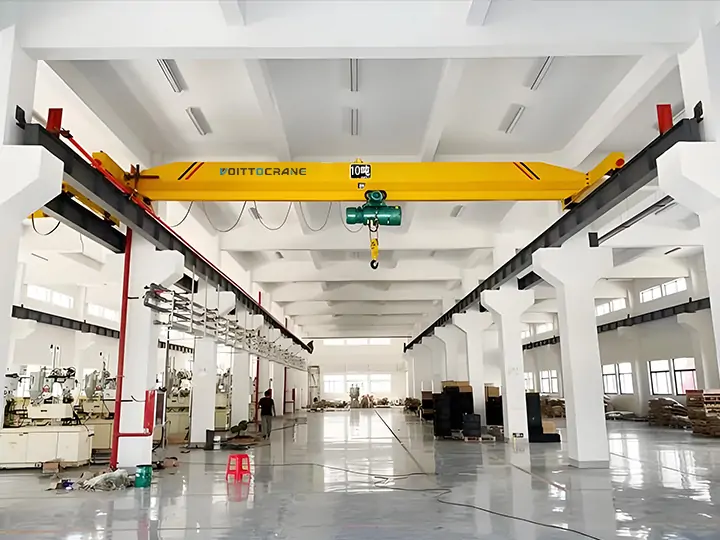


Crane over-hoisting — sometimes called an over-winding or over-travel accident — occurs when a hook block rises past its designed upper limit and collides violently with the hoist drum, trolley frame, or crane structure. The impact can snap the wire rope instantly, dropping the load and the hook without warning. Understanding why it happens, and what stops it from happening, is one of the most practical things a crane manager or maintenance engineer can know. This guide covers the root causes (equipment and human), how to restore safe operation after an event, and the layered prevention system that keeps it from recurring — from limit switch selection through operator discipline. What Crane Over-Hoisting Actually Means Over-hoisting is the loss of control over vertical hook travel at the upper extreme of the hoist’s range, as defined under hoist safety standards including ASME B30.16 and OSHA 1910.179. In normal operation, the upper limit switch cuts power to the hoist motor before the hook block can reach the drum. Over-hoisting happens when that cut-off fails — for any reason — and the hook…
A well-maintained overhead crane typically lasts 20 to 30 years, depending on its duty class. That number is a design convention, not a warranty: what really ends a crane’s life is fatigue in its load-bearing steel structure, not the age on the calendar. Buyers see “30-year design life” in tender documents, and owners of older equipment are asked whether to repair, refurbish or replace. Neither figure says how much life is actually left. This guide explains where the 20-, 25- and 30-year figures come from, how design life is calculated, what shortens it, and how to estimate remaining cycles with our free Crane Lifespan Calculator. Crane design service life is the total number of working cycles a crane is calculated to perform under stated loading conditions, as classified under ISO 4301-1. How Long Does an Overhead Crane Last by Duty Class? Reference design lives run from about 20 to 30 years by working class Lighter duty classes carry longer reference lives: roughly 30 years for A1–A2, 25 years for A3–A5 and 20 years for A6–A7. The reason is the cycle…
The gearbox, drum, and sheave form the mechanical core of any overhead crane hoist mechanism — and when any one of them fails, the entire lift stops. These three components are also where most unplanned maintenance calls originate, because their failure symptoms overlap and early warning signs are easy to misread. A grinding noise, for instance, could point to a gearbox with insufficient backlash, a drum with a worn groove, or a seized sheave starved of lubrication — three very different corrective actions. This guide helps maintenance engineers and plant managers do two things quickly: identify which component is failing based on what they are seeing or hearing, and know the exact wear threshold at which replacement is no longer optional. For teams evaluating suppliers or spare-part sourcing, the compliance section at the end covers the certification documents worth requesting before a part ships. Diagnose the Fault First: Symptom Quick-Reference Before pulling tools, match the symptom to the component. The table below maps observable signs to the most likely source and the urgency level. What you are seeing or hearing…

 English English
  Español
 Português
 العربية
 Français
 Русский


