Le portique conforme à la norme européenne FEM est un appareil de levage haute performance. Conçu selon les normes européennes FEM les plus exigeantes, il allie légèreté, efficacité énergétique et précision de commande. L'équipement est doté de palans électriques à câble européens, d'un variateur de fréquence (VFD) et d'une structure en acier optimisée. Comparé aux portiques traditionnels, il offre une pression sur les roues réduite, une hauteur de levage supérieure, un fonctionnement plus fluide et des besoins de maintenance moindres. Disponible en versions monopoutre et bipoutre, avec des capacités de levage allant de 1 tonne à plus de 320 tonnes, ce portique peut être personnalisé pour répondre aux exigences de diverses applications industrielles.
Le portique standard FEM est disponible en deux configurations structurelles : des systèmes monopoutre avec des capacités de levage nominales de 1 à 32 tonnes et des modèles bipoutre avec des capacités de levage de 5 à 320 tonnes. Les deux configurations sont conformes aux normes FEM 1.001 et ISO 4305, sont équipées de systèmes de sécurité redondants et présentent une vitesse de levage de 2 mètres par seconde. Cet équipement est généralement utilisé pour la manutention de matériaux dans les secteurs de la sidérurgie, de la construction navale et de l’assemblage industriel. Il est certifié CE et conçu pour une durée de vie allant jusqu’à 25 ans.
Qu'est-ce qu'un portique standard FEM ?
Le portique conforme à la norme FEM est un système de levage au sol. Ce portique européen se caractérise par une poutre principale à section caissonnée soudée et des poutres d'extrémité boulonnées, ce qui réduit le temps d'installation de 30 % par rapport aux structures rivetées. De plus, le système à poutre unique offre une portée de 6 à 18 mètres et occupe un espace horizontal minimal, tandis que la configuration à poutre double permet une portée plus importante, de 15 à 35 mètres. Grâce à l'intégration de freins limiteurs de charge redondants, de deux points de suspension et de capteurs de force de précision, ce système certifié FEM atteint une disponibilité de 99,2 %.
Grue portique monopoutre
Grue portique bipoutre
Sa conception modulaire permet d'augmenter la capacité de levage sans remplacer la structure principale, prolongeant ainsi la durée de vie de l'équipement à plus de 25 ans. Par conséquent, lors du choix de la configuration de poutres appropriée, les utilisateurs doivent prendre en compte l'agencement de l'usine, la fréquence de charge et les exigences de production.
Types de portiques standard FEM
Un portique monopoutre est constitué d'une poutre en acier soudée unique, montée sur quatre pieds. Il offre une capacité de levage de 1 à 32 tonnes, une portée de 6 à 18 mètres et une hauteur de levage de 6 à 12 mètres. Ce système compact est idéal pour les espaces à faible hauteur sous plafond, nécessitant 18% de hauteur sous plafond en moins que les modèles bipoutres. De plus, les modèles monopoutre sont équipés d'un chariot de levage simplifié, ce qui allonge les intervalles de maintenance et réduit les besoins en pièces détachées de 25%.
Les portiques à double poutre sont constitués de deux poutres principales parallèles. Ce modèle offre une capacité de levage de 5 à 320 tonnes, une portée de 15 à 35 mètres et une hauteur de levage de 10 à 25 mètres. Cette conception répartit la charge sur deux points d'appui, améliorant ainsi la stabilité lors des opérations de levage dynamiques. De ce fait, le système à double poutre est parfaitement adapté à la manutention d'équipements industriels lourds, de composants navals de grande taille et aux opérations industrielles en continu.
Avantages et caractéristiques
Les portiques européens sont conçus selon les normes européennes FEM les plus avancées, alliant légèreté, efficacité énergétique et technologie de commande intelligente. Je présenterai ci-dessous les principaux avantages et caractéristiques d'un portique conforme à la norme FEM.
Conception légère: Par rapport aux portiques traditionnels, son poids mort est réduit jusqu'à 30%, ce qui réduit efficacement la charge sur les roues et les coûts de construction des fondations.
Voyages dans la région de Greater HookLa conception à faible hauteur sous plafond maximise la hauteur de levage.
Économe en énergie et performant: Des systèmes d'entraînement avancés et des moteurs à haut rendement réduisent la consommation d'énergie jusqu'à 40%.
Un contrôle précisLa régulation à fréquence variable assure un fonctionnement fluide, un positionnement précis et minimise les oscillations de la charge.
Faible entretien requisDes composants modulaires et un système d'entraînement fiable minimisent les besoins de maintenance et les temps d'arrêt.
Longue durée de vieDes composants de haute qualité et une conception structurelle optimisée garantissent la durabilité de l'équipement.
Fonctionnement silencieux: La technologie d'entraînement avancée réduit considérablement le bruit de fonctionnement.
Prise en charge de l'automatisation intelligenteLes portiques européens peuvent être intégrés à des systèmes de commande PLC, des systèmes anti-balancement, une surveillance à distance et des solutions automatisées de manutention.
Application
Les utilisateurs font fonctionner un portique FEM Standard pour effectuer des tâches de manutention de matériaux dans les secteurs de la fabrication, de la logistique, des ports, de la construction navale, de l'énergie éolienne et de l'industrie lourde.
Usines de fabricationLes utilisateurs exploitent des ponts roulants européens dans les ateliers de fabrication pour assurer le transport et l'assemblage de composants de grande taille.
Industries de la structure en acier et de la transformation des métauxLes opérateurs utilisent un portique standard FEM pour lever et transporter l'acier et les grandes pièces métalliques, ainsi que pour les déplacer entre les postes de soudage.
Entrepôts et centres logistiquesLes portiques européens assurent les opérations de chargement, de déchargement, d'empilage et de logistique des marchandises lourdes.
Ports et terminauxLes utilisateurs emploient des portiques européens pour effectuer des opérations de chargement, de déchargement et de transbordement dans les parcs à conteneurs et à marchandises en vrac.
Chantiers navals de construction et de réparation navalesLes exploitants de chantiers navals utilisent des portiques de levage conformes à la norme européenne FEM pour soulever les sections de coque des navires et les grands éléments structurels.
Énergie éolienne et industries des nouvelles énergiesLes utilisateurs font fonctionner cet équipement pour soulever les pales d'éoliennes, les gros composants, les sections de tour et les nacelles.
Composants préfabriqués et industries de la constructionLes opérateurs l'utilisent pour soulever des poutres en béton préfabriqué, des composants préfabriqués et de grands modules de construction.
Parcs à bestiaux à ciel ouvert et parcs de stockage de matériaux lourdsLes utilisateurs font fonctionner ces grues pour transporter de l'acier, du minerai et des équipements lourds.
Construction de transports ferroviaires et d'infrastructuresLes opérateurs utilisent des portiques FEM Standard pour lever des éléments structuraux de métro, des sections de pont préfabriquées et de grands éléments structuraux pour les systèmes de transport ferroviaire.
Usines intelligentes et ateliers automatisésLes portiques de type européen assurent la manutention des matériaux et la planification des opérations dans les lignes de production intelligentes et les systèmes sans pilote.
Spécification
Paramètres
Poutre unique 1–5 t
Poutre unique 5–16 t
Poutre unique 16–32 t
Poutre double 5–100 t
Poutre double 100–320 t
Capacité de levage
1–5 t
5–16 t
16–32 t
5–100 t
100–320 t
Largeur de la travée
4–6 m
6–12 m
8–18 m
15–25 m
25–35 m
Hauteur de levage
6–8 m
6–10 m
8–12 m
10-18 m
12–25 m
Vitesse de levage
2 m/s
2 m/s
2 m/s
2 m/s
2 m/s
Vitesse du tramway
20-30 m/min
20-30 m/min
20–40 m/min
30–50 m/min
30–50 m/min
Voyages en pont
15–20 m/min
15–20 m/min
20–25 m/min
20-30 m/min
20-30 m/min
Puissance moteur
2,2 kW
3,7 kW
5,5 kW
15–37 kW
45–75 kW
Classe de service (FEM)
A5
A5
A5
A5
A5
Précision de la cellule de charge
±0,5%
±0,5%
±0,5%
±0,5%
±0,5%
Alimentation électrique
380–480 V triphasé
380–480 V triphasé
380–480 V triphasé
380–480 V triphasé
380–480 V triphasé
normes
FEM 1.001 ISO 4305
FEM 1.001 ISO 4305
FEM 1.001 ISO 4305
FEM 1.001 ISO 4305
FEM 1.001 ISO 4305
RemarqueLes spécifications ci-dessus sont standard. VOITTO Crane propose des solutions sur mesure, non standard.
Éléments de la grue à portique standard FEM
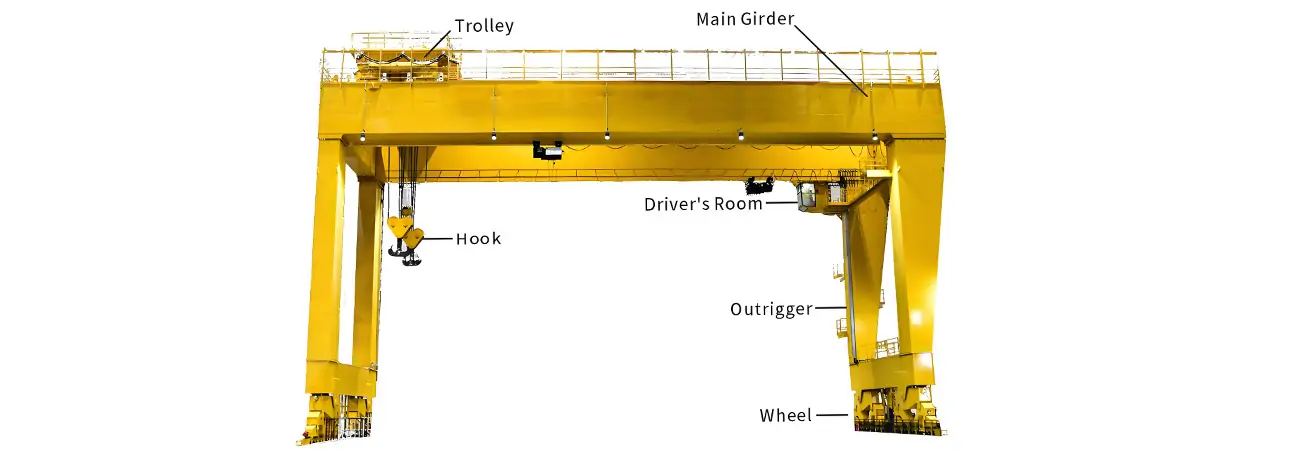
Le portique standard FEM intègre douze composants mécaniques, électriques et structurels majeurs, conçus pour fonctionner ensemble afin d'effectuer des tâches de levage.
Poutre principale (poutre simple ou double) : des poutres en acier à section caissonnée soudée sont utilisées comme éléments porteurs principaux.
Poutres d'extrémité : Des chariots à quatre roues montés sur les pieds transfèrent la charge structurelle à la fondation.
Pieds et cadre : Des colonnes en acier de construction soudées s'étendent des fondations jusqu'à la hauteur de la poutre principale.
Ensemble chariot : Un chariot de levage à commande électrique équipé de quatre roues en acier rectifiées avec précision, de roulements à rouleaux coniques étanches et de surfaces de contact avec les rails trempées.
Mécanisme de levage : Système d’enroulement motorisé à tambour, câble métallique ou chaîne.
Capteur de charge : Capteur de force de précision monté au point de suspension, qui transmet les données de poids au système de contrôle en temps réel.
Système de freinage : Freins électromagnétiques à ressort et à déclenchement pneumatique.
Système d'entraînement du moteur : Moteur à induction triphasé à cage d'écureuil couplé à un réducteur.
Variateur de fréquence (VFD) : Unité de conversion de puissance conforme au niveau de sécurité fonctionnelle de la norme EN 61800-5-1, permettant une accélération en douceur et une décélération dynamique.
Armoire de commande électrique : Un contrôleur logique basé sur un automate programmable logé dans un boîtier en acier inoxydable conforme aux normes IEC 60529 IP55 et NEMA 4X, intégrant des relais, des contacteurs et un module récepteur sans fil.
Système de télécommande sans fil : un émetteur portatif alimenté par batterie doté d’une redondance à deux canaux et d’un dispositif d’arrêt d’urgence intégré.
Dispositifs de sécurité et interrupteurs de fin de course : une combinaison d’interrupteurs de fin de course électriques (couvrant le levage, le déplacement du chariot et la traversée du portique) et de dispositifs mécaniques de goupille de cisaillement de surcharge.
Guide des prix des portiques européens
La matrice de prix complète ci-dessous détaille les plages de capacité, les paramètres dimensionnels et les fourchettes d'investissement estimées pour les systèmes à poutre unique et à double poutre dans les applications industrielles typiques.
Type
Capacité
Portée (m)
Hauteur de levage (m)
Fourchette de prix (USD)
Monopoutre
1 à 5 tonnes
5–18
6–12
$8 000 – $25 000
Monopoutre
5 à 10 tonnes
8–22
6–15
$15 000 – $45 000
Monopoutre
10 à 20 tonnes
10–25
8–18
$30 000 – $80 000
Double poutre
10 à 50 tonnes
10–30
8–20
$35 000 – $120 000
Double poutre
50 à 100 tonnes
15–35
10–25
$80 000 – $250 000
Double poutre
100 à 320 tonnes
18–45
12–35
$200 000 – $600 000
RemarqueLes prix indiqués ci-dessus sont donnés à titre indicatif uniquement. Les coûts réels dépendent des spécifications exactes.
Fabricant et fournisseur européen de portiques
VOITTO Crane fabrique des portiques monopoutre et bipoutre conformes aux normes FEM et bénéficie de 25 ans d'expérience dans le secteur des infrastructures de levage industrielles. Présents en Europe, en Amérique du Sud, en Asie du Sud-Est et en Asie centrale, nous avons livré avec succès plus de 480 systèmes de pont roulant. Les retours clients indiquent qu'après la mise en service de ces équipements, l'efficacité du cycle opérationnel a augmenté de 221 tonnes.
De plus, nous sommes en mesure de personnaliser des solutions pour des conditions d'exploitation spécifiques, notamment les environnements difficiles tels que les entrepôts frigorifiques à -40 °C, les environnements marins exposés au brouillard salin et les environnements antidéflagrants conformes à la directive ATEX. Ainsi, que vous ayez besoin d'une solution compacte à poutre unique pour les espaces confinés ou d'un système à poutre double de grande taille pour des opérations intensives en continu, nous pouvons adapter une solution à vos plans de production. Si vous recherchez une solution de portique conforme à la norme FEM, veuillez nous contacter. nous contacter.
Spécialisés dans les solutions d'exportation de ponts roulants, portiques, grues à flèche, grues portuaires et ponts roulants. Plus de 10 ans d'expérience dans l'accompagnement de clients internationaux : conseils avant-vente, choix de la capacité et configurations sur mesure.
Quelle est la principale différence entre les portiques standard FEM à poutre unique et à poutre double ?
Les systèmes à poutre unique (1 à 32 tonnes) sont constitués d'une seule poutre reposant sur quatre pieds, occupant un espace horizontal minimal sur des portées de 4 à 18 mètres, ce qui les rend idéaux pour les installations compactes. Les configurations à double poutre (5 à 320 tonnes) utilisent deux poutres parallèles, permettant des portées de 15 à 35 mètres et offrant une stabilité de charge supérieure.
Combien de temps faut-il généralement pour installer un portique standard FEM ?
L'installation d'une poutre unique nécessite 6 à 10 jours ouvrables pour les fondations, l'assemblage et les essais de réception en usine (FAT). Les systèmes à double poutre requièrent 10 à 16 jours ouvrables en raison de leur structure plus complexe. De plus, la préparation des installations, incluant le temps de cure du béton, allonge les délais de 5 à 7 jours. Par conséquent, entre la commande et la mise en service, prévoyez 10 à 14 semaines pour une poutre unique et 12 à 16 semaines pour une poutre double.
Est-il possible de moderniser les systèmes à poutre unique en les équipant de systèmes à double poutre ?
La conversion complète d'une poutre simple à une poutre double nécessite un remplacement structurel intégral, ce qui n'est pas économiquement viable. Cependant, des systèmes de poutres auxiliaires permettent d'augmenter la capacité d'une poutre simple de 10 à 151 tonnes sans modifications majeures. Par conséquent, pour toute augmentation de capacité prévue au-delà de 32 tonnes, nous recommandons de planifier dès le départ l'installation d'une poutre double. Cette approche stratégique permet ainsi d'éviter des conversions coûteuses en cours de vie.
Quel est le programme de maintenance préventive applicable aux portiques standard FEM ?
La maintenance préventive comprend des inspections visuelles hebdomadaires, une lubrification mensuelle (poutre unique : 2 points ; poutre double : 4 points), des audits trimestriels des tableaux électriques et un contrôle non destructif annuel des joints soudés par ultrasons, réalisé par un organisme tiers selon la norme EN 13134. Le respect de ce programme permet ainsi de prolonger la durée de vie d’une poutre unique de 2 à 3 ans et celle d’une poutre double de 3 à 5 ans.
Les portiques FEM Standard sont-ils adaptés aux environnements extérieurs ou marins ?
Oui, le déploiement en extérieur exige de l'acier galvanisé à chaud (épaisseur minimale de 85 µm selon la norme EN ISO 1461) et des boîtiers électriques en acier inoxydable NEMA 4X. De plus, les commandes sans fil doivent être conformes à la norme EN 60204-32 relative à l'immunité électromagnétique industrielle. Par conséquent, les installations côtières et offshore bénéficient d'une protection contre les embruns salés grâce à une conception adaptée au milieu marin (IEC 60721-3-3C5). Les configurations à poutre simple et double permettent toutes deux une mise à niveau environnementale.
Qualification et honneur
Engineered Strength, fournisseur mondial de grues
service
Exclusif et considérable, le client d'abord.
01
Des solutions fiables et personnalisées
Notre équipe de prévente propose des consultations, en adaptant les solutions à vos besoins et à votre environnement.
Offrir des options de personnalisation pour la capacité de levage, la portée et la hauteur de levage, etc. pour répondre à des besoins spécifiques.
02
Processus de production actualisé
Mise à jour des progrès en temps réel : Rapports hebdomadaires et communication avec les PM.
Essais avant livraison : 100% contrôles de charge et de sécurité, rapports détaillés.
03
Un service après-vente digne de confiance
Garantie de 3 à 5 ans et remplacement gratuit en cas de défaut de fabrication.
Assistance en ligne 24 heures sur 24, 7 jours sur 7, et assistance sur place pour les problèmes liés aux grues.
FAQ
Engineered Strength, fournisseur mondial de grues
Comment les grandes grues à portique sont-elles expédiées à l'étranger ?
Les grandes grues à portique sont généralement expédiées à l'étranger après avoir été démontées en modules, c'est-à-dire que la grue est démontée en composants principaux (poutres, pieds, palans) pour être transportée par conteneurs. Pour les méga-grues, nous utilisons des navires spécialisés dans le transport de charges lourdes, équipés de ponts renforcés, et les pièces critiques sont protégées par des revêtements anticorrosion pendant le transport.
Quelles normes de tension vos grues à portique prennent-elles en charge ?
Nos portiques sont compatibles avec les normes mondiales en matière de tension électrique afin de garantir un fonctionnement sans faille partout dans le monde. Ne vous inquiétez plus au sujet de la tension électrique.
Peut-il être personnalisé ?
Oui, la capacité de levage, la portée, la hauteur, le type de structure et les options de levage peuvent être personnalisés pour répondre à des conditions de travail spécifiques.
Pouvez-vous concevoir une grue à portique pour des conditions extérieures extrêmes ?
Oui, nos grues à portique peuvent être utilisées de manière stable dans des environnements difficiles tels que des vents forts ou des températures basses grâce à leur construction spéciale et à la structure des matériaux.
Livrez-vous à l'étranger ?
Oui, l'expédition internationale et l'assistance à l'exportation sont disponibles pour les clients internationaux.
Prendre contact
N'hésitez pas à nous laisser un message. Nous vous répondrons dans les 24 heures.
Veuillez préciser vos besoins en vous référant aux aspects suivants :
De quel produit de grue avez-vous besoin ?
Quelle est la capacité de levage maximale (en tonnes) requise pour votre projet ?
Pouvez-vous préciser la hauteur de levage nécessaire (en mètres) ?
Pouvez-vous fournir des détails sur l'environnement de travail, tels que l'état du sol, les limites de l'espace et les obstacles éventuels ?
Quelle est la fréquence d'utilisation prévue et la durée du projet ?




 English
  Español
  Português
  العربية
  Français
  Русский