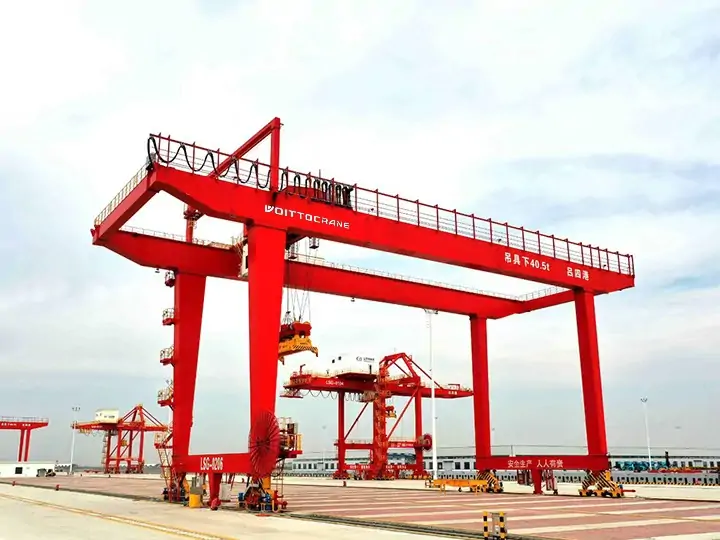
This container gantry crane is a type of heavy-duty lifting equipment. The unit possesses the structural strength and operational precision required for the efficient handling of containers, enabling efficient transshipment between ships, storage yards, and transport vehicles.
A container gantry crane is a large piece of equipment widely used in ports, docks, and container yards. Its structure uses the gantry as the main frame to support the main beam and the lifting mechanism on it. Its main function is to load, unload, stack, and transport containers. VOITTO offers various types of container gantry cranes, including RTG cranes, rail-mounted gantry cranes, STS cranes, and straddle carrier cranes. These machines cater to different mobility, infrastructure, and automation requirements, enabling terminal operators and yard planners to precisely select the most suitable equipment based on throughput targets and on-site conditions.
Product Description
A container gantry crane is a heavy-duty gantry lifting system purpose-built for loading, unloading, stacking, and transferring shipping containers in high-throughput environments. Unlike general-purpose gantry cranes, it is engineered around container-specific handling requirements — spreader compatibility, precise stacking positioning, and duty cycles suited to continuous terminal operation.
RTG Crane
Rail Mounted Crane
STS Crane
Straddle Carrier Crane
This equipment is widely used at container terminals, port yards, rail container yards, inland container yards, and logistics hubs. At these locations, the key challenge lies not only in lifting heavy loads, but also in the ability of container gantry cranes to quickly, accurately, and safely handle large volumes of containers within limited spaces, thereby increasing throughput at ports, terminals, and container yards.
Types Of Container Gantry Cranes
We supply four main types of container gantry cranes: RTG gantry cranes, rail-mounted gantry cranes, ship-to-shore quay cranes, and container straddle carrier cranes. Each type is designed to meet your specific lifting needs. Let’s take a closer look at these four types of container gantry cranes.
Rubber-Tyred Gantry Crane
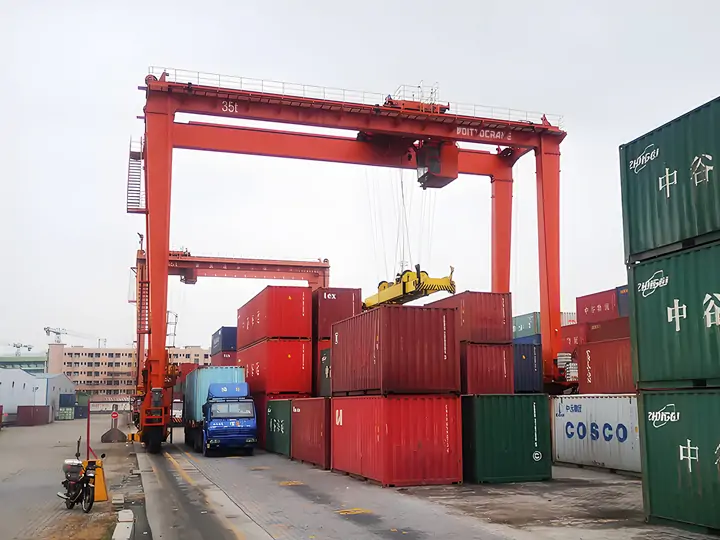
An RTG crane uses rubber tires for mobility, offering flexible relocation and efficient stacking capabilities. Compared to rail-mounted gantry cranes, RTG cranes do not require the installation of fixed tracks.
Application: Port operators use this equipment in scenarios where frequent adjustments to the operational area are required, such as container road yards, rail transshipment terminals, and large- and medium-sized port yards.
Features: It can flexibly move within the range of the yard without a fixed track. In addition, the container gantry crane is equipped with a trolley. The trolley with a container spreader moves horizontally along the track. Equipped with an automated control system, the trolley ensures accurate grabbing and placement of containers.
This rail-mounted container gantry crane operates on fixed rails. The RMG moves along pre-laid tracks via steel wheels and, when used in conjunction with container spreaders, enables the precise lifting and high-density stacking of 20-foot, 40-foot, and 45-foot containers.
Application: This equipment is suitable for container yards or transshipment stations in ports, terminals, railways, and logistics facilities, where it is used for the handling and loading/unloading of international standard containers and wide-body rail containers.
Features: This equipment offers high stability and precise, efficient lifting operations. The entire machine is electrically powered, featuring stable energy consumption, a wide operating range, and easy maintenance. Additionally, the equipment can be equipped with dual-container spreaders or telescopic spreaders and supports coordinated operation of dual trolleys (main trolley + auxiliary trolley).
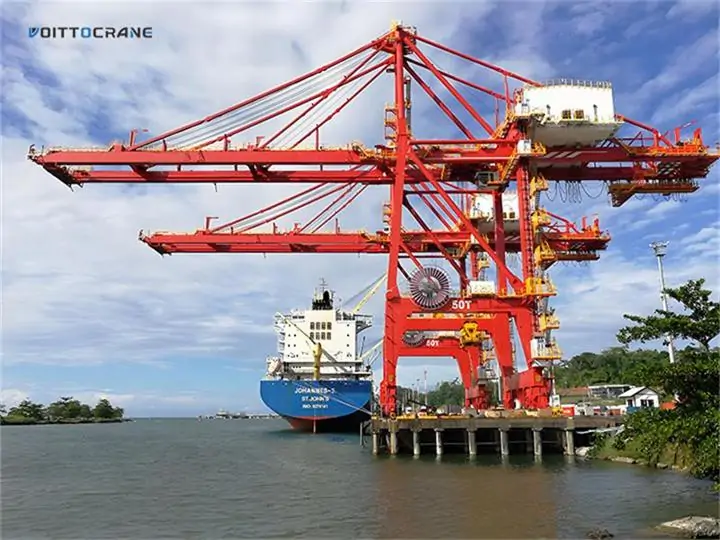
An STS crane is a specialized piece of lifting equipment used for loading and unloading operations on large container ships. This equipment is primarily installed along the quay and, using a long cantilever structure that extends over the ship, lifts containers from the ship’s hold to terminal trucks or loads containers from the terminal onto the ship.
Application: Terminal operators use this equipment for direct container loading and unloading between ships and the terminal, as well as for transshipment operations between ocean-going vessels and rail or road transport vehicles.
Features: The entire machine features an extra-large structure and a wide-span design, offering extremely high loading and unloading efficiency, precise positioning capabilities, and outstanding wind resistance. In addition, the equipment uses sealed steel wire ropes, and the trolley wheel sets are equipped with elastic supports, providing excellent noise reduction performance and meeting environmental protection requirements.
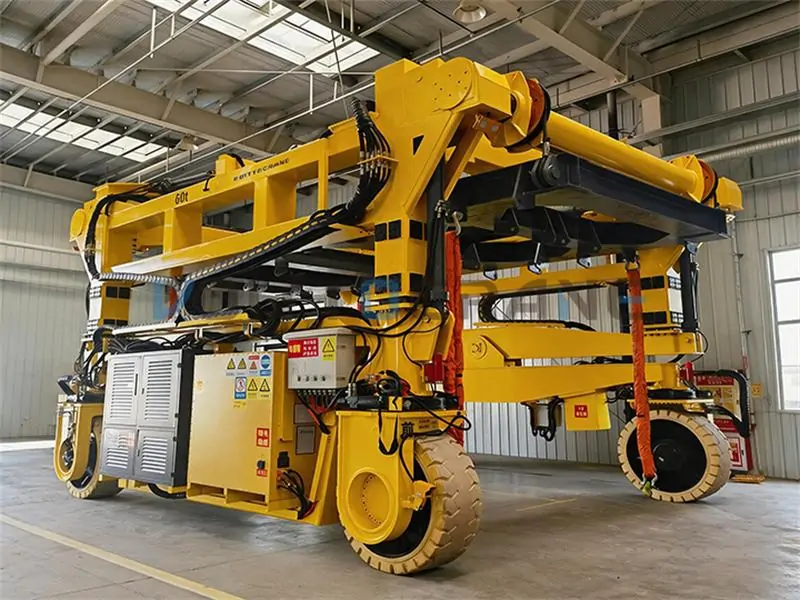
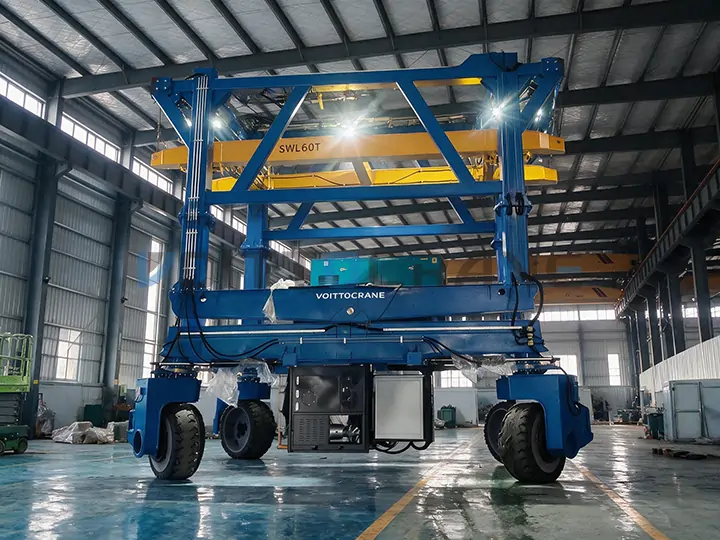
A container straddle carrier spans the top of a container via its frame and uses specialized lifting gear on its underside to lift, move, and stack containers. They can navigate autonomously within a yard, enabling rapid transfer between ship loading/unloading areas, storage areas, and container trucks.
Application: Users operate this equipment to perform short-distance container transport, stacking, and transshipment tasks. Applications include large container port terminals, automated container yards, rail container hubs, inland ports, and intermodal logistics centers.
Features: This container straddle carrier is highly flexible, offers efficient transport capabilities, and is highly adaptable. The equipment can lift and move containers directly by straddling them, reducing the need for transshipment steps required by traditional loading and unloading equipment.
Differences Between RTG Crane、RMG Crane and STS Crane
A container gantry crane is a category that includes several structural configurations — each suited to different terminal layouts, budgets, and automation goals. The comparison below is built for procurement teams evaluating mobility, infrastructure investment, and throughput trade-offs before specifying equipment.
Comparison Mode
RTG
RMG
STS
Straddle Carrier Crane
Structural Features
Supported by rubber tires, with truss or box-type main girder, spanning multiple rows of containers.
Runs on fixed rails, mainly double-girder structure with high rigidity and stability.
Features a tall gantry with a luffing jib, extending over the sea from the quay.
A mobile wheeled carrier with a U-shaped frame structure, designed to straddle containers and lift them using a spreader mounted beneath the top frame.
Mobility
Tire-driven, capable of free steering in yards, suitable for flexible movement.
Moves linearly along laid rails, with mobility limited to rail paths.
Fixed on quay-side rails, only movable along the shoreline.
Highly mobile with rubber tires, capable of independent driving, turning, and transferring containers between different operational areas without fixed tracks.
Lifting Capacity
Typically 35-70 tons (container-specific), suitable for single-container lifting.
Similar to RTG (35-70 tons), but with stronger load stability due to fixed rails.
Capacity exceeds 60 tons, capable of lifting double containers.
Typically 30-80 tons, suitable for handling 20ft, 40ft, and 45ft containers, with some heavy-duty models supporting twin-container operations.
Span Range
Span of 20-35 meters, covering 4-6 rows of containers + traffic lanes.
Larger span (30-50 meters), ideal for dense yard layouts.
Span usually 40-70 meters, with jib outreach of 30-45 meters to cover the full width of ships.
No fixed span limitation. The frame width is designed according to container dimensions, allowing direct access between container rows and flexible yard layouts.
Application Scenarios
Container yards, logistics centers, suitable for scenarios requiring frequent position changes.
Large container terminals, professional yards, suitable for high-frequency operations with fixed routes.
Dedicated to quay sides, responsible for loading/unloading containers between ships and terminals.
Container terminals, intermodal yards, railway terminals, inland container depots, and logistics parks require transport and stacking operations.
Operation Efficiency
Single-container efficiency: 25-35 cycles/hour, high flexibility but lower positioning accuracy.
Efficiency: 30-40 cycles/hour, precise rail positioning for assembly line operations.
Highest efficiency: 40-60 cycles/hour (higher with double-container handling), core equipment for ship-to-shore operations.
Efficiency: 20-40 cycles/hour depending on operation mode, providing fast container transfer between quay cranes, trucks, and storage areas.
Flexibility
High, movable anywhere in the yard for multi-zone operations.
Medium, limited to rail range; requires auxiliary equipment for inter-rail connection.
Low, fixed on the quay with only shoreline-direction adjustment.
It can stack up to four layers high, and a single machine can handle the lifting, handling, and stacking of containers.
Infrastructure Cost
No rail laying needed, low initial investment with simple site leveling.
Requires rail laying and foundation treatment, higher infrastructure cost than RTG.
Most complex structure, highest infrastructure cost, requiring supporting quay facilities.
Lower infrastructure investment compared with RTG/RMG/STS because it mainly requires a flat operating surface.
Power Source
Diesel engine-driven (traditional) or electric (in new energy transition).
Mostly electric-driven via cables or sliding contacts, more environmentally friendly.
Mostly electric-driven, some with energy storage systems for high-power operations.
Available in diesel, hybrid, and fully electric configurations, providing flexible energy solutions for different terminal requirements.
Container Gantry Crane for Port and Terminal Operations
In port and terminal operations, container throughput directly determines berth productivity and yard turnaround time. If container gantry cranes are properly laid out within the yard, they become more than just lifting equipment—they serve as a key lever for directly boosting terminal efficiency.
For terminal operators evaluating new equipment or upgrading their capacity, the core considerations during the selection process often lie not in “how much lifting capacity the equipment has,” but rather in “how high an hourly container throughput this configuration can sustain, and how well it can be scaled for automation.”
Buying Guide: How to Choose a Container Gantry Crane
Operators can use the following factors as a reference when selecting the appropriate container gantry crane equipment.
Container throughput — Estimate the target hourly throughput to determine the required cycle time and assess whether a single-trolley or double-trolley configuration is more appropriate.
Yard Size and Layout — Span requirements depend on the number of container rows and traffic lanes the crane must cover in a single travel cycle.
Stacking Height — While higher stacking density (5–6 layers) increases storage capacity per unit area, it also requires greater lifting height and stronger anti-sway control capabilities.
Span Requirements — The span should match the width of the container area in the yard. An excessively large span increases structural costs without providing any benefits in terms of throughput.
Rail-Mounted (RMG) vs. Rubber-Tired (RTG) — RMGs are suitable for scenarios with fixed operating paths, high frequency, and stringent precision requirements. RTGs are suitable for yards that require flexible positioning adjustments and do not wish to invest in rail infrastructure.
Level of Automation — Semi-automated configurations reduce reliance on operators for repetitive tasks; fully automated systems (supporting ARMG upgrades) are suitable for terminals planning to reduce labor costs over the long term.
Operating Environment — Factors such as high humidity, dusty conditions in coastal areas, and continuous multi-shift operations should serve as key considerations when selecting corrosion protection measures and service classes (A6–A8).
Container Gantry Crane Manufacturers
VOITTO Crane is dedicated to providing custom-designed container gantry crane systems for ports, rail yards, and high-throughput logistics hubs. We offer customized solutions tailored to our clients’ project requirements to perfectly fit the layout of their ports or terminals.
Our manufacturing team has three decades of extensive experience in the heavy-duty lifting equipment sector, serving global export markets. Whether you need rail-mounted, rubber-tired, or custom container cranes, please contact VOITTO to discuss your project requirements and receive a customized quote.
Specialized in Overhead Crane, Gantry Crane, Jib Crane, Port Crane & EOT Crane export solutions. 10+ years helping global clients with pre-sales consultation, capacity selection and site-specific configurations.
A container gantry crane is a gantry-frame lifting system designed specifically to load, unload, stack, and transfer shipping containers in ports, terminals, and container yards, using spreader-based lifting rather than general-purpose hooks.
How much does a container gantry crane cost?
Cost depends primarily on lifting capacity, span, stacking height, and automation level. RTG configurations typically involve lower upfront cost due to no rail infrastructure requirement, while RMG and STS involve higher infrastructure investment but greater long-term precision and throughput. Share your capacity and site details for a specific quotation.
Can a container gantry crane handle 40ft containers?
Yes. Container gantry cranes are engineered for standard 20ft, 40ft, and 45ft container dimensions, with spreader systems configurable for single or double-container handling.
Can container gantry cranes be automated?
Yes. Configurations range from manually operated with remote-assist control to semi-automated and fully automated (ARMG-ready) systems, allowing terminals to phase in automation as operational needs evolve.
What capacity container gantry crane do I need?
Capacity selection depends on your container weight classes and whether double-box handling is required. Most terminal applications fall between 35–50 tons for single-container handling, with STS and heavy-duty RMG configurations reaching 65–75 tons.
Qualification and Honor
Engineered Strength, Global Crane Supplier
service
Exclusive and Considerable, Customer First.
01
Reliable and Customized Solutions
Our pre-sale team provides consultations, tailoring solutions to your needs and environment.
Offer customization options for lifting capacity, span and lifting height etc. to meet specific needs.
02
Updated Production Process
Real-Time Progress Updates: Weekly reports and PM communication.
3-5 years warranty and free replacement for non-manufacturing defects.
24/7 online support and on-site assistance for crane issues.
FAQ
Engineered Strength, Global Crane Supplier
How are large gantry cranes shipped overseas?
Large gantry cranes are typically shipped overseas through modular disassembly, where the crane is broken down into major components (beams, legs, hoists) for containerized transport. For mega-cranes, we use specialized heavy-lift vessels equipped with reinforced decks, and critical parts are protected with anti-corrosion coatings during transit.
Have your gantry cranes been used in major infrastructure projects?
Yes, our gantry cranes have participated in large-scale bridge construction projects and railroad construction in Brazil, Pakistan, Indonesia, Malaysia, Egypt, and other countries, in which we have played a particularly key role and contributed to these construction projects!
Do you ship internationally?
Yes, international shipping and export support are available for global customers.
Get In Touch
Please feel free to leave a message. We will reply in 24 hours.
Please specify your requirement by referring to the following aspects:
Which crane product do you need?
What is the maximum lifting capacity (in tons) required for your project?
Could you specify the lifting height (in meters) needed?
Can you provide details on the working environment, such as ground conditions, space limitations, and any obstacles?
What is the expected frequency of use and the duration of the project?




 English
  Español
  Português
  العربية
  Français
  Русский