We offer advanced rail gantry crane solutions tailored specifically for ports, steel mills, and manufacturing facilities, designed to maximize production efficiency and operational reliability. The automation level supports flexible customization, allowing for seamless switching between manual operation and fully automated, unmanned operation as needed.
A Rail gantry crane (also known as a rail-mounted container gantry crane, or RMG crane for short). These specialized gantry lifting systems operate along fixed rails, enabling precise positioning and handling of heavy loads across vast operational areas such as container yards, steel mills, shipyards(boat lift capacity), and manufacturing facilities. Unlike overhead cranes, a rail gantry crane runs on tracks laid on the ground, with a self-supporting leg structure spanning the entire work area. This configuration is not only suitable for outdoor environments but can also be deployed in facilities where the building infrastructure cannot support the load of an overhead crane.
Modern rail gantry cranes incorporate advanced automation features, including remote operation, semi-automated and fully automated container handling, precision positioning systems, and integration with terminal operating systems or warehouse management software. These features maximize operational efficiency while reducing labor requirements and enhancing safety.
Our series of rail-mounted container gantry cranes encompasses RMG systems for container handling at ports and terminals, heavy-duty industrial rail gantry cranes designed specifically for the steel and manufacturing sectors, as well as specialized configurations tailored to specific material handling applications.
Features and Advantages
Structural Design: This equipment achieves maximum load capacity while maintaining a lightweight design. Its modular structure facilitates future maintenance and expansion. The entire unit features an IP65 protection rating and a weather-resistant design with a 250-micron coating system, ensuring stable operation in harsh environments. The equipment has a service life of over 30 years.
Automation: This equipment utilizes laser guidance to achieve precise positioning within a ±25mm range. Integrated OCR technology enables fully automated container loading and unloading, with an operational efficiency of over 30 containers per hour. It supports remote control, allowing a single operator to manage multiple cranes simultaneously. A comprehensive collision-avoidance system is established through the use of laser scanners and a vision system.
Operational Efficiency: Optimized motion profiles and a dual-trolley configuration ensure high production efficiency. With variable frequency drive (VFD) technology and regenerative braking, energy savings of up to 30% to 40% are achieved. The entire unit has a minimal footprint and does not obstruct traffic beneath the crane.
Safety and Reliability: The rail gantry crane features multiple safety mechanisms, including overload limiters (110% alarm/125% cut-off), a fail-safe braking system that maintains load stability during power outages, a fully enclosed operator’s cab equipped with ergonomic controls and climate control, and comprehensive, convenient maintenance access via inspection platforms and walkways.
Smart Technology: The PLC-based control system, supplemented by an HMI interface, integrates seamlessly with TOS/WMS systems to optimize operational workflows. It supports remote diagnostics to facilitate preventive maintenance planning and offers highly flexible automation level options, ranging from fully manual operation to fully automated modes.
Application
Ports and Container Terminals: Rail-mounted container gantry cranes utilize laser-guided positioning technology and incorporate optical character recognition (OCR) systems, enabling them to stack containers up to six high. Intermodal rail terminals employ rail-mounted gantry cranes that span multiple tracks and truck lanes to facilitate the transfer of containers between rail and road transport. These cranes are also used in port hinterland yards for high-density container storage.
Steel Mills and the Metal Industry: Steel mills utilize heavy-duty rail gantry crane equipped with specialized coil lifting attachments to handle the storage and processing of steel coils. For sheet metal handling, electromagnetic lifting systems or grabs are commonly used to manage structural steel, long products, and various metal profiles in open-air yards. In scrap yards, grabs or electromagnetic lifters are employed to perform scrap sorting, stacking, and loading/unloading tasks.
Manufacturing and Warehousing: In the mining machinery, power generation equipment, and industrial machinery sectors, factories are equipped with rail gantry cranes to ensure the precise positioning of components during assembly operations. Raw material handling departments also utilize this equipment to unload incoming goods, manage storage areas, and transport materials to production lines.
Precast Concrete Operations: Precast concrete manufacturers utilize rail-mounted gantry cranes to stack and retrieve finished products—such as wall panels, bridge girders, and structural components—within outdoor storage yards. Individual items in this process may weigh in excess of 100 tons.
Parts of Rail Gantry Crane
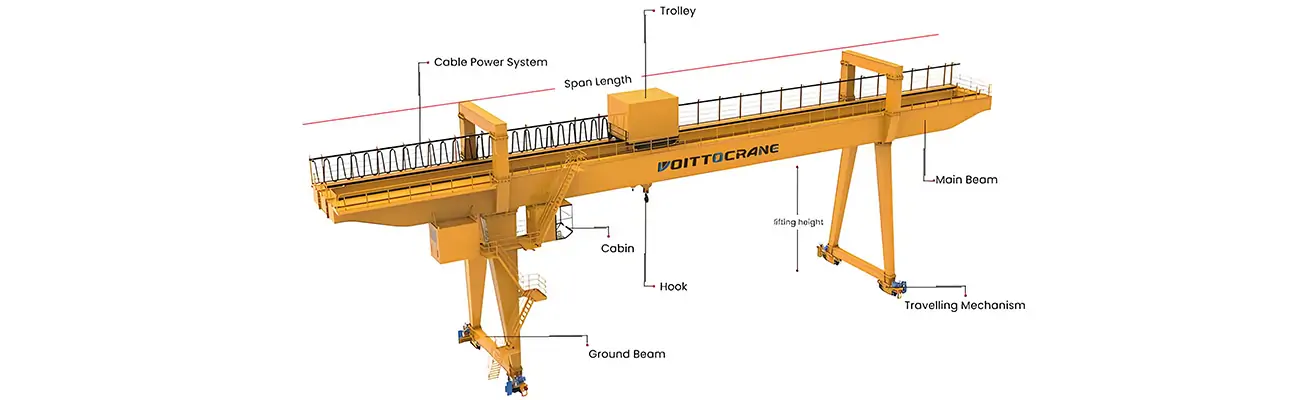
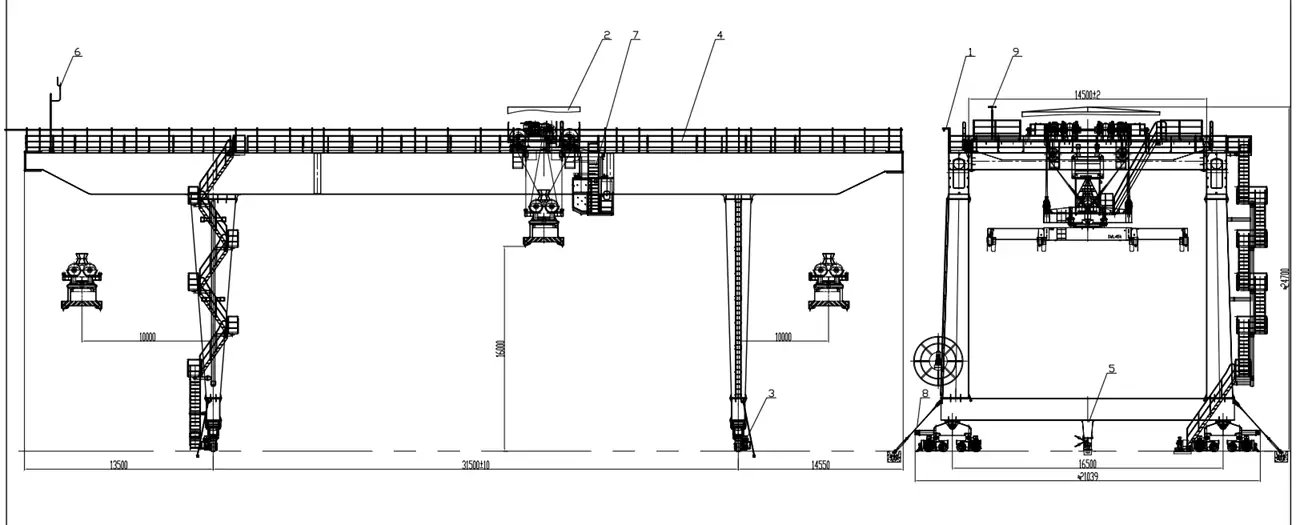
The rail gantry crane mainly consists of a main girder, end beams, crane traveling mechanism, trolley, container clamps, ground beam, hoisting mechanism, Legs, electrical control system, power supply system, driver’s cab, and safety monitoring devices.
Main Girder: The primary load-bearing structure of the entire equipment, used to support the hoisting mechanism and the trolley running rails.
End Beam: Installed at both ends of the main girder and connected to the legs.
Legs: Connect the main girder to the base girder, support the main girder, and transfer the load to the ground, thereby forming a gantry frame structure.
Ground Girder: Located between the bases of the two legs and equipped with the crane’s travel system.
Travel Mechanism: Consists of components such as drive motors, gear reducers, and wheel assemblies.
Trolley: Mounted on the main girder, it moves laterally along the girder to perform lifting and hoisting operations.
Hoisting Mechanism: This lifting device consists of a winch, steel wire rope, hook, and container lifting attachments.
Electrical Control System: Includes electrical control cabinets, operator control panels, and a PLC system.
Power Supply System: Utilizes conductor rails, cable reels, and other methods to provide power to the entire machine and the trolley.
Crane Control Room: Allows operators to monitor and manually control the crane’s operation.
Gantry Crane Safety Devices: Primarily include limit switches, anti-collision devices, anemometers, rail clamps, emergency braking systems, and overload protection devices.
Rail Mounted Gantry Crane Specifications
Types
Light-Duty Model
Medium-Duty Model
Heavy-Duty Model
Container RMG
Lifting Capacity
5-20 tons
20-50 tons
50-150 tons
40-65 tons (under spreader)
Span Range
15-35 meters
25-45 meters
30-60 meters
20-35 meters
Lifting Height
10-20 meters
15-30 meters
20-40 meters
15-25 meters (under spreader)
Crane Travel Speed
30-45 m/min
40-60 m/min
20-40 m/min
30-120 m/min
Trolley Travel Speed
20-40 m/min
30-50 m/min
15-30 m/min
40-80 m/min
Hoisting Speed (Loaded)
8-16 m/min
10-20 m/min
5-15 m/min
30-60 m/min
Work Duty Class
A5-A6
A6-A7
A7-A8
A8
Power Supply
380-480V, 3Ph, 50/60Hz
380-480V, 3Ph, 50/60Hz
380-480V, 3Ph, 50/60Hz
380-480V, 3Ph, 50/60Hz
Control System
PLC + Pendant/Cabin
PLC + Cabin/Remote
PLC + Cabin/Remote
PLC + Full Automation
Rail Gauge
Customized
Customized
Customized
Based on span + 4-8m
Operating Temperature
-20°C to +40°C
-25°C to +45°C
-30°C to +50°C
-35°C to +45°C
Rail Mounted Gantry Crane Price
The price of this rail gantry crane varies depending on specific configuration parameters (such as load capacity, span, level of automation, material type, and additional safety features). The following are some reference prices. The final quote will be tailored to your specific requirements.
Lifting Capacity
Span Range
Price Range ($)
30 ton
22m-30m
250,000 – 320,000
50 ton
22m-32m
400,000 – 460,000
60 ton
22m-32m
500,000 – 660,000
100 ton
22m-60m
800,000 – 1,200,000
Note: The above prices are for reference only. Actual prices are subject to specific specifications.
Rail Mounted Gantry Crane for Sale
As a leading manufacturer and supplier of rail gantry cranes, VOITTO Crane provides comprehensive material handling solutions to industries worldwide. Our areas of expertise include automated rail mounted gantry crane, heavy industrial rail gantry crane equipment, and specialized material handling systems.
Our engineering team utilizes state-of-the-art design tools, including 3D parametric modeling, finite element analysis (FEA), and dynamic simulation software. Every rail mounted container crane design undergoes rigorous engineering reviews to ensure compliance with international standards such as FEM, ISO, and CMAA specifications. If you require a customized solution, please feel free to contact us at any time.
FAQ
What is a rail gantry crane and how does it differ from other crane types?
A rail gantry crane is a type of gantry crane that travels on ground-level rails rather than building-mounted runways. It features self-supporting leg structures on each side of the operational area, with the bridge spanning between the legs. This differs from overhead bridge cranes that require building columns for runway support, and from rubber-tired gantry cranes (RTG) that use rubber tires instead of rail wheels. Rail gantry cranes offer advantages, including higher precision, greater stability, lower maintenance, and suitability for fully automated operations compared to RTG alternatives.
What is the typical capacity range for rail gantry cranes?
The lifting capacity of rail gantry cranes ranges from 20 tons for light-duty applications to over 500 tons for heavy-duty industrial use.
What maintenance does a rail gantry crane require?
Rail gantry cranes require regular preventive maintenance, including daily pre-operational inspections (visual checks of brakes, controls, safety devices), weekly lubrication of moving components, monthly inspection of wire ropes and structural components, and quarterly comprehensive examinations of all mechanical and electrical systems. Annual maintenance should include detailed structural inspection, non-destructive testing of critical welds, load testing verification, and component replacement as needed. Outdoor cranes require periodic coating inspection and touch-up. Maintenance costs typically represent 2-4% of the crane purchase price annually. Automated systems may require specialized software maintenance and sensor calibration.
Can rail mounted gantry cranes operate outdoors in all weather conditions?
Yes, properly specified rail gantry cranes operate effectively in outdoor environments across diverse weather conditions. Weather protection features include corrosion-resistant coatings, sealed electrical enclosures (IP65+), and drainage systems. Consult with manufacturers to specify appropriate environmental protection for specific site conditions.
Can existing rail gantry cranes be upgraded or modified?
Yes, existing rail gantry cranes can often be upgraded or modified to enhance performance, extend service life, or add new capabilities. Structural assessments evaluate remaining crane life and capacity for modifications. Upgrades prove cost-effective when the existing structure remains sound, but operational technology has become outdated.
Qualification and Honor
Engineered Strength, Global Crane Supplier
service
Exclusive and Considerable, Customer First.
01
Reliable and Customized Solutions
Our pre-sale team provides consultations, tailoring solutions to your needs and environment.
Offer customization options for lifting capacity, span and lifting height etc. to meet specific needs.
02
Updated Production Process
Real-Time Progress Updates: Weekly reports and PM communication.
3-5 years warranty and free replacement for non-manufacturing defects.
24/7 online support and on-site assistance for crane issues.
FAQ
Engineered Strength, Global Crane Supplier
Have your gantry cranes been used in major infrastructure projects?
Yes, our gantry cranes have participated in large-scale bridge construction projects and railroad construction in Brazil, Pakistan, Indonesia, Malaysia, Egypt, and other countries, in which we have played a particularly key role and contributed to these construction projects!
How are large gantry cranes shipped overseas?
Large gantry cranes are typically shipped overseas through modular disassembly, where the crane is broken down into major components (beams, legs, hoists) for containerized transport. For mega-cranes, we use specialized heavy-lift vessels equipped with reinforced decks, and critical parts are protected with anti-corrosion coatings during transit.
What voltage standards do your gantry cranes support?
Our gantry cranes support global voltage standards to ensure seamless operation worldwide. Solve any concerns you have about voltage.
Can it be customized?
Yes, lifting capacity, span, height, structure type, and hoist options can be customized to match specific working conditions.
Can you design a gantry crane for extreme outdoor conditions?
Yes, our gantry cranes can be used stably in harsh environments such as strong winds or low temperatures due to their special construction and material structure.
Get In Touch
Please feel free to leave a message. We will reply in 24 hours.
Please specify your requirement by referring to the following aspects:
Which crane product do you need?
What is the maximum lifting capacity (in tons) required for your project?
Could you specify the lifting height (in meters) needed?
Can you provide details on the working environment, such as ground conditions, space limitations, and any obstacles?
What is the expected frequency of use and the duration of the project?




 English
  Español
  Português
  العربية
  Français
  Русский