The boat lift gantry crane is a heavy-duty lifting equipment designed to safely and efficiently hoist and transport boats, yachts and other marine vessels.
A boat lift gantry crane is a self-propelled gantry crane fitted with rubber tyres. This equipment is specifically designed for lifting and handling various types of vessels weighing between 50 and 300 tonnes. Its span ranges from 9 to 16 metres, with a lifting height of between 5 and 25 metres. The equipment is primarily used in the shipbuilding industry, marina management, and naval vessel maintenance, and has obtained numerous certifications, including CE, ISO, and EAC.
Product description
A boat lift gantry crane is a self-propelled rubber-tyred portal structure purpose-built to hoist, carry, and precisely position watercraft up to 300 tons along hardstand areas without fixed rail infrastructure.
Often marketed as a marine travel lift or yacht crane, this equipment straddles the vessel with two parallel vertical legs connected by an overhead beam. Hydraulic slings — typically 2 to 6 in number — wrap beneath the hull to distribute load in compliance with FEM 1.001 design rules. The crane then drives under its own diesel or electric power at crawl speed (0–3 km/h) to transfer the boat from water to dry-dock or service bay.
Unlike fixed gantry cranes, the marine travel lift requires no runway girders, which reduces civil infrastructure costs by up to 40 % and makes it the preferred solution for expanding or temporary yards. However, the site surface must meet a minimum bearing capacity of 15–20 N/cm² as specified in ISO 9927-3 to ensure safe operation.
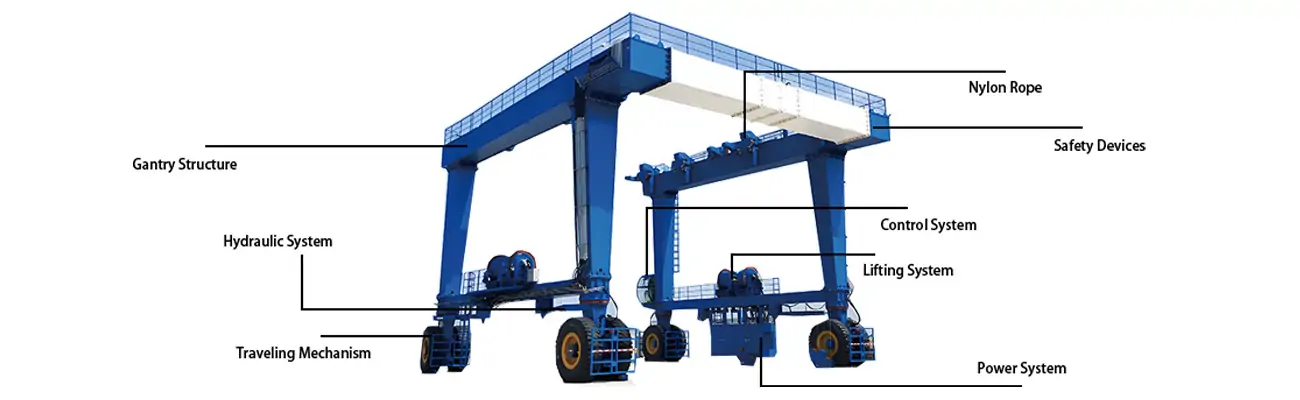
Parts of Boat Lift Gantry Crane
A boat lift gantry crane mainly consists of a gantry structure, a lifting system, a traveling mechanism, a hydraulic system, a control system, a power system, nylon ropes, and safety devices. These components work together to lift and move the vessel.
Gantry Structure: The gantry structure provides overall support and spanning space for the boat hoist.
Lifting System: The lifting system uses nylon rope, pulleys, and lifting mechanisms to lift and raise the hull.
Travelling Mechanism: The walking mechanism consists of a multi-wheel drive and a steering device.
Hydraulic System: The hydraulic system provides power for lifting, steering, and driving.
Control System: The operator controls the entire equipment via the cab or remote control.
Power System: The power system drives the lifting, walking, and hydraulic operation of the equipment.
Safety Devices: Include limit switches, overload protection, and an emergency stop.
Nylon Rope: As a flexible load-bearing component, nylon rope evenly distributes the stress on the hull.
Features and Advantages
This boat lift gantry crane integrates structural, hydraulic, and control technologies, enabling it to perform lifting operations safely and reliably in corrosive marine environments.
High-strength Steel Gantry Frame: Manufactured from Q345B or equivalent grade steel, sandblasted to SA 2.5 standard, and coated with an epoxy zinc-rich primer and a polyurethane topcoat.
Variable-frequency Drive and Lifting Stability: The hoisting system enables smooth, low-speed control (positioning speed < 0.1 m/min).
Four-point Independent Hydraulic Sling System: Each sling cylinder can be controlled independently, enabling lateral levelling of up to ±5° for asymmetrical hulls.
360° Omnidirectional Steering System: All axles of the entire unit can be steered independently, resulting in a turning radius of less than 8 metres for 100-tonne class equipment.
Electronic Load Monitoring System: Real-time load sensors are fitted to each sling, with the individual loads at each lifting point and the total load displayed simultaneously on the in-cab screen.
Advanced Cab: The unit features an ergonomically designed cab equipped with an air conditioning system, joystick controls, and at least four hull-mounted surveillance cameras.
Corrosion-resistant Drivetrain: The entire unit utilises marine-grade sealed bearings, stainless steel hydraulic fittings, and electrical control boxes with an IP65 protection rating.
Application
The boat lift gantry crane finds application across any industry that handles watercraft at the interface between afloat and ashore.
Military and Maritime Rescue: Maintenance personnel use it for the maintenance and upkeep of naval vessels, for hoisting vessels during rescue operations, and for the transport of emergency supplies.
Shipbuilding and Ship Repair: Operators use this equipment in shipyards and repair yards to hoist, move, and launch new vessels or vessels undergoing repair.
Port and Dock Operations: Users employ this equipment in ports and docks to carry out cargo handling, vessel launching, and shore-based maintenance work.
Yacht Clubs and Private Marinas: Maintenance personnel use it for the day-to-day maintenance, servicing, and mooring management of yachts.
Fisheries: Users employ this equipment to hoist and maintain fishing vessels, as well as to install and maintain aquaculture facilities.
Offshore Oil and Gas Platforms: Operators utilise this equipment for the construction and maintenance of platforms, as well as for the hoisting of supplies and equipment.
boat-lift-gantry-crane-case
boat-lift-gantry-crane-case
Technical Specifications
The following specifications reflect the VOITTO standard product range. Customised configurations are also available on request.
Product Name
Boat Lift Gantry Crane
Lifting Capacity
50 – 300 ton
Span
9 – 16 m
Lifting Height
5 – 25 m
Travel Speed (loaded)
0 – 3 km/h
Hoisting Speed
0 – 1.5 m/min (VFD)
Number of Slings
2 – 6 (hydraulic independent)
Drive System
Diesel / Full-Electric (optional)
Steering Mode
4-wheel / 360° oscillating
Working Duty Class
FEM 1.001 M5
Structural Steel Grade
Q345B / S355JR equivalent
Corrosion Protection
Epoxy-zinc + PU topcoat, ≥ 250 µm DFT
Electrical Protection
IP65 enclosures
Certification
CE / ISO 9927-1 / EAC TR CU 010/2011
Customisation
Span, capacity, sling count, drive type
Boat Lift Gantry Crane for Sale
VOITTO Crane specialises in the engineering and manufacture of boat lift gantry cranes. Our products are validated through a comprehensive quality system that covers the entire process from design to delivery. This system encompasses the traceability of raw materials, welding inspections during the manufacturing process in accordance with ISO 3834-2, and final factory acceptance tests witnessed by a certified third-party body.
If you are looking for reliable, efficient, and durable yacht crane equipment. Please contact us.
Specialized in Overhead Crane, Gantry Crane, Jib Crane, Port Crane & EOT Crane export solutions. 10+ years helping global clients with pre-sales consultation, capacity selection and site-specific configurations.
What is the maximum lifting capacity of a boat lift gantry crane?
The lifting capacity of a standard boat travel lift typically ranges from 50 to 300 tonnes. For equipment requiring a capacity exceeding 300 tonnes, VOITTO Crane can provide bespoke engineering solutions, with a maximum customised lifting capacity of up to 1,200 tonnes.
How does a marine travel lift differ from a fixed shipyard crane?
A marine travel lift is rubber-tyred and self-propelled, therefore requiring no fixed runways or rail foundation. This mobility reduces civil works costs by up to 40 % compared with fixed gantry systems. However, the hardstand must achieve a minimum bearing capacity of 15–20 N/cm² as specified in ISO 9927-3 for safe operation.
Can a boat travel lift handle catamarans and multi-hull vessels?
Yes. Wide-span variants (up to 16 m) and hydraulic telescopic sling systems allow multi-hull accommodation. The four-point independent sling control levels asymmetric hulls up to ±5°.
Which certifications should I require when purchasing a yacht crane?
Generally, the buyer should request that the supplier provide a CE Declaration of Conformity, documentation certifying compliance with ISO 9927-1, and EAC TR CU 010/2011 certification. Furthermore, before final acceptance, it is strongly recommended that the supplier be required to provide a third-party dynamic load test report for 125% of the safe working load (SWL), as well as a welding quality certification certificate in accordance with ISO 3834-2.
Why is VFD hoisting important for boat lift cranes used in marinas?
This variable-frequency hoisting technology enables ultra-precise positioning at speeds of less than 0.1 metres per minute, thereby eliminating the impact loads on the slings as the hull enters and exits the water. This technology provides better protection for the hull’s gelcoat and anti-fouling coating, and extends the equipment’s maintenance intervals.
Qualification and Honor
Engineered Strength, Global Crane Supplier
service
Exclusive and Considerable, Customer First.
01
Reliable and Customized Solutions
Our pre-sale team provides consultations, tailoring solutions to your needs and environment.
Offer customization options for lifting capacity, span and lifting height etc. to meet specific needs.
02
Updated Production Process
Real-Time Progress Updates: Weekly reports and PM communication.
3-5 years warranty and free replacement for non-manufacturing defects.
24/7 online support and on-site assistance for crane issues.
FAQ
Engineered Strength, Global Crane Supplier
Can you design a gantry crane for extreme outdoor conditions?
Yes, our gantry cranes can be used stably in harsh environments such as strong winds or low temperatures due to their special construction and material structure.
What’s your warranty policy for gantry cranes?
All parts of our gantry cranes come with a one-year warranty.
We also provide online customer service, ready to solve your problems at any time, and after-sales documentation support.
If the problem is still not solved, we can appoint our engineers to your site.
What is the price range of a standard gantry crane?
The price of a gantry crane ranges from $1300 to $1900875. Usually, the price is determined by the specific parameters. Contact us now to get a more professional quote!
How are large gantry cranes shipped overseas?
Large gantry cranes are typically shipped overseas through modular disassembly, where the crane is broken down into major components (beams, legs, hoists) for containerized transport. For mega-cranes, we use specialized heavy-lift vessels equipped with reinforced decks, and critical parts are protected with anti-corrosion coatings during transit.
What voltage standards do your gantry cranes support?
Our gantry cranes support global voltage standards to ensure seamless operation worldwide. Solve any concerns you have about voltage.
Get In Touch
Please feel free to leave a message. We will reply in 24 hours.
Please specify your requirement by referring to the following aspects:
Which crane product do you need?
What is the maximum lifting capacity (in tons) required for your project?
Could you specify the lifting height (in meters) needed?
Can you provide details on the working environment, such as ground conditions, space limitations, and any obstacles?
What is the expected frequency of use and the duration of the project?




 English
  Español
  Português
  العربية
  Français
  Русский